
Fat Intake Calculator-Use our Fat Intake Calculator to estimate how many grams of fat you may need each day based on your daily calorie intake.Dietary fat is an important part of a balanced diet. Your body uses fat for energy, helps absorb certain vitamins, and needs essential fatty acids for normal body functions.Make complicated calculations easier with our Body Type Calculator simple free calculator tools.
🥑 Fat Intake Calculator
Our calculator makes it easy to convert your daily calorie target into fat grams per day.
You can also use this guide to understand daily fat intake, calories from fat, healthy fat intake, saturated fat, unsaturated fat, and how to calculate fat grams.
What Is a Fat Intake Calculator?
A Fat Intake Calculator is an online tool that estimates your daily fat intake in grams.
The calculation is usually based on:
- Daily calorie intake
- Percentage of calories coming from fat
- Calories provided by each gram of fat
One gram of dietary fat provides about 9 calories.
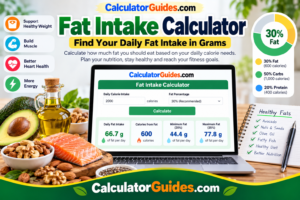
For example, if you eat 2,000 calories per day and choose a 30% fat target:
2,000 × 30% ÷ 9 = 66.7 grams
So, 30% of a 2,000-calorie diet provides about 67 grams of fat.
The adult Acceptable Macronutrient Distribution Range (AMDR) for total fat is commonly given as 20% to 35% of total calories.
How to Use the Fat Intake Calculator
Using the calculator is simple.
Step 1: Enter your daily calories
Enter the number of calories you normally plan to consume each day.
For example:
2,000 calories
Step 2: Choose your fat percentage
Choose the percentage of calories you want to come from fat.
For example:
30%
Step 3: Calculate
The calculator converts your selected percentage into grams of fat.
Step 4: Check your result
You will see your estimated daily fat intake in grams and the calories that come from fat.
Remember that this is a general nutrition calculation, not a personal medical prescription.
How Much Fat Should I Eat Per Day?
For adults, a commonly used AMDR for total dietary fat is 20% to 35% of daily calories.
The exact amount in grams depends on how many calories you eat.
For example:
| Daily Calories | 20% Fat | 30% Fat | 35% Fat |
|---|---|---|---|
| 1,500 | 33 g | 50 g | 58 g |
| 1,800 | 40 g | 60 g | 70 g |
| 2,000 | 44 g | 67 g | 78 g |
| 2,200 | 49 g | 73 g | 86 g |
| 2,500 | 56 g | 83 g | 97 g |
| 3,000 | 67 g | 100 g | 117 g |
These numbers are calculated using 9 calories per gram of fat.
Your individual needs can be different depending on your overall diet, age, health, activity, and other factors.
Fat Intake Calculator Formula
The basic formula is very simple.
Fat grams formula
Fat (g) = Daily Calories × Fat Percentage ÷ 9
Remember to convert the percentage into a decimal.
For example, 30% becomes 0.30.
Example
Suppose your daily calorie target is 2,000 calories and 30% of your calories come from fat.
First calculate calories from fat:
2,000 × 0.30 = 600 calories
Then convert calories to grams:
600 ÷ 9 = 66.7 grams
So your calculated fat intake is approximately:
67 grams per day
This same calculation is used by many online fat intake calculators.
Calories From Fat Calculator
You can also calculate how many calories come from dietary fat.
The formula is:
Fat Calories = Fat Grams × 9
For example, if you eat 60 grams of fat:
60 × 9 = 540 calories
So 60 grams of fat provide about 540 calories.
You can also work backward:
Fat Grams = Fat Calories ÷ 9
Fat Percentage Calculator
Your daily calories can be divided among the three main macronutrients:
- Protein
- Carbohydrates
- Fat
Fat provides about 9 calories per gram, while protein and carbohydrates provide about 4 calories per gram.
For example, if 2,000 calories are consumed and 30% come from fat:
2,000 × 0.30 = 600 calories from fat
Then:
600 ÷ 9 = 66.7 g fat
What Is a Healthy Fat Intake?
There is no single number of fat grams that is right for everyone.
Your fat intake depends partly on your total calorie intake.
For adults, the commonly referenced AMDR for total fat is 20–35% of calories.
For example, a person eating 1,800 calories and a person eating 2,800 calories will have different fat requirements if they use the same percentage.
That is why a daily fat intake calculator uses your calorie target instead of giving everyone the same number.
Total Fat vs. Saturated Fat
It is important to understand that total fat and saturated fat are not the same thing.
Total fat includes different types of fat, including:
- Saturated fat
- Monounsaturated fat
- Polyunsaturated fat
- Trans fat
A food can contain total fat while having very different amounts of saturated and unsaturated fat.
For this reason, simply looking at total fat grams does not tell you the whole story about the quality of your diet.
Saturated Fat Intake
Saturated fat is one type of dietary fat.
The Dietary Guidelines for Americans have used a limit of less than 10% of daily calories from saturated fat for people age 2 and older.
For a 2,000-calorie diet:
2,000 × 10% = 200 calories
Then:
200 ÷ 9 ≈ 22 grams
So 10% of a 2,000-calorie diet corresponds to about 22 grams of saturated fat.
This is a general dietary reference, not an individualized medical target.
Unsaturated Fat
Unsaturated fats include monounsaturated fats (MUFA) and polyunsaturated fats (PUFA).
They are commonly found in foods such as:
- Nuts
- Seeds
- Avocado
- Olive oil
- Other plant oils
- Some fish
When choosing fat-containing foods, overall food quality and dietary pattern matter rather than focusing only on one number.
Different Types of Dietary Fat
Saturated Fat
Saturated fat is found in foods such as butter, fatty meats, some dairy products, and some tropical oils.
Many dietary guidelines recommend limiting saturated fat.
Monounsaturated Fat
Monounsaturated fats are found in foods such as olive oil, avocados, peanuts, and some nuts.
Polyunsaturated Fat
Polyunsaturated fats include omega-3 and omega-6 fatty acids.
They can be found in foods such as fish, seeds, nuts, and certain vegetable oils.
Trans Fat
Trans fats are a type of unsaturated fat with an unusual chemical structure. Industrial trans fats are generally minimized in modern dietary guidance.
Fat Intake for Weight Loss
People often search for fat intake for weight loss or ask, “How many grams of fat should I eat to lose weight?”
There is no single fat number that automatically causes weight loss.
Weight change depends on overall energy intake, activity, food choices, and other individual factors.
A calorie-controlled diet can contain different percentages of fat and still support weight management.
The important thing is to look at your total calorie intake and overall diet, rather than removing all dietary fat.
Fat is also energy-dense, providing about 9 calories per gram, so portion sizes can add calories quickly.
Fat Intake for Muscle Gain
People trying to gain muscle may also use a fat intake calculator to plan their macros.
Fat can be part of a balanced diet while you focus on:
- Total calories
- Protein intake
- Carbohydrates
- Training
- Recovery
- Overall food quality
There is no universal fat target for every person who wants to build muscle.
Your calorie needs and the rest of your diet should be considered together.
Fat Intake on a 2,000-Calorie Diet
A 2,000-calorie diet is a useful example.
At different fat percentages:
20% fat
2,000 × 0.20 ÷ 9 = 44.4 g
25% fat
2,000 × 0.25 ÷ 9 = 55.6 g
30% fat
2,000 × 0.30 ÷ 9 = 66.7 g
35% fat
2,000 × 0.35 ÷ 9 = 77.8 g
So a 20–35% range gives approximately:
44–78 grams of total fat per day
for a 2,000-calorie diet.
Fat Intake on a 1,800-Calorie Diet
For 1,800 calories:
20% fat
1,800 × 0.20 ÷ 9 = 40 g
30% fat
1,800 × 0.30 ÷ 9 = 60 g
35% fat
1,800 × 0.35 ÷ 9 = 70 g
So the 20–35% calculation gives approximately:
40–70 grams of fat per day
Fat Intake on a 2,500-Calorie Diet
For 2,500 calories:
20% fat
2,500 × 0.20 ÷ 9 = 55.6 g
30% fat
2,500 × 0.30 ÷ 9 = 83.3 g
35% fat
2,500 × 0.35 ÷ 9 = 97.2 g
That gives approximately:
56–97 grams of total fat per day
at the 20–35% range.
How Much Fat Is in a Gram?
One gram of dietary fat provides approximately:
9 calories
This is why fat is more calorie-dense than protein or carbohydrates.
For comparison:
- 1 g fat = about 9 calories
- 1 g protein = about 4 calories
- 1 g carbohydrate = about 4 calories
This conversion is the reason the calculator divides calories from fat by 9.
Is Dietary Fat Bad for You?
No. Dietary fat is an important nutrient.
Your body needs fat for several normal functions, including energy and the absorption of fat-soluble vitamins.
The important question is not simply whether you eat fat, but how much fat you eat and what types of fat make up your diet.
A balanced eating pattern can include healthy sources of dietary fat.
Foods That Contain Healthy Fats
Examples of foods that provide mostly unsaturated fats include:
- Avocado
- Almonds
- Walnuts
- Peanuts
- Seeds
- Olive oil
- Canola oil
- Some fish
However, the amount you eat still matters because all fat provides calories.
Common High-Fat Foods
Some foods can contain a large amount of fat in a relatively small serving.
Examples include:
- Oils
- Butter
- Nuts
- Nut butters
- Cheese
- Fried foods
- Fatty meats
This does not automatically mean these foods must be avoided. Portion size and the overall diet are important.
Fat Intake Calculator for Keto Diet
People following a ketogenic diet often consume a much higher percentage of calories from fat than the general adult AMDR.
A standard fat-intake calculator based on the general 20–35% range is therefore not the same thing as a ketogenic macro calculator.
If you are following a therapeutic or medically supervised ketogenic diet, use the targets provided by your healthcare professional or dietitian.
Fat Intake Calculator for Athletes
Athletes may have different nutrition needs depending on their sport, training volume, body size, and energy requirements.
An endurance athlete, strength athlete, and recreational exerciser may all have different diets.
Instead of choosing a fat target based only on body weight, it is better to consider total calorie needs and the balance of protein, carbohydrates, and fat.
Why Use a Fat Intake Calculator?
A free Fat Intake Calculator can save time when planning your daily nutrition.
It can help you:
- Calculate fat grams per day
- Convert calories to fat grams
- Calculate calories from fat
- Compare different fat percentages
- Understand your daily fat target
- Plan your macronutrients
- Check your calculations
- Understand total dietary fat
The calculator gives you a starting point, while your complete diet provides the bigger picture.
Frequently Asked Questions
How much fat should I eat per day?
For adults, a commonly referenced range is 20–35% of daily calories from fat. The number of grams depends on your total calorie intake.
How many grams of fat are in 2,000 calories?
At 30% of calories from fat:
2,000 × 0.30 ÷ 9 = 66.7 grams
So it is about 67 grams of fat.
How do I calculate my daily fat intake?
Multiply your daily calories by your chosen fat percentage and divide by 9.
Fat grams = Calories × Fat % ÷ 9
How much fat should I eat to lose weight?
There is no single fat intake that guarantees weight loss. Your total calorie intake and overall diet are important factors. A calorie deficit is generally needed for weight loss.
Is 50 grams of fat a day too much?
It depends on your total calorie intake and dietary needs. Fifty grams provides about 450 calories from fat.
Is 100 grams of fat a day too much?
It depends on your total calorie intake and the type of fat. One hundred grams provides about 900 calories.
How many calories are in 1 gram of fat?
One gram of fat provides approximately 9 calories.
What is the difference between total fat and saturated fat?
Total fat includes all types of dietary fat. Saturated fat is only one type of fat within total fat.
What is a good fat percentage?
For adults, the commonly referenced AMDR for total fat is 20–35% of total calories. Individual dietary needs can vary.
Should I avoid fat when dieting?
No. Dietary fat is an essential part of nutrition. Instead of eliminating all fat, focus on an appropriate amount and choose a variety of nutrient-dense foods.
Does fat help you feel full?
Fat can contribute to meal satisfaction, but fullness also depends on protein, fiber, food volume, and the overall meal.
Can I use this calculator for meal planning?
Yes. You can use the estimated result as one part of your daily macro plan. For a personalized medical or nutrition plan, speak with a qualified healthcare professional or registered dietitian.
Final Thoughts
The Fat Intake Calculator makes it easier to understand how many grams of fat fit into your daily calorie target.
The basic calculation is simple:
Fat grams = Daily Calories × Fat Percentage ÷ 9
For adults, the commonly referenced total-fat AMDR is 20–35% of calories. For example, on a 2,000-calorie diet, that works out to about 44–78 grams of fat per day.
Remember that total fat is only one part of a healthy diet. The type of fat, overall food choices, calories, protein, carbohydrates, fiber, and your individual needs all matter.
Use our Fat Intake Calculator to get a quick estimate and make daily nutrition planning easier.