
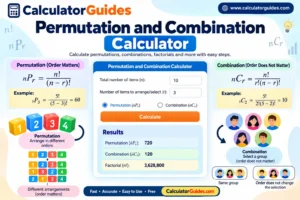
Permutation and Combination Calculator-A Permutation and Combination Calculator helps you quickly solve problems involving arrangements and selections. It can calculate permutations, combinations, factorials, and related values without requiring you to work through long formulas by hand.Explore our free online calculator tools for quick answers across Fitness & Health Calculators different categories.
Permutation and Combination Calculator
Calculator Guides
These calculations are commonly used in mathematics, probability, statistics, computer science, competitive exams, and everyday counting problems.
The main difference is simple:
- Permutation is about arranging items where order matters.
- Combination is about selecting items where order does not matter.
For example, if you have 5 people and want to choose 2 people for a team, you are dealing with a combination. But if you want to choose a president and vice president from those 5 people, you are dealing with a permutation, because the positions are different.
This calculator makes both types of calculations much easier.
What Is a Permutation?
A permutation is an arrangement of objects in a particular order.
In a permutation, order matters.
For example, suppose you have three letters:
A, B, C
If you arrange all three letters, you can make:
- ABC
- ACB
- BAC
- BCA
- CAB
- CBA
There are 6 different arrangements.
Even though the same three letters are used, the order changes the result.
For example:
ABC and BAC are different permutations.
Permutation Formula
The basic permutation formula is:
nPr = n! / (n – r)!
Where:
- n = total number of items
- r = number of items being arranged
- ! = factorial
For example:
If you have 5 objects and want to arrange 3 of them:
5P3 = 5! / (5 – 3)!
5P3 = 5! / 2!
5P3 = 120 / 2
5P3 = 60
So, there are 60 possible arrangements.
What Is a Combination?
A combination is a selection of objects where the order does not matter.
For example, imagine you have five people:
A, B, C, D, and E.
You want to select two people for a team.
Choosing:
A and B
is the same as choosing:
B and A
because the order of the people does not matter.
Therefore, this is a combination.
Combination Formula
The standard combination formula is:
nCr = n! / [r!(n – r)!]
Where:
- n = total number of items
- r = number of items selected
- ! = factorial
For example:
5C2 = 5! / [2!(5 – 2)!]
5C2 = 5! / (2! × 3!)
5C2 = 120 / (2 × 6)
5C2 = 10
So, there are 10 possible combinations.
Permutation vs Combination
The easiest way to remember the difference is:
Permutation = Arrangement
Combination = Selection
| Feature | Permutation | Combination |
|---|---|---|
| Order matters? | Yes | No |
| Main idea | Arrange | Select |
| Formula | nPr | nCr |
| Example | Race positions | Team selection |
| ABC vs BAC | Different | Same selection |
| Common use | Rankings, passwords, seats | Teams, groups, committees |
Simple Example
Suppose there are 4 students:
A, B, C, D
You need to select 2 students.
If order does not matter:
AB = BA
This is a combination.
If the first student becomes captain and the second becomes vice-captain:
A-B and B-A are different.
This is a permutation.
How Does a Permutation and Combination Calculator Work?
A permutation and combination calculator normally requires two values:
1. Enter n
This represents the total number of available objects.
2. Enter r
This represents how many objects you want to select or arrange.
The calculator then calculates:
- nPr
- nCr
- factorial values
- sometimes the difference between the two results
For example, enter:
n = 10
r = 3
The calculator gives:
10P3 = 720
and
10C3 = 120
The results are different because permutation considers order while combination does not.
What Is the Difference Between nPr and nCr?
The symbols nPr and nCr are commonly used in permutation and combination problems.
nPr
nPr means the number of ways to arrange r items from n items.
Formula:
nPr = n! / (n-r)!
nCr
nCr means the number of ways to select r items from n items.
Formula:
nCr = n! / [r!(n-r)!]
There is an important relationship between them:
nPr = nCr × r!
This makes sense because once you select r objects, you can arrange those selected objects in r! different ways.
What Is Factorial?
Factorial is an important part of both permutation and combination calculations.
A factorial is written using the ! symbol.
For example:
5! = 5 × 4 × 3 × 2 × 1
So:
5! = 120
Some common factorial values are:
| Number | Factorial |
|---|---|
| 0 | 1 |
| 1 | 1 |
| 2 | 2 |
| 3 | 6 |
| 4 | 24 |
| 5 | 120 |
| 6 | 720 |
| 7 | 5,040 |
| 8 | 40,320 |
| 9 | 362,880 |
| 10 | 3,628,800 |
Why Is 0! Equal to 1?
By definition:
0! = 1
This is important because factorial is used in permutation and combination formulas.
For example:
nC0 = 1
There is exactly one way to select nothing from a group.
Permutation Examples
Let’s look at some simple permutation examples.
Example 1: Arranging Books
You have 5 different books and want to place 3 of them on a shelf.
Here:
n = 5
r = 3
Use:
5P3 = 5! / (5 – 3)!
5P3 = 120 / 2
5P3 = 60
There are 60 different arrangements.
Example 2: Choosing Race Positions
There are 8 runners in a race.
You want to know how many ways the first, second, and third positions can be awarded.
Here:
n = 8
r = 3
Because first, second, and third positions are different, order matters.
Therefore:
8P3 = 8! / 5!
8P3 = 8 × 7 × 6
8P3 = 336
There are 336 possible ways to fill the three positions.
Combination Examples
Example 1: Selecting a Team
There are 10 students, and you need to select 3 students for a team.
Order does not matter.
So:
n = 10
r = 3
Use:
10C3 = 10! / [3! × 7!]
The result is:
120
Therefore, there are 120 possible teams.
Example 2: Choosing Lottery Numbers
Suppose you need to select 6 numbers from 49 numbers, and the order of selection does not matter.
This is a combination problem.
The calculation is:
49C6
The calculator can calculate the result instantly.
This type of calculation is commonly used when studying probability and lottery mathematics.
Permutations With Repetition
Sometimes an item can be used more than once.
For example, consider a 4-digit PIN where digits can repeat.
A digit can be selected from:
0 to 9
There are 10 possible choices for each position.
Therefore:
10 × 10 × 10 × 10 = 10,000
possible PINs.
When repetition is allowed, the calculation method is different from a standard permutation where items cannot be reused.
Permutations Without Repetition
When an item cannot be used more than once, each selection reduces the number of choices.
For example, suppose you have 6 different digits and need to create a 3-digit arrangement without repeating a digit.
The calculation is:
6 × 5 × 4 = 120
So there are 120 possible arrangements.
This is equivalent to:
6P3 = 120
Combinations With Repetition
A combination can also allow repetition.
For example, imagine selecting 3 items from 5 types when the same type can be selected more than once.
The formula commonly used is:
(n + r – 1)Cr
Where:
- n = number of types
- r = number of selections
For example:
(5 + 3 – 1)C3
7C3 = 35
So there are 35 possible selections when repetition is allowed.
Circular Permutation
A circular permutation involves arranging objects around a circle.
This is different from arranging objects in a straight line because rotations can represent the same arrangement.
For n distinct objects arranged around a circle, the basic formula is:
(n – 1)!
For example, if 5 people sit around a round table:
(5 – 1)!
= 4!
= 24
So there are 24 circular arrangements under the standard assumption that rotations are considered the same.
Permutation With Identical Objects
Sometimes some objects are identical.
For example, consider the word:
LEVEL
It contains repeated letters.
The standard formula for arrangements with repeated objects is:
n! / (n₁! × n₂! × n₃!…)
where each factorial represents the number of repetitions of an identical item.
This prevents identical arrangements from being counted multiple times.
How to Calculate Permutations Manually
You do not always need a calculator.
For example:
7P3
Instead of calculating the entire factorial:
7! / 4!
you can cancel the common terms:
7 × 6 × 5
Therefore:
7P3 = 210
This shortcut is useful for smaller calculations.
How to Calculate Combinations Manually
Consider:
8C3
The formula is:
8! / (3! × 5!)
Canceling the common factorial terms gives:
8 × 7 × 6 / (3 × 2 × 1)
So:
336 / 6 = 56
Therefore:
8C3 = 56
For large values of n, a calculator is much faster and reduces the chance of arithmetic mistakes.
When Should You Use Permutation?
Use a permutation when changing the order creates a different result.
Common examples include:
- Arranging books
- Ranking competitors
- Assigning seats
- Creating ordered passwords
- Creating PINs
- Selecting winners for different positions
- Assigning jobs to people
- Creating schedules
- Arranging letters
- Ordering objects
- Determining race positions
Easy Test
Ask yourself:
“If I change the order, is the result different?”
If the answer is yes, you probably need a permutation.
When Should You Use Combination?
Use a combination when changing the order does not create a different result.
Common examples include:
- Selecting a team
- Choosing committee members
- Selecting lottery numbers
- Choosing subjects
- Selecting products
- Choosing a group of people
- Picking cards
- Selecting ingredients
- Creating a group from a larger set
Easy Test
Ask:
“Does the order matter?”
If the answer is no, you probably need a combination.
Permutation and Combination in Probability
Permutations and combinations are closely connected to probability.
For example, when calculating the probability of selecting a particular group of objects, combinations can help determine the total number of possible selections.
For ordered outcomes, permutations may be more appropriate.
A common probability structure is:
Probability = Favorable Outcomes / Total Possible Outcomes
The permutation or combination calculation helps determine the number of possible outcomes.
This is why these concepts are frequently used in probability questions.
Permutation and Combination in Real Life
These concepts are not limited to classroom mathematics.
They can be used in many real-world situations.
Passwords
Security systems may need to determine how many possible character arrangements exist.
Seating Arrangements
Schools, events, conferences, and meetings may involve arranging people in different positions.
Team Selection
Sports teams and project teams often require selecting groups from a larger number of people.
Scheduling
Different tasks can be arranged in different orders.
Lottery Mathematics
Combinations help determine how many different sets of numbers can be selected.
Business
Companies can use combinations and permutations when analyzing possible product, employee, or scheduling choices.
Computer Science
Algorithms often use permutations and combinations when generating possible arrangements or selections.
Permutation and Combination Calculator for Probability
A calculator can also make probability calculations easier when a problem involves many possible outcomes.
For example, suppose a group contains 12 people and you need to select 4 people.
The number of possible groups is:
12C4
If the positions are different, such as president, secretary, treasurer, and manager, then you may need:
12P4
The correct choice depends on whether the selected people have different roles.
Common Mistakes in Permutation and Combination
1. Confusing nPr With nCr
This is one of the most common mistakes.
Remember:
nPr → order matters
nCr → order does not matter
2. Using the Wrong Value for r
The value of r represents the number of objects being selected or arranged.
For example, if you have 10 objects and choose 4:
n = 10
r = 4
3. Forgetting Factorial
Factorial is an important part of both formulas.
Remember:
5! = 120
not 5.
4. Thinking AB and BA Are Always Different
It depends on the problem.
If you are selecting two people for a team:
AB = BA
If you are assigning first and second positions:
AB ≠ BA
Understanding the question is more important than simply remembering a formula.
5. Ignoring Repetition
Check whether objects can be reused.
A password may allow repeated characters, while a problem about arranging different books may not.
Frequently Asked Questions
What is a permutation and combination calculator?
A permutation and combination calculator is an online tool that calculates the number of possible arrangements and selections using mathematical formulas such as nPr and nCr.
What is the difference between permutation and combination?
Permutation is used when order matters. Combination is used when order does not matter.
What is the formula for permutation?
The standard formula is:
nPr = n! / (n-r)!
What is the formula for combination?
The standard formula is:
nCr = n! / [r!(n-r)!]
What does nPr mean?
nPr represents the number of ways to arrange r objects from n available objects.
What does nCr mean?
nCr represents the number of ways to select r objects from n available objects.
Is 0 factorial equal to 1?
Yes. By definition:
0! = 1
When should I use nPr?
Use nPr when the order of the selected objects matters, such as ranking people or assigning different positions.
When should I use nCr?
Use nCr when the order does not matter, such as selecting a team or committee.
Can permutations include repetition?
Yes. Some permutation problems allow repetition, but the formula is different from permutations without repetition.
Can combinations include repetition?
Yes. When repetition is allowed, a different combination formula is used.
What is 5P3?
5P3 = 60
There are 60 ways to arrange 3 objects selected from 5 objects.
What is 5C3?
5C3 = 10
There are 10 ways to select 3 objects from 5 objects when order does not matter.
Why is permutation larger than combination?
For the same n and r, permutation usually has a larger value because each selected group can be arranged in multiple orders.
The relationship is:
nPr = nCr × r!
Can I use a permutation calculator for probability?
Yes. Permutation calculations can be useful when probability problems involve ordered outcomes.
Can I use a combination calculator for probability?
Yes. Combination calculations are commonly used when probability problems involve selecting groups where order does not matter.
Quick Permutation and Combination Reference
Permutation
nPr = n! / (n-r)!
Use when:
Order matters
Combination
nCr = n! / [r!(n-r)!]
Use when:
Order does not matter
Factorial
n! = n × (n-1) × (n-2) × … × 1
Relationship
nPr = nCr × r!
Circular Permutation
(n-1)!
for the standard circular arrangement of n distinct objects.
Permutation and Combination Calculator Example
Suppose you have 10 different items and want to select 4.
If order matters:
Use permutation:
10P4
The result is:
5,040
If order does not matter:
Use combination:
10C4
The result is:
210
The same numbers produce very different answers because the two calculations answer different questions.
This is the key idea behind permutations and combinations.
How to Use Our Permutation and Combination Calculator
Using a calculator should be simple.
Step 1: Enter the total number
Enter n, which represents the total number of available objects.
Step 2: Enter the selection number
Enter r, which represents the number of objects you want to select or arrange.
Step 3: Choose the calculation
Select either:
- Permutation
- Combination
Step 4: Calculate
The calculator will show the result.
For large numbers, using a calculator is much more convenient than calculating multiple factorials manually.
Why Use an Online Permutation and Combination Calculator?
An online calculator can save time and reduce calculation errors.
It is especially useful when working with large values because factorials can become extremely large very quickly.
For example:
20!
is already a very large number.
Instead of calculating every multiplication manually, you can enter the values into a calculator and get the result immediately.
It is useful for:
- Students
- Teachers
- Researchers
- Engineers
- Programmers
- Probability learners
- Statistics students
- Competitive exam preparation
- Anyone solving counting problems
Final Thoughts
A Permutation and Combination Calculator is a simple way to solve counting problems involving arrangements and selections.
The most important thing to remember is the difference between the two:
Permutation = order matters
Combination = order does not matter
If you are arranging people, ranking objects, assigning positions, or creating ordered arrangements, permutation is usually the correct concept.
If you are simply choosing a group, team, committee, or set of objects and the order does not matter, combination is usually the right choice.
Once you understand this basic difference, most permutation and combination questions become much easier.
Use the Permutation and Combination Calculator to calculate nPr, nCr, factorials, and related values quickly, then use the result to understand the problem rather than spending time on long manual calculations.