
Debt Consolidation Calculator-Use our free Debt Consolidation Calculator to estimate your consolidated loan payment, total interest, payoff time, and potential savings compared with your existing debts.Looking for more free online calculators? Explore our complete collection of Commission Calculator, Calculator,Personal Loan Calculator conversion, and everyday calculators at CalculatorGuides.com to find the right tool for your needs.
Combine your existing debts into a single manageable payment and calculate potential savings. Calculator Guides - Debt Consolidation
Debt Consolidation Calculator
#
Debt Name
Remaining Balance
Monthly Min.
Interest
A Debt Consolidation Calculator helps you compare multiple existing debts with a single consolidated loan.
If you have several credit cards, personal loans, or other debts, managing different:
- Interest rates
- Monthly payments
- Due dates
- Outstanding balances
can become difficult.
Debt consolidation combines eligible debts into a new loan or repayment arrangement. The new loan may have a different interest rate, monthly payment, and repayment period.
A calculator can help you estimate:
- Current total debt
- Current monthly payments
- Consolidated monthly payment
- Total interest
- Total repayment
- Potential interest savings
- Potential monthly payment difference
- Estimated payoff period
Important: Debt consolidation does not automatically reduce your debt. A lower monthly payment can sometimes result from extending the repayment period, which may increase the total interest paid. Always compare the complete cost, including fees and other charges.
What Is Debt Consolidation?
Debt consolidation means combining multiple debts into one new debt or repayment arrangement.
For example, suppose you have:
- Credit Card A: ₹1,00,000
- Credit Card B: ₹75,000
- Personal Loan: ₹1,25,000
Your total debt is:
₹3,00,000
Instead of making three separate payments, you might use a consolidation loan to repay the existing debts and then make one payment toward the new loan.
The new loan may have a different interest rate and tenure.
What Is a Debt Consolidation Calculator?
A Debt Consolidation Calculator compares your existing debts with a proposed consolidated loan.
You can enter information such as:
- Debt balance
- Interest rate
- Monthly payment
- New loan amount
- New interest rate
- New loan term
- Origination or processing fees
The calculator can then estimate whether consolidation could reduce your monthly payment or overall interest cost.
How Does Debt Consolidation Work?
A simple consolidation process looks like this:
Step 1: List Your Existing Debts
Write down each debt balance, interest rate, and monthly payment.
Step 2: Add the Balances
Calculate your total outstanding debt.
Step 3: Compare Consolidation Offers
Look at the proposed interest rate, tenure, fees, and monthly payment.
Step 4: Calculate the New Payment
Use the consolidated loan amount, interest rate, and tenure.
Step 5: Compare the Total Cost
Do not look only at the monthly payment. Compare the total amount you would pay over the entire loan.
Debt Consolidation Formula
For a standard fixed-rate installment loan, the monthly payment can be estimated using:
M = P × [r(1 + r)^n] ÷ [(1 + r)^n − 1]
Where:
- M = monthly payment
- P = loan principal
- r = monthly interest rate
- n = total number of monthly payments
If the annual interest rate is 12%:
Monthly rate = 12% ÷ 12 = 1%
or:
r = 0.01
The exact calculation depends on the loan’s terms and compounding method.
Debt Consolidation Example
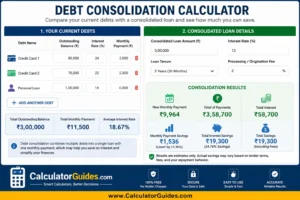
Suppose you have three debts:
| Debt | Balance | Interest Rate |
|---|---|---|
| Credit Card A | ₹80,000 | 24% |
| Credit Card B | ₹70,000 | 22% |
| Personal Loan | ₹1,50,000 | 14% |
| Total | ₹3,00,000 | — |
You consider a consolidation loan of:
₹3,00,000
at:
12% annual interest
for:
3 years
The calculator can compare the estimated cost of the new loan with the remaining cost of your existing debts.
The actual savings depend on the remaining tenure of each existing debt and all applicable fees.
Debt Consolidation Monthly Payment
Suppose your new consolidated loan is:
₹3,00,000
Interest rate:
12%
Term:
36 months
The estimated monthly payment is approximately:
₹9,964
Total payments would be approximately:
₹3,58,700
So the estimated interest would be about:
₹58,700
These figures are a mathematical example and exclude fees, taxes, insurance, or other lender-specific charges.
Debt Consolidation Interest Calculator
The total interest on a fixed installment loan can be estimated as:
Total Interest = Total Payments − Principal
For example:
Principal:
₹3,00,000
Total payments:
₹3,58,700
Estimated interest:
₹58,700
A calculator can help you compare this amount with the remaining interest on your existing debts.
Debt Consolidation Savings Calculator
Potential savings can be estimated as:
Potential Savings = Current Remaining Cost − Consolidated Loan Cost
However, you should include all relevant fees.
A more complete comparison is:
Net Savings = Existing Debt Cost − (New Loan Payments + New Loan Fees)
This is more useful than comparing interest rates alone.
Monthly Payment Savings
Debt consolidation can sometimes reduce the monthly payment.
For example:
Current monthly payments:
₹15,000
New consolidated payment:
₹10,000
Monthly payment difference:
₹5,000
But this does not automatically mean you save ₹5,000 per month overall.
If the new loan lasts much longer, you could pay more total interest.
Lower Monthly Payment vs Lower Total Cost
This is one of the most important things to understand about debt consolidation.
Suppose:
Existing debts
Monthly payments:
₹15,000
Remaining period:
24 months
Consolidated loan
Monthly payment:
₹10,000
Remaining period:
48 months
The new payment is lower, but you are making payments for twice as long.
Therefore, compare:
Total amount paid
rather than only:
Monthly payment
Debt Consolidation With a Longer Term
Extending the loan term can make monthly payments more affordable.
However, a longer term can increase total interest.
For example:
₹3,00,000 at 12%
could cost less interest over 3 years than over 5 years, even though the 5-year option has a lower monthly payment.
The right choice depends on your cash flow and overall financial situation.
Debt Consolidation With a Lower Interest Rate
A lower interest rate can reduce the cost of borrowing.
For example:
Existing debt rate:
24%
New consolidation rate:
14%
This may create an opportunity to reduce interest costs.
But the actual savings depend on:
- Remaining debt
- Remaining tenure
- New tenure
- Fees
- Prepayment charges
- Taxes or other costs
Debt Consolidation With Credit Cards
Credit card balances can have relatively high interest rates.
Consolidating credit card debt into a lower-rate installment loan may reduce interest costs if the new loan has favorable terms.
However, you should also avoid building new credit card balances after consolidation.
Otherwise, you could end up with:
New consolidation loan + new credit card debt
instead of actually reducing your debt.
Debt Consolidation for Personal Loans
If you have multiple personal loans, consolidation can potentially replace several monthly payments with one payment.
Compare:
- Outstanding principal
- Current interest rate
- Remaining tenure
- Prepayment charges
- New loan interest rate
- Processing fees
- New repayment period
A lower rate is useful only if the complete cost of the new arrangement is favorable.
Debt Consolidation and Credit Score
Applying for a new loan can affect your credit profile depending on the lender, country, and application process.
Debt consolidation itself is not automatically good or bad for your credit score.
What matters over time includes factors such as:
- Payment history
- Outstanding balances
- Credit utilization
- Number of accounts
- New credit applications
- Length of credit history
Making payments on time can be important for maintaining a healthy credit history.
Debt Consolidation and Credit Utilization
For revolving credit such as credit cards, paying down balances can reduce credit utilization.
Lower utilization can be beneficial to credit profiles in some scoring systems.
However, closing old credit accounts is not always necessary or beneficial.
Consider the terms and your broader credit situation before closing accounts.
Debt Consolidation Fees
A consolidation loan may involve additional costs such as:
- Origination fee
- Processing fee
- Application fee
- Prepayment charge
- Transfer fee
- Documentation fee
These costs should be included when comparing loans.
For example:
New loan:
₹3,00,000
Processing fee:
2%
Fee:
₹6,000
If the lender deducts the fee from the loan proceeds, you may receive less than ₹3,00,000 even though the loan principal is ₹3,00,000.
Debt Consolidation Calculator With Fees
A useful calculation should compare:
Total New Loan Cost = Principal + Interest + Applicable Fees
Suppose:
Principal:
₹3,00,000
Interest:
₹58,700
Fees:
₹6,000
Estimated total cost:
₹3,64,700
This should then be compared with the remaining cost of your existing debts.
Debt Consolidation and Prepayment Charges
Some existing loans may charge a fee when you repay them early.
If you are consolidating an existing loan, check whether early repayment creates an additional cost.
For an accurate comparison:
Existing Debt Cost = Remaining Payments + Applicable Prepayment Costs
Then compare this with the new loan’s total cost.
Debt Consolidation for Multiple Debts
Suppose you have:
- Credit card
- Personal loan
- Medical debt
- Store financing
You can enter each debt separately into a calculator.
The calculator can total:
Current Debt = Debt 1 + Debt 2 + Debt 3 + Debt 4
Then compare it with the proposed consolidation loan.
Debt Consolidation vs Balance Transfer
These are related but different approaches.
Debt Consolidation
Combines multiple debts into a new loan or repayment arrangement.
Balance Transfer
Moves an existing credit-card balance to another card or lender, often under promotional terms.
A balance transfer may have:
- Promotional interest rate
- Transfer fee
- Limited promotional period
- Higher rate after the promotion
Always compare the complete cost rather than focusing only on the introductory rate.
Debt Consolidation vs Debt Settlement
These should not be confused.
Debt Consolidation
You generally repay the debt through a new loan or combined payment arrangement.
Debt Settlement
A settlement arrangement may involve negotiating to pay less than the full amount owed.
Debt settlement can have different credit, tax, legal, and financial consequences.
Debt Consolidation vs Refinancing
Refinancing generally means replacing an existing loan with a new loan, often to obtain a different rate or terms.
Debt consolidation can involve refinancing multiple debts into one loan.
The exact terminology can vary by lender and country.
Debt Snowball vs Debt Consolidation
Debt consolidation is not the only debt-management strategy.
The debt snowball method focuses on paying off the smallest debt first while maintaining minimum payments on other debts.
Another approach is the debt avalanche, which prioritizes the debt with the highest interest rate.
These strategies can be compared with consolidation depending on your financial situation.
Debt Avalanche vs Consolidation
The debt avalanche method generally prioritizes high-interest debt.
For example:
- Pay minimums on all debts.
- Put additional money toward the highest-interest balance.
- Continue until the highest-interest debt is cleared.
- Move to the next-highest rate.
If your existing debts already have favorable rates, consolidation may not necessarily save money.
Debt Consolidation and Emergency Savings
Using all available savings to pay debt can leave you without cash for unexpected expenses.
A sudden emergency could then force you to borrow again.
Your debt strategy should therefore consider both:
- Debt repayment
- Emergency savings
The appropriate balance depends on your circumstances.
Debt Consolidation for High-Interest Debt
Consolidation may be worth investigating when:
- You have multiple high-interest debts
- The new rate is meaningfully lower
- Fees are reasonable
- You can afford the new payment
- You avoid accumulating new debt
- The total repayment cost is lower
These conditions are not guarantees that consolidation is the best option.
Debt Consolidation Calculator Formula Summary
Total Existing Debt
Total Debt = Balance 1 + Balance 2 + Balance 3 + …
Maximum Monthly Payment Formula
M = P × [r(1+r)^n] ÷ [(1+r)^n − 1]
Total Loan Payments
Total Payments = Monthly Payment × Number of Payments
Total Interest
Interest = Total Payments − Principal
Net Savings
Net Savings = Existing Debt Cost − New Debt Cost
When comparing real loans, include applicable fees and penalties.
How to Use the Debt Consolidation Calculator
Step 1: Enter Your Existing Debts
Add each outstanding balance.
Step 2: Enter Interest Rates
Enter the applicable rate for each debt.
Step 3: Enter Current Payments
Enter the monthly payment for each debt if available.
Step 4: Enter the New Loan Amount
Usually, this should cover the debts you want to consolidate plus any applicable financing costs.
Step 5: Enter the New Interest Rate
Enter the proposed consolidation loan rate.
Step 6: Enter the New Loan Term
Enter the repayment period.
Step 7: Add Fees
Include processing, origination, or other applicable charges.
Step 8: Compare
Look at:
- Current monthly payments
- New monthly payment
- Current remaining cost
- New total cost
- Interest difference
- Potential savings
Common Debt Consolidation Mistakes
Looking Only at the Monthly Payment
A lower payment can come from a longer loan term.
Ignoring Fees
Processing or origination fees can reduce your savings.
Ignoring Prepayment Charges
Existing lenders may charge for early repayment.
Continuing to Use Credit Cards
Adding new debt after consolidation can make the situation worse.
Using an Unreasonably Long Loan Term
A longer term may increase total interest.
Assuming a Lower Rate Always Saves Money
The complete repayment cost matters.
Forgetting Taxes or Other Costs
Depending on the debt and jurisdiction, other financial consequences may apply.
Frequently Asked Questions
What is a Debt Consolidation Calculator?
It is a tool that compares multiple existing debts with a proposed consolidated loan and estimates payments, interest, total cost, and potential savings.
Does debt consolidation reduce debt?
Not by itself. Consolidation usually changes how the debt is structured. You still owe the underlying amount unless you make additional repayments.
Does debt consolidation lower monthly payments?
It can, but not always. A lower payment may result from a lower interest rate, a longer repayment period, or both.
Does debt consolidation save money?
It can save money when the new borrowing cost is lower than the remaining cost of the existing debts after considering all fees and charges.
Is debt consolidation the same as debt settlement?
No. Consolidation generally replaces multiple debts with a new repayment arrangement, while settlement involves negotiating debt repayment, often for less than the amount owed.
Can I consolidate credit card debt?
Yes, depending on the lender and your eligibility.
Can I consolidate personal loans?
Potentially. The availability and terms depend on the lender and your financial circumstances.
Does debt consolidation affect credit score?
Applying for a new loan and changing your existing accounts can affect your credit profile depending on the circumstances and credit-reporting system.
What credit score do I need for debt consolidation?
There is no universal minimum. Lenders use their own eligibility criteria, which may include credit history, income, debt-to-income ratio, and other factors.
Is debt consolidation a good idea?
It can be useful when it reduces borrowing costs or makes repayment easier without creating a higher total cost. It is not automatically the best option for everyone.
Is a lower monthly payment always better?
No. A lower payment can come with a longer repayment period and more total interest.
Should I close my credit cards after consolidation?
Not necessarily. Closing accounts can have consequences for your credit profile and available credit. Consider the account terms and your spending habits before deciding.
Can I consolidate debt with bad credit?
Some lenders offer consolidation products to borrowers with lower credit scores, but rates and fees may be less favorable.
Does the calculator include fees?
It can if you enter them. Including fees makes the comparison more realistic.
Can I use the calculator for multiple debts?
Yes. Add each debt’s balance, rate, and payment to calculate the combined position.
Is the Debt Consolidation Calculator accurate?
The mathematical estimate is accurate for the information entered. Actual loan offers can differ because lenders use their own terms, fees, eligibility criteria, and calculation methods.
Is the Debt Consolidation Calculator free?
Yes. The CalculatorGuides.com Debt Consolidation Calculator is free to use.
Debt Consolidation Calculator – Important Things to Check
Before choosing a consolidation loan, compare:
- Current balances
- Current interest rates
- Remaining repayment periods
- Current monthly payments
- New interest rate
- New loan term
- Processing or origination fees
- Prepayment charges
- Total repayment amount
- Monthly payment
- Your ability to avoid taking on new debt
The goal should not simply be a lower monthly payment. Look at the total cost of becoming debt-free.
Conclusion
A Debt Consolidation Calculator helps you compare your existing debts with a potential consolidated loan.
The most important numbers are not just the new monthly payment. You should also compare the total interest, fees, repayment period, and overall amount you will pay.
For example, a consolidation loan can reduce your monthly payment but still cost more overall if it extends your repayment period significantly.
Debt consolidation can be useful when a new loan has a lower overall borrowing cost and provides a manageable repayment structure. But it does not make debt disappear, and continuing to accumulate new debt can undermine the benefits.
Use the CalculatorGuides.com Debt Consolidation Calculator to compare your current debts with a proposed consolidation plan and understand the potential payment and cost differences before making a financial decision.