
Body Type Calculator-Our Body Type Calculator helps you understand your general body shape and body type using simple measurements. Depending on the calculator method, you can look at your body proportions, frame size, or common somatotype categories such as ectomorph, mesomorph, and endomorph.Make complicated calculations easier with our BAC Calculator simple free calculator tools.
💃 Body Type Calculator
You can use a body type calculator to learn more about your proportions, choose clothing styles, understand your body measurements, or simply learn more about your natural build.
Enter your measurements into the calculator above to get your result.
What Is a Body Type Calculator?
A Body Type Calculator is an online tool that estimates your general body type or body shape from measurements.
Different calculators use different methods. Some focus on measurements such as the bust, waist, hips, chest, and shoulders, while others use measurements such as height and wrist size to estimate frame size and somatotype.
A body type calculator is not a medical test. Your result is simply a general description of your body proportions or build.
How to Use the Body Type Calculator
Using the calculator is easy.
Step 1: Select your measurement system
Choose either:
- Inches
- Centimeters
Use the same measurement system for all your measurements.
Step 2: Enter your measurements
Depending on the calculator, you may need:
- Height
- Weight
- Wrist circumference
- Bust or chest
- Waist
- Hips
- Shoulders
- High hip
Step 3: Calculate your body type
Click the Calculate button.
The calculator compares your measurements and gives you an estimated result.
Step 4: Understand your result
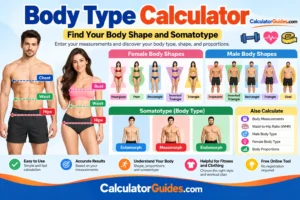
Your result may show a body shape such as hourglass, pear, rectangle, triangle, or inverted triangle, or a somatotype such as ectomorph, mesomorph, or endomorph, depending on the method being used.
What Are the Main Body Types?
There are two common ways people use the term “body type.”
One is body shape, which looks at your proportions.
The other is somatotype, which describes broad physical build tendencies.
These are not the same thing.
Ectomorph
An ectomorph is traditionally described as having a relatively lean or narrow frame, with less overall body mass.
Common descriptions include:
- Slim build
- Narrower frame
- Long-looking limbs
- Difficulty gaining body mass
However, people do not always fit perfectly into one category. Most people have a combination of characteristics.
Mesomorph
A mesomorph is traditionally described as having a more athletic or muscular-looking build.
Common descriptions include:
- Medium or broader frame
- More visible muscle
- Athletic appearance
- Relatively easy muscle development
Again, this is a broad description rather than a fixed biological category.
Endomorph
An endomorph is traditionally described as having a broader or softer build and a tendency to carry more body mass.
Common descriptions include:
- Wider frame
- Rounder appearance
- Easier weight gain
- More body fat
These three categories are best treated as general fitness terminology rather than strict labels. Modern calculators often describe them as estimates or tendencies.
Body Shape Calculator
A body shape calculator is slightly different from a somatotype calculator.
It usually looks at the proportions between areas such as:
- Bust or chest
- Waist
- Hips
- Shoulders
This can help identify a general body shape.
For example, female body-shape calculators commonly use categories such as hourglass, pear, rectangle, spoon, triangle, and inverted triangle. Male body-shape calculators may use categories such as trapezoid, rectangle, triangle, inverted triangle, and oval.
Female Body Type Calculator
A female body type calculator commonly uses bust, waist, high-hip, and hip measurements.
The most commonly discussed female body shapes include:
Hourglass Body Shape
The bust and hips are relatively similar in size, while the waist is noticeably smaller.
Pear Body Shape
The hips are wider in proportion to the upper body.
Rectangle Body Shape
The waist, hips, and upper body have relatively similar proportions.
Inverted Triangle Body Shape
The shoulders or upper body are wider than the hips.
Spoon Body Shape
The hips are more prominent compared with the bust and waist.
Body-shape categories are descriptive and can vary slightly depending on the measurement rules used by a calculator.
Male Body Type Calculator
A male body type calculator can use measurements such as chest, shoulders, waist, and hips.
Common male body-shape descriptions include:
- Trapezoid
- Inverted triangle
- Rectangle
- Triangle
- Oval
For example, an inverted-triangle shape generally has a wider upper body compared with the waist and hips.
A rectangle shape has more similar measurements through the shoulders, waist, and hips.
What Measurements Do You Need?
The exact measurements depend on the calculator.
Bust or Chest
Measure around the fullest part of the chest.
Keep the measuring tape level and avoid pulling it too tightly.
Waist
Measure around your natural waist or the measurement point specified by the calculator.
Keep your body relaxed while measuring.
Hips
Measure around the fullest part of the hips and buttocks.
Shoulders
Some body type calculators use shoulder measurements to understand upper-body proportions.
Wrist
Somatotype or frame-size calculators may use wrist circumference together with height.
Measure around the narrowest part of the wrist. Some calculators use the height-to-wrist relationship as a simple frame-size estimate.
How to Measure Your Body Correctly
Getting accurate measurements is important.
Follow these simple tips:
- Use a flexible measuring tape.
- Stand naturally.
- Keep the tape level around your body.
- Do not pull the tape extremely tight.
- Do not leave a large gap between the tape and your body.
- Take each measurement twice if possible.
- Use the same units throughout the calculation.
For body-shape measurements, the tape should be snug but not tight enough to compress the body.
What Is a Somatotype?
A somatotype is a traditional way of describing physical build using three broad categories:
Ectomorph + Mesomorph + Endomorph
Some more advanced somatotype methods actually give three scores rather than placing a person into only one category. The Heath-Carter method, for example, describes endomorphy, mesomorphy, and ectomorphy as separate components.
This is why two different body type calculators can sometimes give different results.
They may simply be using different methods.
Body Type vs. Body Shape
These terms are often used interchangeably, but they can mean different things.
| Body Type | Body Shape |
|---|---|
| Usually refers to overall build | Usually refers to body proportions |
| May use frame size | Often uses bust, waist, hips, or shoulders |
| May include ectomorph, mesomorph, endomorph | May include hourglass, pear, rectangle, etc. |
| Used mostly in fitness discussions | Often used for clothing and styling |
Knowing which method a calculator uses makes your result easier to understand.
Waist-to-Hip Ratio
Some body type calculators also show your waist-to-hip ratio (WHR).
The basic formula is:
WHR = Waist Circumference ÷ Hip Circumference
For example, if your waist is 80 cm and your hips are 100 cm:
80 ÷ 100 = 0.80
Your waist-to-hip ratio would be 0.80.
WHR describes the relationship between your waist and hip measurements. It should not be confused with a diagnosis or a complete measure of health.
Body Type Calculator for Men and Women
A calculator can be designed for both men and women, but the measurements and classification rules may differ.
For example:
Women:
Bust + waist + high hip + hip measurements may be used for body-shape classification.
Men:
Chest + shoulders + waist + hips may be used for body-shape classification.
Some calculators also provide separate male and female modes because body-shape formulas are not necessarily the same.
Body Type and Weight
Your body weight can affect how your body looks, but weight alone does not tell you your body shape.
Two people can have the same height and weight but have different:
- Muscle mass
- Waist size
- Hip size
- Shoulder width
- Bone structure
- Body proportions
This is why a body type calculator may use several measurements instead of weight alone.
Can Your Body Shape Change?
Your basic skeletal structure does not usually change much after adulthood, but your visible body proportions can change.
For example, changes in:
- Body weight
- Muscle mass
- Training
- Waist size
- Hip size
- Pregnancy
- Age-related changes
can affect your measurements and overall appearance.
So, a body type result should not be treated as a permanent label.
Does Body Type Affect Fitness?
Your natural build can influence how your body looks and how you respond to certain types of training, but it does not determine your fitness level.
Your results are also affected by:
- Exercise
- Nutrition
- Sleep
- Genetics
- Training experience
- Daily activity
- Lifestyle
There is no single body type that is automatically better than another.
Body Type Calculator for Clothing
Many people use a body shape calculator to understand which clothing styles may work well with their proportions.
For example, someone may want to know whether their proportions are closer to:
- Hourglass
- Pear
- Rectangle
- Inverted triangle
- Triangle
- Trapezoid
The result can be used as a starting point when choosing clothes.
Remember that clothing advice is a matter of preference. A body-shape category does not tell you what you should or should not wear.
Why Can Different Body Type Calculators Give Different Results?
This is a common question.
Different calculators may use different inputs and formulas.
One calculator might use:
Height + wrist circumference
while another might use:
Bust + waist + hips
Another may use:
Shoulders + waist + hips
Because the methods are different, the results can also be different.
This does not necessarily mean that one calculator is wrong.
It means that they are answering slightly different questions.
Is a Body Type Calculator Accurate?
A body type calculator provides an estimate, not a medical or laboratory measurement.
Body-shape results depend on:
- How accurately you measure
- Which measurements are used
- The classification method
- The formula used by the calculator
Somatotype categories are also broad descriptions rather than exact health classifications.
For this reason, use your result as a helpful guide rather than a strict label.
Body Type Calculator Example
Suppose someone enters these measurements:
- Bust: 36 inches
- Waist: 28 inches
- Hips: 38 inches
The calculator compares these measurements and looks at the differences between the upper body, waist, and hips.
If the bust and hips are relatively similar and the waist is noticeably smaller, the result may be classified as an hourglass-type shape, depending on the calculator’s specific rules.
The exact result can change if different classification formulas are used.
Body Type Calculator vs. BMI Calculator
A BMI Calculator and a Body Type Calculator answer different questions.
BMI Calculator
BMI uses height and weight to calculate a numerical value.
Body Type Calculator
A body type or body shape calculator looks at physical proportions or frame characteristics.
You should not use a body type result as a replacement for BMI, body-fat measurements, or professional health advice.
Frequently Asked Questions
What is a Body Type Calculator?
A Body Type Calculator is an online tool that estimates your general body shape or somatotype using measurements such as height, wrist, bust, waist, hips, chest, or shoulders.
What are the 3 main body types?
The traditional three somatotype categories are ectomorph, mesomorph, and endomorph.
What is an ectomorph?
Ectomorph is a traditional term for a relatively lean or narrow-framed build.
What is a mesomorph?
Mesomorph is traditionally used to describe a more athletic or muscular-looking build.
What is an endomorph?
Endomorph is traditionally used to describe a broader or softer build.
What is a body shape calculator?
A body shape calculator estimates your body proportions using measurements such as bust, waist, hips, chest, or shoulders.
What is the most common female body shape?
There is no single body shape that everyone has. Common classification systems include hourglass, pear, rectangle, spoon, triangle, and inverted triangle.
What is the difference between body type and body shape?
Body type usually describes a broader physical build or somatotype, while body shape usually describes the proportions between different parts of the body.
Can men use a body type calculator?
Yes. Some calculators have specific male body-shape categories based on chest, shoulders, waist, and hip measurements.
Can women use a body type calculator?
Yes. Female body-shape calculators commonly use bust, waist, high-hip, and hip measurements.
Can my body type change?
Your basic frame does not normally change significantly, but your body measurements and visible proportions can change because of weight changes, muscle growth, aging, and other factors.
Is a body type calculator a medical test?
No. It is a general estimation tool and should not be used to diagnose a health condition.
What is waist-to-hip ratio?
Waist-to-hip ratio is calculated by dividing waist circumference by hip circumference.
WHR = Waist ÷ Hips
Which measurements are needed for a body shape calculator?
Depending on the calculator, you may need bust or chest, waist, hips, high hips, shoulders, height, or wrist circumference.
Can I use centimeters instead of inches?
Yes, if the calculator supports metric measurements. Just make sure you use the correct unit for every measurement.
Final Thoughts
A Body Type Calculator is a simple way to learn more about your general body shape, proportions, or somatotype.
You may see results such as ectomorph, mesomorph, endomorph, hourglass, pear, rectangle, triangle, trapezoid, or inverted triangle, depending on the calculation method.
Remember that these categories are only general descriptions. Your body is more complex than a single label, and your shape can change as your weight, muscle mass, activity, and other factors change.
Enter your measurements into the CalculatorGuides.com Body Type Calculator above and use the result as a simple guide to better understand your proportions.