
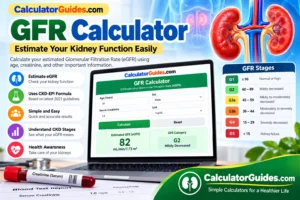
GFR Calculator-Use our GFR Calculator to estimate your glomerular filtration rate (GFR) and learn more about kidney function.GFR is an important measure used to understand how well the kidneys filter waste from the blood. Because GFR is usually estimated rather than measured directly, it is commonly called estimated GFR or eGFR.Make complicated calculations easier with our BAC Calculator simple free calculator tools.
🩺 Adult eGFR Calculator (CKD-EPI)
👶 Pediatric GFR Calculator (Schwartz)
Our calculator can help you estimate eGFR using information such as serum creatinine, age, and sex. Depending on the calculator method, cystatin C may also be used. The current adult CKD-EPI approach recommended by the National Kidney Foundation does not use a race coefficient.
Important: This calculator provides an estimate and is not a diagnosis. Your healthcare professional should interpret your eGFR together with your medical history, urine tests, and other laboratory results.
What Is GFR?
GFR stands for Glomerular Filtration Rate.
It describes how well the kidneys filter blood.
Healthy kidneys continuously remove waste and extra fluid from the blood. GFR gives healthcare professionals an estimate of how well this filtering process is working.
A measured GFR can be obtained with specialized testing, but in everyday medical care, GFR is usually estimated from blood test results, which is why the term eGFR is commonly used.
What Is an eGFR Calculator?
An eGFR Calculator is a tool that estimates kidney filtration using information from a blood test and basic personal information.
For adults, the current NKF-recommended creatinine equation is the 2021 CKD-EPI creatinine equation. It uses:
- Serum creatinine
- Age
- Sex
The result is usually reported in:
mL/min/1.73 m²
The calculator may also use cystatin C, either alone or together with creatinine, depending on the equation being used.
How to Use the GFR Calculator
Using a GFR calculator is simple.
Step 1: Enter your age
Enter your age in years.
Step 2: Select your sex
Choose the sex required by the calculator.
Step 3: Enter your serum creatinine
Enter the creatinine value from your blood test.
Make sure you use the correct unit shown by the calculator, such as mg/dL or µmol/L.
Step 4: Add cystatin C if available
Some eGFR calculators allow you to enter a cystatin C result.
Using both creatinine and cystatin C can provide another eGFR estimate.
Step 5: Calculate
Click Calculate to see your estimated GFR.
The result can then be compared with the standard GFR categories.
GFR Calculator Formula
The current 2021 CKD-EPI creatinine equation uses serum creatinine, age, and sex.
The equation is:
eGFR = 142 × min(Scr/κ, 1)^α × max(Scr/κ, 1)^−1.200 × 0.9938^Age × 1.012 [if female]
In this equation:
- Scr = standardized serum creatinine
- κ = 0.7 for females and 0.9 for males
- α = −0.241 for females and −0.302 for males
- Age = age in years
This is the race-free 2021 CKD-EPI creatinine equation recommended by the National Kidney Foundation for adults.
You do not need to calculate this formula by hand. An online GFR Calculator can do the calculation for you.
What Is a Normal GFR?
There is no single GFR number that is considered perfect for every adult.
GFR normally changes with age, and it tends to decrease as people get older. The National Kidney Foundation notes that a normal adult eGFR is usually above 90, but the result must be interpreted in context.
A higher eGFR generally indicates better filtering function, but one result by itself does not tell the complete story about kidney health.
Urine albumin, medical history, blood pressure, diabetes status, and other factors can also matter.
GFR Stages and eGFR Categories
The standard GFR categories are:
| GFR Category | eGFR | Description |
|---|---|---|
| G1 | 90 or higher | Normal or high |
| G2 | 60–89 | Mildly decreased |
| G3a | 45–59 | Mildly to moderately decreased |
| G3b | 30–44 | Moderately to severely decreased |
| G4 | 15–29 | Severely decreased |
| G5 | Below 15 | Kidney failure |
These categories are used as part of chronic kidney disease classification.
Does eGFR Above 90 Mean Everything Is Normal?
Not necessarily.
An eGFR of 90 or higher is in the G1 category, but G1 alone does not mean a person has chronic kidney disease.
Similarly, an eGFR between 60 and 89 does not automatically mean CKD.
Evidence of kidney damage, such as increased urine albumin, is also important. The NKF notes that G1 and G2 do not fulfill CKD criteria in the absence of evidence of kidney damage.
What Does an eGFR Below 60 Mean?
An eGFR below 60 can indicate reduced kidney function.
However, one low result should not automatically be interpreted as chronic kidney disease.
CKD is generally identified when reduced kidney function or markers of kidney damage persist for 3 months or more. NIDDK lists eGFR below 60 or evidence of kidney damage such as increased urine albumin as important criteria.
Your healthcare professional may repeat testing and look at your previous results to understand whether your kidney function is changing.
What Does an eGFR Below 15 Mean?
An eGFR below 15 falls into the G5 category, which is classified as kidney failure.
This is a serious result that requires medical evaluation. An eGFR result should always be interpreted with other clinical information rather than by the calculator alone.
GFR and Creatinine
Creatinine is one of the most common blood measurements used to estimate GFR.
Creatinine is a waste product that comes from normal muscle metabolism. The kidneys remove creatinine from the blood.
When kidney filtration decreases, blood creatinine can increase.
However, creatinine is affected by factors other than kidney function. This is one reason eGFR equations use additional information such as age and sex.
The 2021 CKD-EPI creatinine equation uses standardized serum creatinine together with age and sex.
What Is the Difference Between GFR and eGFR?
The terms are closely related but are not exactly the same.
GFR means glomerular filtration rate.
eGFR means estimated glomerular filtration rate.
A true measured GFR requires specialized testing. An eGFR is calculated from laboratory results and other information.
For most routine kidney evaluation, healthcare professionals use an eGFR rather than directly measuring GFR.
Creatinine Clearance vs. eGFR
You may also see the term creatinine clearance.
Creatinine clearance is another way to estimate kidney filtration and traditionally involves urine collection together with blood creatinine.
eGFR is calculated using an estimating equation and does not normally require a 24-hour urine collection.
These numbers should not automatically be treated as interchangeable. The appropriate measurement depends on the clinical situation.
CKD-EPI Calculator
The CKD-EPI Calculator is based on equations developed by the Chronic Kidney Disease Epidemiology Collaboration.
The current 2021 CKD-EPI creatinine equation is a race-free equation and is recommended by the National Kidney Foundation for estimating GFR in adults.
The equation can estimate GFR using standardized creatinine, age, and sex.
Another 2021 CKD-EPI equation combines creatinine and cystatin C.
Cystatin C and eGFR
Cystatin C is another blood marker that can be used to estimate kidney filtration.
An eGFR can be calculated using:
- Creatinine
- Cystatin C
- Creatinine + cystatin C
The combined creatinine-cystatin C equation may be useful in some situations, including cases where creatinine may not reflect kidney filtration as accurately because of differences in muscle mass or diet.
eGFR and Body Surface Area
Standard eGFR is normally reported relative to a body surface area of:
1.73 m²
This makes eGFR results easier to compare between people.
However, in some situations, a healthcare professional may need an absolute or BSA-adjusted GFR in mL/min, particularly for certain medication dosing decisions.
The National Kidney Foundation’s calculator provides both standardized eGFR and an option to adjust the result for body surface area using height and weight.
GFR Calculator for Adults
The current adult eGFR equations are intended for adults.
NIDDK states that its adult eGFR calculator is designed for people 18 years and older. Different equations are used for children and young people.
If the person being tested is under 18, use an appropriate pediatric eGFR calculator and follow medical guidance.
eGFR by Age
Age is an important part of eGFR calculation.
GFR naturally tends to decline with age, even in people who do not have kidney disease.
For this reason, you should not compare your eGFR with another person’s number without considering age and other health information.
For example, an eGFR of 70 does not necessarily have the same meaning for every person.
Why Can eGFR Change?
Your eGFR can change between tests.
Possible reasons include changes in creatinine, hydration, illness, medications, and other health factors.
Small changes do not always mean that kidney function is getting worse. The NKF notes that small fluctuations in GFR are common, and trends over time can be more useful than a single number.
This is why doctors often look at previous laboratory results rather than judging kidney health from one eGFR value.
Is eGFR the Same as Kidney Function?
eGFR is an important estimate of kidney filtration, but it is not a complete measurement of kidney health.
Kidney health can also involve:
- Urine albumin
- Blood pressure
- Diabetes
- Medical history
- Other blood tests
- Imaging
- Symptoms
- Changes in eGFR over time
The NKF uses both GFR category and albuminuria category when classifying chronic kidney disease.
eGFR and Urine Albumin
A urine test called the urine albumin-to-creatinine ratio (uACR) is often used along with eGFR.
The common albuminuria categories are:
| Category | uACR |
|---|---|
| A1 | Less than 30 mg/g |
| A2 | 30–300 mg/g |
| A3 | More than 300 mg/g |
Both eGFR and albuminuria can help healthcare professionals understand kidney disease risk.
GFR Calculator Example
Suppose an adult has a blood test showing a particular serum creatinine value.
The GFR calculator combines the creatinine result with age and sex and applies the appropriate equation.
The result might look like:
eGFR = 82 mL/min/1.73 m²
That number falls within the G2 range of 60–89.
But this does not automatically mean the person has CKD. Other evidence, such as kidney damage or albuminuria, and the duration of the finding must be considered.
Why Use an Online GFR Calculator?
A GFR calculator can make the calculation easier because the formula is complicated.
It can help you:
- Estimate eGFR
- Understand your laboratory result
- Check which GFR category a result falls into
- Learn about CKD stages
- Understand the difference between GFR and eGFR
- See how creatinine, age, and sex are used in the calculation
- Learn about CKD-EPI equations
The calculator should be used as an educational tool and not as a replacement for professional medical advice.
Frequently Asked Questions
What is a GFR Calculator?
A GFR Calculator estimates the glomerular filtration rate of the kidneys. For adults, eGFR can be estimated from serum creatinine, age, and sex using an equation such as the 2021 CKD-EPI equation.
What does GFR stand for?
GFR stands for Glomerular Filtration Rate. It describes how well the kidneys filter blood.
What does eGFR stand for?
eGFR stands for estimated Glomerular Filtration Rate. It is an estimate of kidney filtration rather than a direct measurement.
What is a normal eGFR?
An eGFR of 90 or higher is generally in the normal or high GFR category, but kidney health cannot be determined from eGFR alone.
Is an eGFR of 60 normal?
An eGFR of 60 is at the lower boundary of the G2 category and may require further evaluation depending on the person’s age, urine albumin, and other health information. A single result does not by itself diagnose CKD.
Is an eGFR of 90 good?
An eGFR of 90 is in the G1 category. However, CKD is not diagnosed from this number alone. Evidence of kidney damage and how long it has been present are also important.
What does an eGFR below 60 mean?
An eGFR below 60 may indicate reduced kidney function. If it persists for at least 3 months, it can be an important criterion for CKD.
What does an eGFR below 15 mean?
An eGFR below 15 falls into the G5 category, which is classified as kidney failure. Medical evaluation is important.
Does age affect GFR?
Yes. GFR naturally decreases with age, so age is included in eGFR equations.
Does creatinine affect eGFR?
Yes. Serum creatinine is an important input in the 2021 CKD-EPI creatinine equation.
What is the CKD-EPI equation?
CKD-EPI is a group of equations used to estimate GFR. The 2021 creatinine equation uses standardized creatinine, age, and sex and does not include a race coefficient.
Can cystatin C be used for eGFR?
Yes. Cystatin C can be used alone or together with creatinine in certain eGFR equations.
Is eGFR a direct measurement of kidney function?
No. eGFR is an estimate. NIDDK notes that estimating equations are not a precise measurement of GFR, and trends can be more informative than a single result.
Can I use this calculator to diagnose kidney disease?
No. An online calculator cannot diagnose CKD. A healthcare professional needs to interpret eGFR together with urine tests, medical history, repeat results, and other information.
Final Thoughts
The GFR Calculator is a simple way to estimate kidney filtration from commonly available laboratory information.
For adults, the current 2021 CKD-EPI equation uses standardized serum creatinine, age, and sex, while other equations can also use cystatin C.
Remember that eGFR is an estimate, not a direct measurement. A single number should not be used to diagnose kidney disease.