
Half-Life Calculator-Use our Half-Life Calculator to calculate the amount of a substance left after a certain amount of time, find the number of half-lives that have passed, or understand how quickly a quantity decreases.Explore our free online calculator tools for quick answers calculatorguides across different categories.
⏳ Half-Life Calculator
⚛️ Decay Constant & Lifetime Converter
🔬 Radioactive Decay Fraction Calculator
The calculator is useful for radioactive decay, chemistry, physics, nuclear science, and exponential decay problems.
Enter the initial amount, half-life, and elapsed time to quickly find the remaining amount.
You can use any consistent unit, such as seconds, minutes, hours, days, or years.
What Is a Half-Life?
Half-life is the amount of time required for a quantity to decrease to half of its original value.
For example, suppose you start with 100 grams of a substance and its half-life is 10 years.
After 10 years:
50 grams remain
After another 10 years:
25 grams remain
After another 10 years:
12.5 grams remain
The amount keeps decreasing by half during each half-life.
Half-life is commonly used to describe radioactive decay, but the idea of exponential decay is also used in other scientific and mathematical situations.
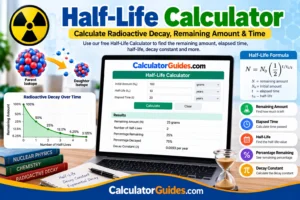
What Is a Half-Life Calculator?
A Half-Life Calculator is an online tool that uses the half-life formula to calculate how much of a substance remains after a certain time.
Depending on the calculator, you may be able to calculate:
- Remaining amount
- Initial amount
- Half-life
- Elapsed time
- Number of half-lives
- Percentage remaining
- Percentage decayed
- Decay constant
- Radioactive decay
The basic calculation uses the relationship between the starting amount, half-life, and elapsed time.
How to Use the Half-Life Calculator
Using the calculator is simple.
Step 1: Enter the initial amount
Enter the amount you started with.
For example:
100 grams
Step 2: Enter the half-life
Enter how long it takes for the substance to decrease by half.
For example:
5 years
Step 3: Enter the elapsed time
Enter how much time has passed.
For example:
10 years
Step 4: Calculate
The calculator will show the amount remaining.
In this example, two half-lives have passed:
10 ÷ 5 = 2 half-lives
Starting with 100 grams:
After 1 half-life = 50 grams
After 2 half-lives = 25 grams
So the remaining amount is:
25 grams
Half-Life Formula
The basic half-life formula is:
N = N₀ × (1/2)^(t / t½)
Where:
- N = amount remaining
- N₀ = initial amount
- t = elapsed time
- t½ = half-life
This formula works for radioactive decay and other exponential decay calculations when the half-life model applies.
Example of the Half-Life Formula
Suppose:
- Initial amount = 200 mg
- Half-life = 4 hours
- Time elapsed = 8 hours
First, find the number of half-lives:
8 ÷ 4 = 2
Now calculate:
N = 200 × (1/2)²
N = 200 × 1/4
N = 50 mg
So, 50 mg remains after 8 hours.
Half-Life Decay Table
The easiest way to understand half-life is to look at what happens after each half-life.
| Number of Half-Lives | Amount Remaining | Percentage Remaining |
|---|---|---|
| 0 | 100% | 100% |
| 1 | 1/2 | 50% |
| 2 | 1/4 | 25% |
| 3 | 1/8 | 12.5% |
| 4 | 1/16 | 6.25% |
| 5 | 1/32 | 3.125% |
| 6 | 1/64 | 1.5625% |
Notice that the amount does not decrease by the same number each time.
Instead, it decreases by the same fraction.
How to Calculate Half-Life
If you know the initial amount, remaining amount, and time, you can calculate the half-life.
A useful rearranged formula is:
t½ = t × ln(2) / ln(N₀/N)
Where:
- t½ = half-life
- t = elapsed time
- N₀ = initial amount
- N = remaining amount
For example, if a substance falls from 100 grams to 25 grams in 20 years, 25 grams is one-quarter of the original amount.
One-quarter means two half-lives have passed.
Therefore:
Half-life = 20 ÷ 2 = 10 years
How to Calculate Remaining Amount
To find the amount remaining, use:
N = N₀ × (1/2)^(t/t½)
For example:
Initial amount = 500 g
Half-life = 10 years
Elapsed time = 30 years
Number of half-lives:
30 ÷ 10 = 3
Remaining amount:
500 × (1/2)³
500 × 1/8 = 62.5 g
So, 62.5 grams remain.
How to Calculate Elapsed Time
Sometimes you know the initial amount, remaining amount, and half-life, but you want to know how much time has passed.
The formula is:
t = t½ × log₂(N₀/N)
For example:
Initial amount = 800 g
Remaining amount = 100 g
Half-life = 6 years
The remaining fraction is:
100 ÷ 800 = 0.125
That is:
1/8
One-eighth represents three half-lives.
Therefore:
Time = 3 × 6
Time = 18 years
What Is the Decay Constant?
The decay constant, usually represented by the Greek letter λ (lambda), describes the rate of radioactive or exponential decay.
The relationship between half-life and decay constant is:
λ = ln(2) / t½
Because ln(2) is approximately 0.693:
λ ≈ 0.693 / t½
For example, if the half-life is 10 hours:
λ = 0.693 / 10
λ = 0.0693 per hour
The decay constant is commonly used in exponential decay equations.
Exponential Decay Formula
Half-life can also be written using the exponential decay formula:
N = N₀e^(-λt)
Where:
- N = amount remaining
- N₀ = initial amount
- e = Euler’s number
- λ = decay constant
- t = elapsed time
The half-life formula and exponential decay formula describe the same type of decay.
Radioactive Decay and Half-Life
Radioactive decay happens when unstable atomic nuclei transform into more stable forms.
Different radioactive isotopes have different half-lives.
Some decay very quickly, while others take thousands or millions of years.
The half-life remains a useful way to describe how quickly a radioactive material decreases over time.
The calculator can work with an amount measured in units such as:
- Grams
- Milligrams
- Kilograms
- Atoms
- Moles
- Activity
The unit of the amount does not change the basic half-life calculation as long as the starting and remaining amounts use compatible units.
Carbon-14 Half-Life Calculator
Carbon-14 is one of the most familiar examples of radioactive decay.
Carbon-14 has a half-life of approximately 5,730 years.
For example, after one carbon-14 half-life, about 50% of the original amount remains.
After two half-lives, about 25% remains.
After three half-lives, about 12.5% remains.
This predictable decay is one reason carbon-14 is used in radiocarbon dating.
Carbon-14 Example
Suppose a sample originally contains 100 units of carbon-14.
After 5,730 years:
50 units remain
After 11,460 years:
25 units remain
After 17,190 years:
12.5 units remain
The same half-life calculation can be used for each step.
Half-Life and Radiocarbon Dating
Radiocarbon dating uses the radioactive decay of carbon-14 to estimate the age of certain materials.
If a sample has a smaller amount of carbon-14 compared with a reference level, scientists can estimate how many half-lives have passed.
For example, if approximately 25% remains:
25% = 1/4
That represents:
2 half-lives
Using the carbon-14 half-life of about 5,730 years:
2 × 5,730 = 11,460 years
This is a simplified example; real radiocarbon dating involves additional scientific corrections and measurements.
What Happens After 5 Half-Lives?
After five half-lives, the remaining fraction is:
(1/2)⁵ = 1/32
So approximately:
3.125% remains
That means approximately:
96.875% has decayed
For example, if you start with 1,000 grams:
After five half-lives:
1,000 ÷ 32 = 31.25 grams
So 31.25 grams remain.
Does Radioactive Material Ever Reach Zero?
Under the ideal mathematical exponential-decay model, the amount gets closer and closer to zero but does not become exactly zero.
Each half-life removes half of what remains.
For example:
100
50
25
12.5
6.25
3.125
The amount becomes very small, but the mathematical curve approaches zero rather than reaching it exactly.
Half-Life vs. Decay Constant
Half-life and decay constant describe the same decay process in different ways.
| Term | Meaning |
|---|---|
| Half-life | Time needed for half the amount to remain |
| Decay constant | Rate constant used in the exponential decay equation |
| Symbol for half-life | t½ |
| Symbol for decay constant | λ |
| Relationship | λ = ln(2) / t½ |
A shorter half-life means faster decay.
A longer half-life means slower decay.
Half-Life Calculator Example
Let’s solve a simple problem.
Question
A substance starts with 400 grams and has a half-life of 6 hours.
How much remains after 18 hours?
Step 1: Find the number of half-lives
18 ÷ 6 = 3
Step 2: Divide by 2 three times
400 → 200
200 → 100
100 → 50
Answer
50 grams remain after 18 hours.
The calculator performs this calculation using the half-life formula.
Why Use a Half-Life Calculator?
A half-life calculation can be easy for a small example, but it becomes more difficult when the numbers are not simple.
A free Half-Life Calculator can help you:
- Calculate remaining amount
- Find elapsed time
- Find half-life
- Calculate percentage remaining
- Find the number of half-lives
- Calculate decay constant
- Check homework
- Solve physics problems
- Solve chemistry problems
- Understand radioactive decay
It can also help reduce simple arithmetic mistakes.
Half-Life Calculator for Physics and Chemistry
Half-life is an important topic in both physics and chemistry.
Students may use half-life calculations when studying:
- Radioactive decay
- Nuclear physics
- Nuclear chemistry
- Exponential decay
- Reaction kinetics
- Isotopes
- Radiocarbon dating
The same mathematical idea can appear in different scientific problems, so understanding the basic formula is useful.
What Units Can I Use?
You can use different units of time with the calculator.
Examples include:
- Seconds
- Minutes
- Hours
- Days
- Months
- Years
The important rule is that the elapsed time and half-life must use the same time unit.
For example, if the half-life is 5 hours, enter elapsed time in hours.
If the half-life is 5,730 years, enter elapsed time in years.
The ratio between the two times is what matters in the formula.
Half-Life and Drug Elimination
The term half-life is also used in pharmacology.
A drug’s half-life generally describes how long it takes for the amount or concentration of the drug in the body to fall by half under the relevant elimination model.
For simple first-order elimination, the same mathematical relationship can be used:
Amount remaining = Initial amount × (1/2)^(time/half-life)
However, real drug behavior can be more complicated. Different drugs can have different pharmacokinetics, and the half-life can vary between people and situations. A calculator should therefore be treated as an educational estimate rather than medical advice.
Half-Life vs. Full Elimination
People sometimes ask how long it takes for something to be completely eliminated.
In the mathematical model, the amount does not become exactly zero.
Instead, it becomes smaller after every half-life.
After:
- 1 half-life → 50% remains
- 2 half-lives → 25% remains
- 3 half-lives → 12.5% remains
- 4 half-lives → 6.25% remains
- 5 half-lives → 3.125% remains
For medicines, the actual time to clear a drug depends on the specific drug and the person, so a simple half-life calculation should not be used to make medical decisions.
Frequently Asked Questions
What is a half-life?
Half-life is the time required for a quantity to decrease to half of its starting value.
What is the half-life formula?
The basic formula is:
N = N₀ × (1/2)^(t/t½)
How do I calculate remaining amount after a half-life?
Divide the initial amount by 2 for every half-life that passes.
For example, after three half-lives:
Initial amount × 1/8
remains.
What is the decay constant formula?
The decay constant is:
λ = ln(2) / t½
or approximately:
λ = 0.693 / t½
What is the difference between half-life and decay constant?
Half-life tells you how long it takes for half the amount to remain. The decay constant describes the rate of exponential decay.
What happens after two half-lives?
After two half-lives, 25% of the original amount remains.
What happens after three half-lives?
After three half-lives, 12.5% remains.
Can a half-life be measured in years?
Yes. Half-life can be measured in years, days, hours, minutes, seconds, or another appropriate unit.
Can I calculate radioactive decay with this calculator?
Yes, a half-life calculator can calculate radioactive decay when the decay follows the half-life model.
Can I use this calculator for carbon-14?
Yes. Carbon-14 decay can be modeled using its half-life of approximately 5,730 years.
Can half-life be used for drugs?
Half-life is also used in pharmacology to describe drug elimination. However, real drug elimination can vary and medical decisions should not be based only on a simple calculator result.
Does the amount ever become exactly zero?
In the ideal exponential model, the amount approaches zero but does not mathematically reach exactly zero.
What is exponential decay?
Exponential decay is a process in which a quantity decreases by the same fraction over equal periods of time. Half-life is one way of describing the rate of this type of decay.
Final Thoughts
The Half-Life Calculator makes it easy to understand how a quantity changes over time.
You can use it to calculate the remaining amount, elapsed time, half-life, number of half-lives, percentage remaining, decay constant, and radioactive decay.
The most important idea is simple: after every half-life, half of the remaining amount is left.
For quick calculations, enter your values into the calculator above and let CalculatorGuides.com do the math for you.