
Quadratic Formula Calculator-Use our Quadratic Formula Calculator to solve quadratic equations quickly and easily. Enter the values of a, b, and c from your equation, and get the solutions, discriminant, and other useful results.Explore our free online calculator tools for quick answers calculatorguides across different categories.
Solve ax² + bx + c = 0 📐 Quadratic Formula Calculator
Convert to y = a(x - h)² + k 📍 Vertex Form & Vertex Finder
Calculate Δ = b² - 4ac 🔍 Discriminant Calculator
This calculator is helpful for students, teachers, homework, exam preparation, and anyone who wants to check a quadratic equation without doing every step by hand.
A quadratic equation usually looks like this:
ax² + bx + c = 0
The quadratic formula can solve quadratic equations even when they cannot be easily solved by factoring.
What Is a Quadratic Formula Calculator?
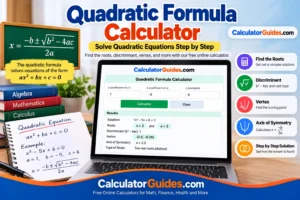
A Quadratic Formula Calculator is an online math tool that solves equations in the form:
ax² + bx + c = 0
You enter three values:
- a = coefficient of x²
- b = coefficient of x
- c = constant
The calculator then uses the quadratic formula to find the value or values of x.
Depending on the equation, the answer can contain:
- Two different real roots
- One repeated real root
- Two complex roots
The calculator can also help you find the discriminant, vertex, axis of symmetry, and other important parts of the quadratic equation.
What Is a Quadratic Equation?
A quadratic equation is an equation where the highest power of the variable is 2.
The standard form is:
ax² + bx + c = 0
where:
- a ≠ 0
- a is the coefficient of x²
- b is the coefficient of x
- c is the constant
For example:
x² − 5x + 6 = 0
Here:
a = 1
b = −5
c = 6
Another example is:
2x² + 7x − 4 = 0
Here:
a = 2
b = 7
c = −4
The quadratic formula can be used to solve both examples.
What Is the Quadratic Formula?
The quadratic formula is:
x = (-b ± √(b² − 4ac)) / 2a
The ± sign means that there can be two answers.
The formula works for any quadratic equation in standard form as long as a is not zero.
The expression inside the square root is called the discriminant.
Quadratic Formula Parts
In the formula:
x = (-b ± √(b² − 4ac)) / 2a
- a is the x² coefficient
- b is the x coefficient
- c is the constant
- b² − 4ac is the discriminant
- 2a is the denominator
How to Use the Quadratic Formula Calculator
Using the calculator is easy.
Step 1: Write the equation in standard form
Make sure the equation looks like:
ax² + bx + c = 0
For example:
x² − 5x + 6 = 0
Step 2: Identify a, b, and c
For this equation:
a = 1
b = −5
c = 6
Step 3: Enter the values
Enter the three numbers into the calculator.
Step 4: Calculate
Click the calculate button.
The calculator will solve the equation and show the roots.
Step 5: Check the result
You can use the answer to verify your homework or continue with your math problem.
Quadratic Formula Example
Let’s solve:
x² − 5x + 6 = 0
First identify the coefficients:
a = 1
b = −5
c = 6
Now use the quadratic formula:
x = (-b ± √(b² − 4ac)) / 2a
Substitute the values:
x = (−(−5) ± √((−5)² − 4(1)(6))) / 2(1)
First calculate the discriminant:
D = 25 − 24
D = 1
Now:
x = (5 ± √1) / 2
Since √1 = 1:
x = (5 ± 1) / 2
This gives two answers:
x = 3
and
x = 2
So the solutions are:
x = 2 and x = 3
What Is the Discriminant?
The discriminant is the part of the quadratic formula under the square root.
The formula is:
D = b² − 4ac
The value of the discriminant tells you what type of roots the quadratic equation has.
If the Discriminant Is Positive
If:
D > 0
the equation has two different real roots.
For example:
x² − 5x + 6 = 0
The discriminant is 1, so there are two real roots.
If the Discriminant Is Zero
If:
D = 0
the equation has one repeated real root.
For example:
x² − 4x + 4 = 0
The answer is:
x = 2
The same root appears twice.
If the Discriminant Is Negative
If:
D < 0
the equation has two complex roots and no real x-intercepts.
For example:
x² + 2x + 5 = 0
The discriminant is:
2² − 4(1)(5)
4 − 20 = −16
Because the discriminant is negative, the equation has complex solutions.
Quadratic Formula Calculator With Steps
A quadratic formula calculator with steps can be useful when you want to understand how the answer was found instead of seeing only the final result.
The basic process is:
- Identify a, b, and c.
- Calculate the discriminant.
- Put the values into the quadratic formula.
- Simplify the square root.
- Calculate the first root.
- Calculate the second root.
- Check the answers in the original equation.
Showing the steps can make it easier to find mistakes, especially with negative numbers.
How to Solve a Quadratic Equation Using the Formula
Let’s solve another example:
2x² + 3x − 2 = 0
Step 1: Identify the coefficients
a = 2
b = 3
c = −2
Step 2: Find the discriminant
D = b² − 4ac
D = 3² − 4(2)(−2)
D = 9 + 16
D = 25
Step 3: Use the formula
x = (−3 ± √25) / 4
x = (−3 ± 5) / 4
Step 4: Find both roots
First root:
x = (−3 + 5) / 4
x = 2 / 4
x = 1/2
Second root:
x = (−3 − 5) / 4
x = −8 / 4
x = −2
Therefore:
x = 1/2 or x = −2
What Are the Roots of a Quadratic Equation?
The roots are the values of x that make the quadratic equation equal to zero.
They are also called:
- Solutions
- Zeros
- x-intercepts
For example:
x² − 5x + 6 = 0
has roots:
x = 2 and x = 3
If you put either value into the original equation, the result is zero.
Real Roots vs. Complex Roots
A quadratic equation can have real or complex solutions.
Two Real Roots
When the discriminant is positive, there are two different real roots.
Example:
x² − 5x + 6 = 0
Roots:
2 and 3
One Repeated Real Root
When the discriminant is zero, there is one repeated real root.
Example:
x² − 4x + 4 = 0
Root:
2
Complex Roots
When the discriminant is negative, the equation has complex roots.
Complex numbers include the imaginary unit:
i = √−1
For example:
x² + 4 = 0
gives:
x² = −4
So:
x = ±2i
Quadratic Equation Calculator
A quadratic equation calculator and a quadratic formula calculator are closely related.
Both can solve equations such as:
ax² + bx + c = 0
A useful calculator can also show additional information such as:
- Roots
- Discriminant
- Root type
- Vertex
- Axis of symmetry
- Factored form
- Step-by-step solution
This gives you more information than simply finding the final value of x.
Vertex of a Quadratic Equation
The vertex is the turning point of the parabola represented by a quadratic function.
For:
f(x) = ax² + bx + c
the x-coordinate of the vertex is:
x = −b / 2a
After finding x, substitute it into the equation to find the y-coordinate.
The vertex is written as:
(h, k)
where h is the x-coordinate and k is the y-coordinate.
Example
For:
x² − 4x + 3
we have:
a = 1
b = −4
The x-coordinate is:
x = −(−4) / 2(1)
x = 2
Now substitute 2:
f(2) = 2² − 4(2) + 3
f(2) = 4 − 8 + 3
f(2) = −1
So the vertex is:
(2, −1)
Axis of Symmetry
The axis of symmetry is the vertical line that passes through the vertex of a parabola.
The formula is:
x = −b / 2a
For example:
x² − 4x + 3
has:
x = 2
So the axis of symmetry is:
x = 2
Does the Parabola Open Up or Down?
The value of a tells you which direction the parabola opens.
If a is positive
If:
a > 0
the parabola opens upward.
The vertex represents the minimum point.
If a is negative
If:
a < 0
the parabola opens downward.
The vertex represents the maximum point.
Factoring vs. Quadratic Formula
Some quadratic equations are easy to solve by factoring.
For example:
x² − 5x + 6 = 0
can be written as:
(x − 2)(x − 3) = 0
So the roots are:
x = 2 and x = 3
However, not every quadratic equation factors easily.
For example:
x² + x + 1 = 0
is not as simple to factor using whole numbers.
The quadratic formula gives you a reliable method for solving any quadratic equation with a ≠ 0.
Completing the Square vs. Quadratic Formula
Completing the square is another method for solving quadratic equations.
For some equations, it can be a useful way to understand the relationship between a quadratic equation and its vertex.
However, the quadratic formula is often faster when you only need the roots.
The quadratic formula can be viewed as a general result obtained from completing the square.
When Should You Use a Quadratic Formula Calculator?
A quadratic formula calculator can be useful when:
- You are solving algebra homework.
- You want to check your answer.
- The equation is difficult to factor.
- You need both roots.
- You need the discriminant.
- You want to know whether roots are real or complex.
- You need the vertex.
- You are preparing for a math exam.
- You want to understand the steps.
It can save time while still helping you understand the mathematics behind the answer.
Common Mistakes When Using the Quadratic Formula
Even when using a calculator, it is helpful to know the common mistakes.
Mistake 1: Forgetting the negative sign
The formula starts with:
−b
If b is negative, the signs can easily become confusing.
For example, if:
b = −5
then:
−b = 5
Mistake 2: Using the wrong value for c
The constant must include its sign.
For:
x² + 3x − 7 = 0
the values are:
a = 1
b = 3
c = −7
Not +7.
Mistake 3: Forgetting 2a
The entire numerator is divided by:
2a
It is not just divided by 2.
Mistake 4: Not putting the equation in standard form
Before using the quadratic formula, arrange the equation as:
ax² + bx + c = 0
Mistake 5: Assuming every answer is a whole number
Some quadratic equations have fractional, decimal, irrational, or complex roots.
Quadratic Formula Calculator for Fractions
Quadratic equations can also contain fractions.
For example:
(1/2)x² + 2x − 3 = 0
The quadratic formula still works.
You simply need to use the correct values for a, b, and c.
A calculator can make these calculations easier because fractions can create several extra steps when working by hand.
Quadratic Formula Calculator for Complex Roots
If the discriminant is negative, the square root contains a negative number.
For example:
x² + 1 = 0
Move 1 to the other side:
x² = −1
Therefore:
x = ±i
where:
i = √−1
A calculator that supports complex roots can display these answers instead of simply saying that there is no solution.
Frequently Asked Questions
What is a quadratic formula calculator?
A quadratic formula calculator is an online tool that solves equations in the form ax² + bx + c = 0 using the quadratic formula.
What is the quadratic formula?
The quadratic formula is:
x = (−b ± √(b² − 4ac)) / 2a
It is used to find the solutions of a quadratic equation.
What are a, b, and c?
In ax² + bx + c = 0:
- a is the coefficient of x²
- b is the coefficient of x
- c is the constant
Can the quadratic formula solve every quadratic equation?
Yes, the quadratic formula can be used for any quadratic equation in standard form as long as a is not zero.
What happens when the discriminant is positive?
A positive discriminant means the equation has two different real roots.
What happens when the discriminant is zero?
A zero discriminant means the equation has one repeated real root.
What happens when the discriminant is negative?
A negative discriminant means the equation has two complex conjugate roots and no real roots.
What is the discriminant formula?
The discriminant formula is:
D = b² − 4ac
How do I find the roots of a quadratic equation?
Put the equation into standard form, identify a, b, and c, and substitute them into the quadratic formula.
What is the difference between roots and solutions?
In a quadratic equation, the terms roots, zeros, and solutions are commonly used for the values of x that make the equation equal to zero.
Can I use decimals in the quadratic formula?
Yes. The values of a, b, and c can be decimals as long as the equation is quadratic and a is not zero.
Can I use negative numbers?
Yes. Negative coefficients are common in quadratic equations. Be especially careful with signs when substituting them into the formula.
What is the vertex of a parabola?
The vertex is the turning point of the parabola. It can be a minimum or maximum depending on whether the coefficient a is positive or negative.
What is the axis of symmetry?
The axis of symmetry is the vertical line through the vertex. Its equation is:
x = −b / 2a
Can a quadratic equation have two equal roots?
Yes. When the discriminant is zero, the quadratic has one repeated root.
Can a quadratic equation have no real roots?
Yes. If the discriminant is negative, there are no real roots, but there are two complex roots.
Final Thoughts
The Quadratic Formula Calculator makes solving quadratic equations much easier. Instead of doing every calculation by hand, enter a, b, and c and get the solutions quickly.
The calculator can help you find quadratic roots, discriminant, real roots, complex roots, vertex, axis of symmetry, and other useful results.
The quadratic formula is:
x = (−b ± √(b² − 4ac)) / 2a
Whether you are learning algebra, checking homework, preparing for an exam, or solving a difficult equation, CalculatorGuides.com can help you work through the problem in a simple and easy-to-understand way.