
Root Calculator-Use our Root Calculator to quickly find the square root, cube root, or nth root of a number. Enter your number, choose the type of root, and get the answer instantly.Explore our free online calculator tools for quick answers calculatorguides across different categories.
Calculate √x and principal square root√ Square Root Calculator
• Square Verification:
• Both Roots: ±
Calculate ∛x (supports positive and negative numbers)∛ Cube Root Calculator
• Cube Verification: ()³ =
Calculate the n-th root of any number n√xⁿ√ General Root Calculator
• Verification: () =
Simplify radicals into exact form a√b✨ Radical Simplifier Calculator
• Breakdown: √() = √( × )
• Decimal Approximation:
You can use this calculator for math homework, school assignments, algebra problems, exams, or everyday calculations.
The calculator can help you find:
- Square root
- Cube root
- Fourth root
- Fifth root
- Nth root
- Decimal root
- Simplified radical form
- Root formula
- Exact and approximate answers
What Is a Root Calculator?
A Root Calculator is an online math tool that finds the root of a number.
A root is the opposite of a power.
For example:
4 × 4 = 16
So:
√16 = 4
Similarly:
3 × 3 × 3 = 27
So:
∛27 = 3
The most common roots are the square root and cube root, but you can also calculate fourth roots, fifth roots, and other nth roots.
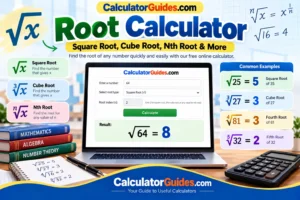
How to Use the Root Calculator
Using the calculator is very easy.
Step 1: Enter a number
Enter the number for which you want to find the root.
For example:
144
Step 2: Choose the root
Select the type of root you want.
You can choose:
- Square root
- Cube root
- Nth root
For an nth root, enter the root index.
For example, use 4 for a fourth root.
Step 3: Calculate
Click the calculate button.
The calculator will show the result.
Step 4: Check the answer
You can check the result by raising it to the selected power.
For example:
√144 = 12
Check:
12² = 144
So the answer is correct.
Square Root Calculator
A Square Root Calculator finds the square root of a number.
The square root asks:
What number multiplied by itself gives the original number?
For example:
√25 = 5
because:
5 × 5 = 25
Another example:
√81 = 9
because:
9 × 9 = 81
Square Root Formula
The square root formula can be written as:
√x = x¹/²
For example:
√64 = 64¹/² = 8
The √ symbol is called the radical sign.
The number inside the radical is called the radicand.
Cube Root Calculator
A Cube Root Calculator finds the number that must be multiplied by itself three times to get the original number.
For example:
∛8 = 2
because:
2 × 2 × 2 = 8
Another example:
∛125 = 5
because:
5 × 5 × 5 = 125
Cube Root Formula
The cube root can be written as:
∛x = x¹/³
For example:
∛27 = 27¹/³ = 3
Nth Root Calculator
An nth root calculator can find roots other than square and cube roots.
The nth root of a number x is written as:
ⁿ√x
The general formula is:
ⁿ√x = x¹/ⁿ
Here:
- x = number
- n = root index
- ⁿ√x = nth root
For example, the fourth root of 81 is:
⁴√81 = 3
because:
3⁴ = 81
Fourth Root Calculator
A fourth root asks which number, when multiplied by itself four times, gives the original number.
For example:
⁴√16 = 2
because:
2 × 2 × 2 × 2 = 16
Another example:
⁴√81 = 3
because:
3⁴ = 81
Fifth Root Calculator
A fifth root works in the same way.
For example:
⁵√32 = 2
because:
2 × 2 × 2 × 2 × 2 = 32
The formula is:
⁵√x = x¹/⁵
You can use the nth root option when you need a fifth root or another root.
What Is the Formula for a Root?
The general root formula is:
ⁿ√x = x¹/ⁿ
This means that finding an nth root is the same as raising a number to the power of 1/n.
Examples:
√16 = 16¹/² = 4
∛27 = 27¹/³ = 3
⁴√81 = 81¹/⁴ = 3
⁵√32 = 32¹/⁵ = 2
This connection between roots and fractional exponents is useful in algebra.
Root Calculator With Steps
A root calculator with steps can make it easier to understand how the answer is found.
For example, consider:
√72
72 is not a perfect square.
We can write:
72 = 36 × 2
Therefore:
√72 = √(36 × 2)
Separate the roots:
√72 = √36 × √2
Since:
√36 = 6
we get:
√72 = 6√2
The decimal value is approximately:
8.485
So:
√72 = 6√2 ≈ 8.485
How to Calculate a Square Root
There are several ways to calculate a square root.
The easiest way for most people is to use a calculator.
But you can also estimate it.
For example, suppose you want to find:
√50
You know:
7² = 49
and:
8² = 64
Therefore, √50 must be between 7 and 8.
The calculator gives:
√50 ≈ 7.071
This is useful when the number is not a perfect square.
Perfect Square Calculator
A perfect square is a number that has a whole-number square root.
Examples include:
- 1 = 1²
- 4 = 2²
- 9 = 3²
- 16 = 4²
- 25 = 5²
- 36 = 6²
- 49 = 7²
- 64 = 8²
- 81 = 9²
- 100 = 10²
- 121 = 11²
- 144 = 12²
For example:
√100 = 10
because 100 is a perfect square.
Numbers such as 2, 3, 5, 6, and 7 do not have whole-number square roots.
Their square roots are irrational numbers.
Simplifying Square Roots
Sometimes a square root can be written in a simpler form.
For example:
√50
Break 50 into:
25 × 2
Then:
√50 = √25 × √2
Therefore:
√50 = 5√2
Another example:
√18 = √(9 × 2)
So:
√18 = 3√2
This is called simplifying a radical.
Square Root of 72
A common example is:
√72
Start by finding a perfect-square factor.
72 = 36 × 2
Therefore:
√72 = √36 × √2
√72 = 6√2
Decimal answer:
√72 ≈ 8.4853
So the simplified form is:
6√2
and the approximate decimal form is:
8.4853
Square Root of 144
The square root of 144 is:
√144 = 12
because:
12 × 12 = 144
This is a perfect square, so the answer is a whole number.
Square Root of 2
The square root of 2 is approximately:
√2 ≈ 1.41421356
It cannot be written exactly as a simple fraction.
Therefore, √2 is an irrational number.
The decimal continues without ending or repeating.
Can You Find the Root of a Negative Number?
It depends on the type of root.
For an odd root, negative numbers can have real answers.
For example:
∛(-8) = -2
because:
(-2)³ = -8
However, an even root such as a square root of a negative number does not have a real answer.
For example:
√(-9)
has no real-number answer.
In complex numbers, it can be written as:
3i
where i is the imaginary unit.
Positive and Negative Square Roots
There is an important difference between the square-root symbol and the solutions of a square equation.
For:
x² = 25
there are two solutions:
x = 5
and:
x = -5
because both:
5² = 25
and:
(-5)² = 25
But when we write:
√25
the principal square root is:
5
So √25 refers to the non-negative principal square root.
Root and Exponent Relationship
Roots and exponents are closely connected.
A square root is the same as raising a number to the power of one-half.
√x = x¹/²
A cube root is:
∛x = x¹/³
An nth root is:
ⁿ√x = x¹/ⁿ
For example:
√16 = 16¹/² = 4
and:
∛64 = 64¹/³ = 4
Understanding this relationship can make algebra problems much easier.
Root Calculator Examples
Here are some common examples.
Example 1: Square Root
√49 = 7
Example 2: Cube Root
∛27 = 3
Example 3: Fourth Root
⁴√16 = 2
Example 4: Fifth Root
⁵√32 = 2
Example 5: Non-Perfect Square
√10 ≈ 3.1623
Example 6: Negative Cube Root
∛(-27) = -3
Example 7: Simplified Radical
√50 = 5√2 ≈ 7.071
Difference Between Square Root and Cube Root
| Feature | Square Root | Cube Root |
|---|---|---|
| Root index | 2 | 3 |
| Symbol | √x | ∛x |
| Formula | x¹/² | x¹/³ |
| Example | √64 = 8 | ∛64 = 4 |
| Negative input | No real result | Real result possible |
The main difference is the root index.
A square root uses 2, while a cube root uses 3.
Root Calculator for Fractions
Roots can also be calculated for fractions.
For example:
√(9/16)
Take the square root of the numerator and denominator:
√9 / √16
= 3/4
Therefore:
√(9/16) = 3/4
The same idea can be applied to many other fractions when the roots can be simplified.
Root Calculator for Decimals
You can also calculate roots of decimal numbers.
For example:
√0.25 = 0.5
because:
0.5 × 0.5 = 0.25
Another example:
√2.25 = 1.5
because:
1.5 × 1.5 = 2.25
This can be useful in measurements, statistics, science, and engineering.
Where Are Roots Used?
Roots are not only used in school math.
They appear in many real-world calculations.
Geometry
The Pythagorean theorem uses square roots.
For a right triangle:
c = √(a² + b²)
Algebra
The quadratic formula contains a square root:
x = [-b ± √(b² − 4ac)] / 2a
Statistics
Standard deviation is based on the square root of variance.
Science
Roots appear in many physics and engineering formulas.
Finance
Some financial formulas use nth roots when finding growth rates over multiple periods.
Why Use an Online Root Calculator?
Calculating simple roots by hand is easy.
However, roots such as √73, ⁵√120, or other non-perfect roots can be harder to calculate accurately.
A free online root calculator can help you:
- Save time
- Reduce calculation mistakes
- Find square roots
- Find cube roots
- Find nth roots
- Check homework
- Simplify radicals
- Convert roots to decimal form
- Verify answers
It is especially helpful when you are working with many calculations.
Frequently Asked Questions
What is a Root Calculator?
A Root Calculator is an online tool that calculates the square root, cube root, or nth root of a number.
What is the square root of a number?
The square root of a number is the value that, when multiplied by itself, gives the original number.
For example:
√36 = 6
because:
6 × 6 = 36
What is the cube root of a number?
The cube root is the number that, when multiplied by itself three times, gives the original number.
For example:
∛64 = 4
because:
4 × 4 × 4 = 64
What is the nth root formula?
The general nth root formula is:
ⁿ√x = x¹/ⁿ
What is the square root of 144?
√144 = 12
because 12 × 12 = 144.
What is the square root of 72?
√72 = 6√2 ≈ 8.4853
What is the square root of 50?
√50 = 5√2 ≈ 7.0711
What is the cube root of 27?
∛27 = 3
What is the cube root of 64?
∛64 = 4
Can I calculate the fourth root?
Yes. Enter 4 as the root index in the nth root option.
For example:
⁴√81 = 3
Can I calculate the fifth root?
Yes.
For example:
⁵√32 = 2
Can a square root be negative?
The principal square root is non-negative. However, the equation x² = a can have both positive and negative solutions when a is positive.
Can I find the root of a negative number?
Odd roots of negative numbers have real answers. Even roots of negative numbers do not have real-number answers.
For example:
∛(-8) = -2
but:
√(-8) has no real value.
What is a perfect square?
A perfect square is a number whose square root is a whole number.
Examples include 1, 4, 9, 16, 25, and 36.
What is a radical?
A radical is a mathematical expression that contains a root symbol.
For example:
√25
is a radical expression.
What is a radicand?
The radicand is the number or expression inside the radical sign.
In:
√49
49 is the radicand.
Is every square root a whole number?
No. Only perfect squares have whole-number square roots.
For example:
√25 = 5
but:
√10 ≈ 3.1623
Is a root the same as an exponent?
Roots can be written as fractional exponents.
For example:
√x = x¹/²
and:
∛x = x¹/³
Final Thoughts
A Root Calculator makes it easy to find square roots, cube roots, and other nth roots without doing complicated calculations by hand.
You can use it to find perfect square roots, decimal roots, simplified radicals, fourth roots, fifth roots, cube roots, and nth roots.
Whether you are a student, teacher, professional, or simply checking a math problem, CalculatorGuides.com can help you get a quick and easy answer.
Enter your number, select the root you need, and calculate your result.