
Ratio Calculator-Use our Ratio Calculator to simplify ratios, find equivalent ratios, solve proportions, calculate missing values, compare ratios, split amounts by a ratio, and convert ratios into fractions, decimals, and percentages.Explore our free online calculator tools for quick answers calculatorguides across different categories.
Solve for missing term in A : B = C : D (leave one box blank)⚖️ Ratio Solver Calculator
• Simplified Ratio (A:B):
• Decimal Value:
Scale recipes, ingredients, or multi-part ratios by a factor or target value📏 Ratio Scaling Calculator
Item
Original
Scaled Value
A ratio is a simple way to compare two or more quantities. You may see ratios in math problems, recipes, maps, sports, business, construction, finance, and everyday life.
Enter your numbers into the calculator to get a quick and easy result.
What Is a Ratio?
A ratio compares two or more quantities.
For example, if a basket has 6 apples and 3 oranges, the ratio of apples to oranges is:
6:3
This ratio can be simplified to:
2:1
That means there are 2 apples for every 1 orange.
A ratio can be written in different ways:
- 2:1
- 2 to 1
- 2/1
The meaning is the same when the quantities are being compared in the same order.
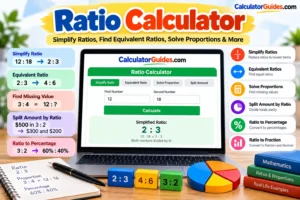
What Is a Ratio Calculator?
A Ratio Calculator is an online tool that helps you solve different types of ratio problems.
You can use it to:
- Simplify a ratio
- Find an equivalent ratio
- Compare two ratios
- Solve a proportion
- Find a missing number
- Split a total by a ratio
- Convert a ratio to a fraction
- Convert a ratio to a decimal
- Convert a ratio to a percentage
- Find the ratio between two numbers
- Work with three-part ratios
- Check ratio calculations
Instead of doing every step manually, you can enter the values and let the calculator do the math.
How to Use the Ratio Calculator
Using our online ratio calculator is easy.
Step 1: Enter the first number
Enter the first part of your ratio.
For example:
12
Step 2: Enter the second number
Enter the second part.
For example:
18
Your ratio is:
12:18
Step 3: Calculate
Click the calculate button.
The calculator can simplify the ratio and show the result.
Step 4: Check the result
The simplified ratio is:
2:3
Both 12 and 18 were divided by their greatest common factor, 6.
How to Simplify a Ratio
To simplify a ratio, divide both numbers by their greatest common factor (GCF).
For example:
12:18
The greatest common factor of 12 and 18 is 6.
Divide both numbers by 6:
12 ÷ 6 = 2
18 ÷ 6 = 3
So:
12:18 = 2:3
The ratio 2:3 is in its simplest form.
Another Ratio Simplification Example
Suppose the ratio is:
20:30
The GCF is 10.
20 ÷ 10 = 2
30 ÷ 10 = 3
Therefore:
20:30 = 2:3
The relationship between the two numbers has not changed. Only the numbers have been reduced.
Ratio Calculator for Two Numbers
You can use a ratio calculator to find the ratio between two numbers.
For example:
25 and 100
Write them as:
25:100
Divide both by 25:
1:4
So the ratio of 25 to 100 is:
1:4
The order is important.
25:100 is not the same as 100:25.
Equivalent Ratio Calculator
Two ratios are equivalent ratios when they represent the same relationship.
For example:
2:3
and
4:6
are equivalent.
Both numbers in 2:3 were multiplied by 2:
2 × 2 = 4
3 × 2 = 6
So:
2:3 = 4:6
You can create many equivalent ratios by multiplying both parts by the same number.
For example:
2:3
can become:
- 4:6
- 6:9
- 8:12
- 10:15
- 20:30
The relationship remains the same.
How to Find an Equivalent Ratio
Suppose you have:
3:5
and you want the first number to become 12.
First find the multiplier:
12 ÷ 3 = 4
Now multiply the second number by 4:
5 × 4 = 20
Therefore:
3:5 = 12:20
This is an equivalent ratio.
Ratio and Proportion Calculator
A ratio and proportion calculator can help you solve problems where two ratios are equal.
For example:
3:4 = 12
Write it as:
3/4 = 12/x
Cross multiply:
3 × x = 4 × 12
3x = 48
x = 16
Therefore:
3:4 = 12:16
The missing number is 16.
How to Solve a Ratio
There are different ways to solve a ratio problem depending on what information you have.
For example:
4:7 = x:21
You can use cross multiplication.
4 × 21 = 7 × x
84 = 7x
x = 12
So:
4:7 = 12:21
The missing value is 12.
Ratio to Percentage Calculator
You can also convert a ratio into percentages.
Suppose the ratio is:
3:2
First add the parts:
3 + 2 = 5
The first part is:
3 ÷ 5 × 100 = 60%
The second part is:
2 ÷ 5 × 100 = 40%
So:
3:2 = 60%:40%
This method is useful when you want to understand how much each part represents out of the total.
Important Ratio Percentage Difference
There are two different ways people sometimes interpret a ratio as a percentage.
For a ratio 3:2, the first part as a share of the total is:
3 ÷ (3 + 2) × 100 = 60%
But if you ask how much 3 is compared with 2:
3 ÷ 2 × 100 = 150%
These are different questions.
Use the first formula when you want the part of the whole.
Ratio to Fraction Calculator
A ratio can also be written as a fraction.
For example:
3:5
can be written as:
3/5
If you want the first part as a fraction of the total, the calculation is different:
3 ÷ (3 + 5) = 3/8
So the first part represents 3/8 of the total.
Always check whether the question is asking for a part-to-part ratio or a part-to-whole fraction.
Ratio to Decimal Calculator
To convert a two-number ratio into a decimal comparison, divide the first number by the second.
For example:
2:5
2 ÷ 5 = 0.4
So the ratio 2:5 has a decimal comparison of 0.4.
You can then multiply the decimal by 100 to express that comparison as a percentage:
0.4 × 100 = 40%
Split a Total by a Ratio
A ratio calculator can also help you divide a total between two or more people or groups.
Suppose you want to divide $500 in a ratio of:
3:2
First add the ratio parts:
3 + 2 = 5
Then divide the total by 5:
500 ÷ 5 = 100
Now multiply each share.
First share:
3 × 100 = $300
Second share:
2 × 100 = $200
So $500 divided in a 3:2 ratio gives:
$300 and $200
Ratio Division Calculator
The same method works for larger ratios.
Suppose you want to divide $1,000 in the ratio:
2:3:5
First add the parts:
2 + 3 + 5 = 10
One ratio part is:
1,000 ÷ 10 = 100
Now calculate each share:
2 × 100 = $200
3 × 100 = $300
5 × 100 = $500
Total:
$200 + $300 + $500 = $1,000
Three-Part Ratio Calculator
Ratios do not always have only two numbers.
For example:
2:3:5
is a three-part ratio.
You may use this type of ratio to divide an amount among three people, departments, teams, or categories.
Suppose the total is 1,000.
Total ratio parts:
2 + 3 + 5 = 10
Each ratio unit:
1,000 ÷ 10 = 100
The three shares are:
- 2 × 100 = 200
- 3 × 100 = 300
- 5 × 100 = 500
Ratio Comparison Calculator
A ratio comparison calculator can help determine whether two ratios represent the same relationship.
For example:
2:3
and
8:12
Simplify 8:12:
8 ÷ 4 = 2
12 ÷ 4 = 3
So:
8:12 = 2:3
Therefore, the ratios are equivalent.
Ratio vs. Fraction
Ratios and fractions can look similar, but they are not always used in the same way.
A ratio such as:
2:3
compares one quantity with another.
A fraction such as:
2/5
can represent a part of a whole.
For example, if a group has 2 red balls and 3 blue balls:
Red-to-blue ratio:
2:3
Red balls as a fraction of the whole:
2/5
Red balls as a percentage of the whole:
40%
This is an important difference to remember.
Ratio vs. Proportion
A ratio compares quantities.
A proportion states that two ratios are equal.
For example:
2:3
is a ratio.
But:
2:3 = 8:12
is a proportion because both ratios have the same relationship.
Ratio Examples in Real Life
Ratios are used in many everyday situations.
Cooking and Recipes
A recipe might use flour and sugar in a ratio of:
2:1
This means 2 parts flour for every 1 part sugar.
If you double the recipe, the ratio stays the same.
4:2
is equivalent to:
2:1
Maps
Maps use ratios to show the relationship between map distance and real distance.
For example, a map scale might show that a certain distance on the map represents a much larger real-world distance.
Sports
Ratios can be used to compare wins and losses, points, attempts, or other statistics.
For example:
8 wins : 2 losses
can be simplified to:
4:1
Business
Businesses can use ratios to compare sales, expenses, profits, employees, or other numbers.
Mixtures
Ratios are common when mixing materials.
For example:
1:4
could mean 1 part of one material for every 4 parts of another.
Ratio Formula
There is no single formula for every ratio problem.
The basic form is:
a
where a and b are the quantities being compared.
For equivalent ratios:
a = ka
where k is the same multiplier.
For a proportion:
a/b = c/d
Cross multiplication gives:
ad = bc
For splitting a total:
Share = Total × Ratio Part ÷ Sum of Ratio Parts
For example, to split 500 in a 3:2 ratio:
First part:
500 × 3 ÷ 5 = 300
Second part:
500 × 2 ÷ 5 = 200
How to Calculate a Ratio by Hand
You can calculate a ratio without a calculator.
Suppose you have:
24 boys and 36 girls
The ratio is:
24:36
Find the GCF:
12
Divide both numbers by 12:
24 ÷ 12 = 2
36 ÷ 12 = 3
Therefore:
24:36 = 2:3
This is the simplest form.
Can Ratios Have Decimals?
Yes.
For example:
1.5:2.5
Multiply both numbers by 2:
1.5 × 2 = 3
2.5 × 2 = 5
So:
1.5:2.5 = 3:5
When possible, multiplying decimal values by the same factor can make the ratio easier to simplify.
Can Ratios Have Negative Numbers?
Mathematically, ratios can contain negative numbers, but whether a negative ratio makes sense depends on the problem.
For normal quantities such as people, ingredients, or physical objects, ratios are usually positive.
For mathematical comparisons involving signed values, negative numbers may be meaningful.
What Happens When One Ratio Number Is Zero?
If a ratio is:
0:5
it means the first quantity is zero compared with five units of the second quantity.
However, a ratio involving division by zero is not defined.
For example, you cannot calculate a normal quotient of:
5:0
because division by zero is undefined.
Common Ratio Mistakes
Mistake 1: Changing only one side
If you multiply one side of a ratio, you must multiply the other side by the same amount.
Correct:
2:3 → 4:6
Incorrect:
2:3 → 4:3
Mistake 2: Forgetting the order
2:5 and 5:2 are different ratios.
Mistake 3: Confusing ratio with percentage
A ratio of 1:3 does not mean the first part is 33.33% of the whole.
There are 4 total parts:
1 + 3 = 4
So the first part is:
1 ÷ 4 × 100 = 25%
Mistake 4: Adding the same number
Adding the same number to both sides does not normally create an equivalent ratio.
For example:
2:3
Adding 2 gives:
4:5
But 4:5 is not equivalent to 2:3.
To create an equivalent ratio, multiply or divide both parts by the same nonzero factor.
Frequently Asked Questions
What is a ratio calculator?
A Ratio Calculator is an online tool that helps simplify ratios, find equivalent ratios, solve proportions, calculate missing values, compare ratios, and perform other ratio calculations.
How do I simplify a ratio?
Divide every part of the ratio by its greatest common factor.
For example:
12:18 → 2:3
What is an equivalent ratio?
An equivalent ratio has the same relationship between its parts.
For example:
2:3 and 4:6 are equivalent ratios.
How do I find a missing number in a ratio?
Set up the two ratios as a proportion and use cross multiplication.
For example:
3:4 = 12
The answer is:
x = 16
How do I convert a ratio to a percentage?
For a two-part ratio, add the two parts and divide the part you want by the total.
For example:
3:2
3 ÷ (3 + 2) × 100 = 60%
How do I convert a percentage to a ratio?
Write the percentage as a ratio out of 100 and simplify it.
For example:
25% = 25:100
Divide both numbers by 25:
1:4
What is the ratio of 10 to 20?
The ratio is:
10:20
Simplified:
1:2
What is the ratio of 5 to 10?
5:10 simplifies to:
1:2
What is the ratio of 12 to 18?
12:18 simplifies to:
2:3
What is the ratio of 20 to 30?
20:30 simplifies to:
2:3
Can I use a ratio calculator for three numbers?
Yes. A multi-part ratio such as 2:3:5 can be simplified and used to divide a total into three shares.
What is the difference between ratio and proportion?
A ratio compares quantities. A proportion says that two ratios are equal.
Can I use decimals in a ratio calculator?
Yes. Decimal ratios can be converted into equivalent whole-number ratios when appropriate.
Can a ratio be simplified?
Yes. Divide all parts by their greatest common factor.
Does the order of a ratio matter?
Yes. A ratio of 2:3 is different from 3:2.
Final Thoughts
Ratios are one of the simplest ways to compare quantities, but some ratio problems can become confusing when they involve missing numbers, percentages, proportions, or large totals.
Our Ratio Calculator makes these calculations easier.
Use it to simplify ratios, find equivalent ratios, solve proportions, calculate missing values, compare ratios, split totals, and convert ratios to fractions, decimals, and percentages.
Whether you are a student solving a math problem, working with a recipe, comparing numbers, or checking a proportion, CalculatorGuides.com can help you get the answer quickly and understand how the calculation works.