
Least Common Multiple Calculator-Use our Least Common Multiple Calculator to quickly find the LCM of two or more numbers. Enter your numbers and get the smallest positive number that is divisible by all of them.Explore our free online calculator tools for quick answers calculatorguides across different categories.
Find the LCM & GCD of positive integers separated by commas or spaces🔢 Least Common Multiple (LCM) Calculator
• Numbers Evaluated:
• Prime Factorization Breakdown:
You can use this LCM Calculator for school homework, math problems, fractions, number theory, and everyday calculations.
The calculator saves time, especially when you are working with larger numbers or several numbers at once.
What Is the Least Common Multiple?
The least common multiple (LCM) is the smallest positive number that is a multiple of two or more numbers.
For example, consider 4 and 6.
The multiples of 4 are:
4, 8, 12, 16, 20, 24, …
The multiples of 6 are:
6, 12, 18, 24, 30, …
The first number that appears in both lists is 12.
Therefore:
LCM(4, 6) = 12
In simple words, the LCM is the smallest number that all the given numbers can divide evenly.
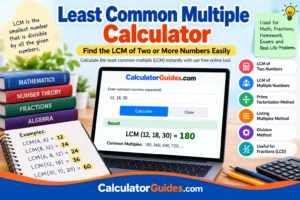
How to Use the LCM Calculator
Using our Least Common Multiple Calculator is easy.
Step 1: Enter your numbers
Enter two or more whole numbers into the calculator.
For example:
12, 18, 30
Step 2: Click Calculate
The calculator will find the least common multiple of the numbers.
Step 3: Check your answer
For:
12, 18, 30
the result is:
LCM = 180
You can then use the answer in your math problem or homework.
LCM Calculator
Our LCM Calculator can be used to find:
- LCM of 2 numbers
- LCM of 3 numbers
- LCM of 4 or more numbers
- Least common multiple of multiple numbers
- LCM using prime factorization
- LCM using the listing method
- LCM using the GCF method
- Least common denominator for fractions
For example:
LCM(6, 8) = 24
LCM(12, 18) = 36
LCM(4, 6, 8) = 24
How to Find the LCM
There are several ways to find the least common multiple.
The most common methods are:
- Listing multiples
- Prime factorization
- Division method
- Using the GCF or HCF
Each method gives the same correct LCM.
Method 1: Find LCM by Listing Multiples
Listing multiples is one of the easiest ways to understand LCM.
Let’s find the LCM of 6 and 8.
Multiples of 6:
6, 12, 18, 24, 30, 36, …
Multiples of 8:
8, 16, 24, 32, 40, …
The first common number is:
24
Therefore:
LCM(6, 8) = 24
This method works well when the numbers are small, but it can take more time for larger numbers.
Method 2: Find LCM Using Prime Factorization
The prime factorization method is useful when the numbers are larger.
Let’s find the LCM of 12 and 18.
First, write the prime factors.
12
12 = 2 × 2 × 3
or:
12 = 2² × 3
18
18 = 2 × 3 × 3
or:
18 = 2 × 3²
Now take the highest power of every prime number.
For 2, the highest power is:
2²
For 3, the highest power is:
3²
Multiply them:
2² × 3²
4 × 9 = 36
Therefore:
LCM(12, 18) = 36
The key rule is simple: for LCM, use every prime factor that appears and take its highest power.
Method 3: Find LCM Using the Division Method
The division method is also called the ladder method in some classrooms.
Let’s find the LCM of:
12, 18, 24
Start by dividing the numbers by prime numbers.
2 | 12   18   24
2 |  6    9   12
2 |  3    9    6
3 |  3    9    3
3 |  1    3    1
3 |  1    1    1
Now multiply all the numbers on the left:
2 × 2 × 2 × 3 × 3 = 72
Therefore:
LCM(12, 18, 24) = 72
This method is especially useful when finding the LCM of three or more numbers.
Method 4: Find LCM Using GCF
For two numbers, you can also use the relationship between the LCM and GCF.
The formula is:
LCM(a, b) = |a × b| ÷ GCF(a, b)
For example, find the LCM of 12 and 18.
First find the GCF:
GCF(12, 18) = 6
Now:
LCM = (12 × 18) ÷ 6
LCM = 216 ÷ 6
LCM = 36
Therefore:
LCM(12, 18) = 36
The relationship can also be written as:
LCM × GCF = a × b
This formula is useful when the GCF is already known.
LCM of Two Numbers
Finding the LCM of two numbers is one of the most common LCM problems.
Example: LCM of 8 and 12
Multiples of 8:
8, 16, 24, 32, 40, …
Multiples of 12:
12, 24, 36, 48, …
The smallest common multiple is:
24
So:
LCM(8, 12) = 24
LCM of Three Numbers
You can also find the LCM of three or more numbers.
For example:
LCM(6, 8, 12)
Prime factors:
6 = 2 × 3
8 = 2³
12 = 2² × 3
Take the highest powers:
2³ × 3
8 × 3 = 24
Therefore:
LCM(6, 8, 12) = 24
An online LCM calculator can make this type of calculation much faster.
LCM of More Than Three Numbers
The same process works for four, five, or more numbers.
For example:
4, 6, 8, 12
Their least common multiple is:
24
Because:
24 ÷ 4 = 6
24 ÷ 6 = 4
24 ÷ 8 = 3
24 ÷ 12 = 2
All the answers are whole numbers, so 24 is a common multiple. Since no smaller positive number works for all four numbers, 24 is the LCM.
What Is a Common Multiple?
A common multiple is a number that is a multiple of two or more numbers.
For example, take 3 and 4.
Multiples of 3:
3, 6, 9, 12, 15, 18, …
Multiples of 4:
4, 8, 12, 16, 20, …
Common multiples include:
12, 24, 36, …
The smallest one is 12.
Therefore:
LCM(3, 4) = 12
There can be many common multiples, but the LCM is the smallest positive one.
LCM vs. GCF
LCM and GCF are related, but they are not the same thing.
LCM means Least Common Multiple.
GCF means Greatest Common Factor.
In some countries, GCF is also called HCF, or Greatest Common Factor/Highest Common Factor depending on the terminology used.
Here is the basic difference:
| LCM | GCF |
|---|---|
| Smallest common multiple | Largest common factor |
| Looks for a number both values divide into | Looks for a number that divides both values |
| Uses highest prime powers | Uses lowest common prime powers |
| Example: LCM(12, 18) = 36 | GCF(12, 18) = 6 |
A simple way to remember it:
LCM goes up to the first shared multiple.
GCF goes down to the biggest shared factor.
LCM and Fractions
The LCM is also useful when working with fractions.
When adding or subtracting fractions with different denominators, you often need a common denominator.
The least common denominator (LCD) is the smallest common multiple of the denominators.
For example:
1/6 + 1/8
The denominators are 6 and 8.
Find their LCM:
LCM(6, 8) = 24
So 24 can be used as the least common denominator.
Convert the fractions:
1/6 = 4/24
1/8 = 3/24
Now add:
4/24 + 3/24 = 7/24
Therefore:
1/6 + 1/8 = 7/24
This is why an LCM calculator can also be helpful when working with fractions.
LCM Examples
Example 1: LCM of 5 and 10
Multiples of 5:
5, 10, 15, 20, …
Multiples of 10:
10, 20, 30, …
The smallest common multiple is:
10
LCM(5, 10) = 10
Example 2: LCM of 9 and 12
Prime factors:
9 = 3²
12 = 2² × 3
Take the highest powers:
2² × 3²
4 × 9 = 36
Therefore:
LCM(9, 12) = 36
Example 3: LCM of 10, 15, and 20
Prime factors:
10 = 2 × 5
15 = 3 × 5
20 = 2² × 5
Take the highest powers:
2² × 3 × 5
4 × 3 × 5 = 60
Therefore:
LCM(10, 15, 20) = 60
Example 4: LCM of 12, 18, and 30
Prime factors:
12 = 2² × 3
18 = 2 × 3²
30 = 2 × 3 × 5
Take the highest power of each prime:
2² × 3² × 5
4 × 9 × 5 = 180
Therefore:
LCM(12, 18, 30) = 180
This is a common example of using prime factorization to find the LCM of three numbers.
Where Is LCM Used?
The least common multiple is not only a school math concept. It can be useful in several real-life situations.
Repeating Events
Suppose one event happens every 4 days and another happens every 6 days.
They will happen together again after:
LCM(4, 6) = 12 days
Schedules
LCM can help find when repeating schedules line up again.
For example, if one task repeats every 5 days and another repeats every 8 days:
LCM(5, 8) = 40
They line up again after 40 days.
Fractions
LCM helps find a common denominator when adding or subtracting fractions.
Mathematics
LCM is used in arithmetic, fractions, number theory, algebra, and many other areas of mathematics.
Why Use an Online LCM Calculator?
Finding the LCM of two small numbers is easy.
But when the numbers become larger or you have several numbers, doing the calculation manually can take more time.
A free LCM Calculator can help you:
- Find LCM quickly
- Check your homework
- Find LCM of two numbers
- Find LCM of three numbers
- Find LCM of multiple numbers
- Work with fractions
- Check prime factorization
- Avoid simple arithmetic mistakes
- Save time on large calculations
You can still learn the manual methods, but the calculator is useful for checking your final answer.
Important Things to Remember
When finding the LCM, remember these simple rules:
- LCM means Least Common Multiple.
- The LCM is the smallest positive common multiple.
- Every input number must divide the LCM evenly.
- For prime factorization, use the highest power of each prime.
- For two numbers, you can use the GCF formula.
- LCM is useful for finding common denominators.
- The LCM is always at least as large as the largest positive input number.
Frequently Asked Questions
What is an LCM calculator?
An LCM calculator is an online tool that finds the least common multiple of two or more numbers.
What does LCM stand for?
LCM stands for Least Common Multiple.
How do I find the least common multiple?
You can find the LCM by listing multiples, using prime factorization, using the division method, or using the GCF formula for two numbers.
What is the LCM of 2 and 3?
The multiples of 2 are 2, 4, 6, 8, and so on. The multiples of 3 are 3, 6, 9, and so on.
Therefore:
LCM(2, 3) = 6
What is the LCM of 4 and 6?
The smallest number divisible by both 4 and 6 is 12.
LCM(4, 6) = 12
What is the LCM of 6 and 8?
The smallest common multiple of 6 and 8 is:
24
Therefore:
LCM(6, 8) = 24
What is the LCM of 12 and 18?
Using prime factorization:
12 = 2² × 3
18 = 2 × 3²
Therefore:
LCM(12, 18) = 36
Can I calculate the LCM of three numbers?
Yes. The same methods can be used to find the LCM of three or more numbers.
For example:
LCM(6, 8, 12) = 24
Is LCM the same as GCF?
No. LCM finds the smallest common multiple, while GCF finds the largest factor shared by the numbers.
What is the difference between LCM and HCF?
LCM means Least Common Multiple. HCF means Highest Common Factor. HCF and GCF generally refer to the same basic concept, although terminology varies by region.
Can LCM be used for fractions?
Yes. The LCM of the denominators can be used to find the least common denominator when adding or subtracting fractions.
What is the LCM of two prime numbers?
If two different prime numbers are given, their LCM is the product of the two primes.
For example:
LCM(5, 7) = 35
Can an LCM be smaller than the numbers entered?
For positive whole numbers, no. The LCM cannot be smaller than the largest input number.
What is the easiest way to find LCM?
For small numbers, listing multiples is easy. For larger numbers, prime factorization or a calculator is usually more convenient.
Final Thoughts
The Least Common Multiple Calculator makes it quick to find the smallest common multiple of two or more numbers.
You can use it for LCM of two numbers, LCM of three numbers, fractions, common denominators, homework, and other math problems.
If you want to calculate the LCM by hand, you can use the listing method, prime factorization, division method, or GCF formula.
For larger numbers, simply enter your values into the calculator and let it do the calculation for you.
Use CalculatorGuides.com whenever you need a quick and easy way to solve common math problems.