
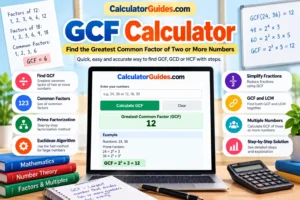
Gcf Calculator-Use our GCF Calculator to quickly find the greatest common factor of two or more numbers. You can also use it to understand common factors, prime factorization, the Euclidean algorithm, and the difference between GCF and LCM.Convert units quickly with our free measurement and Factor Calculator conversion calculators.
Find the GCF, HCF & LCM of integers separated by commas or spaces🧮 Greatest Common Factor (GCF) Calculator
• Numbers Evaluated:
• Prime Factorization Breakdown:
Simply enter your numbers and get the answer quickly.
This free Greatest Common Factor Calculator is useful for students, teachers, homework, math practice, simplifying fractions, and anyone who wants to find the largest number that divides a group of numbers evenly.
What Is GCF?
GCF stands for Greatest Common Factor.
The GCF is the largest whole number that divides two or more numbers without leaving a remainder.
For example, consider 12 and 18.
The factors of 12 are:
1, 2, 3, 4, 6, 12
The factors of 18 are:
1, 2, 3, 6, 9, 18
The common factors are:
1, 2, 3, 6
The largest common factor is 6.
Therefore:
GCF(12, 18) = 6
GCF is also called GCD (Greatest Common Divisor) or HCF (Highest Common Factor). These names describe the same mathematical value for positive whole numbers.
How to Use the GCF Calculator
Using our GCF Calculator online is easy.
Step 1: Enter your numbers
Enter two or more whole numbers into the calculator.
For example:
24, 36
Step 2: Click Calculate
The calculator finds the greatest common factor of the numbers.
Step 3: Check your result
The result will show the GCF.
For:
24 and 36
the answer is:
GCF = 12
You can use the result to check your homework or continue with another math problem.
GCF Calculator Example
24 and 36
Factors of 24
1, 2, 3, 4, 6, 8, 12, 24
Factors of 36
1, 2, 3, 4, 6, 9, 12, 18, 36
Common factors
1, 2, 3, 4, 6, 12
The largest number in the common list is:
12
Therefore:
GCF(24, 36) = 12
How to Find the GCF
There are several ways to find the greatest common factor.
The three common methods are:
- Listing factors
- Prime factorization
- Euclidean algorithm
All three methods give the same GCF. The best method depends on the numbers you are working with.
Method 1: Listing the Factors
This is one of the easiest methods for small numbers.
Suppose you want to find the GCF of:
18 and 30
Factors of 18:
1, 2, 3, 6, 9, 18
Factors of 30:
1, 2, 3, 5, 6, 10, 15, 30
Common factors:
1, 2, 3, 6
The greatest common factor is:
6
So:
GCF(18, 30) = 6
This method works well for small numbers, but listing every factor can take a long time with larger numbers.
Method 2: Prime Factorization
Prime factorization breaks a number into its prime factors.
Let’s find the GCF of:
48 and 60
Prime factorization of 48:
48 = 2 × 2 × 2 × 2 × 3
or:
48 = 2⁴ × 3
Prime factorization of 60:
60 = 2 × 2 × 3 × 5
or:
60 = 2² × 3 × 5
The prime factors shared by both numbers are:
2 and 3
For the GCF, use the lowest power of each shared prime.
So:
GCF = 2² × 3
GCF = 4 × 3
GCF = 12
Therefore:
GCF(48, 60) = 12
Prime factorization is a useful method because it makes the shared factors easy to see.
Method 3: Euclidean Algorithm
The Euclidean algorithm is a fast way to find the GCF, especially when the numbers are large.
Let’s find the GCF of:
48 and 18
Start by dividing the larger number by the smaller number:
48 ÷ 18 = 2 remainder 12
Now use 18 and 12:
18 ÷ 12 = 1 remainder 6
Now use 12 and 6:
12 ÷ 6 = 2 remainder 0
When the remainder becomes zero, the last non-zero remainder is the GCF.
Therefore:
GCF(48, 18) = 6
The Euclidean algorithm repeatedly uses the remainder until it reaches zero.
GCF of Three Numbers
You can also find the GCF of three or more numbers.
For example:
12, 18, and 30
First find:
GCF(12, 18) = 6
Then find:
GCF(6, 30) = 6
Therefore:
GCF(12, 18, 30) = 6
The same approach can be continued when you have more numbers.
GCF of Four Numbers
Suppose the numbers are:
24, 36, 48, 60
First:
GCF(24, 36) = 12
Then:
GCF(12, 48) = 12
Then:
GCF(12, 60) = 12
Therefore:
GCF(24, 36, 48, 60) = 12
A multi-number GCF calculator can do this calculation automatically.
GCF and GCD
You may see GCF and GCD used in different math resources.
They mean the same thing:
- GCF = Greatest Common Factor
- GCD = Greatest Common Divisor
- HCF = Highest Common Factor
For example:
GCF(24, 36) = 12
GCD(24, 36) = 12
HCF(24, 36) = 12
The answer is the same.
GCF and HCF
HCF is commonly used in some school systems, while GCF is common in many U.S. math resources.
For example:
The HCF of 20 and 30 is:
10
The GCF of 20 and 30 is also:
10
So you can use either term when referring to the greatest shared factor.
GCF vs. LCM
GCF and LCM are related, but they are not the same thing.
GCF means the largest number that divides all the given numbers evenly.
LCM means the smallest positive number that is a multiple of all the given numbers.
For example, with 12 and 18:
GCF = 6
LCM = 36
Simple difference
| GCF | LCM |
|---|---|
| Greatest Common Factor | Least Common Multiple |
| Largest shared factor | Smallest shared multiple |
| Divides the numbers | Is divisible by the numbers |
| Useful for simplifying fractions | Useful for finding common denominators |
For two non-zero numbers, GCF and LCM are also connected by the relationship:
GCF × LCM = Product of the two numbers
For 12 and 18:
6 × 36 = 216
and:
12 × 18 = 216
So the relationship works.
GCF and LCM Calculator
If you need both values, a GCF and LCM Calculator can calculate them together.
For example, enter:
24 and 36
The calculator can return:
GCF = 12
LCM = 72
The same prime factorization can be used to understand both calculations.
How GCF Helps Simplify Fractions
GCF is also useful when reducing fractions.
Suppose you have:
24/36
The GCF of 24 and 36 is:
12
Divide both the numerator and denominator by 12:
24 ÷ 12 = 2
36 ÷ 12 = 3
So:
24/36 = 2/3
The fraction is now in its simplest form.
This is one of the most common practical uses of the greatest common factor.
GCF of 8 and 12
Let’s find the GCF of:
8 and 12
Factors of 8:
1, 2, 4, 8
Factors of 12:
1, 2, 3, 4, 6, 12
Common factors:
1, 2, 4
Therefore:
GCF = 4
GCF of 15 and 25
Factors of 15:
1, 3, 5, 15
Factors of 25:
1, 5, 25
The greatest common factor is:
5
Therefore:
GCF(15, 25) = 5
GCF of 18 and 24
Factors of 18:
1, 2, 3, 6, 9, 18
Factors of 24:
1, 2, 3, 4, 6, 8, 12, 24
The common factors are:
1, 2, 3, 6
Therefore:
GCF(18, 24) = 6
GCF of 20 and 30
Factors of 20:
1, 2, 4, 5, 10, 20
Factors of 30:
1, 2, 3, 5, 6, 10, 15, 30
The greatest shared factor is:
10
Therefore:
GCF(20, 30) = 10
What If the GCF Is 1?
Sometimes two numbers have no common factor greater than 1.
For example:
8 and 15
Factors of 8:
1, 2, 4, 8
Factors of 15:
1, 3, 5, 15
The only common factor is:
1
Therefore:
GCF(8, 15) = 1
When two numbers have a GCF of 1, they are called coprime or relatively prime.
Can GCF Be Found for More Than Two Numbers?
Yes.
The GCF can be calculated for two, three, four, or more whole numbers.
For example:
18, 24, 30, 42
The greatest number that divides all four numbers evenly is:
6
Therefore:
GCF = 6
A calculator that accepts multiple inputs can make this much faster.
Can GCF Be Used With Negative Numbers?
The GCF is normally discussed using positive factors. For calculations involving negative integers, the absolute values are used for the divisor calculation.
For example:
GCF(-12, 18) = 6
The negative sign does not change the greatest positive common divisor.
Can GCF Be Used With Decimals?
The standard GCF concept is normally defined for whole numbers or integers.
If your numbers contain decimals, it is usually better to convert them into equivalent whole-number values first when appropriate.
For example:
1.2 and 1.8
Multiply both by 10:
12 and 18
Now:
GCF(12, 18) = 6
The correct approach depends on what the original math problem is asking.
Why Use a GCF Calculator?
Finding the GCF by hand is easy for small numbers, but it can take more time with larger numbers.
A free GCF calculator can help you:
- Find the greatest common factor quickly
- Check your homework
- Find the GCD
- Find the HCF
- Check common factors
- Understand prime factorization
- Use the Euclidean algorithm
- Simplify fractions
- Compare GCF and LCM
- Work with multiple numbers
It is especially useful when you want to check your answer after solving a problem manually.
Who Can Use a GCF Calculator?
Students
Students can use a GCF calculator for homework, worksheets, practice questions, and exam preparation.
Teachers
Teachers can use it to check answers and create examples for lessons.
Parents
Parents can use the calculator to help children understand factors and divisibility.
Anyone Working With Numbers
You do not need to be a math expert. If you have two or more numbers and want to know their greatest common factor, the calculator can do the work for you.
Frequently Asked Questions
What does GCF stand for?
GCF stands for Greatest Common Factor.
It is the largest whole number that divides two or more numbers evenly.
What is the GCF of 12 and 18?
The GCF of 12 and 18 is:
6
What is the difference between GCF and GCD?
There is no mathematical difference for positive integers. GCF means Greatest Common Factor, while GCD means Greatest Common Divisor. Both refer to the largest positive integer that divides the given numbers without a remainder.
What is HCF?
HCF means Highest Common Factor. It is another name for GCF and GCD.
How do I find the GCF?
You can find the GCF by listing factors, using prime factorization, or using the Euclidean algorithm.
What is the easiest way to find GCF?
For small numbers, listing factors is simple. For larger numbers, prime factorization or the Euclidean algorithm can be faster.
What is the GCF of two prime numbers?
If two different prime numbers are used, their GCF is usually 1.
For example:
GCF(7, 11) = 1
Can I find the GCF of three numbers?
Yes. The GCF can be found for three or more numbers.
Is GCF the same as LCM?
No.
GCF is the largest shared factor, while LCM is the smallest positive shared multiple.
Can GCF simplify fractions?
Yes. Divide the numerator and denominator by their GCF to reduce a fraction to its simplest form.
What is the Euclidean algorithm?
The Euclidean algorithm finds the GCF by repeatedly dividing and using the remainder until the remainder becomes zero.
What is prime factorization?
Prime factorization breaks a whole number into a product of prime numbers.
For example:
60 = 2² × 3 × 5
What happens when the GCF is 1?
When the GCF of two numbers is 1, the numbers are called coprime or relatively prime.
Final Thoughts
The GCF Calculator is a simple way to find the greatest common factor of two or more numbers.
You can use it to find the GCF, GCD, HCF, common factors, prime factors, and related LCM calculations.
For small numbers, you can find the answer by listing factors. For larger numbers, prime factorization and the Euclidean algorithm can make the calculation much easier.
Whether you are solving a school math problem, simplifying a fraction, checking homework, or simply working with numbers, CalculatorGuides.com helps you find the answer quickly and understand how the calculation works.