
Volume Calculator-A Volume Calculator helps you quickly find how much three-dimensional space an object or container holds. You can calculate the volume of common shapes such as a cube, rectangular prism, cylinder, sphere, cone, pyramid, and hemisphere.Explore our free online calculator tools for quick answers across Fitness & Health Calculators different categories.
🔴 Sphere Volume Calculator CalculatorGuides
🍦 Cone Volume Calculator CalculatorGuides
🧊 Cube Volume Calculator CalculatorGuides
🛢️ Cylinder Volume Calculator CalculatorGuides
📦 Rectangular Tank Volume Calculator CalculatorGuides
💊 Capsule Volume Calculator CalculatorGuides
Provide any two values below to calculate🍳 Spherical Cap Volume Calculator CalculatorGuides
🍧 Conical Frustum Volume Calculator CalculatorGuides
🏉 Ellipsoid Volume Calculator CalculatorGuides
🔺 Square Pyramid Volume Calculator CalculatorGuides
🧪 Tube Volume Calculator CalculatorGuides
Instead of remembering every formula or doing the calculations by hand, enter the measurements into the calculator and get the answer instantly.
Volume is normally measured in cubic units, such as cubic centimeters (cm³), cubic meters (m³), cubic inches (in³), or cubic feet (ft³). For liquids and containers, volume is also commonly expressed in liters, milliliters, gallons, and quarts.
This guide explains what volume means, how to calculate it, the most common volume formulas, worked examples, unit conversions, and common mistakes to avoid.
What Is Volume?
Volume is the amount of three-dimensional space occupied by an object or enclosed inside a container.
For example:
- A box has a certain amount of space inside it.
- A water tank can hold a certain number of liters.
- A ball takes up a certain amount of space.
- A cylinder-shaped bottle has a specific internal capacity.
- A swimming pool has a measurable volume of water.
Unlike area, which measures a flat surface, volume measures length, width, and height in three dimensions.
Simple example
Suppose you have a box that is:
- Length = 10 cm
- Width = 5 cm
- Height = 4 cm
Its volume is:
Volume = 10 × 5 × 4
Volume = 200 cm³
So, the box occupies 200 cubic centimeters of space.
What Does a Volume Calculator Do?
A volume calculator uses the appropriate mathematical formula for the shape you select.
Depending on the shape, you may need to enter:
- Length
- Width
- Height
- Radius
- Diameter
- Side length
- Base length
- Base width
The calculator then applies the correct formula and gives you the volume.
For example:
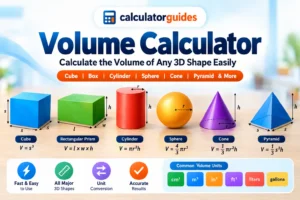
Cube:
V = s³
Rectangular prism:
V = l × w × h
Cylinder:
V = πr²h
Sphere:
V = 4/3 × πr³
Cone:
V = 1/3 × πr²h
Pyramid:
V = 1/3 × base area × height
These are standard formulas used in geometry, mathematics, science, engineering, construction, and many everyday calculations.
How to Use the Volume Calculator
Using a volume calculator is simple.
Step 1: Select the shape
Choose the 3D shape you want to calculate.
Common options include:
- Cube
- Rectangular prism
- Cylinder
- Sphere
- Cone
- Pyramid
- Hemisphere
Step 2: Enter the measurements
Enter the dimensions requested by the calculator.
For example, a rectangular box usually requires:
- Length
- Width
- Height
A cylinder usually requires:
- Radius
- Height
A sphere normally requires:
- Radius
Step 3: Check your units
Make sure your measurements use compatible units.
For example, do not enter:
- Length = 5 meters
- Width = 20 centimeters
- Height = 3 meters
unless the calculator is designed to handle unit conversion.
It is usually easier to convert everything into the same unit first.
Step 4: Calculate
Click the calculate button.
The calculator applies the correct formula and gives you the volume.
Step 5: Read the result
If your measurements are in centimeters, the result will normally be in cubic centimeters (cm³).
If your measurements are in feet, the result will normally be in cubic feet (ft³).
Volume Formulas for Common 3D Shapes
Different shapes require different formulas.
Here are the most important volume formulas.
| Shape | Volume Formula |
|---|---|
| Cube | V = s³ |
| Rectangular Prism | V = l × w × h |
| Cylinder | V = πr²h |
| Sphere | V = 4/3πr³ |
| Cone | V = 1/3πr²h |
| Square Pyramid | V = 1/3s²h |
| Hemisphere | V = 2/3πr³ |
Understanding these formulas makes it easier to check the result from a calculator.
Volume of a Cube
A cube has six equal square faces. All of its sides have the same length.
Cube volume formula
V = s³
Where:
- V = volume
- s = side length
Example
Suppose a cube has a side length of 5 inches.
V = 5³
V = 5 × 5 × 5
V = 125 in³
So, the cube has a volume of 125 cubic inches.
Cube volume calculator
To calculate cube volume, you only need to know the length of one side.
If the side is 10 cm:
10 × 10 × 10 = 1,000 cm³
Volume of a Rectangular Prism
A rectangular prism is a box-shaped object.
Examples include:
- Boxes
- Rooms
- Shipping containers
- Cabinets
- Storage containers
- Rectangular tanks
Formula
V = l × w × h
Where:
- l = length
- w = width
- h = height
Example
A box has:
- Length = 12 ft
- Width = 5 ft
- Height = 4 ft
Calculate:
V = 12 × 5 × 4
V = 240 ft³
The volume is 240 cubic feet.
This is one of the simplest and most commonly used volume calculations.
Volume of a Cylinder
A cylinder has two circular ends and one curved surface.
Common examples include:
- Cans
- Pipes
- Cylindrical tanks
- Bottles
- Drums
- Some water containers
Cylinder volume formula
V = πr²h
Where:
- V = volume
- π ≈ 3.14159
- r = radius
- h = height
Example
Suppose a cylinder has:
- Radius = 3 cm
- Height = 10 cm
First square the radius:
3² = 9
Then:
V = π × 9 × 10
V = 90π
V ≈ 282.74 cm³
So, the cylinder’s volume is approximately 282.74 cubic centimeters.
How to Find Cylinder Volume From Diameter
Sometimes you are given the diameter instead of the radius.
Remember:
Radius = Diameter ÷ 2
For example, if the diameter is 20 cm:
Radius = 20 ÷ 2 = 10 cm
Now use:
V = πr²h
This is an important point because using the diameter directly as the radius will produce an incorrect answer.
Volume of a Sphere
A sphere is a perfectly round three-dimensional object.
Examples include:
- Balls
- Marbles
- Some tanks
- Spherical containers
Sphere volume formula
V = 4/3πr³
Where:
- V = volume
- r = radius
- π ≈ 3.14159
Example
Suppose the radius of a sphere is 6 cm.
V = 4/3 × π × 6³
Since:
6³ = 216
The result is approximately:
V = 904.78 cm³
So the sphere’s volume is about 904.78 cubic centimeters.
Volume of a Cone
A cone has a circular base and narrows to a single point.
Examples include:
- Ice cream cones
- Funnels
- Traffic cones
- Conical containers
- Some piles of material
Cone volume formula
V = 1/3πr²h
Where:
- r = radius
- h = vertical height
Example
A cone has:
- Radius = 4 cm
- Height = 9 cm
Then:
V = 1/3 × π × 4² × 9
V = 1/3 × π × 16 × 9
V = 48π
V ≈ 150.80 cm³
The volume is approximately 150.80 cubic centimeters.
Why Is Cone Volume One-Third of a Cylinder?
A cone with the same base radius and height as a cylinder has exactly one-third of the cylinder’s volume.
Cylinder:
V = πr²h
Cone:
V = 1/3πr²h
For example, if a cylinder and cone both have:
- Radius = 3 cm
- Height = 8 cm
The cylinder has a volume of approximately 226.19 cm³.
The cone has approximately 75.40 cm³.
The cone is exactly one-third of the matching cylinder.
Volume of a Pyramid
A pyramid has a base and triangular sides that meet at a point.
For a square pyramid:
V = 1/3 × s² × h
Where:
- s = side length of the square base
- h = vertical height
For a rectangular pyramid, the general formula is:
V = 1/3 × l × w × h
Example
A rectangular pyramid has:
- Length = 6 m
- Width = 4 m
- Height = 9 m
Then:
V = 1/3 × 6 × 4 × 9
V = 72 m³
Volume of a Hemisphere
A hemisphere is half of a sphere.
Examples include:
- Bowl-shaped objects
- Dome shapes
- Half-spherical containers
Formula
V = 2/3πr³
Because a hemisphere is half of a sphere:
Sphere = 4/3πr³
Half of that is:
2/3πr³
Volume of a Prism
A prism has the same cross-sectional shape along its length.
The general idea is:
Volume = Base Area × Height
For example, a rectangular prism has a rectangular base:
Base Area = length × width
Therefore:
Volume = length × width × height
This idea also works for other types of prisms when the base area is known.
What Are Cubic Units?
Volume is measured using cubic units because it describes three dimensions.
For example:
- cm³ = cubic centimeters
- m³ = cubic meters
- mm³ = cubic millimeters
- in³ = cubic inches
- ft³ = cubic feet
- yd³ = cubic yards
The small 3 means the unit is being used in three dimensions.
For example:
5 cm³
means five cubic centimeters.
It does not mean 5 centimeters of length.
Volume vs Area
Volume and area are different measurements.
Area
Area measures a two-dimensional surface.
Examples:
- Square feet
- Square meters
- Square centimeters
Area uses units such as:
ft², m², cm²
Volume
Volume measures three-dimensional space.
Examples:
- Cubic feet
- Cubic meters
- Cubic centimeters
Volume uses:
ft³, m³, cm³
A simple way to remember it:
Area = 2D
Volume = 3D
Volume vs Capacity
Volume and capacity are closely related, but they are not always used in exactly the same way.
Volume generally describes the amount of three-dimensional space occupied by an object or enclosed by a container.
Capacity usually describes how much a container can hold, especially liquids.
For example:
A water tank might have a volume of:
0.5 m³
That is equal to:
500 liters
So the tank’s capacity can be described as approximately 500 liters.
Volume Conversion
Sometimes you need to convert a volume from one unit to another.
Some useful relationships are:
Metric conversions
1 liter = 1,000 milliliters
1 cubic meter = 1,000 liters
1 liter = 1,000 cm³
Therefore:
1 cm³ = 1 mL
This makes cubic centimeters and milliliters especially easy to compare.
Cubic Meters to Liters
One of the most common volume conversions is:
1 m³ = 1,000 liters
For example:
2 m³ = 2,000 liters
And:
0.5 m³ = 500 liters
This conversion is useful for:
- Water tanks
- Swimming pools
- Industrial containers
- Storage tanks
- Construction projects
Cubic Feet to Gallons
For US measurements:
1 cubic foot ≈ 7.48052 US gallons
For example:
10 ft³ ≈ 74.81 US gallons
Be careful when working with gallons because US gallons and Imperial gallons are different units.
If you are working with a real tank or container, make sure you know which gallon system is being used.
Common Volume Units
Here are some of the most common units used to measure volume.
Metric
- Cubic millimeter (mm³)
- Cubic centimeter (cm³)
- Cubic meter (m³)
- Milliliter (mL)
- Liter (L)
US customary / Imperial
- Cubic inch (in³)
- Cubic foot (ft³)
- Cubic yard (yd³)
- US gallon
- Imperial gallon
- Quart
- Pint
How to Calculate Volume by Hand
You can calculate volume without an online calculator if you know the correct formula.
The basic process is:
1. Identify the shape
Decide whether the object is a:
- Cube
- Box
- Cylinder
- Sphere
- Cone
- Pyramid
- Other 3D shape
2. Find the required measurements
Depending on the shape, you may need the:
- Length
- Width
- Height
- Radius
- Diameter
- Side
3. Choose the formula
Use the formula that matches the shape.
4. Substitute the numbers
Put your measurements into the formula.
5. Calculate
Perform the arithmetic carefully.
6. Add the correct cubic unit
If the dimensions are in meters, the answer is in m³.
If they are in inches, the answer is in in³.
Worked Volume Examples
Example 1: Box
Length = 8 cm
Width = 5 cm
Height = 3 cm
V = l × w × h
V = 8 × 5 × 3
V = 120 cm³
Example 2: Cube
Side = 7 m
V = s³
V = 7³
V = 343 m³
Example 3: Cylinder
Radius = 5 m
Height = 4 m
V = πr²h
V = π × 5² × 4
V = 100π
V ≈ 314.16 m³
Example 4: Sphere
Radius = 3 m
V = 4/3πr³
V = 4/3 × π × 3³
V = 36π
V ≈ 113.10 m³
Example 5: Cone
Radius = 3 m
Height = 5 m
V = 1/3πr²h
V = 1/3 × π × 9 × 5
V = 15π
V ≈ 47.12 m³
How to Calculate the Volume of a Tank
The formula depends on the tank’s shape.
Rectangular tank
Use:
V = length × width × height
Cylindrical tank
Use:
V = πr²h
Spherical tank
Use:
V = 4/3πr³
After calculating the volume, you can convert the result into liters if needed.
For example:
1 m³ = 1,000 L
This is useful when estimating water storage capacity.
How to Calculate Water Tank Volume
Water tanks commonly have rectangular or cylindrical shapes.
Rectangular water tank
Suppose a tank measures:
- Length = 2 m
- Width = 1.5 m
- Height = 1 m
Volume:
2 × 1.5 × 1 = 3 m³
Convert to liters:
3 × 1,000 = 3,000 liters
So the tank can hold approximately 3,000 liters if those are its usable internal dimensions.
How to Calculate Swimming Pool Volume
A simple rectangular swimming pool can be calculated with:
Volume = length × width × average depth
For example:
- Length = 10 m
- Width = 5 m
- Average depth = 1.5 m
Then:
10 × 5 × 1.5 = 75 m³
Convert to liters:
75 × 1,000 = 75,000 liters
An average depth is useful when a pool has a sloped bottom.
How to Calculate the Volume of a Box
For any box-shaped object:
Volume = Length × Width × Height
For example:
A box is 20 inches long, 10 inches wide, and 8 inches high.
V = 20 × 10 × 8
V = 1,600 in³
So its volume is 1,600 cubic inches.
How to Calculate Volume From Diameter
This is especially common for cylinders and spheres.
First convert diameter to radius:
r = d ÷ 2
For example:
Diameter = 12 cm
r = 12 ÷ 2 = 6 cm
Then use the appropriate formula.
For a sphere:
V = 4/3π(6³)
For a cylinder, you would also need the height.
Why Is the Radius Important?
For circular shapes such as cylinders, cones, and spheres, the formula uses the radius.
The radius is the distance from the center of the circle to its edge.
The diameter goes all the way across the circle through its center.
Therefore:
Diameter = 2 × Radius
and:
Radius = Diameter ÷ 2
Using the wrong one can make a large difference in the final answer.
Real-Life Uses of a Volume Calculator
Volume calculations are not only used in school.
They are useful in many everyday and professional situations.
Construction
Volume is used to estimate:
- Concrete
- Soil
- Sand
- Gravel
- Excavation space
- Foundations
For example, contractors can calculate the volume of a concrete slab before estimating the required material.
Shipping
Companies calculate the volume of boxes and cargo to understand how much space products occupy.
Water storage
Volume helps determine the capacity of:
- Water tanks
- Pools
- Containers
- Reservoirs
Manufacturing
Manufacturers use volume when designing parts, containers, tanks, and products.
Engineering
Engineers use volume calculations for equipment, pipes, tanks, and many other structures.
Education
Students use volume formulas in:
- Geometry
- Algebra
- Physics
- Engineering mathematics
Home projects
You may need volume when:
- Filling a pool
- Buying soil
- Choosing a storage container
- Measuring a fish tank
- Calculating concrete
- Estimating water capacity
Volume Calculator for Students
Students often need to calculate the volume of common 3D shapes.
A good way to solve volume problems is to remember the basic pattern:
Box → length × width × height
Cube → side³
Cylinder → πr²h
Sphere → 4/3πr³
Cone → 1/3πr²h
Pyramid → 1/3 × base area × height
Instead of memorizing many unrelated formulas, notice that several formulas are based on base area × height.
Common Mistakes When Calculating Volume
Even simple volume problems can produce incorrect answers if the measurements are entered incorrectly.
1. Using diameter instead of radius
For a cylinder, sphere, or cone, check whether the measurement is radius or diameter.
If you have diameter, divide it by 2.
2. Mixing units
Do not blindly multiply:
- meters
- centimeters
- inches
Convert them to a common unit first.
3. Forgetting cubic units
Volume is not measured in ordinary length units.
Use:
cm³, m³, ft³, in³, etc.
4. Using the wrong formula
A cylinder and a cone look similar, but their formulas are different.
Cylinder:
πr²h
Cone:
1/3πr²h
5. Confusing area with volume
Area is two-dimensional.
Volume is three-dimensional.
6. Using slant height as the height
For a cone or pyramid, the volume formula generally requires the vertical/perpendicular height, not the slant height.
7. Rounding too early
If you use π, keeping a few extra decimal places during the calculation can give a more accurate final result.
Volume Calculator vs Manual Calculation
Both methods can produce the same result.
Manual calculation
Useful when:
- Learning mathematics
- Showing work in school
- Understanding formulas
- Checking an answer
Online calculator
Useful when:
- You need a quick result
- You are working with many numbers
- You need fewer calculation errors
- You want to compare different units
- You want to calculate several shapes
A calculator is especially convenient because you only need to enter the measurements and select the appropriate shape.
Frequently Asked Questions About Volume
What is a volume calculator?
A volume calculator is an online tool that calculates the amount of three-dimensional space occupied by a shape or container. It can calculate volume for shapes such as cubes, rectangular prisms, cylinders, spheres, cones, and pyramids.
What is the basic formula for volume?
The formula depends on the shape. For a rectangular prism, the formula is:
V = length × width × height
Other shapes have different formulas.
How do you calculate volume?
First identify the shape, collect the required measurements, choose the correct formula, enter the measurements, and calculate the result.
What is the volume of a cube?
The volume of a cube is:
V = s³
where s is the length of one side.
What is the volume of a rectangular box?
Use:
V = length × width × height
Multiply all three dimensions together.
What is the formula for cylinder volume?
The cylinder volume formula is:
V = πr²h
where r is the radius and h is the height.
What is the formula for sphere volume?
The sphere volume formula is:
V = 4/3πr³
where r is the radius.
What is the formula for cone volume?
The cone volume formula is:
V = 1/3πr²h
where r is the radius and h is the vertical height.
How do I find the radius if I know the diameter?
Divide the diameter by 2.
Radius = Diameter ÷ 2
For example, a diameter of 18 cm gives a radius of 9 cm.
Is volume measured in square units or cubic units?
Volume is measured in cubic units because it represents three dimensions.
Examples include:
- cm³
- m³
- ft³
- in³
How many liters are in one cubic meter?
1 cubic meter = 1,000 liters.
Is 1 cm³ equal to 1 mL?
Yes.
1 cubic centimeter = 1 milliliter
This is a useful relationship for small liquid volumes.
How do I calculate the volume of a water tank?
Use the formula that matches the tank’s shape.
For a rectangular tank:
V = length × width × height
For a cylindrical tank:
V = πr²h
Then convert the answer into liters if needed.
How do I calculate pool volume?
For a simple rectangular pool:
Volume = length × width × average depth
If the pool has different depths, use its average depth for a basic estimate.
Can volume be converted into liters?
Yes. For example:
1 m³ = 1,000 L
Other volume units can also be converted into liters using the appropriate conversion factor.
What is the difference between volume and capacity?
Volume measures three-dimensional space, while capacity usually refers to how much a container can hold, especially liquids. They are closely related and are often converted between units such as cubic meters and liters.
Why does a cone have a one-third in its formula?
A cone with the same base and height as a cylinder has exactly one-third of the cylinder’s volume. Therefore, its formula includes 1/3.
Can I calculate volume without a calculator?
Yes. You only need the correct formula and measurements. An online volume calculator simply makes the process faster and reduces manual arithmetic.
Quick Volume Formula Chart
| 3D Shape | Formula |
|---|---|
| Cube | s³ |
| Box | l × w × h |
| Cylinder | πr²h |
| Sphere | 4/3πr³ |
| Cone | 1/3πr²h |
| Square Pyramid | 1/3s²h |
| Hemisphere | 2/3πr³ |
Quick Volume Reference
Volume of a cube:
Side × Side × Side
Volume of a box:
Length × Width × Height
Volume of a cylinder:
π × Radius² × Height
Volume of a sphere:
4/3 × π × Radius³
Volume of a cone:
1/3 × π × Radius² × Height
Volume of a pyramid:
1/3 × Base Area × Height
1 liter:
1,000 milliliters
1 cubic meter:
1,000 liters
1 cm³:
1 mL
Why Use Our Volume Calculator?
Our Volume Calculator is designed to make common volume calculations quick and easy.
You can use it when you need to:
- Calculate the volume of a box
- Find cylinder volume
- Calculate sphere volume
- Find cone volume
- Calculate cube volume
- Estimate tank capacity
- Convert volume measurements
- Check homework calculations
- Calculate construction material volume
- Understand 3D geometry
You do not need to remember complicated calculations every time. Simply choose the correct shape, enter your measurements, and check the result.
Final Thoughts
A Volume Calculator is a simple way to find how much space a three-dimensional object occupies. The most important thing is choosing the correct formula and entering the measurements correctly.
For a box, multiply length × width × height. For a cylinder, use πr²h. For a sphere, use 4/3πr³. For a cone, use 1/3πr²h.
Always check whether your measurement is a radius or diameter, keep your units consistent, and remember that volume is expressed in cubic units.
Whether you are a student working on geometry, a homeowner checking tank capacity, or someone calculating the size of a container, a volume calculator can save time and make the calculation much easier.