
Slope Calculator-A Slope Calculator helps you quickly find the slope of a line when you know two points, the rise and run, or the equation of a line. Instead of calculating everything by hand, you can enter the values and get the answer in seconds.Explore our free online calculator tools for quick answers across Fitness & Health Calculators different categories.
Calculate slope using 2 points or 1 point & slope/angle📈 Slope Calculator CalculatorGuides
Point 1
Point 2
Slope is one of the most important ideas in coordinate geometry. It tells you how steep a line is and whether the line goes upward, downward, or stays flat as you move from left to right.
Our Slope Calculator is useful for students, teachers, engineers, architects, programmers, and anyone working with graphs, coordinates, measurements, or mathematical formulas.
What Is Slope?
Slope describes the steepness and direction of a straight line.
In simple words, slope tells you how much a line goes up or down when it moves horizontally.
The basic idea is:
Slope = Rise ÷ Run
Here:
- Rise is the change in the vertical direction.
- Run is the change in the horizontal direction.
For example, if a line goes up 4 units while moving 2 units to the right:
Slope = 4 ÷ 2 = 2
So, the slope is 2.
A larger positive slope means the line rises more quickly. A negative slope means the line goes downward as you move from left to right.
Slope Calculator
To calculate the slope between two points, enter:
- First point: (x₁, y₁)
- Second point: (x₂, y₂)
The calculator uses the standard slope formula:
m = (y₂ − y₁) ÷ (x₂ − x₁)
For example:
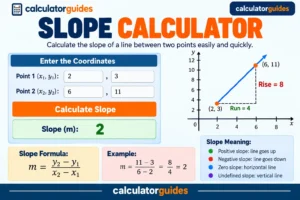
Point 1 = (2, 3)
Point 2 = (6, 11)
First find the change in y:
11 − 3 = 8
Then find the change in x:
6 − 2 = 4
Now:
Slope = 8 ÷ 4 = 2
The slope is 2.
Slope Formula
The most common slope formula is:
m = (y₂ − y₁) / (x₂ − x₁)
The letter m is normally used to represent slope.
Where:
- m = slope
- x₁ = x-coordinate of the first point
- y₁ = y-coordinate of the first point
- x₂ = x-coordinate of the second point
- y₂ = y-coordinate of the second point
The formula finds the difference between the two y-values and divides it by the difference between the two x-values.
Another way to remember the formula is:
Slope = Change in Y / Change in X
Or:
Slope = Rise / Run
These formulas describe the same basic idea.
How to Calculate Slope
Calculating slope is easy when you follow a few simple steps.
Suppose you have two points:
(3, 4) and (7, 12)
Step 1: Identify the coordinates
The first point is:
x₁ = 3
y₁ = 4
The second point is:
x₂ = 7
y₂ = 12
Step 2: Find the change in Y
Subtract the first y-value from the second y-value:
12 − 4 = 8
Step 3: Find the change in X
Subtract the first x-value from the second x-value:
7 − 3 = 4
Step 4: Divide
Slope = 8 ÷ 4
Slope = 2
Therefore, the slope of the line is 2.
What Does Slope Mean?
The slope tells you how a line behaves as you move from left to right.
There are four basic types of slope:
- Positive slope
- Negative slope
- Zero slope
- Undefined slope
Understanding these four types makes graphs much easier to read.
Positive Slope
A line has a positive slope when it moves upward from left to right.
For example:
m = 3
This means the line rises 3 units for every 1 unit it moves to the right.
A positive slope looks like:
↗
For example, consider these two points:
(1, 2) and (3, 8)
The slope is:
m = (8 − 2) / (3 − 1)
m = 6 / 2
m = 3
So the line has a positive slope of 3.
Negative Slope
A line has a negative slope when it moves downward from left to right.
For example:
m = -2
This means the line falls 2 units for every 1 unit it moves to the right.
A negative slope looks like:
↘
Suppose the points are:
(2, 10) and (6, 2)
The slope is:
m = (2 − 10) / (6 − 2)
m = -8 / 4
m = -2
Therefore, the slope is -2.
Zero Slope
A horizontal line has a zero slope.
For example:
m = 0
This happens when the two points have the same y-coordinate.
Suppose the points are:
(2, 5) and (8, 5)
The slope is:
m = (5 − 5) / (8 − 2)
m = 0 / 6
m = 0
So the slope is zero.
A horizontal line looks like:
→
A zero slope means there is no vertical change as you move horizontally.
Undefined Slope
A vertical line has an undefined slope.
This happens when the two points have the same x-coordinate.
For example:
(4, 2) and (4, 10)
Using the slope formula:
m = (10 − 2) / (4 − 4)
m = 8 / 0
Division by zero is not defined.
Therefore, the slope is undefined.
A vertical line looks like:
↑
This is why you should never say that the slope of a vertical line is zero. A vertical line has an undefined slope, while a horizontal line has a zero slope.
Rise Over Run
You may often hear the phrase rise over run when learning about slope.
It is simply another way to describe the slope formula.
Slope = Rise / Run
Rise
Rise means the vertical change.
You calculate it by subtracting the y-values:
Rise = y₂ − y₁
Run
Run means the horizontal change.
You calculate it by subtracting the x-values:
Run = x₂ − x₁
Therefore:
Slope = Rise / Run
For example, if a line rises 10 units and runs 5 units:
Slope = 10 / 5 = 2
Slope Between Two Points
One of the most common uses of a slope calculator is finding the slope between two points.
Suppose:
Point A = (4, 7)
Point B = (10, 19)
Use:
m = (y₂ − y₁) / (x₂ − x₁)
Substitute the values:
m = (19 − 7) / (10 − 4)
m = 12 / 6
m = 2
The slope between the two points is 2.
The order of the points does not change the final slope as long as you subtract consistently.
How to Find Slope From a Graph
You can also find the slope by looking at a graph.
Choose two clear points on the line.
Then:
- Start at the first point.
- Count how many units you move vertically.
- Count how many units you move horizontally.
- Divide rise by run.
For example, if the line rises 6 squares while moving 3 squares to the right:
Slope = 6 / 3 = 2
If the line falls 6 squares while moving 3 squares to the right:
Slope = -6 / 3 = -2
The sign is important because it tells you the direction of the line.
Slope From an Equation
You can also find the slope when you have the equation of a line.
The most common form is called slope-intercept form:
y = mx + b
Here:
- m = slope
- b = y-intercept
- x = independent variable
- y = dependent variable
For example:
y = 4x + 7
The number in front of x is 4.
Therefore:
Slope = 4
Another example:
y = -3x + 5
The slope is:
-3
So you can often find the slope directly by looking at the coefficient of x.
What Is the Y-Intercept?
The y-intercept is the point where a line crosses the y-axis.
In:
y = mx + b
the value b represents the y-intercept.
For example:
y = 2x + 6
Here:
m = 2
and:
b = 6
So the slope is 2 and the y-intercept is 6.
The y-intercept is written as the point:
(0, 6)
What Is the X-Intercept?
The x-intercept is the point where a line crosses the x-axis.
At the x-axis:
y = 0
For example:
y = 2x − 8
To find the x-intercept:
0 = 2x − 8
Add 8:
8 = 2x
Divide by 2:
x = 4
So the x-intercept is:
(4, 0)
Slope of a Horizontal Line
A horizontal line has the same y-value everywhere.
For example:
y = 5
Every point on this line has a y-coordinate of 5.
The slope is:
0
So:
Horizontal line → Zero slope
Slope of a Vertical Line
A vertical line has the same x-value everywhere.
For example:
x = 4
Every point on this line has an x-coordinate of 4.
The slope is:
Undefined
So:
Vertical line → Undefined slope
Slope as a Fraction
Slope does not always have to be a whole number.
For example:
m = 3/4
This means the line rises 3 units for every 4 units it moves horizontally.
A slope can also be:
- 1/2
- 2/3
- 5/8
- -3/4
- -2/5
Fractions are common when working with graphs and coordinate geometry.
For example:
m = 6/8
can be simplified to:
m = 3/4
Both values represent the same slope.
Decimal Slope
You can convert a slope fraction into a decimal.
For example:
m = 3/4
Therefore:
m = 0.75
Another example:
m = -5/2
Therefore:
m = -2.5
A decimal can make some calculations easier, especially when comparing different slopes.
Percentage Slope
Slope can also be expressed as a percentage.
The basic relationship is:
Slope Percentage = Slope × 100
For example:
Slope = 0.25
Then:
0.25 × 100 = 25%
So a slope of 0.25 is a 25% slope.
Similarly:
Slope = 0.5
means:
50% slope
Percentage slope is commonly used for roads, ramps, construction, drainage, and other practical measurements.
Slope Angle
The slope of a line can also be converted into an angle.
The relationship is:
θ = arctan(m)
where:
- θ = angle of the line
- m = slope
For example, if:
m = 1
then:
θ = arctan(1)
The angle is:
45°
So a slope of 1 represents a 45-degree angle relative to the horizontal.
For a negative slope, the angle indicates that the line falls as it moves from left to right.
Slope and Steepness
A larger absolute slope generally means a line is steeper.
For example:
- Slope = 0.5
- Slope = 1
- Slope = 2
- Slope = 5
The line with slope 5 is steeper than the line with slope 0.5.
When comparing negative slopes, the absolute value is useful for comparing steepness.
For example:
-4
is steeper than:
-1
because:
|-4| = 4
and:
|-1| = 1
The negative sign tells you the direction, while the size of the number tells you how steep the line is.
Slope Calculator Example
Let’s calculate the slope between:
(5, 8) and (9, 20)
Use the formula:
m = (y₂ − y₁) / (x₂ − x₁)
Substitute the values:
m = (20 − 8) / (9 − 5)
Calculate the differences:
m = 12 / 4
Therefore:
m = 3
The slope is 3.
This means the line rises 3 units for every 1 unit it moves to the right.
Another Example With Negative Slope
Suppose the points are:
(2, 12) and (8, 6)
Formula:
m = (6 − 12) / (8 − 2)
m = -6 / 6
m = -1
The slope is -1.
This means the line falls 1 unit for every 1 unit it moves to the right.
Example With Zero Slope
Suppose the points are:
(3, 7) and (10, 7)
Formula:
m = (7 − 7) / (10 − 3)
m = 0 / 7
m = 0
The line is horizontal.
Example With Undefined Slope
Suppose the points are:
(6, 2) and (6, 15)
Formula:
m = (15 − 2) / (6 − 6)
m = 13 / 0
Because division by zero is undefined, the slope is:
Undefined
The line is vertical.
Why Use a Slope Calculator?
Calculating slope by hand is simple, but mistakes can happen when coordinates contain negative numbers, fractions, or decimals.
A slope calculator can help you:
- Save time
- Reduce calculation mistakes
- Check homework
- Understand graph relationships
- Calculate slope between two points
- Work with positive and negative coordinates
- Convert slope into a percentage
- Understand line steepness
- Check mathematical work
Students can use the calculator to verify their answers after solving a problem manually.
Where Is Slope Used?
Slope is not only a classroom concept. It is useful in many real-world situations.
Mathematics
Slope is used in:
- Coordinate geometry
- Algebra
- Linear equations
- Graphs
- Functions
- Statistics
Construction
Slope helps describe the angle or grade of:
- Roofs
- Ramps
- Roads
- Driveways
- Drainage systems
Engineering
Engineers use slope when studying lines, surfaces, gradients, and changes in measurements.
Physics
Slope can represent a rate of change. For example, the slope of a distance-time graph can represent speed.
Economics
Slope can be used to understand relationships between variables on graphs, such as changes in cost, demand, or revenue.
Geography
Slope is used to describe the steepness of land, hills, roads, and terrain.
Slope vs Gradient
The words slope and gradient are often used to describe the same basic concept.
Both can describe the change in vertical position compared with horizontal position.
For example:
Gradient = Rise / Run
and:
Slope = Rise / Run
In many mathematical situations, the terms can be used interchangeably.
However, the preferred word can vary depending on the country, profession, or subject.
Common Slope Calculation Mistakes
Slope calculations are easy when the formula is used carefully, but several mistakes are common.
1. Mixing the Coordinates
If you start with:
(x₁, y₁)
and:
(x₂, y₂)
make sure the x-values and y-values stay together.
Do not accidentally use x₁ with y₂.
2. Changing the Subtraction Order
You can calculate:
(y₂ − y₁) / (x₂ − x₁)
or:
(y₁ − y₂) / (x₁ − x₂)
Both produce the same result.
But you should not change the order in only one part of the formula.
3. Forgetting Negative Signs
Negative coordinates can easily cause mistakes.
For example:
-3 − 5 = -8
not 2.
Always calculate the signs carefully.
4. Calling a Vertical Line Zero
A horizontal line has zero slope.
A vertical line has undefined slope.
This is one of the most common slope mistakes.
5. Dividing by Zero
If the x-values are identical, the denominator becomes zero.
For example:
(x₂ − x₁) = 0
The slope is undefined.
Frequently Asked Questions About Slope
What is the formula for slope?
The standard slope formula is:
m = (y₂ − y₁) / (x₂ − x₁)
It can also be written as:
Slope = Rise / Run
How do I calculate slope between two points?
Take the difference between the y-values and divide it by the difference between the x-values.
For points (x₁, y₁) and (x₂, y₂):
m = (y₂ − y₁) / (x₂ − x₁)
What does a positive slope mean?
A positive slope means the line rises as you move from left to right.
For example:
m = 2
means the line rises 2 units for every 1 unit of horizontal movement.
What does a negative slope mean?
A negative slope means the line falls as you move from left to right.
For example:
m = -2
means the line falls 2 units for every 1 unit of horizontal movement.
What is the slope of a horizontal line?
The slope of a horizontal line is:
0
A horizontal line has no vertical change.
What is the slope of a vertical line?
The slope of a vertical line is undefined because calculating it would require division by zero.
Can slope be a fraction?
Yes. Slope can be a fraction, decimal, whole number, or negative number.
For example:
m = 3/4 = 0.75
What is rise over run?
Rise over run is another way of describing slope.
Rise is the change in y.
Run is the change in x.
Therefore:
Slope = Rise / Run
How do I find slope from a graph?
Choose two points on the line. Count the vertical change and horizontal change between them. Then divide:
Slope = Rise / Run
Remember to include the negative sign if the line goes downward from left to right.
How do I find slope from y = mx + b?
In the equation:
y = mx + b
the value of m is the slope.
For example:
y = 5x + 2
has a slope of:
5
What is the slope of y = 7?
The equation y = 7 represents a horizontal line.
Therefore, its slope is:
0
What is the slope of x = 7?
The equation x = 7 represents a vertical line.
Therefore, its slope is:
undefined
Can slope be greater than 1?
Yes.
A slope can be any positive or negative number, as long as the calculation is defined.
For example:
m = 4
is a valid slope.
Can slope be zero?
Yes.
A slope of zero means the line is horizontal.
Can slope be negative?
Yes.
A negative slope means the line decreases from left to right.
How is slope related to steepness?
The absolute value of the slope indicates the steepness of a straight line.
For example, a slope of 4 has greater steepness than a slope of 1.
The sign tells you the direction.
How do you convert slope to percentage?
Multiply the slope by 100.
For example:
0.30 × 100 = 30%
So a slope of 0.30 is a 30% slope.
How do you convert slope to an angle?
Use:
θ = arctan(m)
where m is the slope.
For example, a slope of 1 corresponds to a 45-degree angle.
Does the order of points matter when calculating slope?
No, provided that you use the same subtraction order in both the numerator and denominator.
For example:
(y₂ − y₁) / (x₂ − x₁)
and:
(y₁ − y₂) / (x₁ − x₂)
give the same result.
What is the difference between slope and y-intercept?
Slope describes how quickly a line rises or falls.
The y-intercept tells you where the line crosses the y-axis.
In:
y = mx + b
m = slope
and:
b = y-intercept
Slope Calculator Quick Reference
| Type of Line | Slope |
|---|---|
| Rising from left to right | Positive |
| Falling from left to right | Negative |
| Horizontal | 0 |
| Vertical | Undefined |
Main Formula
m = (y₂ − y₁) / (x₂ − x₁)
Rise Over Run
Slope = Rise / Run
Slope-Intercept Form
y = mx + b
Percentage Slope
Slope × 100
Angle
θ = arctan(m)
Final Thoughts
A Slope Calculator is a simple way to calculate the slope of a line without doing the calculation manually. The main idea behind slope is straightforward: compare the vertical change with the horizontal change.
The most important formula to remember is:
m = (y₂ − y₁) / (x₂ − x₁)
You can also remember it as:
Slope = Rise / Run
A positive slope means the line rises from left to right. A negative slope means it falls. A horizontal line has a slope of zero, while a vertical line has an undefined slope.
Once you understand these basic ideas, slope becomes much easier to use in algebra, geometry, graphs, engineering, construction, physics, and real-life measurements.
Use the Slope Calculator to quickly check the slope between two points, understand the direction of a line, and verify your calculations.