
Mulch Calculator-Use our free Mulch Calculator to find how much mulch you need for a garden bed, yard, or landscaping project Calculate cubic yards, cubic feet, and bags of mulch easily..All Online Calculators.
🌱 Mulch Calculator | CalculatorGuides
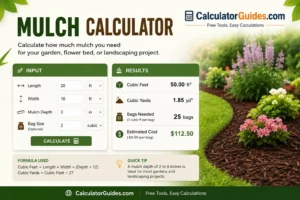
A Mulch Calculator helps you find out how much mulch you need for your garden, flower bed, trees, or landscaping project.
Instead of guessing how many bags or cubic yards to buy, you can enter the length, width, and desired mulch depth to get an estimate.
The calculator can help you estimate:
- Cubic yards of mulch
- Cubic feet of mulch
- Number of mulch bags
- Mulch depth
- Garden bed coverage
- Landscaping mulch requirements
- Cost of mulch
- How much area one bag can cover
Whether you are adding mulch around trees, creating a new flower bed, or refreshing an existing landscape, a mulch calculator can make planning much easier.
What Is Mulch?
Mulch is a layer of material placed on top of soil.
It can be made from materials such as:
- Wood chips
- Shredded wood
- Bark
- Straw
- Leaves
- Compost
- Pine needles
- Rubber
- Decorative stone
Mulch is commonly used around plants, trees, shrubs, and flower beds.
It can help the soil retain moisture, reduce weed growth, protect plant roots, and improve the appearance of a landscape.
Why Use a Mulch Calculator?
Buying too little mulch can leave part of your garden uncovered.
Buying too much can leave you with extra bags or material.
A mulch calculator gives you a useful estimate before you buy.
For example, if your garden bed is:
20 feet long
and:
10 feet wide
with a mulch depth of:
3 inches
you can calculate the amount of mulch required instead of estimating by eye.
Mulch Calculator Formula
The basic formula is:
Mulch Volume = Length × Width × Depth
The important part is making sure all measurements use compatible units.
For measurements in feet, convert mulch depth from inches to feet:
Depth in feet = Depth in inches ÷ 12
Then:
Cubic Feet = Length × Width × Depth in Feet
To convert cubic feet to cubic yards:
Cubic Yards = Cubic Feet ÷ 27
This works because:
1 cubic yard = 27 cubic feet
Mulch Calculator Example
Suppose your garden bed is:
- Length = 20 ft
- Width = 10 ft
- Depth = 3 inches
First convert 3 inches to feet:
3 ÷ 12 = 0.25 ft
Now calculate volume:
20 × 10 × 0.25 = 50 cubic feet
Convert to cubic yards:
50 ÷ 27 = 1.85 cubic yards
So you need approximately:
1.85 cubic yards of mulch
In practice, you may want to purchase a little extra to allow for settling, uneven ground, and measurement differences.
How Much Mulch Do I Need?
The amount of mulch you need depends mainly on:
- Area
- Mulch depth
A larger area requires more mulch.
A deeper mulch layer also requires more material.
For example, the same 100-square-foot garden requires twice as much mulch at 4 inches deep as it does at 2 inches deep.
How Deep Should Mulch Be?
The ideal mulch depth depends on the type of mulch and where you are using it.
For many garden and landscape applications, around 2 to 4 inches is commonly used.
A shallow layer may not provide enough coverage.
A very deep layer can cause problems, especially around plants and tree trunks.
Always follow recommendations appropriate for your plants and mulch type.
Mulch Depth Guide
| Mulch Depth | Common Use |
|---|---|
| 1 inch | Light decorative coverage |
| 2 inches | Many flower beds |
| 3 inches | Common landscaping depth |
| 4 inches | Deeper coverage in some areas |
| 5+ inches | Usually more than needed for many applications |
More mulch is not always better. Excessive mulch can hold too much moisture and reduce airflow around plant roots.
Mulch Coverage Calculator
A mulch calculator can also work in the opposite direction.
If you already know how much mulch you have, you can estimate how much area it can cover.
For example, suppose you have:
2 cubic yards of mulch
and want a depth of:
3 inches
You can calculate the approximate area it will cover.
First convert:
2 cubic yards × 27 = 54 cubic feet
Then convert the depth:
3 inches ÷ 12 = 0.25 feet
Area:
54 ÷ 0.25 = 216 square feet
So 2 cubic yards can cover approximately:
216 square feet at 3 inches deep
Actual coverage may vary because mulch can settle and ground surfaces are not always perfectly level.
Mulch Calculator for Bags
Mulch is often sold in bags.
Common bag sizes include:
- 1 cubic foot
- 1.5 cubic feet
- 2 cubic feet
- 3 cubic feet
Check the volume printed on the bag because bag sizes vary by product.
To estimate the number of bags:
Number of Bags = Total Cubic Feet Needed ÷ Cubic Feet per Bag
For example, if you need:
50 cubic feet
and each bag contains:
2 cubic feet
then:
50 ÷ 2 = 25 bags
You would need approximately:
25 bags
It is usually sensible to round up if the result is not a whole number.
How Many Bags of Mulch Do I Need?
Here are some approximate examples for a 3-inch mulch depth:
| Area | Approx. Mulch Needed |
|---|---|
| 50 sq ft | 0.46 cu yd |
| 100 sq ft | 0.93 cu yd |
| 200 sq ft | 1.85 cu yd |
| 500 sq ft | 4.63 cu yd |
| 1,000 sq ft | 9.26 cu yd |
These figures assume a uniform 3-inch depth.
How Many Bags of Mulch Per Cubic Yard?
Because:
1 cubic yard = 27 cubic feet
the number of bags depends on the bag size.
1-Cubic-Foot Bags
27 ÷ 1 = 27 bags
2-Cubic-Foot Bags
27 ÷ 2 = 13.5 bags
So you would need about:
14 bags
3-Cubic-Foot Bags
27 ÷ 3 = 9 bags
Always check the actual volume printed on your mulch bag.
Mulch Calculator for a Circular Garden Bed
Not every garden is rectangular.
For a circular bed, use:
Area = π × Radius²
Then:
Mulch Volume = Area × Depth
For example, if a circular garden has a radius of:
5 feet
Area:
π × 5²
≈ 78.54 square feet
At a depth of:
3 inches = 0.25 feet
Volume:
78.54 × 0.25
≈ 19.64 cubic feet
Convert to cubic yards:
19.64 ÷ 27 ≈ 0.73 cubic yards
So you would need approximately:
0.73 cubic yards of mulch
Mulch Calculator for a Tree Ring
You can use the calculator to estimate mulch around trees.
If the mulch area is circular, measure the radius or diameter of the area you want to cover.
For a circular area:
Area = πr²
Then multiply the area by the desired mulch depth.
Important Tree-Mulching Tip
Avoid piling mulch directly against the trunk.
The common “mulch volcano” shape can keep the trunk unnecessarily wet and may contribute to tree health problems.
Instead, spread mulch evenly and leave space around the trunk.
Mulch Calculator for Irregular Areas
Some garden beds have unusual shapes.
You can divide the area into smaller shapes.
For example:
- Rectangle
- Square
- Circle
- Triangle
Calculate each section separately and then add the areas together.
For a rectangular section:
Area = Length × Width
For a triangle:
Area = ½ × Base × Height
For a circle:
Area = π × Radius²
This gives you a better estimate for an irregular landscape.
Mulch for Flower Beds
Mulch is commonly used around flowers and ornamental plants.
Before adding mulch:
- Remove existing weeds.
- Clear unwanted debris.
- Level the soil if needed.
- Spread mulch evenly.
- Keep mulch away from plant stems.
- Water according to the needs of the plants.
The correct mulch depth depends on the plants and the material being used.
Mulch for Vegetable Gardens
Mulch can also be used around vegetables.
It can help:
- Reduce weeds
- Hold moisture
- Reduce soil splash
- Moderate soil temperature
- Add organic matter when organic mulch breaks down
However, mulch should not be placed directly against plant stems.
Mulch for Trees
Mulching around trees can help protect the soil and reduce competition from grass and weeds.
A wide, shallow layer is generally preferable to a tall pile against the trunk.
Keep mulch away from the trunk flare and avoid covering the trunk itself.
Mulch for Landscaping
Mulch is widely used in landscaping because it provides both practical and visual benefits.
It can make areas around:
- Shrubs
- Trees
- Flower beds
- Walkways
- Garden borders
look cleaner and more finished.
The type of mulch you choose can also affect the appearance of your landscape.
Types of Mulch
Wood Mulch
Wood mulch is popular for gardens and landscaping.
It can be available as:
- Wood chips
- Shredded wood
- Colored wood mulch
It slowly breaks down and can add organic matter to the soil.
Bark Mulch
Bark mulch is commonly used around trees, shrubs, and ornamental plants.
It can provide a natural appearance and usually breaks down slowly.
Straw Mulch
Straw can be useful in vegetable gardens and around some plants.
It is lightweight and can help reduce weeds and soil moisture loss.
Leaf Mulch
Shredded leaves can be used as an organic mulch.
They break down over time and return organic matter to the soil.
Compost
Compost can improve soil organic matter, but it is not always used in the same way as a thick decorative mulch layer.
Rubber Mulch
Rubber mulch is sometimes used in landscape areas where long-lasting coverage is desired.
It does not provide the same organic benefits as wood or leaf mulch.
Organic vs Inorganic Mulch
Organic Mulch
Examples include:
- Wood chips
- Bark
- Leaves
- Straw
- Compost
Organic mulch gradually decomposes.
Inorganic Mulch
Examples include:
- Rubber
- Stone
- Gravel
Inorganic materials generally last longer but do not add organic matter to the soil in the same way organic mulch does.
How Often Should You Add Mulch?
There is no single schedule that works for every garden.
Organic mulch gradually breaks down and may need to be refreshed.
Before adding new mulch, check the existing depth.
If enough mulch remains, you may only need to redistribute it instead of adding another thick layer.
Adding new mulch every year without checking the existing layer can lead to excessive depth.
Does Mulch Reduce Weeds?
Mulch can help reduce weeds by blocking light and making it harder for some weed seeds to establish.
However, mulch is not a permanent weed barrier.
Some weeds can grow through mulch, especially if the mulch becomes thin or weed seeds land on the surface.
For better results:
- Remove existing weeds first.
- Apply an appropriate mulch depth.
- Keep the mulch layer reasonably even.
- Check the area regularly.
Does Mulch Help Keep Soil Moist?
Yes, mulch can reduce evaporation from the soil surface.
This can help soil stay moist for longer periods, especially during hot or dry weather.
However, mulch does not replace proper watering.
The amount of water your plants need depends on the plant type, soil, climate, rainfall, and season.
Does Mulch Improve Soil?
Organic mulch can improve soil as it decomposes.
Materials such as:
- Wood chips
- Leaves
- Bark
- Straw
gradually break down and contribute organic matter.
The speed of decomposition depends on the material and environmental conditions.
Mulch Calculator and Cost
You can also estimate your mulch cost.
The basic formula is:
Total Cost = Amount of Mulch × Price per Unit
If mulch is sold by the cubic yard:
Cost = Cubic Yards × Price per Cubic Yard
If it is sold by the bag:
Cost = Number of Bags × Price per Bag
For example:
3 cubic yards × $45 per yard = $135
Remember to consider delivery fees if ordering bulk mulch.
Bulk Mulch vs Bagged Mulch
Bulk Mulch
Bulk mulch is often sold by:
cubic yard
It can make sense for larger landscaping projects.
Bagged Mulch
Bagged mulch is commonly sold by:
cubic foot
It can be convenient for smaller garden projects and is easier to carry in small quantities.
The better choice depends on the size of your project, available transportation, storage, and local prices.
Mulch Calculator for Large Areas
For a large yard or landscaping project, accurate measurements become more important.
Measure:
- Length
- Width
- Different sections
- Desired depth
Then calculate each section and add the results.
For large projects, ordering a small amount more than the calculated quantity can help account for uneven surfaces and settling.
How Much Mulch for 100 Square Feet?
At 2 inches deep:
100 × (2 ÷ 12) = 16.67 cubic feet
Convert to cubic yards:
16.67 ÷ 27 ≈ 0.62 cubic yards
At 3 inches deep:
100 × (3 ÷ 12) = 25 cubic feet
25 ÷ 27 ≈ 0.93 cubic yards
At 4 inches deep:
100 × (4 ÷ 12) = 33.33 cubic feet
33.33 ÷ 27 ≈ 1.23 cubic yards
How Much Mulch for 500 Square Feet?
At a depth of 3 inches:
500 × 0.25 = 125 cubic feet
Then:
125 ÷ 27 ≈ 4.63 cubic yards
So you need approximately:
4.63 cubic yards
before allowing for settling or extra material.
How Much Mulch for 1,000 Square Feet?
At 3 inches:
1,000 × 0.25 = 250 cubic feet
Then:
250 ÷ 27 ≈ 9.26 cubic yards
Therefore, approximately:
9.26 cubic yards
of mulch is needed.
How to Use the Mulch Calculator
Using a mulch calculator is simple.
Step 1: Measure the Area
Measure the length and width of your garden bed.
Step 2: Choose the Mulch Depth
Enter the depth you want, usually in inches.
Step 3: Select the Shape
Use the appropriate calculation for:
- Rectangle
- Square
- Circle
- Other shapes
Step 4: Calculate
The calculator determines the approximate volume of mulch required.
Step 5: Choose How You Will Buy It
You can compare the result with:
- Cubic yards
- Cubic feet
- Bag sizes
Step 6: Add a Small Allowance
Consider purchasing a little extra if the area is uneven or you expect settling.
Mulch Calculator Features
A useful Mulch Calculator can include:
- Square-foot coverage calculation
- Cubic-foot calculation
- Cubic-yard calculation
- Bag calculation
- Multiple depth options
- Feet and inches support
- Metric measurements
- Cost estimation
- Circular-area calculation
- Rectangular-area calculation
- Easy-to-understand results
These features make the calculator useful for both small garden projects and larger landscaping jobs.
Tips for Buying Mulch
Before buying mulch, check:
Measure Twice
Accurate measurements reduce waste.
Check Bag Size
Not every mulch bag contains the same amount.
Check Bulk Pricing
For large projects, compare the price of bulk mulch with bagged mulch.
Consider Delivery
Bulk mulch may require delivery if you do not have a suitable vehicle.
Buy for the Actual Depth
Do not automatically choose a very thick layer.
Check the Material
Different mulch types have different appearances, lifespans, and uses.
Common Mulch Calculator Mistakes
Forgetting to Convert Inches to Feet
If your area is measured in feet and depth is in inches, convert the depth first.
For example:
3 inches = 0.25 feet
Confusing Cubic Feet and Square Feet
Square feet measure area.
Cubic feet measure volume.
Mulch quantity is a volume measurement.
Forgetting That 1 Cubic Yard Equals 27 Cubic Feet
The conversion is:
1 cubic yard = 27 cubic feet
Buying Based Only on Bag Count
Always check the volume of each bag.
Adding Too Much Mulch
A thicker layer is not automatically better.
Mulching Against Tree Trunks
Keep mulch away from tree trunks and plant stems.
Frequently Asked Questions
What is a Mulch Calculator?
A Mulch Calculator estimates how much mulch is needed to cover an area at a selected depth.
How do I calculate how much mulch I need?
Use:
Length × Width × Depth
Make sure the units are compatible.
How many cubic feet are in a cubic yard?
27 cubic feet
How many cubic yards are in a cubic foot?
Approximately:
0.037 cubic yards
How much mulch do I need for 100 square feet?
At 3 inches deep, approximately:
0.93 cubic yards
How much mulch do I need for 500 square feet?
At 3 inches deep, approximately:
4.63 cubic yards
How much mulch do I need for 1,000 square feet?
At 3 inches deep, approximately:
9.26 cubic yards
How deep should mulch be?
A depth of around 2 to 4 inches is commonly used in many landscape applications, but the appropriate depth depends on the material and where it is being used.
How many bags of mulch are in a cubic yard?
It depends on the bag size.
For example:
- 1-cu-ft bags → 27 bags
- 2-cu-ft bags → 13.5 bags
- 3-cu-ft bags → 9 bags
Round up to a whole bag when necessary.
How much area does one bag of mulch cover?
It depends on the bag’s volume and the desired depth.
A 2-cubic-foot bag, for example, covers:
24 square feet at 1 inch
12 square feet at 2 inches
8 square feet at 3 inches
6 square feet at 4 inches
These are approximate coverage figures.
Should I put mulch around a tree?
Yes, mulch can be useful around trees, but avoid piling it against the trunk. Keep the trunk flare visible and spread mulch evenly.
Does mulch stop weeds?
Mulch can reduce weed growth but does not completely prevent weeds.
Does mulch help plants retain water?
Yes. Mulch can reduce evaporation from the soil surface and help maintain more consistent soil moisture.
Should old mulch be removed before adding new mulch?
Not always. Check the existing depth first. If there is already enough mulch, redistributing it may be better than continually adding more.
Does mulch eventually break down?
Organic mulch does. Wood, bark, leaves, and straw gradually decompose. Inorganic materials generally last longer.
Can I use a Mulch Calculator for a circular garden?
Yes. Use the circle’s radius or diameter and the desired mulch depth.
Can I calculate mulch cost?
Yes. Multiply the amount of mulch needed by the price per cubic yard or price per bag.
Is the Mulch Calculator accurate?
The calculator provides a mathematical estimate based on the measurements you enter. Actual mulch requirements can vary because of uneven ground, settling, spreading, and differences in the material.
Is the Mulch Calculator free?
Yes. The CalculatorGuides.com Mulch Calculator is free to use.
Mulch Calculator – Quick Reference
| Item | Formula |
|---|---|
| Area | Length × Width |
| Depth in feet | Inches ÷ 12 |
| Cubic feet | Area × Depth |
| Cubic yards | Cubic Feet ÷ 27 |
| Bags needed | Cubic Feet ÷ Bag Size |
| Mulch cost | Quantity × Price |
| Circle area | π × Radius² |
Useful Conversions
1 cubic yard = 27 cubic feet
1 foot = 12 inches
1 cubic foot = 1,728 cubic inches
Conclusion
A Mulch Calculator takes the guesswork out of planning a garden or landscaping project.
The basic calculation is:
Mulch Volume = Length × Width × Depth
For measurements in feet and inches, remember to convert the depth from inches to feet before calculating.
For example, a 20 × 10 ft garden bed with 3 inches of mulch needs approximately:
1.85 cubic yards of mulch
The exact amount you should buy can be slightly higher because mulch may settle and real garden surfaces are rarely perfectly level.
Use the CalculatorGuides.com Mulch Calculator to estimate cubic feet, cubic yards, bags, coverage, and mulch cost before starting your landscaping project.