
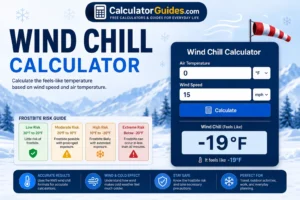
Wind Chill Calculator-Cold weather can feel much colder when the wind is blowing.For example, an air temperature of 0°F (-17.8°C) with a strong wind can feel significantly colder than the actual thermometer reading.Explore our complete collection of Fuel Cost Calculator , Mileage Calculator,Dividend Calculator,Horsepower Calculator, Dew Point Calculator,conversion, and everyday calculators at CalculatorGuides.com to find the right tool for your needs.
🌬️ Wind Chill Calculator - CalculatorGuides
Calculated Wind Chill Index:
A Wind Chill Calculator estimates how cold the outdoor conditions feel based on air temperature and wind speed.
You can use it to calculate:
- Wind chill temperature
- Feels-like temperature
- Cold-weather conditions
- Frostbite risk
- Wind chill in °F
- Wind chill in °C
- Difference between actual temperature and apparent temperature
The National Weather Service defines wind chill as the cooling effect of wind and cold on exposed skin.
Important: Wind chill is an apparent temperature for people and animals. It does not mean that the actual air temperature has changed.
What Is Wind Chill?
Wind chill describes how cold the air feels when both temperature and wind are considered.
When wind blows across exposed skin, it increases the rate at which heat is removed from the body.
As wind speed increases, exposed skin can cool faster.
This is why:
Cold + Wind = Feels Colder
The National Weather Service explains that wind chill is based on the rate of heat loss from exposed skin caused by cold and wind.
Why Does Wind Make It Feel Colder?
Your body continuously transfers heat to the surrounding environment.
When the air is cold, your body loses heat.
Wind can remove the thin layer of relatively warm air surrounding exposed skin, increasing heat loss.
For example:
- Air temperature = 20°F
- Calm wind = feels close to 20°F
- Strong wind = can make it feel considerably colder
The wind does not actually lower the measured air temperature. It increases the rate at which your body loses heat.
Wind Chill Calculator Formula
The commonly used National Weather Service wind-chill formula is:
Wind Chill (°F) = 35.74 + 0.6215T − 35.75(V^0.16) + 0.4275T(V^0.16)
Where:
- T = air temperature in °F
- V = wind speed in mph
- Wind Chill = apparent temperature in °F
The National Weather Service specifies that this formula is used for temperatures at or below 50°F and wind speeds above 3 mph.
Wind Chill Example
Suppose:
Air temperature:
0°F
Wind speed:
15 mph
The wind chill is approximately:
−19°F
So although the actual air temperature is 0°F, exposed skin can experience conditions equivalent to about −19°F in terms of the cooling effect.
The National Weather Service gives this same example and notes that exposed skin can freeze in about 30 minutes under those conditions.
Wind Chill in Celsius
The standard NWS formula uses Fahrenheit and miles per hour.
If your temperature is in Celsius, convert it first:
°F = (°C × 9/5) + 32
After calculating wind chill in Fahrenheit, convert the result back:
°C = (°F − 32) × 5/9
For example:
−10°C
converts to:
14°F
The wind-chill calculation can then be performed using the standard formula.
Wind Speed Conversion
Wind speed may be reported in:
- mph
- km/h
- m/s
- knots
Useful conversion:
1 mph ≈ 1.609 km/h
Therefore:
Wind Speed in km/h = mph × 1.609
For example:
20 mph:
20 × 1.609
≈ 32.2 km/h
Make sure your calculator uses the correct wind-speed unit before calculating wind chill.
Wind Chill vs Actual Temperature
These are not the same measurement.
Actual Temperature
The temperature measured by a thermometer.
Wind Chill
An estimate of how cold conditions feel because of wind and cold.
For example:
Actual temperature: 10°F
Wind chill: −5°F
The thermometer still reads 10°F.
The −5°F value represents the apparent cooling effect on exposed skin.
Does Wind Chill Lower the Actual Temperature?
No.
Wind chill does not lower the actual air temperature.
It describes how quickly your body loses heat.
The National Weather Service also explains that objects such as car radiators and water pipes do not cool below the actual air temperature because of wind chill. Wind can make them cool to the surrounding air temperature faster, but it does not create a temperature below the actual air temperature.
Does Wind Chill Freeze Water?
Wind chill does not make water freeze below the actual air temperature.
For example, if:
Air temperature = 40°F
Wind chill = 30°F
The water does not suddenly experience an actual temperature of 30°F because of wind chill.
The actual temperature remains 40°F.
Water freezes when its actual temperature reaches its freezing point under the relevant conditions.
Wind Chill and Frostbite
Wind chill is important because greater heat loss from exposed skin can increase the risk of frostbite.
Frostbite risk depends on:
- Actual temperature
- Wind speed
- Exposure time
- Clothing
- Skin exposure
- Individual factors
The NWS wind-chill charts include frostbite-time information for certain combinations of temperature and wind speed.
Frostbite Example
Suppose:
Temperature:
0°F
Wind:
15 mph
Wind chill:
−19°F
The National Weather Service indicates that exposed skin can freeze in approximately 30 minutes under these conditions.
This is why exposed skin should be protected during severe cold.
Wind Chill and Hypothermia
Wind chill can increase the rate of heat loss from the body.
Prolonged exposure to cold and wind can contribute to hypothermia, especially when a person is wet, inadequately dressed, exhausted, or exposed for a long period.
Signs of serious cold exposure can include:
- Shivering
- Confusion
- Extreme tiredness
- Poor coordination
- Slurred speech
- Drowsiness
Severe symptoms require immediate medical attention.
Wind Chill and Clothing
Proper clothing can reduce heat loss.
During very cold and windy conditions, useful precautions include:
- Wear multiple layers.
- Cover exposed skin.
- Protect hands and feet.
- Wear a warm hat.
- Keep clothing dry.
- Protect the face in strong winds.
The National Weather Service recommends staying dry and out of the wind and using appropriate layers during extreme cold.
Wind Chill Calculator Example in Celsius
Suppose:
Air temperature:
−10°C
Wind speed:
20 km/h
First convert the values to the units used by the standard formula.
−10°C:
14°F
20 km/h:
12.43 mph
The calculator then estimates the wind chill.
The result will be lower than the actual air temperature because the wind increases the rate of heat loss.
Wind Chill at 32°F
Suppose the air temperature is:
32°F (0°C)
With little or no wind, the apparent temperature remains close to the actual temperature.
As wind speed increases, the wind-chill value decreases.
This illustrates an important point:
Wind chill becomes more significant when cold temperatures combine with stronger winds.
Wind Chill at 20°F
Suppose:
Temperature:
20°F
Wind:
20 mph
The wind chill is approximately:
−2°F
So the conditions can feel substantially colder than the actual 20°F temperature.
Wind Chill at 10°F
Suppose:
Temperature:
10°F
Wind:
20 mph
The wind chill is approximately:
−9°F
This demonstrates how a strong wind can significantly increase the apparent cold.
Wind Chill Chart
A simplified example:
| Air Temperature | Wind Speed | Approx. Wind Chill |
|---|---|---|
| 30°F | 10 mph | 21°F |
| 20°F | 10 mph | 9°F |
| 10°F | 10 mph | −4°F |
| 0°F | 10 mph | −16°F |
| 0°F | 20 mph | −22°F |
| −10°F | 20 mph | −35°F |
Values can vary slightly depending on the calculation method and rounding.
The National Weather Service publishes official wind-chill charts for more detailed combinations.
Wind Chill and Wind Speed
Wind speed is one of the two main inputs.
Generally:
Higher wind speed → greater heat loss → lower wind chill
For example, at the same air temperature:
- Calm wind produces little additional cooling effect.
- Moderate wind produces more cooling.
- Strong wind produces an even greater cooling effect.
The relationship is not linear, so doubling wind speed does not simply double the wind-chill difference.
Wind Chill and Humidity
Humidity is not normally included in the standard NWS wind-chill formula.
NWS research found that relative humidity had an insignificant effect on the wind-chill calculation, so it was left out of the formula for simplicity.
This is different from the Heat Index, where humidity is a major input.
Wind Chill vs Heat Index
These measurements describe opposite weather situations.
Wind Chill
Used for cold weather.
Inputs:
- Air temperature
- Wind speed
Heat Index
Used for hot weather.
Inputs:
- Air temperature
- Relative humidity
So:
Cold + Wind → Wind Chill
Heat + Humidity → Heat Index
Wind Chill vs Dew Point
Dew point measures atmospheric moisture.
Wind chill measures the apparent cooling effect of cold temperatures and wind.
They answer different questions.
Dew Point
“How much moisture is in the air?”
Wind Chill
“How cold can the conditions feel because of wind and cold?”
Wind Chill and Outdoor Activities
Wind chill is useful when planning:
- Hiking
- Camping
- Skiing
- Snowboarding
- Running
- Cycling
- Outdoor work
- Winter travel
- Outdoor sports
A temperature that looks manageable on a weather app may become much more uncomfortable when strong winds are present.
Wind Chill for Winter Sports
People participating in winter sports should consider:
- Actual temperature
- Wind speed
- Wind chill
- Exposure time
- Clothing
- Shelter availability
- Frostbite risk
A wind-chill calculator can help provide a quick estimate, but local weather warnings should take priority.
Wind Chill for Outdoor Workers
People working outside may have prolonged exposure to cold and wind.
Risk can increase when:
- Temperatures are very low.
- Wind speeds are high.
- Clothing becomes wet.
- Workers remain outside for long periods.
- There are limited warm-up areas.
Appropriate workplace cold-weather procedures should be followed.
Wind Chill for Drivers
Wind chill does not directly make a vehicle’s engine or fuel colder than the actual air temperature.
However, very cold actual temperatures can affect:
- Battery performance
- Engine starting
- Tire pressure
- Fluids
- Fuel economy
Wind can make exposed surfaces cool to the surrounding air temperature faster.
Wind Chill and Animals
Wind chill also matters for animals because exposed skin and body surfaces can lose heat faster in cold, windy conditions.
Pets and livestock may need protection from:
- Cold
- Wind
- Wet conditions
- Prolonged exposure
The standard wind-chill index is based on a human-face model, so it should not be treated as an exact measurement of how every animal experiences cold.
Wind Chill and Sunshine
Standard wind-chill calculations generally assume little or no warming effect from sunlight.
Bright sunshine can make conditions feel warmer than the calculated wind chill.
The National Weather Service notes that bright sunshine can increase the apparent wind-chill temperature by roughly 10°F to 18°F under certain conditions.
When Is Wind Chill Defined?
The National Weather Service’s standard wind-chill temperature is defined for:
- Air temperatures at or below 50°F
- Wind speeds above 3 mph
Outside these conditions, the standard wind-chill formula is not intended to provide a meaningful wind-chill value.
Why Doesn’t Wind Chill Apply to Warm Weather?
Wind can make warm weather feel more comfortable by increasing evaporation and heat transfer.
But the standard wind-chill index was specifically designed for cold conditions.
For hot weather, other measures such as heat index or other apparent-temperature indices are more appropriate.
How to Calculate Wind Chill
You need:
- Air temperature
- Wind speed
Step 1
Enter the air temperature.
Step 2
Select °F or °C.
Step 3
Enter wind speed.
Step 4
Select mph, km/h, knots, or another supported unit.
Step 5
Calculate the wind chill.
The calculator converts the inputs into the required units and estimates the apparent temperature.
Wind Chill Formula Summary
The NWS formula is:
WCT = 35.74 + 0.6215T − 35.75(V^0.16) + 0.4275T(V^0.16)
Where:
- WCT = wind chill temperature in °F
- T = air temperature in °F
- V = wind speed in mph
The formula is intended for the specified cold-temperature and wind-speed range.
Common Wind Chill Calculation Mistakes
Confusing Wind Chill With Actual Temperature
Wind chill is a feels-like temperature, not the measured air temperature.
Using Wind Chill Above the Valid Range
The standard NWS formula is intended for temperatures at or below 50°F and wind speeds above 3 mph.
Forgetting Wind-Speed Units
10 mph and 10 km/h are not the same wind speed.
Assuming Wind Chill Freezes Objects
Wind chill does not cool objects below the actual air temperature.
Ignoring Exposure Time
A wind-chill number alone does not tell the complete story. Exposure duration and exposed skin matter.
Ignoring Sunlight
Bright sunshine can make conditions feel warmer than the standard wind-chill value suggests.
Frequently Asked Questions
What is a Wind Chill Calculator?
A Wind Chill Calculator estimates how cold outdoor conditions feel by combining air temperature and wind speed.
What is wind chill?
Wind chill is the apparent temperature caused by the combined effects of cold air and wind on exposed skin.
How is wind chill calculated?
The standard NWS calculation uses air temperature in Fahrenheit and wind speed in miles per hour.
What is the wind chill formula?
The commonly used NWS formula is:
WCT = 35.74 + 0.6215T − 35.75(V^0.16) + 0.4275T(V^0.16)
Does wind chill change the actual temperature?
No. The actual air temperature remains unchanged.
Does wind chill freeze water?
No. Wind chill does not make water colder than the actual air temperature.
Can wind chill cause frostbite?
Cold and wind can increase heat loss from exposed skin and therefore increase frostbite risk. The risk also depends on exposure time and other conditions.
What temperature is considered dangerous with wind chill?
There is no single universal danger number for everyone. Increasingly low wind chills and longer exposure increase the risk of cold injury. Follow local official warnings.
Does humidity affect wind chill?
Humidity is not included in the standard NWS wind-chill formula because its effect was found to be insignificant for the index.
Does sunlight affect wind chill?
Bright sunshine can make conditions feel warmer than the standard wind-chill calculation suggests.
Can I calculate wind chill in Celsius?
Yes. The temperature can be converted between Celsius and Fahrenheit.
Can I use km/h instead of mph?
Yes, if the calculator converts the wind speed correctly before applying the standard formula.
What is the difference between wind chill and heat index?
Wind chill describes cold conditions affected by wind, while heat index describes hot conditions affected by humidity.
Is wind chill the same as feels-like temperature?
Wind chill is one type of feels-like or apparent temperature used for cold conditions.
Does wind chill apply to cars?
No. Wind chill is designed to describe the effect of wind and cold on people and animals. Objects can cool faster in wind but cannot cool below the actual air temperature because of wind chill.
Is the Wind Chill Calculator accurate?
The calculation is accurate when used within the formula’s intended range and with correct inputs. Real-world heat loss can vary because of clothing, exposure, sunlight, activity, and individual factors.
Is the Wind Chill Calculator free?
Yes. The CalculatorGuides.com Wind Chill Calculator is free to use.
Wind Chill Calculator – Important Things to Remember
For the best result, enter:
- Accurate air temperature
- Correct temperature unit
- Accurate wind speed
- Correct wind-speed unit
Also consider:
- Exposure time
- Amount of exposed skin
- Clothing
- Wet conditions
- Sunlight
- Physical activity
- Shelter from wind
For severe cold, follow official weather warnings rather than relying on a calculator alone.
Conclusion
A Wind Chill Calculator helps you understand why cold weather can feel much colder when wind is present.
The calculation combines air temperature and wind speed to estimate the apparent cooling effect on exposed skin. The standard National Weather Service formula is intended for cold conditions, specifically temperatures at or below 50°F and wind speeds above 3 mph.
For example, when the air temperature is 0°F and the wind speed is 15 mph, the wind chill is approximately −19°F. Under those conditions, exposed skin can be at significant frostbite risk, so appropriate protection is important.
Remember that wind chill is not the actual air temperature. It does not make water, cars, pipes, or other objects colder than the actual air temperature. It describes the increased rate of heat loss caused by wind and cold.
Use the CalculatorGuides.com Wind Chill Calculator to quickly estimate the feels-like temperature from air temperature and wind speed and better understand cold-weather conditions.