
Sleep Calculator-Use our free Sleep Calculator to find recommended bedtimes and wake-up times based on sleep duration and sleep cycles. Learn about sleep cycles, sleep needs, and better sleep habits.Explore our complete collection of Fuel Cost Calculator , Mileage Calculator,Dividend Calculator,Horsepower Calculator, Dew Point Calculator,conversion, and everyday calculators at CalculatorGuides.com to find the right tool for your needs.
🌙 Sleep Cycle & Bedtime Calculator - CalculatorGuides
Recommended Bedtimes to Wake Up Refreshed:
A Sleep Calculator helps you plan a bedtime or wake-up time based on your desired sleep duration.
Getting enough sleep is an important part of everyday health and wellbeing. However, simply spending a certain number of hours in bed does not always mean you will get the same amount of quality sleep.
Our Sleep Calculator can help you estimate:
- Recommended bedtime
- Recommended wake-up time
- Total sleep duration
- Possible sleep-cycle timing
- Sleep schedule options
- Time needed to fall asleep
You can use it when planning your schedule for work, school, travel, exercise, or an early morning start.
Important: A sleep calculator provides an estimate. Sleep cycles are not exactly the same length for everyone or every night. Your individual sleep needs can also vary by age and other factors.
What Is a Sleep Calculator?
A Sleep Calculator is a simple tool that works backward or forward from your desired sleep time.
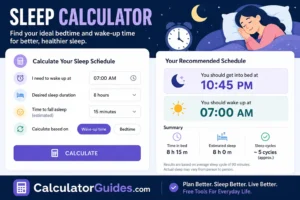
For example, if you need to wake up at:
7:00 AM
you can calculate possible bedtimes based on your desired amount of sleep.
If you want:
8 hours of sleep
a simple calculation gives:
11:00 PM bedtime
If you usually need 15 minutes to fall asleep, you could consider getting into bed around:
10:45 PM
This is a planning estimate, not a guarantee that you will fall asleep at exactly that time.
How Much Sleep Do You Need?
Sleep needs vary by age.
General recommendations from the CDC include:
| Age Group | Recommended Sleep |
|---|---|
| Newborns | 14–17 hours |
| Infants | 12–16 hours, including naps |
| Toddlers | 11–14 hours, including naps |
| Preschool children | 10–13 hours, including naps |
| School-age children | 9–12 hours |
| Teenagers | 8–10 hours |
| Adults 18–60 | 7 or more hours |
| Adults 61–64 | 7–9 hours |
| Adults 65+ | 7–8 hours |
Individual sleep needs can vary.
For most adults, regularly getting less than the recommended amount is not a good sleep strategy simply because a calculator shows a convenient wake-up time.
How Does a Sleep Calculator Work?
There are two common ways to use a sleep calculator.
Wake-Up Time Method
Enter the time you need to wake up.
The calculator works backward to suggest possible bedtimes.
Bedtime Method
Enter the time you plan to go to bed.
The calculator works forward to suggest possible wake-up times.
A useful calculator can also allow you to add the approximate time it takes to fall asleep.
Sleep Calculator Based on Sleep Duration
Suppose you need to wake up at:
6:30 AM
and want:
8 hours of sleep.
Your approximate sleep time would be:
10:30 PM to 6:30 AM
If you normally take 15 minutes to fall asleep, getting into bed around:
10:15 PM
could provide an opportunity for approximately eight hours of sleep.
Sleep Calculator for 7 Hours
If your target wake-up time is:
7:00 AM
and you want:
7 hours of sleep:
Bedtime = 12:00 AM
If you need about 15 minutes to fall asleep:
Get into bed around 11:45 PM.
Remember that seven hours is a general minimum recommendation for many adults, not necessarily the ideal amount for every person.
Sleep Calculator for 8 Hours
Wake-up time:
7:00 AM
Desired sleep:
8 hours
Approximate bedtime:
11:00 PM
If you normally take 15 minutes to fall asleep:
Bedtime routine/get into bed around 10:45 PM.
Sleep Calculator for 9 Hours
Wake-up time:
7:00 AM
Desired sleep:
9 hours
Approximate bedtime:
10:00 PM
If you need 15 minutes to fall asleep:
Get into bed around 9:45 PM.
Nine hours may be appropriate for some people, especially depending on age and individual circumstances.
Sleep Calculator for an Early Wake-Up
Suppose you need to wake up at:
5:00 AM
For 8 hours of sleep:
9:00 PM bedtime
For 7 hours:
10:00 PM bedtime
For 9 hours:
8:00 PM bedtime
If you need time to fall asleep, start your bedtime routine earlier.
Sleep Calculator for 6 AM Wake-Up
If you need to wake up at:
6:00 AM
then:
| Sleep Goal | Approx. Bedtime |
|---|---|
| 7 hours | 11:00 PM |
| 8 hours | 10:00 PM |
| 9 hours | 9:00 PM |
These times are based on the assumption that you are asleep for the entire period.
Sleep Calculator for 7 AM Wake-Up
For a 7:00 AM wake-up:
| Sleep Goal | Approx. Bedtime |
|---|---|
| 7 hours | 12:00 AM |
| 8 hours | 11:00 PM |
| 9 hours | 10:00 PM |
If you need time to fall asleep, get into bed earlier.
Sleep Calculator for 8 AM Wake-Up
For an 8:00 AM wake-up:
| Sleep Goal | Approx. Bedtime |
|---|---|
| 7 hours | 1:00 AM |
| 8 hours | 12:00 AM |
| 9 hours | 11:00 PM |
A consistent sleep schedule can be more useful than trying to find a theoretically perfect bedtime.
What Is a Sleep Cycle?
Sleep occurs in repeating periods involving different stages.
A typical sleep cycle includes:
- Non-REM sleep
- REM sleep
During the night, you move through these stages repeatedly.
The National Heart, Lung, and Blood Institute explains that sleep cycles repeat several times during a typical night and that REM and non-REM sleep have different characteristics.
Are Sleep Cycles Exactly 90 Minutes?
You may have heard that every sleep cycle lasts exactly 90 minutes.
That is an oversimplification.
Sleep cycles can vary in length during the night and between individuals.
Therefore, a calculator that assumes every person has exactly four or five 90-minute cycles should be treated as a rough planning tool rather than a scientifically precise measurement.
Sleep Cycle Calculator
Some sleep calculators use an approximate cycle length of:
90 minutes
For example:
5 cycles × 90 minutes = 450 minutes
450 minutes equals:
7.5 hours
However, this should not be interpreted as your body’s exact sleep-cycle requirement.
Actual sleep architecture is more variable.
Sleep Calculator With 90-Minute Cycles
If a calculator uses a simplified 90-minute cycle model, possible sleep durations might include:
- 4 cycles = 6 hours
- 5 cycles = 7.5 hours
- 6 cycles = 9 hours
These are mathematical estimates.
For most adults, regularly targeting only six hours because it represents four 90-minute cycles is not a good general recommendation.
The total amount of sleep matters too.
Why Sleep Duration Matters
Sleep supports many important functions, including:
- Memory
- Learning
- Attention
- Mood
- Physical recovery
- Immune function
- General health
The CDC notes that sufficient sleep is important for health and wellbeing.
Sleep Calculator and Sleep Quality
Sleep quantity is only one part of good sleep.
Sleep quality can also be affected by:
- Frequent awakenings
- Noise
- Light
- Temperature
- Stress
- Caffeine
- Alcohol
- Irregular schedules
- Sleep disorders
Someone who spends eight hours in bed but repeatedly wakes up may not get the same quality of sleep as someone who sleeps continuously.
Bedtime Calculator
A bedtime calculator can work backward from your required wake-up time.
For example:
Wake-up:
6:30 AM
Sleep goal:
8 hours
Bedtime:
10:30 PM
Add a 15-minute sleep-onset period:
10:15 PM in bed
This gives you time to fall asleep while still aiming for approximately eight hours of actual sleep.
Wake-Up Time Calculator
You can also work forward.
Suppose you go to bed at:
10:30 PM
If you sleep for:
8 hours
your approximate wake-up time is:
6:30 AM
If it takes 15 minutes to fall asleep, you could set your schedule around:
10:15 PM in bed → 6:30 AM wake-up
Sleep Calculator for Children
Children generally need more sleep than adults.
The recommended amount varies substantially by age.
For example:
- School-age children generally need 9–12 hours
- Teenagers generally need 8–10 hours
Parents should use age-appropriate sleep recommendations rather than applying an adult sleep target to children.
Sleep Calculator for Teenagers
Teenagers generally need:
8–10 hours of sleep per 24 hours.
If a teenager needs to wake at 6:30 AM and aims for 9 hours of sleep, the approximate sleep time would begin around:
9:30 PM
Real-world schedules may be affected by school, homework, activities, and natural changes in sleep timing during adolescence.
Sleep Calculator for Adults
For adults aged 18–60, the CDC recommends 7 or more hours of sleep per night.
A practical sleep schedule can therefore start by identifying:
- Your required wake-up time
- Your target sleep duration
- Your approximate time needed to fall asleep
- A consistent bedtime routine
Sleep Calculator for Seniors
Sleep needs can change with age.
The CDC recommends:
- 7–9 hours for adults aged 61–64
- 7–8 hours for adults aged 65 and older
Individual needs still vary.
Sleep Calculator and Naps
Naps can be useful for some people, but they do not necessarily replace adequate nighttime sleep.
If you regularly need long or frequent naps despite getting enough time in bed, it may be worth discussing the issue with a healthcare professional.
Sleep Calculator and Bedtime Routine
Going to bed at the right time is only part of the process.
A consistent routine can help prepare your body for sleep.
You can try:
- Going to bed at a similar time
- Waking at a similar time
- Keeping your bedroom comfortable
- Reducing bright light before bed
- Limiting caffeine later in the day
- Avoiding heavy meals close to bedtime
The CDC recommends maintaining a consistent sleep schedule and creating a comfortable, quiet, relaxing sleep environment.
Sleep Calculator and Caffeine
Caffeine can interfere with sleep, particularly when consumed later in the day.
If you have trouble falling asleep, consider how much caffeine you consume and when you consume it.
Common sources include:
- Coffee
- Tea
- Energy drinks
- Cola
- Chocolate
- Some medications
Individual sensitivity varies.
Sleep Calculator and Screens
Phones, computers, tablets, and televisions can make it harder for some people to wind down before bed.
A relaxing pre-sleep routine can be more useful than simply calculating a bedtime.
Consider reducing stimulating activities before going to bed.
Sleep Calculator and Exercise
Regular physical activity can support healthy sleep for many people.
However, the timing and intensity of exercise can affect individuals differently.
If intense exercise close to bedtime makes it harder for you to fall asleep, consider moving the workout earlier.
Sleep Calculator and Alcohol
Alcohol can make some people feel sleepy initially but can negatively affect sleep quality and cause nighttime awakenings.
If sleep quality is a concern, consider whether alcohol is affecting your sleep pattern.
Sleep Calculator for Shift Workers
People who work nights or rotating shifts may have different sleep schedules.
A calculator can help organize a target sleep period, but shift work can make maintaining a consistent schedule difficult.
Useful factors include:
- Work schedule
- Commute
- Daylight exposure
- Bedroom darkness
- Noise
- Sleep duration
Sleep Calculator for Travel
A sleep calculator can also help when planning sleep around travel.
For example, before an early flight, you can calculate the bedtime needed to get enough sleep before your departure.
For long-distance travel, however, time-zone changes can disrupt your normal sleep schedule.
Sleep Calculator and Jet Lag
Jet lag occurs when your internal body clock is out of sync with the local time after traveling across time zones.
A calculator cannot eliminate jet lag, but planning sleep and wake times around your destination’s time zone can help organize your schedule.
What Is a Good Bedtime?
There is no single bedtime that is perfect for everyone.
A good bedtime depends on:
- Your wake-up time
- Your sleep needs
- Your daily schedule
- Your natural sleep timing
- Your age
- Your work or school commitments
The most important goal is generally getting enough good-quality sleep on a consistent basis.
What Is a Good Wake-Up Time?
A good wake-up time is one that allows you to get enough sleep and fits your daily schedule.
For example, waking at 6 AM is not automatically healthier than waking at 8 AM.
If you wake at 6 AM but regularly sleep only five or six hours, the earlier wake-up time may work against adequate sleep.
How Much Sleep Should I Get?
There is no single number for everyone.
For adults aged 18–60, the general recommendation is 7 or more hours per night.
Your individual sleep need may be different.
If you regularly feel tired despite allowing enough time for sleep, consider speaking with a healthcare professional.
Sleep Calculator Formula
The simplest calculation is:
Bedtime = Wake-Up Time − Desired Sleep Duration
For example:
Wake-up time:
7:00 AM
Sleep duration:
8 hours
Bedtime:
11:00 PM
If you need 15 minutes to fall asleep:
Get into bed around 10:45 PM.
Sleep Time Calculation
Another simple formula is:
Sleep Duration = Wake-Up Time − Sleep Start Time
Example:
Sleep:
11:00 PM
Wake:
7:00 AM
Sleep opportunity:
8 hours
This assumes you fall asleep immediately.
Sleep Calculator With Sleep-Onset Time
If you normally take 20 minutes to fall asleep:
Bedtime = Required Sleep Start − 20 minutes
Example:
Desired sleep:
8 hours
Wake-up:
6:00 AM
Required sleep start:
10:00 PM
Approximate time to get into bed:
9:40 PM
This gives you approximately 20 minutes to fall asleep.
Common Sleep Calculator Mistakes
Treating 90 Minutes as an Exact Sleep Cycle
Sleep cycles vary. A fixed 90-minute calculation is only an approximation.
Getting Too Little Sleep
Choosing a bedtime only because it completes a certain number of “cycles” can lead to insufficient sleep.
Ignoring Sleep-Onset Time
The time you get into bed is not necessarily the time you fall asleep.
Ignoring Age
Children and teenagers generally need more sleep than adults.
Focusing Only on the Calculator
A calculator cannot measure sleep quality or diagnose sleep problems.
Changing Your Schedule Constantly
A consistent sleep schedule can be helpful.
Frequently Asked Questions
What is a Sleep Calculator?
A Sleep Calculator helps estimate when you should go to bed or wake up based on your desired sleep duration.
How many hours should adults sleep?
Adults aged 18–60 generally need 7 or more hours per night according to CDC recommendations.
Is 8 hours of sleep enough?
Eight hours falls within a common healthy sleep range for adults, but individual needs vary.
Is 7 hours enough?
For adults aged 18–60, the CDC recommends 7 or more hours. Some people may need more.
Is 9 hours too much?
Not necessarily. Sleep needs vary by age and individual circumstances. Certain age groups naturally require more sleep.
Are sleep cycles exactly 90 minutes?
No. Sleep cycles vary in length, so 90 minutes should be treated as a rough estimate rather than an exact biological rule.
What time should I go to bed if I wake at 6 AM?
For 8 hours of sleep, approximately 10 PM. If you need time to fall asleep, get into bed earlier.
What time should I go to bed if I wake at 7 AM?
For 8 hours of sleep, approximately 11 PM.
What time should I go to bed if I wake at 8 AM?
For 8 hours of sleep, approximately 12 AM.
Can a Sleep Calculator improve sleep?
It can help you plan a consistent schedule, but it cannot guarantee better sleep.
Does a Sleep Calculator account for sleep cycles?
Some calculators do, usually by using an approximate cycle length. However, actual sleep cycles vary.
Should I wake up at the end of a sleep cycle?
There is no reliable way for a simple calculator to know exactly when your individual sleep cycle ends. Getting adequate total sleep is more important than relying on an exact 90-minute cycle calculation.
Can I use a Sleep Calculator for children?
Yes, but use age-appropriate sleep recommendations. Children generally require more sleep than adults.
What if I sleep enough but still feel tired?
Persistent tiredness can have many causes. If you regularly feel tired despite getting enough sleep, consider discussing it with a healthcare professional.
Is the Sleep Calculator accurate?
It is accurate as a time-calculation tool, but it cannot predict exactly when you will fall asleep or how your individual sleep cycles will behave.
Is the Sleep Calculator free?
Yes. The CalculatorGuides.com Sleep Calculator is free to use.
Sleep Calculator – Important Things to Remember
A good sleep schedule should consider:
- Age
- Required sleep duration
- Wake-up time
- Time needed to fall asleep
- Sleep consistency
- Sleep environment
- Lifestyle
- Work or school schedule
Do not sacrifice recommended sleep time simply to match an estimated sleep-cycle schedule.
If you regularly have trouble falling asleep, staying asleep, wake too early, or feel excessively tired during the day, consider talking with a healthcare professional.
Conclusion
A Sleep Calculator is a useful planning tool for finding an approximate bedtime or wake-up time based on how much sleep you want.
For example, if you need to wake at 7:00 AM and want 8 hours of sleep, a simple calculation gives a bedtime of approximately 11:00 PM. If you usually need 15 minutes to fall asleep, you could get into bed around 10:45 PM.
Sleep cycles can be useful for understanding how sleep works, but they should not be treated as fixed 90-minute periods. Your sleep cycles can vary throughout the night and from one person to another.
The most important goal is to allow enough time for quality sleep consistently. For most adults, that means at least 7 hours per night, while children and teenagers generally need more.
Use the CalculatorGuides.com Sleep Calculator to plan your sleep schedule, choose a practical bedtime, and build a routine that gives you enough time to rest.