
NSC Calculator-The National Savings Certificate (NSC) is a government-backed small savings investment designed for people who want a fixed-term investment with predictable returns.Looking for more free online calculators? Explore our complete collection of Gold Rate Calculator, NPS Calculator ,Long Term Capital Gain Tax Calculator, Short Term Capital Gain Tax Calculator,Gold Loan Calculator,conversion and everyday calculators at CalculatorGuides to find the right tool for your needs.
🚀 CalculatorGuides - NSC Calculator
📊 NSC Results
But calculating the final maturity amount manually can be confusing. An NSC Calculator helps you estimate:
- NSC maturity amount
- Interest earned
- Investment growth
- Annual interest
- Total return
- Tax-related benefits
- Maturity value after the investment period
At CalculatorGuides.com, our NSC Calculator is designed to make the calculation simple and easy to understand.
Important: Interest rates and small-savings rules can change. Always verify the current NSC interest rate and applicable rules with India Post or the Ministry of Finance before investing.
What Is NSC?
NSC stands for National Savings Certificate.
It is a fixed-income savings product available through India Post.
NSC is commonly considered by investors who want:
- Government-backed savings
- A fixed investment period
- Predictable interest
- Tax-saving eligibility under applicable rules
- A relatively simple investment product
NSC has a standard maturity period of 5 years for certificates issued under the current scheme framework.
What Is an NSC Calculator?
An NSC Calculator estimates how much your investment may grow by maturity.
You normally enter:
- Investment amount
- NSC interest rate
- Investment period
The calculator can then estimate:
- Total maturity amount
- Interest earned
- Effective investment growth
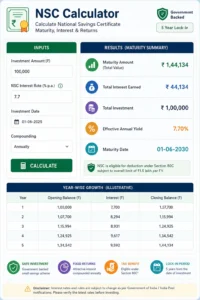
For example, if you invest ₹1,00,000 and the applicable annual interest rate is 7.7%, the calculator can estimate the value at the end of five years using the NSC compounding rules.
NSC Interest Rate
NSC interest rates are set by the Government of India and can change periodically.
For the current applicable rate, check the latest official information from India Post or the Ministry of Finance before entering the rate into the calculator.
Do not assume that a rate shown on an old article is still current.
This is particularly important because small-savings interest rates can be revised for different quarters.
How Does NSC Interest Work?
NSC interest is compounded annually.
The interest is generally treated as reinvested during the first four years.
At maturity, the investor receives the accumulated amount according to the applicable scheme rules.
This means the final value is higher than simply adding the annual interest amount to the original investment.
NSC Calculation Formula
A simplified compound-interest calculation can be represented as:
Maturity Value = Principal × (1 + r)ⁿ
Where:
- Principal = Initial NSC investment
- r = Annual interest rate
- n = Number of years
However, NSC has specific scheme rules concerning annual interest and maturity, so an NSC calculator should use the appropriate NSC calculation method rather than treating every investment like an ordinary bank deposit.
NSC Calculator Example
Suppose:
Investment:
₹1,00,000
Annual interest rate:
7.7%
Period:
5 years
Using annual compounding as an illustration:
Year 1 interest:
₹1,00,000 × 7.7%
= ₹7,700
The interest is added to the investment for calculation in subsequent years.
The final maturity value can therefore be significantly higher than the original ₹1 lakh investment.
The exact maturity amount should be calculated using the applicable NSC scheme rules and rate.
NSC Interest Calculation
A simplified yearly illustration at 7.7% would look like this:
| Year | Approx. Value |
|---|---|
| Initial Investment | ₹1,00,000 |
| After Year 1 | ₹1,07,700 |
| After Year 2 | ₹1,15,387 |
| After Year 3 | ₹1,24,272 |
| After Year 4 | ₹1,33,837 |
| After Year 5 | ₹1,44,134 |
This is a mathematical illustration using annual compounding. Actual NSC maturity calculations should follow the applicable certificate rules.
NSC Maturity Period
The standard maturity period for an NSC issued under the current scheme is:
5 years
The maturity date is determined according to the certificate’s issue date and applicable rules.
For example, an NSC purchased in August 2026 would generally mature after the applicable five-year period.
Always check the maturity date mentioned on your certificate or official account.
NSC Investment Limit
There is generally no maximum investment limit for purchasing NSC.
However, there can be a minimum investment requirement and prescribed denomination rules.
The tax deduction under Section 80C has its own annual limit.
This means:
Investment limit ≠ Tax deduction limit
These two concepts should not be confused.
Minimum NSC Investment
NSC can generally be purchased in prescribed denominations, with the minimum investment starting from a relatively small amount.
Additional certificates can be purchased in multiples of the prescribed denomination.
Check the latest India Post rules for the current minimum amount and denomination requirements.
NSC Tax Benefit
Investment in NSC can qualify for a deduction under Section 80C, subject to the applicable conditions and overall Section 80C limit.
The combined Section 80C deduction limit is:
₹1.5 lakh per financial year
This limit is shared with other eligible investments and payments.
For example, if you already have:
- EPF contributions
- Life insurance premiums
- Eligible tuition fees
- PPF contributions
you may not be able to claim an additional ₹1.5 lakh separately for NSC.
The total eligible Section 80C amount is subject to the applicable overall limit.
Is NSC Interest Taxable?
NSC interest is taxable according to the applicable income-tax rules.
Unlike some tax-free investment products, NSC interest should not automatically be treated as tax-free.
The interest that is deemed reinvested can have specific treatment under the tax rules.
Always consider your tax slab and current income-tax provisions when calculating the after-tax return.
NSC and Section 80C
NSC can be used as one of the eligible investments for Section 80C tax planning, subject to the applicable rules.
The Section 80C limit is shared across several investments and expenses.
Therefore, if your other eligible Section 80C deductions already reach ₹1.5 lakh, additional NSC investment generally will not create another ₹1.5 lakh deduction.
NSC Tax Benefit Example
Suppose you invest:
₹1,00,000
and you have enough unused Section 80C eligibility.
The qualifying investment can potentially be included within the overall Section 80C limit.
If your applicable tax rate is 20%, the theoretical tax saving on a ₹1 lakh eligible deduction could be:
₹1,00,000 × 20%
= ₹20,000
This is only an illustration.
The actual tax benefit depends on your taxable income, tax regime, available Section 80C limit, and applicable tax rules.
NSC Under the New Tax Regime
Tax deductions differ between the old and new income-tax regimes.
Section 80C deductions are generally associated with the old tax regime, subject to the applicable conditions.
Therefore, before investing in NSC specifically for tax savings, check whether you are using the old or new tax regime and whether the deduction is available to you.
Do not assume that every NSC investor receives a Section 80C tax benefit regardless of tax regime.
NSC vs PPF
NSC and PPF are both government-backed savings options, but they work differently.
| Feature | NSC | PPF |
|---|---|---|
| Maturity | 5 years | 15 years |
| Interest | Fixed for applicable issue period | Government-set rate |
| Tax deduction | Eligible under 80C subject to rules | Eligible under 80C subject to rules |
| Interest taxation | Taxable under applicable rules | Generally exempt subject to applicable rules |
| Investment style | Fixed-term certificate | Long-term account |
| Liquidity | More limited | Partial withdrawal rules apply |
Choose based on your goal rather than looking only at the interest rate.
NSC vs Fixed Deposit
NSC and bank fixed deposits can both provide predictable returns, but they are not identical.
| Feature | NSC | Fixed Deposit |
|---|---|---|
| Issuer | India Post/Government small-savings framework | Bank |
| Standard NSC term | 5 years | Depends on FD |
| Interest | Government-notified | Bank-specific |
| Tax benefit | Eligible NSC investment can qualify under 80C | Only qualifying tax-saving FDs under applicable rules |
| Interest tax | Taxable under applicable rules | Taxable under applicable rules |
| Premature withdrawal | Restricted | Depends on bank/product |
NSC vs SCSS
SCSS stands for Senior Citizens Savings Scheme.
SCSS is designed specifically for eligible senior citizens, while NSC is not restricted in the same way.
The two products also have different:
- Maturity periods
- Interest-payment structures
- Eligibility rules
- Tax treatment
Choose according to your age, income needs, and investment objective.
NSC vs KVP
KVP stands for Kisan Vikas Patra.
KVP and NSC are both small-savings products, but their maturity structures and purposes differ.
NSC has a standard five-year maturity under the current scheme, while KVP is designed around a specified doubling/maturity period determined by the prevailing rules.
Check the current rates before comparing the two.
Can You Buy NSC Online?
India Post provides digital banking and other services through its official systems, but availability of NSC purchase through a particular digital channel can depend on the current service structure.
NSC can be purchased through eligible India Post offices subject to the applicable rules.
Check the latest India Post instructions before relying on a particular purchase method.
Who Should Consider NSC?
NSC may be suitable for investors who prefer:
- Fixed-income investments
- A five-year investment horizon
- Government-backed small savings
- Predictable interest
- Potential Section 80C eligibility under applicable rules
- Lower market risk than equity investments
It may be less suitable for someone who needs high liquidity or is looking for equity-like long-term growth.
NSC for Tax Saving
NSC is commonly considered for tax planning because eligible investments can qualify under Section 80C.
However, tax saving should not be the only reason to invest.
Compare:
- Your tax regime
- Existing Section 80C investments
- Liquidity needs
- Investment horizon
- Expected returns
- Alternative investments
NSC Interest Reinvestment
One special feature of NSC is the treatment of annual interest.
The interest is generally considered reinvested during the first four years, subject to the applicable rules.
This helps explain why the maturity amount is higher than:
Principal + One Year’s Interest × 5
Compound growth is important when estimating the final value.
NSC Calculator With Monthly Savings
NSC is not normally structured like a monthly SIP.
Instead, you generally invest a lump sum by purchasing certificates.
If you want to invest every month, you would need to make separate purchases, each with its own investment date and applicable maturity calculation.
A standard NSC Calculator normally calculates one investment amount at a time.
NSC Maturity Example
Suppose you invest:
₹2,00,000
at an illustrative annual rate of:
7.7%
The investment compounds according to the NSC rules.
A simple compound-interest illustration would produce approximately:
₹2,88,268 after five years
The exact maturity value should be verified using the applicable certificate calculation and official rate.
NSC Calculator for ₹5 Lakh
Suppose:
Investment:
₹5,00,000
Illustrative rate:
7.7%
Term:
5 years
A simplified compound calculation gives approximately:
₹7.21 lakh
The exact maturity amount depends on the applicable NSC issue rate and calculation rules.
NSC Calculator for ₹10 Lakh
Suppose:
Investment:
₹10,00,000
Illustrative annual rate:
7.7%
Term:
5 years
A simplified compound calculation gives approximately:
₹14.41 lakh
This is an illustration, not a guarantee of the maturity amount.
NSC and Inflation
NSC provides a fixed nominal return, but inflation reduces purchasing power over time.
For example, if an investment grows by 7.7% while inflation averages 6%, the real increase in purchasing power is much smaller than 7.7%.
This is important when planning long-term financial goals.
NSC and Real Return
A simplified approximation is:
Real Return ≈ NSC Interest Rate − Inflation Rate
For example:
NSC rate:
7.7%
Inflation:
6%
Approximate real return:
1.7%
The exact real return is calculated using:
Real Return = (1 + Nominal Return) ÷ (1 + Inflation) − 1
This gives a more accurate view of purchasing-power growth.
How to Use the NSC Calculator
Step 1: Enter Investment Amount
Enter the amount you want to invest.
Step 2: Enter Interest Rate
Use the current NSC interest rate applicable to the certificate.
Step 3: Enter Investment Date
The investment date helps determine the applicable certificate period.
Step 4: Calculate
The calculator estimates:
- Total investment
- Interest earned
- Maturity value
- Approximate annual growth
Step 5: Consider Tax
If you are using NSC for tax planning, check your Section 80C eligibility and tax regime separately.
NSC Calculator Formula Summary
Basic Compound Growth
Maturity Value = Principal × (1 + r)ⁿ
Where:
- P = Principal
- r = annual interest rate
- n = number of years
Interest Earned
Interest = Maturity Value − Principal
Real Return
Real Return = [(1 + Return) ÷ (1 + Inflation)] − 1
The actual NSC maturity calculation should follow the official NSC scheme rules.
Common NSC Calculation Mistakes
Using an Old Interest Rate
NSC rates can change for new investments.
Confusing Investment Limit With Section 80C Limit
The ₹1.5 lakh figure relates to the overall Section 80C deduction limit, not the maximum amount you can invest in NSC.
Assuming Interest Is Tax-Free
NSC interest is taxable under applicable income-tax rules.
Ignoring Your Tax Regime
Section 80C deductions are generally relevant under the old tax regime.
Treating NSC Like an SIP
NSC is normally a lump-sum certificate investment rather than a monthly SIP.
Ignoring Inflation
A nominal return does not tell you the entire story.
Frequently Asked Questions
What is NSC?
NSC stands for National Savings Certificate, a government-backed small-savings investment available through India Post.
What is the NSC maturity period?
The standard maturity period for the current NSC framework is 5 years.
Is NSC interest compounded?
Yes. NSC interest is compounded annually under the applicable scheme rules.
What is the current NSC interest rate?
The rate can change periodically. Check the latest official India Post or Ministry of Finance notification before investing.
Is NSC tax-free?
No. NSC interest is taxable according to the applicable income-tax rules.
Is NSC eligible for Section 80C?
Eligible NSC investment can qualify for Section 80C deduction, subject to the applicable conditions and overall limit.
What is the Section 80C limit?
The overall Section 80C deduction limit is ₹1.5 lakh per financial year, subject to the applicable rules.
Can I invest more than ₹1.5 lakh in NSC?
The Section 80C limit is not the same as the investment limit. You may be able to invest more, but the amount eligible for Section 80C deduction is subject to the applicable overall limit.
Can I withdraw NSC before maturity?
NSC is designed as a fixed-term investment. Premature encashment is restricted and permitted only in specified circumstances under the applicable rules.
Is NSC better than PPF?
Neither is automatically better. NSC has a five-year maturity, while PPF is designed for a much longer period. Your goal and liquidity requirements matter.
Is NSC better than FD?
It depends on the interest rate, tax treatment, liquidity, safety preference and investment goal.
Can senior citizens invest in NSC?
Yes, NSC is not limited only to senior citizens, subject to the general eligibility rules.
Can I buy NSC for my child?
NSC can be held on behalf of minors according to the applicable India Post rules.
Can I buy NSC every year?
Yes, you can make new NSC investments, with each investment following the applicable rules and rate for the relevant issue.
Can I invest monthly in NSC?
NSC is normally purchased as certificates rather than as a monthly SIP. You can make separate purchases if you want to invest periodically.
Is NSC interest included in taxable income?
NSC interest is taxable according to the applicable income-tax rules.
Can NSC save income tax?
Eligible NSC investment can qualify for Section 80C deduction under the applicable tax regime and conditions.
Is NSC useful under the new tax regime?
Section 80C deductions generally do not provide the same benefit under the new tax regime. Check the current rules before investing for tax-saving purposes.
Is the NSC Calculator accurate?
The calculator is mathematically accurate based on the rate and inputs entered, but the actual maturity amount depends on the applicable NSC issue rate and official scheme rules.
Is the NSC Calculator free?
Yes. The CalculatorGuides.com NSC Calculator is free to use.
NSC Calculator – Things to Check Before Investing
Before purchasing NSC, check:
- Current interest rate
- Maturity date
- Investment amount
- Section 80C eligibility
- Tax regime
- Interest taxation
- Liquidity requirements
- Existing tax-saving investments
- Inflation
- Alternative investments
For the latest rules, verify information with India Post or the Ministry of Finance.
Conclusion
The NSC Calculator helps you estimate how a National Savings Certificate investment can grow over its five-year maturity period.
NSC can be useful for investors who want a government-backed fixed-income investment with a predictable maturity structure. Eligible investments can also provide a Section 80C deduction, subject to the overall ₹1.5 lakh annual limit and applicable tax rules.
However, the tax benefit should not be confused with tax-free interest. NSC interest is taxable under the applicable income-tax rules.
The most important number to enter into the calculator is the current NSC interest rate applicable to your investment. Small-savings rates can change, so an old rate should not be used for a new investment.
Use the CalculatorGuides.com NSC Calculator to estimate your investment growth, interest earned and maturity value, and then compare the result with your financial goals, tax situation and investment horizon.