
Short Term Capital Gain Tax Calculator-When you sell an investment or asset for more than its cost within the applicable short-term holding period, the profit may be treated as a Short Term Capital Gain (STCG).Looking for more free online calculators? Explore our complete collection of EMI calculator, NPS Calculator ,Long Term Capital Gain Tax Calculator, Currency Converter,Gold Loan Calculator,conversion and everyday calculators at CalculatorGuides to find the right tool for your needs.
📈 CalculatorGuides - STCG Tax Calculator
📊 STCG Tax Computation
Calculating short-term capital gains can be confusing because the tax treatment depends on the type of asset, holding period, transaction conditions, and the applicable section of the Income Tax Act.
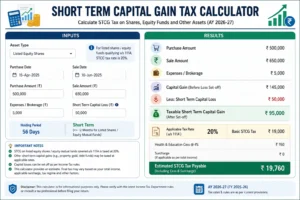
The Short Term Capital Gain Tax Calculator at CalculatorGuides.com helps you estimate your capital gain and potential tax liability using simple inputs.
You can use it to understand:
- Purchase value
- Sale value
- Capital gain
- Eligible expenses
- Applicable tax rate
- Section 111A tax
- Capital losses
- Estimated STCG tax
- Cess and surcharge where applicable
Important: STCG taxation differs between assets. The 20% rate discussed below applies to eligible gains covered by Section 111A. Other short-term capital gains can be taxed at applicable rates rather than automatically at 20%.
What Is Short Term Capital Gain?
Short Term Capital Gain, or STCG, is the profit from transferring a capital asset that qualifies as a short-term capital asset under the applicable tax rules.
A simple calculation is:
Capital Gain = Sale Value − Cost of Acquisition − Eligible Transfer Expenses
For example:
You purchased shares for:
₹2,00,000
and sold them for:
₹2,80,000
Ignoring eligible expenses:
STCG = ₹2,80,000 − ₹2,00,000
= ₹80,000
The tax treatment then depends on the type of asset and applicable provisions.
What Is an STCG Tax Calculator?
An STCG Tax Calculator is an online tool that estimates the tax payable on short-term capital gains.
It can help you calculate:
- Sale value
- Purchase cost
- Capital gain
- Taxable gain
- Applicable tax rate
- Estimated tax
- Cess
- Surcharge, where applicable
- Capital-loss adjustment
It is especially useful when you sell investments during the financial year and want to estimate your tax liability.
Short Term Capital Gain Tax Rate in India
The applicable tax rate depends on the asset.
For eligible short-term capital gains covered by Section 111A, the current rate is 20% for AY 2026–27. The Income Tax Department’s current return forms specifically identify short-term capital gains chargeable at 20%.
This commonly includes qualifying transactions involving:
- Listed equity shares
- Equity-oriented mutual funds
- Certain business-trust units
when the required conditions are satisfied.
Not every STCG is taxed at 20%.
Short-term gains that do not fall under Section 111A may be taxed at the applicable normal or special rate.
What Is Section 111A?
Section 111A provides a special tax rate for specified short-term capital gains.
For eligible transactions, the current rate is:
20%
The applicable conditions must be satisfied.
Therefore, simply buying and selling an asset within a short period does not automatically mean that the 20% Section 111A rate applies.
STCG on Listed Shares
Suppose you buy eligible listed shares for:
₹5,00,000
and sell them for:
₹6,50,000
Your capital gain is:
₹1,50,000
If the transaction qualifies under Section 111A:
₹1,50,000 × 20% = ₹30,000
This is the basic tax before applicable cess, surcharge, and any eligible loss adjustments.
STCG on Equity Mutual Funds
Eligible equity-oriented mutual funds can also fall under Section 111A when the required conditions are met.
Example:
Purchase:
₹3,00,000
Sale:
₹4,00,000
STCG:
₹1,00,000
Basic Section 111A tax:
₹1,00,000 × 20% = ₹20,000
The final tax liability can be different after considering applicable cess, surcharge, and losses.
STCG on Property
Short-term capital gains from property are treated differently from Section 111A equity gains.
If a property qualifies as a short-term capital asset, the gain may generally be taxed at the applicable normal income-tax rate rather than automatically at 20%.
This is an important difference.
Do not use the Section 111A 20% rate for every short-term asset.
STCG on Gold
Gold and certain other assets can have different holding-period and tax rules.
If the asset is classified as short-term, the resulting gain may be taxed at the applicable rate rather than the special Section 111A rate.
Therefore, select the correct asset type when using an STCG calculator.
STCG on Debt Mutual Funds
Debt and other mutual funds can have specific tax treatment depending on the fund, acquisition date, and applicable provisions.
Do not assume that every mutual fund receives the same tax treatment as an equity-oriented mutual fund.
The calculator should therefore ask for the type of investment before applying a tax rate.
How Is Short Term Capital Gain Calculated?
A basic calculation is:
STCG = Sale Value − Cost of Acquisition − Eligible Transfer Expenses
For example:
Sale value:
₹8,00,000
Purchase cost:
₹6,00,000
Transfer expenses:
₹10,000
STCG:
₹8,00,000 − ₹6,00,000 − ₹10,000
= ₹1,90,000
The applicable tax rate is then applied based on the asset and relevant tax provision.
STCG Example for Shares
Suppose:
- Purchase price = ₹4,00,000
- Sale price = ₹5,50,000
- Eligible expenses = ₹5,000
Capital gain:
₹5,50,000 − ₹4,00,000 − ₹5,000
= ₹1,45,000
If it qualifies under Section 111A:
Tax:
₹1,45,000 × 20%
= ₹29,000
This is before cess, surcharge, and any capital-loss adjustment.
STCG Example With Capital Loss
Suppose you have:
STCG profit = ₹2,00,000
and an eligible capital loss of:
₹50,000
The amount that can be set off depends on whether the loss is short-term or long-term and the applicable set-off rules.
The Income Tax Department provides specific rules for set-off and carry-forward of capital losses.
This is why a good STCG calculator should include a capital-loss input.
Short-Term Capital Loss
A Short-Term Capital Loss (STCL) occurs when you sell a capital asset for less than its applicable cost.
Example:
Purchase:
₹5,00,000
Sale:
₹4,20,000
Loss:
₹80,000
The tax treatment of the loss depends on the applicable capital-loss set-off rules.
Can Short-Term Capital Loss Be Set Off Against LTCG?
Generally, eligible short-term capital losses can be set off against both:
- Short-term capital gains
- Long-term capital gains
subject to the applicable income-tax provisions.
This can make short-term losses useful for reducing taxable capital gains.
Can Long-Term Capital Loss Be Set Off Against STCG?
Generally, long-term capital losses are more restricted and can be set off against eligible long-term capital gains rather than short-term gains.
Always check the current set-off rules before filing your return.
Carry Forward of Capital Loss
If eligible capital losses cannot be fully adjusted in the same financial year, they may be carried forward subject to the applicable conditions.
One important condition is timely filing of the income-tax return where required.
Do not assume that an unused capital loss automatically remains available forever.
STCG and Basic Exemption Limit
For some taxpayers, the interaction between special-rate capital gains and the basic exemption limit can affect the final tax calculation.
The treatment can depend on:
- Residential status
- Age
- Total income
- Type of capital gain
- Applicable tax regime
- Other income
Therefore, a simple:
STCG × 20%
calculation is not always the complete tax calculation.
STCG and Other Income
Suppose you have:
Salary income:
₹8 lakh
STCG:
₹2 lakh
Your overall tax calculation can involve both normal-rate income and special-rate capital gains.
The tax on STCG under Section 111A is separately identified in the income-tax return calculation.
The Income Tax Department’s current return forms distinguish STCG chargeable at 20% from short-term gains chargeable at other rates.
Health and Education Cess
After calculating the applicable income tax, Health and Education Cess may apply according to the prevailing tax rules.
Therefore, the basic STCG tax is not necessarily the final amount payable.
For example:
Basic tax:
₹20,000
The final liability can be higher after applicable cess.
Surcharge on STCG
High-income taxpayers may be subject to surcharge.
However, the Income Tax Department states that the enhanced 25% and 37% surcharge rates do not apply to income taxable under Sections 111A, 112 and 112A; the maximum surcharge on tax payable on such income is generally 15%, subject to specified exceptions.
For large transactions, calculate surcharge using your complete income profile rather than applying a flat percentage.
STCG on Shares vs Other Assets
| Asset | Possible STCG Treatment |
|---|---|
| Eligible listed equity | 20% under Section 111A, subject to conditions |
| Eligible equity mutual funds | 20% under Section 111A, subject to conditions |
| Property | Generally applicable normal/special rate depending on rules |
| Gold | Depends on applicable asset classification and tax rules |
| Other investments | Depends on the relevant provision |
The important point is:
20% is not a universal STCG rate.
STCG Holding Period
Whether an asset is short-term depends on the applicable holding-period rule for that asset.
Different assets can have different definitions of short-term and long-term.
Therefore, the purchase date and sale date can be important inputs in an STCG calculator.
STCG Tax on Intraday Trading
Intraday equity trading can have different tax treatment because transactions may be treated as speculative business income rather than capital gains.
Therefore, do not automatically use an STCG calculator for every intraday trade.
Your tax treatment depends on the nature of the trading activity and applicable rules.
STCG on Futures and Options
Futures and options trading can also have different tax treatment from ordinary investment capital gains.
Depending on the circumstances, derivatives trading may be treated as business income.
Therefore, an STCG calculator should not automatically be used for every F&O transaction.
STCG and STT
For eligible equity transactions under Section 111A, conditions involving Securities Transaction Tax (STT) can be relevant.
The exact conditions depend on the transaction and applicable law.
Therefore, keep your contract notes and transaction records.
How to Use the Short Term Capital Gain Tax Calculator
Step 1: Select the Asset
Choose the type of investment or asset.
Step 2: Enter Purchase Value
Enter the amount paid to acquire the asset.
Step 3: Enter Sale Value
Enter the amount received from the sale.
Step 4: Enter Purchase and Sale Dates
These dates help determine the holding period.
Step 5: Add Eligible Expenses
Enter eligible transfer-related expenses.
Step 6: Add Capital Losses
If you have eligible capital losses, enter them.
Step 7: Select Tax Treatment
Choose the relevant Section 111A or applicable-rate calculation.
Step 8: Calculate
The calculator estimates:
- Capital gain
- Taxable gain
- Basic tax
- Cess
- Applicable surcharge
- Estimated total tax
STCG Calculator Example
Suppose:
Purchase value:
₹10,00,000
Sale value:
₹13,00,000
Eligible transfer expenses:
₹10,000
Capital gain:
₹13,00,000 − ₹10,00,000 − ₹10,000
= ₹2,90,000
If eligible under Section 111A:
Basic tax:
₹2,90,000 × 20%
= ₹58,000
Applicable cess and surcharge, if any, would be added separately.
STCG Calculator With Loss Adjustment
Suppose:
STCG:
₹3,00,000
Eligible short-term capital loss:
₹75,000
After the applicable set-off:
₹2,25,000
If the remaining gain qualifies under Section 111A:
₹2,25,000 × 20%
= ₹45,000
This is a simplified illustration. The actual tax computation should follow the applicable set-off rules.
STCG and Tax Harvesting
Investors sometimes realize gains or losses intentionally as part of tax planning.
This is known as tax harvesting.
Before selling an investment solely for tax reasons, consider:
- Transaction charges
- Brokerage
- Market conditions
- Future investment plans
- Capital losses
- Holding period
- Applicable tax rules
Tax should be one part of the investment decision, not the only factor.
Common STCG Tax Calculation Mistakes
Applying 20% to Every STCG
Only eligible Section 111A gains receive the special rate.
Ignoring the Asset Type
Shares, property, gold and other assets can have different rules.
Forgetting Transfer Expenses
Eligible expenses can reduce the capital gain.
Ignoring Capital Losses
Capital losses can affect taxable gains.
Treating Intraday Trading as Investment STCG
Intraday trading can have different business-income treatment.
Ignoring STT Conditions
Section 111A eligibility can depend on transaction conditions.
Calculating Tax Without Cess
The basic tax may not equal the final liability.
Frequently Asked Questions
What is STCG?
STCG stands for Short Term Capital Gain. It is the gain from transferring a capital asset that qualifies as short-term under the applicable tax rules.
What is the current STCG tax rate on shares?
Eligible short-term capital gains covered by Section 111A are currently taxed at 20% for AY 2026–27.
Is all STCG taxed at 20%?
No. The 20% rate applies to eligible gains covered by Section 111A. Other short-term capital gains may be taxed at applicable normal or special rates.
What is Section 111A?
Section 111A provides a special tax rate for specified short-term capital gains from qualifying transactions.
Is STCG on equity mutual funds 20%?
Eligible equity-oriented mutual-fund gains covered by Section 111A can be taxed at 20%, subject to the applicable conditions.
Is STCG on property taxed at 20%?
Not automatically. Property STCG can be taxed at applicable normal rates rather than the Section 111A special rate.
How do I calculate STCG?
A basic calculation is:
Sale Value − Cost of Acquisition − Eligible Transfer Expenses
The resulting gain is then taxed according to the applicable asset-specific provision.
Can I deduct brokerage from capital gains?
Eligible transfer expenses can generally affect the capital-gain calculation, subject to the applicable rules.
Can capital losses reduce STCG?
Yes, eligible capital losses can affect taxable gains according to the applicable set-off rules.
Can STCL be set off against LTCG?
Generally, eligible short-term capital losses can be set off against both short-term and long-term capital gains, subject to the applicable rules.
Can LTCG loss be set off against STCG?
Generally, long-term capital loss is restricted to eligible long-term capital gains.
Can unused capital losses be carried forward?
Eligible losses can generally be carried forward subject to the applicable conditions and filing requirements.
Does STCG affect my total income?
Yes. Capital gains form part of your overall tax computation, although eligible gains may be taxed at a special rate.
Is cess applicable to STCG tax?
Applicable Health and Education Cess can be added to the income-tax liability.
Is surcharge applicable to STCG?
It can apply depending on your total income. Special surcharge limits apply to income taxed under Section 111A and certain other special-rate provisions.
Is intraday trading STCG?
Not necessarily. Intraday equity trading can be treated as speculative business income rather than capital gains.
Can I use this calculator for F&O?
F&O can have business-income treatment, so a standard STCG calculator may not be appropriate.
Does holding period determine whether a gain is short-term?
Yes, but the applicable holding-period threshold depends on the type of asset.
Is the Short Term Capital Gain Tax Calculator free?
Yes. The CalculatorGuides.com Short Term Capital Gain Tax Calculator is free to use.
Short Term Capital Gain Tax Calculator – Important Things to Check
Before finalizing your tax estimate, check:
- Asset type
- Purchase date
- Sale date
- Purchase cost
- Sale value
- Eligible transfer expenses
- Section 111A eligibility
- STT requirements
- Capital losses
- Other income
- Basic exemption interaction
- Cess
- Surcharge
- Residential status
- Applicable tax regime
For a large investment transaction, verify the calculation against the latest Income Tax Department rules or consult a qualified tax professional.
Conclusion
A Short Term Capital Gain Tax Calculator helps you estimate the tax that may arise when you sell an investment or asset for a profit within its applicable short-term holding period.
The most important point is that not every STCG is taxed at the same rate. For eligible transactions covered by Section 111A, the current tax rate is 20% for AY 2026–27. Other short-term capital gains can be taxed at their applicable normal or special rates.
Your final tax calculation can also be affected by capital losses, eligible expenses, other income, cess, surcharge, residential status, and the specific type of asset.
Use the CalculatorGuides.com Short Term Capital Gain Tax Calculator to estimate your capital gain and compare different scenarios. Always verify the final amount against the latest Income Tax Department rules before filing your return.