
FIRE Calculator-Use our free FIRE Calculator to estimate your FIRE number, retirement age, monthly investment, savings goal, and financial independence timeline. Learn FIRE formulas, examples, inflation, returns and withdrawal rates.Looking for more free online calculators? Explore our complete collection of EMI calculator, NPS Calculator ,Long Term Capital Gain Tax Calculator, Short Term Capital Gain Tax Calculator,Gold Loan Calculator,conversion and everyday calculators at CalculatorGuides to find the right tool for your needs.
🔥 CalculatorGuides - FIRE Calculator
📊 Retirement Planning Results
What if you could know approximately how much money you need to retire early?
That is the main question behind the FIRE movement.
FIRE stands for Financial Independence, Retire Early. The idea is simple: build enough investments and savings that your assets can eventually support your living expenses without depending completely on a salary.
A FIRE Calculator helps estimate how much money you may need before you can become financially independent.
It can help you estimate:
- FIRE number
- Retirement corpus
- Monthly investment required
- Annual investment required
- Expected retirement age
- Years until financial independence
- Savings rate
- Investment growth
- Inflation-adjusted expenses
- Withdrawal amount
- Lean FIRE target
- Regular FIRE target
- Fat FIRE target
At CalculatorGuides.com, our FIRE Calculator is designed to make early-retirement planning easier to understand without complicated financial language.
Important: FIRE calculations are estimates. Investment returns, inflation, taxes, expenses, and market performance can change over time. A calculator cannot guarantee that a particular retirement corpus will last for life.
What Is FIRE?
FIRE means Financial Independence, Retire Early.
Financial independence means having enough financial resources that you do not need to depend entirely on active employment to pay for your regular living expenses.
Early retirement means choosing to stop full-time work earlier than the traditional retirement age.
FIRE does not necessarily mean never working again.
Some people who reach financial independence continue to:
- Work part-time
- Start a business
- Freelance
- Travel
- Volunteer
- Work on personal projects
- Choose work they enjoy
The important difference is that earning a salary becomes a choice rather than the only way to pay your bills.
What Is a FIRE Calculator?
A FIRE Calculator estimates the amount of money you may need to become financially independent.
It usually considers:
- Current age
- Current savings
- Current investments
- Annual expenses
- Annual income
- Monthly investment
- Expected investment return
- Inflation
- Retirement withdrawal rate
- Desired retirement age
The calculator then estimates your potential FIRE number and how long it could take to reach it.
What Is a FIRE Number?
Your FIRE number is the approximate investment portfolio you need to support your planned spending without relying on a regular salary.
A simple formula is:
FIRE Number = Annual Retirement Expenses ÷ Withdrawal Rate
For example:
Annual expenses:
₹6,00,000
Assumed withdrawal rate:
4%
FIRE number:
₹6,00,000 ÷ 0.04
= ₹1.5 crore
This is only a simplified illustration.
Your actual FIRE number can be higher or lower depending on your age, investment portfolio, taxes, inflation, healthcare costs, asset allocation, and retirement period.
What Is the 4% Rule?
The 4% rule is a commonly discussed retirement-planning guideline.
The basic idea is that a retiree withdraws approximately 4% of the initial retirement portfolio in the first year and adjusts withdrawals over time according to the framework used in the original research.
It is not a guaranteed rule.
A 4% withdrawal rate may not be appropriate for everyone, especially someone planning to retire very early and potentially fund several decades of expenses.
For early retirement, many people test more conservative withdrawal rates such as:
- 4%
- 3.5%
- 3%
- 2.5%
The lower the withdrawal rate, the larger the required FIRE corpus.
FIRE Number Examples
Suppose your annual expenses are:
₹6 lakh
At 4% Withdrawal Rate
₹6 lakh ÷ 0.04
= ₹1.5 crore
At 3.5%
₹6 lakh ÷ 0.035
= ₹1.71 crore approximately
At 3%
₹6 lakh ÷ 0.03
= ₹2 crore
The lower withdrawal rate requires a larger portfolio.
Why Early Retirement Needs Careful Planning
Retiring at 40 is very different from retiring at 65.
Someone retiring at 40 may need their portfolio to support them for several decades.
That means early retirees need to think carefully about:
- Inflation
- Market volatility
- Healthcare
- Taxes
- Unexpected expenses
- Sequence of returns
- Portfolio diversification
- Long-term withdrawal strategy
A simple retirement calculation may not capture all of these risks.
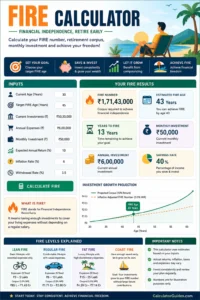
FIRE Calculator Formula
A simple FIRE calculation is:
FIRE Number = Annual Expenses ÷ Withdrawal Rate
For example:
Annual expenses = ₹8,00,000
Withdrawal rate = 4%
FIRE number:
₹8,00,000 ÷ 0.04
= ₹2 crore
This calculation provides a starting point for retirement planning.
How Inflation Changes Your FIRE Number
Inflation is one of the most important factors in FIRE planning.
Suppose your current annual expenses are:
₹6 lakh
If your expenses increase by inflation over time, you may need much more money in the future.
For example, at 6% annual inflation, ₹6 lakh of annual expenses today would become approximately:
₹19.3 lakh after 20 years
This means a person planning to retire 20 years from now should not simply use today’s expenses.
Inflation-Adjusted Expenses Formula
A basic future-expense formula is:
Future Expenses = Current Expenses × (1 + Inflation Rate)ⁿ
Where:
- Current Expenses = today’s annual spending
- Inflation Rate = assumed annual inflation
- n = number of years
For example:
Current expenses = ₹6 lakh
Inflation = 6%
Time = 20 years
Future expenses:
₹6,00,000 × (1.06)²⁰
≈ ₹19.24 lakh
The exact result depends on the assumptions used.
FIRE Calculator Example
Suppose:
- Current age = 30
- Current savings = ₹20 lakh
- Annual expenses = ₹6 lakh
- Monthly investment = ₹50,000
- Expected return = 10%
- Inflation = 6%
- Target withdrawal rate = 3.5%
The calculator can project:
- Future expenses
- Required FIRE corpus
- Investment growth
- Approximate FIRE age
- Years remaining
Because returns and inflation are uncertain, it is useful to run multiple scenarios rather than relying on one result.
FIRE Calculator With Monthly Investment
Your monthly investment is one of the most important inputs.
For example:
₹20,000 per month
Annual investment:
₹2.4 lakh
₹50,000 per month
Annual investment:
₹6 lakh
₹1,00,000 per month
Annual investment:
₹12 lakh
A larger investment can accelerate your path to financial independence, especially when combined with a long investment period.
FIRE Calculator and Compound Growth
Compounding means your investment growth can itself generate additional growth.
For example, if your portfolio earns returns and you leave those returns invested, the portfolio can potentially grow faster over time.
This is why starting early can be powerful.
However, investment returns are not guaranteed.
Actual market returns can vary significantly from year to year.
FIRE and Savings Rate
Your savings rate is another major FIRE metric.
A basic formula is:
Savings Rate = Amount Saved ÷ Income × 100
For example:
Monthly income:
₹1,00,000
Monthly savings/investment:
₹40,000
Savings rate:
40%
A higher savings rate generally means you have more money available to invest and less money required to maintain your current lifestyle.
FIRE Savings Rate Example
Suppose two people each earn:
₹1,00,000 per month
Person A
Spends ₹80,000.
Saves ₹20,000.
Savings rate:
20%
Person B
Spends ₹50,000.
Saves ₹50,000.
Savings rate:
50%
Person B is saving much more relative to income and may reach financial independence sooner, assuming similar investment returns and circumstances.
FIRE and Lifestyle Expenses
FIRE is not only about making more money.
Your spending level also matters.
If your annual expenses are:
₹12 lakh
your required FIRE corpus will generally be larger than someone whose annual expenses are:
₹6 lakh
This does not mean you should reduce every expense.
The goal is to create a spending level that supports a lifestyle you actually value.
Lean FIRE
Lean FIRE means reaching financial independence with a relatively low-cost lifestyle.
For example, if someone can comfortably live on:
₹4 lakh per year
their FIRE number could be much lower than someone who needs ₹15 lakh per year.
Lean FIRE may work well for people who:
- Have low housing costs
- Prefer a simple lifestyle
- Have limited financial obligations
- Are comfortable with lower discretionary spending
The important word is comfortably.
Cutting essential expenses to an unsustainable level is not a good retirement plan.
Regular FIRE
Regular FIRE aims to provide enough investment income to maintain your desired normal lifestyle without depending on full-time employment.
For example:
Annual retirement expenses:
₹8 lakh
At a 3.5% withdrawal rate:
₹8 lakh ÷ 0.035
≈ ₹2.29 crore
The actual target depends on your personal circumstances.
Fat FIRE
Fat FIRE means reaching financial independence while maintaining a higher level of spending.
Suppose annual retirement expenses are:
₹20 lakh
At a 3.5% withdrawal rate:
₹20 lakh ÷ 0.035
≈ ₹5.71 crore
Fat FIRE requires a much larger portfolio because the desired lifestyle costs more.
Coast FIRE
Coast FIRE is different from traditional FIRE.
The basic idea is to build enough investments early in life that you may eventually reach your retirement target through investment growth without making large additional contributions.
For example, someone may build a substantial portfolio at age 30 and then reduce their investment contributions while continuing to work enough to cover current expenses.
The investments have time to potentially grow toward the retirement target.
Barista FIRE
Barista FIRE generally means reaching a point where your investments cover a large part of your future retirement needs, while you continue working part-time to cover current expenses or benefits.
It can provide a middle ground between:
Full-time employment
and
Complete retirement
FIRE Calculator and Retirement Age
A FIRE Calculator can estimate your potential financial independence age.
For example:
Current age:
30
Projected FIRE age:
45
Years until FIRE:
15
The actual age can change significantly if you change:
- Savings
- Income
- Expenses
- Investment returns
- Inflation
- Withdrawal rate
How to Reach FIRE Faster
There are three main levers:
Increase Income
Higher income can provide more money to invest.
Reduce Unnecessary Spending
Lower expenses can increase your savings rate.
Invest Consistently
Regular long-term investing can help build your portfolio.
The strongest FIRE plans often use all three.
FIRE Calculator With Income Growth
Your salary may increase over time.
For example:
Current salary:
₹1,00,000/month
Annual increase:
8%
If your income rises while your lifestyle expenses grow more slowly, you may be able to increase your investments.
A FIRE Calculator with an annual contribution step-up can model this.
FIRE Step-Up Investment
Suppose you currently invest:
₹40,000/month
and increase your investment by:
10% every year
Your future contributions could become:
- Year 1: ₹40,000
- Year 2: ₹44,000
- Year 3: ₹48,400
- Year 4: ₹53,240
This can significantly improve the projected investment growth compared with keeping the contribution fixed.
FIRE Calculator With Current Investments
If you already have investments, enter your current portfolio value.
For example:
Current investments:
₹30 lakh
Monthly contribution:
₹50,000
The calculator should account for both:
- Existing portfolio growth
- Future contributions
This is more useful than calculating only the future value of new investments.
FIRE and Emergency Fund
Your retirement portfolio should not necessarily be your only source of financial security.
Before pursuing aggressive FIRE targets, consider maintaining an emergency fund for unexpected expenses.
An emergency fund can help cover:
- Job loss
- Medical expenses
- Major repairs
- Family emergencies
- Unexpected bills
The appropriate amount depends on your circumstances.
FIRE and Debt
High-interest debt can make reaching financial independence more difficult.
Suppose you are earning investment returns while paying a high interest rate on credit-card debt.
The debt cost can be substantial.
A FIRE plan should therefore consider:
- Credit-card debt
- Personal loans
- Home loans
- Vehicle loans
- Other liabilities
Debt repayment can be an important part of the path to financial independence.
FIRE and Home Loans
A home loan creates a special planning decision.
You may choose to:
- Invest more
- Make additional loan payments
- Balance investing and debt repayment
The right choice depends on the loan rate, investment risk, cash flow, tax treatment, and personal goals.
Your FIRE Calculator can show the investment side, but it cannot determine which debt strategy is best for everyone.
FIRE and Healthcare
Healthcare costs can be a major retirement expense.
Early retirees should consider:
- Health insurance
- Emergency medical expenses
- Family coverage
- Long-term healthcare needs
- Inflation in medical costs
Do not assume your normal monthly expenses will remain exactly the same after retirement.
FIRE and Children
If you have children, your FIRE plan may need to include future expenses such as:
- Education
- Healthcare
- Activities
- Housing support
- Other family goals
These expenses should be separated from basic retirement spending when possible.
FIRE and Taxes
Investment returns are not always equal to after-tax returns.
Depending on the investment and your situation, you may have tax consequences from:
- Capital gains
- Interest
- Dividends
- Withdrawals
- Other investment income
A FIRE calculation should ideally use an estimated after-tax return when planning conservatively.
FIRE Calculator: Nominal vs Real Returns
This is an important concept.
Nominal Return
The investment return before adjusting for inflation.
Real Return
The approximate return after considering inflation.
A simple approximation is:
Real Return ≈ Nominal Return − Inflation
For example:
Nominal return = 10%
Inflation = 6%
Approximate real return = 4%
The exact real return is calculated differently, but this simple approach is useful for understanding the concept.
FIRE Number Using Real Returns
When planning for retirement, it can be useful to think in today’s purchasing power.
Suppose your current annual expenses are:
₹8 lakh
Instead of simply assuming those expenses will remain ₹8 lakh forever, you can calculate the future cost after inflation or work with real returns.
This helps avoid underestimating the amount needed for retirement.
FIRE Calculator Example for India
Suppose:
- Current age = 35
- Current investments = ₹50 lakh
- Annual expenses = ₹8 lakh
- Monthly investment = ₹75,000
- Expected return = 10%
- Inflation = 6%
- Withdrawal rate = 3.5%
The calculator can estimate the future value of your current portfolio and future contributions and compare the result with your inflation-adjusted FIRE target.
This is a planning example, not a guaranteed outcome.
FIRE Number Example
Suppose your desired retirement expenses are:
₹10 lakh per year
Using a 3.5% withdrawal rate:
₹10,00,000 ÷ 0.035
= approximately ₹2.86 crore
Using a 3% withdrawal rate:
₹10,00,000 ÷ 0.03
= approximately ₹3.33 crore
This shows why your chosen withdrawal rate has a major effect on your FIRE target.
How to Use the FIRE Calculator
Step 1: Enter Your Current Age
Enter your current age.
Step 2: Enter Your Desired FIRE Age
Enter the age at which you would like financial independence.
Step 3: Enter Current Investments
Include your current investment portfolio.
Step 4: Enter Annual Expenses
Enter how much you currently spend each year.
Step 5: Enter Monthly Investment
Enter the amount you invest each month.
Step 6: Enter Expected Return
Use a realistic long-term assumption.
Step 7: Enter Inflation
Enter your estimated annual inflation rate.
Step 8: Enter Withdrawal Rate
Choose a withdrawal assumption appropriate for your planning horizon.
Step 9: Calculate
The calculator estimates your FIRE number and projected financial independence timeline.
What Does the FIRE Calculator Show?
Depending on the calculator settings, it can show:
- Current portfolio
- Monthly contribution
- Annual contribution
- Savings rate
- Estimated investment growth
- Future expenses
- FIRE number
- Projected FIRE age
- Years remaining
- Required monthly investment
- Retirement withdrawal amount
FIRE Calculator for a ₹1 Crore Goal
Suppose your target is:
₹1 crore
The calculator can work backward to estimate the contribution required.
Your required investment depends on:
- Current age
- Existing investments
- Investment return
- Time available
- Contribution frequency
Someone with ₹50 lakh already invested will have a very different requirement from someone starting from zero.
FIRE Calculator for a ₹5 Crore Goal
For a larger target such as:
₹5 crore
the same principles apply.
You can compare:
- Fixed monthly investment
- Annual step-up investment
- Different retirement ages
- Different return assumptions
A higher target may require either:
- More time
- More investment
- Higher income
- Lower expenses
- Or a combination of these
FIRE Calculator and Investment Return
Do not use an extremely high expected return simply to reach your target faster on paper.
For example, comparing:
8% return
with:
12% return
over several decades can produce a very large difference in the projected portfolio.
The higher return assumption also comes with greater uncertainty.
It is usually better to test multiple scenarios.
FIRE Scenario Planning
A good FIRE plan can use three scenarios.
Conservative
Lower return and higher inflation.
Base Case
Moderate return and reasonable inflation.
Optimistic
Higher return and lower inflation.
For example:
| Scenario | Return | Inflation |
|---|---|---|
| Conservative | 7% | 6% |
| Base | 9% | 5% |
| Optimistic | 11% | 5% |
These are only planning assumptions, not forecasts.
FIRE and Sequence of Returns Risk
Sequence of returns risk is especially important after retirement.
Imagine two retirees have the same average long-term investment return.
If one experiences large market losses during the first few years of retirement, their portfolio may be affected much more severely because they are withdrawing money while the portfolio is falling.
This is one reason early retirees need a carefully considered withdrawal strategy.
FIRE Withdrawal Strategy
After reaching FIRE, you still need a plan for using your portfolio.
Possible approaches include:
- Fixed percentage withdrawals
- Inflation-adjusted withdrawals
- Flexible withdrawals
- Cash or short-term reserves
- Dynamic withdrawal strategies
There is no single strategy that works for every retiree.
FIRE Is More Than a Number
Reaching a FIRE number does not automatically mean that retirement will be successful.
You also need to consider:
- Where you will live
- Healthcare
- Family responsibilities
- Lifestyle
- Taxes
- Insurance
- Emergency expenses
- Investment risk
- Social life
- Purpose after leaving full-time work
Financial independence gives you choices, but planning for those choices matters.
Common FIRE Planning Mistakes
Using Today’s Expenses Forever
Inflation can significantly increase future expenses.
Assuming Investment Returns Are Guaranteed
Markets can perform very differently from your assumptions.
Using an Aggressive Withdrawal Rate
A very early retirement can last many decades.
Ignoring Taxes
Your investment returns and withdrawals can have tax consequences.
Forgetting Healthcare
Medical expenses can be significant.
Ignoring Debt
High-interest debt can slow wealth accumulation.
Saving Everything and Enjoying Nothing
FIRE should support your life rather than make the journey unnecessarily miserable.
FIRE Calculator FAQs
What does FIRE stand for?
FIRE stands for Financial Independence, Retire Early.
What is a FIRE number?
Your FIRE number is the approximate investment portfolio needed to support your planned retirement spending.
How do I calculate my FIRE number?
A simple formula is:
FIRE Number = Annual Retirement Expenses ÷ Withdrawal Rate
For example, ₹8 lakh annual expenses at a 4% withdrawal rate require approximately ₹2 crore.
What is the 4% rule?
It is a commonly discussed retirement-planning guideline based on withdrawing around 4% of the initial portfolio in the first year, with adjustments under the framework. It is not a guarantee.
Is 4% safe for early retirement?
It may not be appropriate for every early retiree. Someone retiring very young may want to test a more conservative withdrawal rate.
What is Lean FIRE?
Lean FIRE means reaching financial independence with a relatively low-cost lifestyle.
What is Fat FIRE?
Fat FIRE means reaching financial independence while maintaining a higher level of spending.
What is Coast FIRE?
Coast FIRE means having enough invested early that your existing investments may potentially grow to your retirement target without requiring large additional contributions.
What is Barista FIRE?
Barista FIRE generally means using investments to cover much of your future retirement needs while continuing some part-time work for income or other benefits.
Does FIRE mean I have to stop working?
No. Financial independence means work can become more optional. You may continue working because you enjoy it.
How much money do I need to retire early?
There is no single number. It depends mainly on your annual expenses, desired retirement lifestyle, investment portfolio, inflation, taxes, and withdrawal rate.
Can I FIRE with ₹1 crore?
Possibly, depending on your expenses and other income sources. For example, ₹1 crore at a 4% withdrawal rate corresponds to roughly ₹4 lakh of first-year withdrawals before considering taxes and other factors.
Can I FIRE with ₹2 crore?
It depends on your annual spending. At a 3.5% withdrawal rate, ₹2 crore corresponds to approximately ₹7 lakh of annual withdrawals before taxes and other considerations.
Does inflation affect my FIRE number?
Yes. Higher inflation generally means you need a larger future retirement corpus.
Does my current investment count toward FIRE?
Yes. Existing investments can form part of your FIRE portfolio if they are intended for retirement and suitable for the plan.
Can I include EPF and NPS in my FIRE calculation?
You can include retirement assets such as EPF and NPS if they will actually be available to support your retirement plan. However, their withdrawal rules and accessibility should be considered.
Should I include my house in my FIRE number?
Usually, a house you live in should not automatically be counted as a retirement investment because it may not generate income. If you plan to sell, downsize, or rent it, its value can be incorporated into a broader plan.
What return should I use in a FIRE Calculator?
Use a realistic long-term assumption and test several scenarios rather than relying on one high return.
What inflation rate should I use?
Use an assumption appropriate to your country, spending pattern, and planning period. Testing higher inflation can make your plan more conservative.
Is the FIRE Calculator accurate?
It is mathematically accurate based on the assumptions entered, but the future cannot be predicted exactly. Actual returns, inflation, taxes, expenses, and market conditions can differ.
Is the FIRE Calculator free?
Yes. The CalculatorGuides.com FIRE Calculator is free to use.
FIRE Calculator – Important Things to Check
Before relying on your FIRE estimate, review:
- Current age
- Target FIRE age
- Current investments
- Annual expenses
- Monthly investment
- Savings rate
- Expected return
- Inflation
- Withdrawal rate
- Taxes
- Healthcare
- Insurance
- Debt
- Family responsibilities
- Emergency fund
It is also useful to calculate your FIRE target using more than one return and withdrawal-rate assumption.
Conclusion
A FIRE Calculator helps turn the idea of early retirement into a measurable financial goal.
The basic calculation starts with your annual retirement expenses and withdrawal rate, but a realistic FIRE plan needs more than one number. Inflation, investment returns, savings, taxes, healthcare costs, debt, family responsibilities, and the length of retirement can all affect how much money you actually need.
For example, ₹8 lakh of annual retirement spending would require about ₹2 crore at a 4% withdrawal rate, but about ₹2.67 crore at a 3% withdrawal rate. The lower withdrawal rate provides a larger portfolio target but does not guarantee financial security.
The most useful way to use a FIRE Calculator is to test several scenarios rather than assuming that one return or withdrawal rate will definitely happen.
Use the CalculatorGuides.com FIRE Calculator to estimate your FIRE number, compare monthly investment strategies, understand the effect of inflation, and see how your potential financial independence timeline changes as your income, savings, and expenses change.
FIRE is ultimately not just about retiring early. It is about building enough financial flexibility that you have more control over how you spend your time and how you choose to work.