
Long Term Capital Gain Tax Calculator-Selling an investment or asset for more than you paid for it can create a capital gain. If the asset qualifies as a long-term capital asset, the profit may be treated as a Long Term Capital Gain (LTCG) and taxed under the applicable income-tax rules.Looking for more free online calculators? Explore our complete collection of EMI calculator, NPS Calculator ,Step Up SIP Calculator, Currency Converter,Gold Loan Calculator,conversion and everyday calculators at CalculatorGuides to find the right tool for your needs.
🌿 CalculatorGuides - LTCG Tax Calculator
📊 LTCG Tax Computation Results
Selling an investment or asset for more than you paid for it can create a capital gain. If the asset qualifies as a long-term capital asset, the profit may be treated as a Long Term Capital Gain (LTCG) and taxed under the applicable income-tax rules.
Calculating LTCG can sometimes be confusing because the tax treatment depends on:
- Type of asset
- Date of purchase
- Date of sale
- Purchase cost
- Sale price
- Eligible expenses
- Applicable tax rate
- Whether the asset falls under Section 112A
- Applicable exemptions or deductions
- Whether indexation is available
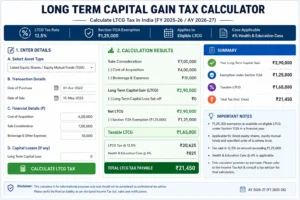
The CalculatorGuides.com Long Term Capital Gain Tax Calculator helps you estimate your potential LTCG and tax liability using the information you enter.
Important: Capital-gains taxation depends on the asset and transaction. The calculator provides an estimate and should not be treated as a substitute for professional tax advice or the final computation in your income-tax return.
What Is Long Term Capital Gain?
A Long Term Capital Gain is generally the profit earned from selling a capital asset that qualifies as a long-term asset under the applicable tax rules.
A simple capital-gain calculation is:
Capital Gain = Sale Value − Cost of Acquisition − Eligible Expenses
The actual tax calculation can be more detailed because different assets can have different holding-period rules, tax rates, exemptions, and special provisions.
What Is a Long Term Capital Gain Tax Calculator?
A Long Term Capital Gain Tax Calculator is an online tool that estimates:
- Sale value
- Purchase cost
- Capital gain
- Taxable LTCG
- Applicable tax rate
- Estimated capital-gains tax
- Potential tax-saving deductions
It can be especially useful when selling:
- Listed shares
- Equity mutual funds
- Property
- Certain securities
- Other qualifying capital assets
How Does LTCG Tax Calculation Work?
A basic calculation follows these steps:
Step 1: Find the Sale Value
Determine how much you received or are treated as receiving from the sale.
Step 2: Determine the Acquisition Cost
Calculate the relevant cost of acquiring the asset.
Step 3: Deduct Eligible Costs
Certain expenses connected with the transfer may be deductible according to the applicable rules.
Step 4: Calculate the Capital Gain
Subtract the eligible costs from the sale value.
Step 5: Determine the Applicable Tax Rate
The rate depends on the asset and applicable provision.
Step 6: Apply Available Exemptions or Deductions
For example, Section 112A has a specific annual threshold for eligible long-term capital gains.
Step 7: Calculate Tax
Apply the relevant rate and applicable surcharge and cess, where applicable.
LTCG Tax Rate in India
The tax rate depends on the type of long-term capital asset.
For many long-term capital gains covered by the current Section 112 framework, the applicable rate is 12.5%, subject to the specific provisions and conditions.
The Income Tax Department’s current AY 2026–27 forms show long-term capital gains chargeable at 12.5%.
However, you should not assume that every asset is taxed in exactly the same way.
LTCG on Listed Equity Shares
Listed equity shares can fall under Section 112A when the applicable conditions are met.
For eligible Section 112A long-term capital gains, the tax rate is currently 12.5% on the amount above the applicable annual threshold.
The Income Tax Department currently recognizes long-term capital gain under Section 112A up to ₹1.25 lakh in its simplified return eligibility rules.
₹1.25 Lakh LTCG Exemption
For eligible Section 112A gains, the first:
₹1,25,000
of aggregate long-term capital gains in the applicable financial year is subject to the Section 112A threshold.
The amount above the threshold is taxed at the applicable Section 112A rate.
This is different from saying that every type of LTCG in India has a ₹1.25 lakh exemption.
The threshold specifically relates to eligible gains covered by Section 112A.
Example: ₹1 Lakh LTCG on Eligible Equity
Suppose your eligible Section 112A long-term capital gain is:
₹1,00,000
Because this is below the current ₹1.25 lakh threshold, there would be no Section 112A LTCG tax on that gain, assuming the relevant conditions are satisfied.
Your overall tax position can still depend on your other income and applicable provisions.
Example: ₹3 Lakh LTCG on Eligible Equity
Suppose:
Eligible LTCG = ₹3,00,000
Section 112A threshold:
₹1,25,000
Taxable amount at the special LTCG rate:
₹3,00,000 − ₹1,25,000
= ₹1,75,000
At 12.5%:
₹1,75,000 × 12.5% = ₹21,875
This is the basic tax before considering applicable cess, surcharge, losses, or other provisions.
LTCG on Equity Mutual Funds
Long-term gains from eligible equity-oriented mutual funds can also fall under Section 112A when the applicable conditions are met.
The calculation generally requires you to consider:
- Purchase value
- Sale value
- Holding period
- Eligible expenses
- Applicable Section 112A rules
- Annual ₹1.25 lakh threshold
Do not automatically apply the same treatment to every mutual fund.
Debt-oriented and other funds can have different tax treatment.
LTCG on Shares Example
Suppose you purchased eligible listed shares for:
₹4,00,000
and later sold them for:
₹7,00,000
Assume there are no deductible transfer expenses for this illustration.
Capital gain:
₹7,00,000 − ₹4,00,000
= ₹3,00,000
If the gain qualifies under Section 112A:
Less annual threshold:
₹1,25,000
Taxable gain:
₹1,75,000
Basic LTCG tax:
₹21,875
Cess and any other applicable tax adjustments would be considered separately.
LTCG on Property
Property taxation can be different from equity taxation.
The applicable rules can depend on:
- Type of property
- Date of acquisition
- Date of sale
- Acquisition cost
- Improvement cost
- Transfer expenses
- Applicable holding period
- Applicable indexation provisions
- Whether special grandfathering rules apply
The Income Tax Department’s current return forms specifically provide separate calculations for long-term capital gains on immovable property.
Long Term Capital Gain on House Property
Suppose you purchased a house for:
₹40 lakh
and later sold it for:
₹70 lakh
A simple calculation would begin with:
₹70 lakh − ₹40 lakh = ₹30 lakh
But the actual taxable gain may not simply be ₹30 lakh.
You may need to consider:
- Eligible improvement costs
- Transfer expenses
- Applicable indexation treatment
- Relevant grandfathering provisions
- Exemptions under the Income Tax Act
Therefore, property LTCG should be calculated separately from equity LTCG.
Indexation and LTCG
Indexation adjusts certain historical costs to account for inflation.
However, the availability and treatment of indexation have changed under recent tax rules.
For certain transfers of immovable property acquired before 23 July 2024, resident individuals and HUFs can have special computational treatment comparing the new 12.5% calculation with the earlier 20% indexed approach, subject to the applicable conditions.
The Income Tax Department’s current forms explicitly include this comparison for qualifying property acquisitions before 23 July 2024.
This is why an LTCG calculator should ask for the asset type and acquisition date rather than blindly applying one formula to every transaction.
What Is Indexed Cost of Acquisition?
Where indexation is applicable, the broad concept is:
Indexed Cost = Original Cost × Cost Inflation Index of Sale Year ÷ Cost Inflation Index of Acquisition Year
The applicable Cost Inflation Index values must be used for the relevant financial years.
Indexation should not be applied automatically to every asset because current tax rules differ by asset and transaction.
LTCG Without Indexation
Under the current framework, many long-term capital gains are calculated using the revised 12.5% rate without indexation.
Whether an alternative indexed calculation is available depends on the asset, acquisition date, taxpayer category, and applicable provisions.
This is particularly important for older property acquired before the relevant 23 July 2024 date.
What Is Cost of Acquisition?
The cost of acquisition is generally the amount paid to acquire the asset, subject to the applicable tax rules.
For example:
Purchase price:
₹5,00,000
The starting acquisition cost is ₹5 lakh.
However, additional eligible costs may need to be considered depending on the asset.
Cost of Improvement
For some assets, eligible improvement costs can be included when calculating capital gains.
For example, certain capital improvements to property may increase the cost base.
Routine repairs should not automatically be treated as capital improvements.
Keep proper records and receipts for major improvements.
Transfer Expenses
Certain expenses directly connected with transferring an asset can potentially reduce the capital gain, subject to the applicable rules.
Examples can include eligible brokerage or transfer-related expenses.
Personal expenses unrelated to the transfer should not simply be deducted from the capital gain.
LTCG and Capital Loss
A capital loss can affect your tax calculation.
There are different rules for:
- Short-term capital losses
- Long-term capital losses
- Set-off
- Carry-forward
The treatment depends on the type of gain and loss.
Do not assume that every capital loss can automatically be deducted from every type of income.
Can Long-Term Capital Loss Reduce LTCG?
A long-term capital loss can generally be set off against eligible long-term capital gains, subject to the applicable income-tax rules.
If the loss cannot be fully utilized in the same year, carry-forward rules may apply if the relevant conditions are satisfied.
This can significantly change the final tax liability.
LTCG Tax and Other Income
Your capital-gains tax does not always operate independently of your other income.
Depending on your circumstances, factors such as:
- Total taxable income
- Residential status
- Special tax rates
- Basic exemption limit
- Surcharge
- Health and education cess
- Applicable deductions
can affect the final tax calculation.
Therefore, an LTCG calculator should be viewed as an estimate of the specific capital gain rather than a complete income-tax return.
Health and Education Cess
After calculating the applicable income tax, Health and Education Cess may apply according to the prevailing tax rules.
Therefore:
Capital Gain × Tax Rate
is not necessarily the final amount you will pay.
The final liability can include applicable cess and, in certain cases, surcharge.
Surcharge on LTCG
High-income taxpayers may be subject to surcharge depending on their total income and applicable tax rules.
A basic LTCG calculator may not include every possible surcharge situation.
For large transactions, verify the final calculation against the current income-tax provisions.
LTCG Tax on Property vs Shares
Property and eligible listed equity are not necessarily taxed in the same way.
| Factor | Eligible Equity | Property |
|---|---|---|
| Section | Often 112A | Generally Section 112 framework |
| Current rate | 12.5% above applicable threshold | Generally 12.5%, subject to applicable provisions |
| ₹1.25 lakh threshold | Applies to eligible Section 112A gains | Not the same Section 112A threshold |
| Indexation | Generally not applicable under current Section 112A treatment | Special rules may apply in qualifying cases |
| Calculation | Purchase/sale and eligible costs | Purchase, improvement, transfer costs and applicable property rules |
Always identify the asset before calculating LTCG.
How to Reduce LTCG Tax Legally
Tax planning should focus on legitimate exemptions and deductions.
Depending on the asset and circumstances, possible provisions can include:
- Section 54
- Section 54B
- Section 54EC
- Section 54F
- Other applicable provisions
Eligibility requirements differ for each section.
Do not claim an exemption simply because you reinvested money; the reinvestment must satisfy the relevant legal conditions.
Section 54
Section 54 can provide relief in certain cases involving long-term capital gains from a residential house property when the applicable conditions are satisfied.
The rules include requirements regarding the purchase or construction of another residential house and prescribed timelines.
Section 54F
Section 54F can provide relief in certain cases involving long-term capital gains from assets other than a residential house, subject to conditions.
The amount of exemption can depend on how much of the net consideration is invested in the qualifying residential property.
Section 54EC
Section 54EC can provide a capital-gains exemption in qualifying property transactions when the prescribed amount is invested in specified bonds within the required period and subject to the applicable conditions.
Always verify the current eligible bonds, investment limits, lock-in requirements, and other conditions.
LTCG Tax Calculator for Shares
To calculate LTCG on eligible shares, you may need:
- Purchase date
- Purchase price
- Number of shares
- Sale date
- Sale price
- Brokerage or eligible expenses
- Previous capital losses
- Other Section 112A gains during the year
The calculator can then estimate the eligible long-term gain and applicable tax.
LTCG Tax Calculator for Mutual Funds
For mutual funds, enter:
- Investment amount
- Purchase date
- Redemption value
- Eligible expenses
- Fund type
- Applicable holding period
The tax treatment can differ depending on whether the fund qualifies for Section 112A or falls under another tax provision.
LTCG Tax Calculator for Property
For property, a more detailed calculator should ask for:
- Purchase price
- Purchase date
- Sale price
- Sale date
- Improvement cost
- Transfer expenses
- Property type
- Acquisition date
- Applicable indexation information
- Exemption claimed, if any
This produces a more meaningful estimate than simply subtracting purchase price from sale price.
How to Use the Long Term Capital Gain Tax Calculator
Step 1: Select Asset Type
Choose:
- Equity shares
- Equity mutual funds
- Property
- Other qualifying assets
Step 2: Enter Purchase Details
Enter the purchase price and acquisition date.
Step 3: Enter Sale Details
Enter the sale price and sale date.
Step 4: Add Eligible Costs
Enter eligible improvement and transfer expenses where applicable.
Step 5: Enter Capital Losses
If applicable, enter eligible carried-forward or current-year capital losses.
Step 6: Select Applicable Tax Treatment
The calculator should use the relevant provision based on the asset.
Step 7: Calculate
The calculator estimates:
- Capital gain
- Taxable LTCG
- Basic tax
- Applicable threshold
- Estimated tax
LTCG Calculation Example
Suppose:
Purchase value:
₹6,00,000
Sale value:
₹10,00,000
Eligible transfer expenses:
₹20,000
Capital gain:
₹10,00,000 − ₹6,00,000 − ₹20,000
= ₹3,80,000
If this is an eligible Section 112A gain:
Less ₹1,25,000 threshold:
₹2,55,000
Tax at 12.5%:
₹31,875
This is a simplified illustration before cess, surcharge, losses, and other applicable adjustments.
What If You Sell Shares at a Loss?
Suppose:
Purchase value:
₹5,00,000
Sale value:
₹4,00,000
Your capital result is:
₹1,00,000 loss
A capital loss is different from a taxable LTCG.
Depending on whether the loss is short-term or long-term and the applicable rules, it may be available for set-off or carry-forward.
LTCG and Tax Harvesting
Tax harvesting generally means realizing capital gains or losses strategically to manage your tax position.
For eligible Section 112A equity gains, the annual ₹1.25 lakh threshold can be relevant.
However, tax harvesting should consider:
- Transaction costs
- Market conditions
- Capital losses
- Holding period
- Applicable tax rules
It should not be done solely to save tax without considering investment goals.
Common LTCG Tax Calculation Mistakes
Using the Wrong Tax Rate
Do not apply 12.5% to every asset without checking the applicable section.
Assuming ₹1.25 Lakh Applies to All LTCG
The ₹1.25 lakh threshold is specifically associated with eligible Section 112A gains.
Ignoring Acquisition Date
The acquisition date can matter, especially for property and grandfathering/indexation provisions.
Forgetting Transfer Expenses
Eligible expenses can affect the capital gain.
Ignoring Capital Losses
Eligible capital losses may reduce taxable gains.
Using Purchase Price as the Only Cost
Improvement costs and other eligible costs may matter.
Treating Calculator Results as Final Tax Liability
The final tax return can involve other income, losses, surcharge, cess, exemptions, and special provisions.
Frequently Asked Questions
What is LTCG?
LTCG stands for Long Term Capital Gain. It is the gain from transferring a capital asset that qualifies as long-term under the applicable tax rules.
What is the current LTCG tax rate in India?
Many long-term capital gains are currently taxed at 12.5%, but the exact treatment depends on the asset and applicable provision.
Is the first ₹1.25 lakh of LTCG tax-free?
The ₹1.25 lakh threshold applies to eligible long-term capital gains covered by Section 112A. It should not be treated as a universal exemption for every type of LTCG.
What is Section 112A?
Section 112A covers specified long-term capital gains, including eligible gains from listed equity shares, equity-oriented mutual funds and specified business trusts, subject to the applicable conditions.
Is LTCG on shares 12.5%?
Eligible Section 112A long-term gains above the applicable annual threshold are taxed at 12.5% under the current rules. (Income Tax Department)
Is LTCG on property 12.5%?
The current general rate for many long-term capital gains is 12.5%, but qualifying property acquired before 23 July 2024 can involve special comparison provisions concerning the earlier indexed 20% calculation for eligible resident individuals/HUFs.
Is indexation still available?
Indexation is not universally available under the current LTCG framework. Special provisions can apply to qualifying immovable property acquired before 23 July 2024.
How is LTCG calculated?
A basic calculation starts with sale value minus cost of acquisition and eligible transfer/improvement costs, followed by the applicable tax rules.
Can capital losses reduce LTCG?
Eligible capital losses can generally be set off against the relevant type of capital gains, subject to the applicable rules.
Is LTCG included in total income?
Capital gains form part of your total income calculation, although certain capital gains are taxed at special rates.
Is LTCG taxed separately from salary?
Certain LTCG is subject to special tax rates, but your overall tax position can still depend on your salary and other income.
Do I pay cess on LTCG?
Applicable Health and Education Cess can be added to the calculated income-tax liability.
Can I save tax on LTCG from property?
Potential exemptions may be available under provisions such as Sections 54, 54F and 54EC when all applicable conditions are satisfied.
Does holding period determine LTCG?
Yes. Whether an asset is short-term or long-term depends on the applicable holding-period rules for that asset.
Can I use this calculator for stocks?
Yes, provided you select the appropriate equity/Section 112A calculation and enter the correct transaction details.
Can I use this calculator for mutual funds?
Yes, but you must select the correct type of mutual fund because different funds can have different tax treatment.
Can I use this calculator for property?
Yes. Property calculations should include purchase date, sale date, acquisition cost, improvement costs, transfer expenses, and applicable indexation or grandfathering provisions.
Is the Long Term Capital Gain Tax Calculator free?
Yes. The CalculatorGuides.com Long Term Capital Gain Tax Calculator is free to use.
LTCG Calculator – Important Things to Check
Before finalizing your tax calculation, check:
- Asset type
- Purchase date
- Sale date
- Purchase cost
- Sale value
- Improvement expenses
- Transfer expenses
- Capital losses
- Applicable tax section
- Section 112A threshold
- Indexation eligibility
- Exemption eligibility
- Cess
- Surcharge
- Residential status
For large property or investment transactions, professional tax advice can be worthwhile.
Conclusion
A Long Term Capital Gain Tax Calculator helps you estimate the tax that may arise when you sell a long-term investment or asset at a profit.
The calculation is not simply:
Sale Price − Purchase Price
The correct result can depend on the asset type, acquisition date, holding period, eligible expenses, capital losses, applicable tax section, exemptions, and current tax rules.
For eligible Section 112A gains, the current rules provide a ₹1.25 lakh annual threshold, with eligible gains above that threshold generally taxed at 12.5%.
Property transactions can require additional care because current rules include special provisions for qualifying property acquired before 23 July 2024, including a comparison mechanism involving the earlier indexed 20% calculation for eligible resident individuals and HUFs.
Use the CalculatorGuides.com Long Term Capital Gain Tax Calculator to get a quick estimate, compare different scenarios, and understand your potential tax liability. Always verify the final calculation against the latest Income Tax Department rules before filing your return.