
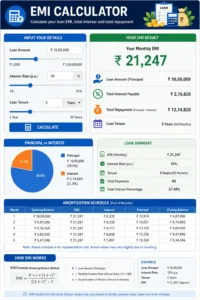
EMI calculator-Use our free EMI Calculator to calculate monthly loan EMI, total interest, principal, repayment amount, and loan cost. Taking a loan is a major financial decision. Whether you are planning to buy a home, car, education, or need a personal loan, knowing your monthly payment can help you plan your budget.Looking for more free online calculators? Explore our complete collection of IPO Return Calculator, APY Return Calculator,Step Up SIP Calculator, Currency Converter,Gold Loan Calculator,conversion and everyday calculators at CalculatorGuides to find the right tool for your needs.
💳 CalculatorGuides - EMI Calculator
📊 EMI Computation Results
An EMI Calculator makes this calculation simple.
EMI stands for Equated Monthly Installment. It is the amount you pay to a lender at regular monthly intervals to repay a loan over a selected period.
Your EMI generally includes two parts:
- Principal
- Interest
At the beginning of many reducing-balance loans, a larger portion of the EMI goes toward interest. As the outstanding principal decreases, the interest portion generally becomes smaller.
The CalculatorGuides.com EMI Calculator helps you estimate your monthly EMI, total interest, total repayment, and principal repayment using the loan amount, interest rate, and loan tenure you enter.
Important: The result is an estimate. Actual EMI and total borrowing cost can differ because of lender-specific rates, fees, insurance, taxes, repayment structures, and other loan terms.
What Is EMI?
EMI means Equated Monthly Installment.
It is a regular payment made by a borrower to repay a loan.
For a standard fixed-rate reducing-balance loan, the EMI remains the same each month, but the amount going toward principal and interest changes over time.
For example, your monthly EMI might be:
₹20,000
In the early months, more of this payment may cover interest.
Later, more of the same EMI can go toward reducing the principal.
What Is an EMI Calculator?
An EMI Calculator is an online financial tool that calculates the estimated monthly payment for a loan.
You normally enter:
- Loan amount
- Interest rate
- Loan tenure
The calculator can show:
- Monthly EMI
- Total principal
- Total interest
- Total repayment
- Interest-to-principal comparison
- Loan repayment schedule
This saves you from doing the calculation manually.
EMI Calculator Formula
The standard EMI formula for a fixed-rate reducing-balance loan is:
EMI = P × r × (1 + r)ⁿ ÷ [(1 + r)ⁿ − 1]
Where:
- P = Loan principal
- r = Monthly interest rate
- n = Number of monthly payments
If the annual interest rate is 12%, the monthly rate is commonly calculated as:
12% ÷ 12 = 1%
As a decimal:
1% = 0.01
If the loan tenure is 5 years:
n = 5 × 12 = 60 months
The calculator uses these values to calculate the estimated EMI.
EMI Example
Suppose you borrow:
₹5,00,000
at:
10% annual interest
for:
5 years
The monthly interest rate is:
10% ÷ 12 = 0.8333%
The loan has:
60 monthly payments
Using the standard EMI formula, the estimated EMI is approximately:
₹10,624 per month
Total repayment is approximately:
₹6,37,416
Estimated total interest:
₹1,37,416
These figures are based on a standard reducing-balance calculation and exclude additional lender charges.
How Does an EMI Calculator Work?
The calculator takes three main inputs:
1. Loan Amount
This is the amount you borrow.
2. Interest Rate
This is the annual interest rate charged on the loan.
3. Loan Tenure
This is how long you have to repay the loan.
The calculator converts the annual interest rate into the applicable monthly rate and the tenure into the total number of monthly payments.
It then applies the EMI formula.
Loan Amount
The loan amount is the principal you borrow.
For example:
₹10 lakh
If you borrow ₹10 lakh, the EMI calculation starts with ₹10 lakh as the principal.
The larger the loan amount, the higher the EMI will generally be when the interest rate and tenure remain unchanged.
Interest Rate
The interest rate has a major effect on your EMI and total loan cost.
For example, a ₹10 lakh loan for the same tenure can have a different EMI at:
- 8%
- 10%
- 12%
- 15%
A higher interest rate generally means:
- Higher EMI
- Higher total interest
- Higher total repayment
Loan Tenure
Tenure means the period over which you repay the loan.
It is usually expressed in months or years.
For example:
- 2 years = 24 months
- 5 years = 60 months
- 10 years = 120 months
- 20 years = 240 months
A longer tenure usually reduces the monthly EMI but can increase the total interest paid.
Short Tenure vs Long Tenure
Suppose you borrow the same amount at the same interest rate.
Shorter Tenure
- Higher monthly EMI
- Lower total interest
- Loan paid off faster
Longer Tenure
- Lower monthly EMI
- Higher total interest
- Loan remains outstanding for longer
Therefore, the lowest EMI is not necessarily the cheapest loan.
EMI Comparison Example
Suppose you borrow:
₹10,00,000
at:
10% annual interest
Compare two tenures.
| Tenure | Approx. EMI | Approx. Total Interest |
|---|---|---|
| 5 years | ₹21,247 | ₹2.75 lakh |
| 10 years | ₹13,215 | ₹5.86 lakh |
The longer loan has a much lower monthly payment, but the total interest is substantially higher.
This is why you should compare both:
Monthly EMI
and
Total Interest
Principal vs Interest
Your EMI consists of principal and interest.
Principal
The original amount you borrowed.
Interest
The cost charged by the lender for providing the loan.
As you make payments, the outstanding principal generally decreases.
Interest is then calculated on the remaining principal under a reducing-balance structure.
EMI Amortization Schedule
An amortization schedule shows how your loan is repaid over time.
It can include:
- Month
- Opening balance
- EMI
- Interest component
- Principal component
- Closing balance
For example:
| Month | EMI | Interest | Principal | Remaining Balance |
|---|---|---|---|---|
| 1 | ₹10,624 | ₹4,167 | ₹6,457 | ₹4,93,543 |
| 2 | ₹10,624 | ₹4,113 | ₹6,511 | ₹4,87,032 |
| 3 | ₹10,624 | ₹4,058 | ₹6,566 | ₹4,80,466 |
The exact figures can vary slightly because of lender rounding and calculation methods.
Why Is Interest Higher at the Beginning?
In a reducing-balance loan, interest is calculated on the outstanding principal.
At the beginning, your outstanding balance is at its highest level.
Therefore, the interest component of the EMI is relatively high.
As you repay the principal, the outstanding balance decreases.
The interest component then generally becomes smaller.
EMI for Home Loan
A Home Loan EMI Calculator can help estimate the monthly payment for a home loan.
Home loans often have long tenures, so even a small change in interest rate can significantly affect the total amount paid.
Before taking a home loan, compare:
- Loan amount
- Interest rate
- Tenure
- EMI
- Processing fee
- Other charges
- Prepayment terms
EMI for Car Loan
A Car Loan EMI Calculator helps estimate the monthly payment for financing a vehicle.
You can calculate your EMI by entering:
- Vehicle price
- Down payment
- Loan amount
- Interest rate
- Tenure
For example:
Car price = ₹10 lakh
Down payment = ₹2 lakh
Loan amount = ₹8 lakh
The calculator can use ₹8 lakh as the principal.
EMI for Personal Loan
A Personal Loan EMI Calculator can help you estimate the repayment cost of an unsecured personal loan.
Personal loans can have different interest rates depending on the lender and borrower.
Before borrowing, compare the complete cost rather than choosing a loan only because it has a low EMI.
EMI for Education Loan
An Education Loan EMI Calculator can help students and families estimate repayment requirements.
Education loans may have specific repayment structures, grace periods, interest calculations, and government-related provisions.
Check the lender’s terms carefully before relying on a standard EMI calculation.
EMI Calculator for Different Interest Rates
Changing the interest rate can significantly affect your EMI.
Suppose:
Loan = ₹10,00,000
Tenure = 5 years
| Interest Rate | Approx. EMI |
|---|---|
| 8% | ₹20,276 |
| 10% | ₹21,247 |
| 12% | ₹22,244 |
| 14% | ₹23,269 |
The loan amount and tenure remain the same, but the EMI increases as the interest rate rises.
EMI Calculator for Different Loan Amounts
Suppose:
Interest rate = 10%
Tenure = 5 years
| Loan Amount | Approx. EMI |
|---|---|
| ₹5 lakh | ₹10,624 |
| ₹10 lakh | ₹21,247 |
| ₹15 lakh | ₹31,871 |
| ₹20 lakh | ₹42,494 |
The EMI generally increases in proportion to the loan amount when the interest rate and tenure remain unchanged.
EMI Calculator for Different Tenures
Suppose:
Loan = ₹10 lakh
Interest = 10%
| Tenure | Approx. EMI |
|---|---|
| 3 years | ₹32,267 |
| 5 years | ₹21,247 |
| 7 years | ₹16,601 |
| 10 years | ₹13,215 |
The longer tenure lowers the monthly EMI, but the total interest cost increases.
What Is Total Interest?
Total Interest is the estimated amount you pay to the lender above the original principal, excluding other fees and costs.
Formula:
Total Interest = Total Loan Payments − Principal
For example:
Total repayment = ₹6,37,416
Principal = ₹5,00,000
Total interest:
₹6,37,416 − ₹5,00,000 = ₹1,37,416
What Is Total Repayment?
Total repayment is the total of all scheduled EMI payments.
For a standard fixed EMI loan:
Total Repayment = EMI × Number of Payments
The result can then be compared with the original loan amount to estimate the interest component.
EMI and Down Payment
For loans such as home loans and car loans, you may make a down payment before taking the loan.
For example:
Property price:
₹50 lakh
Down payment:
₹10 lakh
Loan:
₹40 lakh
The EMI is calculated on the loan amount, not the full property price.
A larger down payment generally means a smaller loan.
EMI and Loan-to-Value Ratio
Lenders may have their own loan-to-value or financing rules.
Your maximum eligible loan may depend on:
- Asset value
- Borrower profile
- Income
- Credit history
- Lender policy
- Applicable regulations
Therefore, an EMI calculator tells you what the payment would be for a given loan amount, but it does not determine whether a lender will approve that amount.
EMI and Credit Score
Your credit profile can influence loan approval and, in some cases, the interest rate offered.
A stronger credit profile may help a borrower receive more favorable terms, although approval and pricing depend on the lender.
An EMI calculator cannot predict your credit score or guarantee loan approval.
What Is a Reducing Interest Rate?
A reducing or diminishing balance method calculates interest on the outstanding loan balance.
As the principal decreases, the interest calculation can also decrease.
This is different from a flat-rate method, where interest may be calculated differently.
When comparing loans, always ask the lender how the interest is calculated.
Reducing Rate vs Flat Rate
Reducing Balance
Interest is calculated on the outstanding principal.
Flat Rate
Interest may be calculated using the original principal throughout the stated period.
A flat interest rate can therefore look lower than a reducing rate while producing a different effective borrowing cost.
Do not compare the percentages without understanding the calculation method.
EMI and Floating Interest Rates
Some loans have floating or variable interest rates.
If the interest rate changes, your:
- EMI
- Tenure
- Or both
may change according to the lender’s loan terms.
A standard EMI calculator normally assumes the interest rate remains unchanged throughout the calculation.
Therefore, a floating-rate loan may produce a different actual repayment schedule.
EMI and Fixed Interest Rates
With a fixed interest rate, the rate remains fixed for the applicable period according to the loan agreement.
If the rate stays unchanged and the loan uses a standard fixed EMI structure, your EMI can remain constant.
However, always check the lender’s actual terms because “fixed” can have different meanings across products.
How Prepayment Affects EMI
Prepayment means paying part of the outstanding loan before the scheduled due date.
Suppose your outstanding loan is:
₹8 lakh
and you make a:
₹2 lakh prepayment
The remaining principal becomes approximately:
₹6 lakh
subject to the lender’s calculation and applicable charges.
After a prepayment, the lender may adjust:
- EMI
- Tenure
- Or both
depending on the loan agreement and your request.
Does Prepayment Reduce Interest?
It can.
When you reduce the outstanding principal earlier, future interest can be calculated on a smaller balance.
The potential savings depend on:
- Amount prepaid
- Timing
- Remaining tenure
- Interest rate
- Loan structure
- Applicable prepayment charges
A prepayment calculator can help compare the original schedule with the revised schedule.
EMI Calculator With Prepayment
A useful calculator can compare:
Without Prepayment
Original EMI and total interest.
With Prepayment
Reduced principal and potential interest savings.
This can help you decide whether using extra cash to reduce the loan is financially useful.
How to Reduce Your EMI
There are several possible ways to reduce the monthly EMI:
Increase the Tenure
A longer tenure generally reduces the monthly payment.
Negotiate a Lower Interest Rate
A lower rate can reduce the EMI.
Borrow Less
A smaller principal produces a smaller EMI.
Make a Larger Down Payment
This reduces the amount you need to borrow.
However, reducing EMI by extending the tenure can increase the total interest paid.
How to Reduce Total Interest
If your goal is to reduce the total cost rather than only the monthly EMI, you can consider:
- Choosing a shorter tenure
- Negotiating a lower interest rate
- Making eligible prepayments
- Borrowing only what you need
- Comparing lenders
- Avoiding unnecessary fees
The right approach depends on your cash flow and financial goals.
EMI and Loan Affordability
A calculator can tell you the EMI, but you also need to consider whether you can comfortably afford it.
Before taking a loan, review:
- Monthly income
- Existing EMIs
- Household expenses
- Insurance
- Emergency savings
- Future financial goals
A loan should fit your overall budget.
Debt-to-Income Ratio
Lenders may consider your existing obligations when assessing your loan application.
A borrower with several existing EMIs may have less capacity for another loan.
The exact eligibility calculation varies by lender.
Therefore, an EMI calculator is useful for planning but does not guarantee approval.
How to Use the EMI Calculator
Step 1: Enter Loan Amount
Enter the amount you want to borrow.
Step 2: Enter Interest Rate
Enter the annual interest rate offered or assumed.
Step 3: Enter Loan Tenure
Enter the repayment period in years or months.
Step 4: Calculate
The calculator displays the estimated:
- Monthly EMI
- Total interest
- Total repayment
Step 5: Compare Scenarios
Try different loan amounts, rates, and tenures to see how the result changes.
EMI Calculator Example
Suppose:
- Loan amount = ₹10,00,000
- Interest rate = 10%
- Tenure = 5 years
Estimated EMI:
₹21,247 per month
Estimated total payment:
₹12,74,820
Estimated total interest:
₹2,74,820
These figures assume a standard fixed-rate reducing-balance loan and may differ slightly from a lender’s actual schedule.
EMI Calculator Example With a Longer Tenure
Now keep the same:
- Loan amount = ₹10,00,000
- Interest rate = 10%
but increase the tenure to 10 years.
Estimated EMI:
₹13,215 per month
Estimated total interest:
approximately ₹5.86 lakh
The EMI becomes much lower, but the total interest becomes much higher.
This is why tenure is an important part of loan planning.
EMI Calculator for Home Loans
For a home loan, the EMI can be large because the principal is often substantial.
For example, if you borrow:
₹50 lakh
for a long period, even a small change in the interest rate can have a large impact on the total repayment.
Before selecting a home loan, compare the complete repayment cost.
EMI Calculator for Car Loans
A car loan generally has a shorter tenure than a home loan.
Your EMI depends on:
- Vehicle price
- Down payment
- Loan amount
- Interest rate
- Tenure
Remember to include other vehicle costs in your budget, such as insurance, fuel, maintenance, and registration.
EMI Calculator for Personal Loans
Personal loans can have relatively high interest rates compared with some secured loans.
Because there is usually no collateral, the lender’s pricing can depend heavily on the borrower’s credit profile and other factors.
Use an EMI calculator to compare the total repayment rather than looking only at the monthly EMI.
EMI Calculator for Business Loans
Business loans can have different repayment structures.
Some may use:
- Monthly EMI
- Interest-only payments
- Different repayment schedules
- Variable rates
A standard EMI calculator may not accurately represent every business-loan structure.
Check the lender’s repayment schedule.
EMI Calculator and Processing Fees
Processing fees are generally separate from the EMI calculation.
For example:
Loan amount = ₹10 lakh
Processing fee = 1%
Processing fee = ₹10,000
If taxes apply to the fee, the total upfront cost can be higher.
Therefore, compare the complete borrowing cost rather than only the EMI.
EMI and Insurance
Some loans may have optional or required insurance depending on the product and lender.
If insurance is financed through the loan, it can increase the principal and therefore affect the EMI.
Check whether insurance is included in the loan amount before comparing EMI quotes.
Common EMI Calculation Mistakes
Mistake 1: Looking Only at EMI
A low EMI can come with a very long tenure and high total interest.
Mistake 2: Ignoring Fees
Processing fees and other charges increase the overall borrowing cost.
Mistake 3: Using the Wrong Interest Rate
Make sure you enter the actual annual rate and understand whether it is fixed, floating, flat, or reducing.
Mistake 4: Ignoring Existing Loans
Your current EMIs affect your overall monthly budget.
Mistake 5: Assuming the Calculator Guarantees the Lender’s EMI
The actual lender schedule can differ because of rounding, fees, rate changes, and repayment structure.
EMI Calculator FAQs
What is an EMI Calculator?
An EMI Calculator estimates your monthly loan payment based on the loan amount, interest rate, and tenure.
What does EMI stand for?
EMI stands for Equated Monthly Installment.
How is EMI calculated?
For a standard fixed-rate reducing-balance loan, EMI is calculated using the principal, monthly interest rate, and number of monthly payments.
Does a higher loan amount increase EMI?
Yes. If the interest rate and tenure remain the same, a higher principal generally produces a higher EMI.
Does a longer tenure reduce EMI?
Generally, yes. But a longer tenure can significantly increase the total interest paid.
Does a higher interest rate increase EMI?
Yes. A higher interest rate generally increases both EMI and total interest.
Is EMI the same every month?
For a standard fixed-rate loan, EMI is generally constant. Floating-rate loans can have changing EMI or tenure depending on the lender’s terms.
What is the difference between principal and interest?
Principal is the amount borrowed. Interest is the cost charged for borrowing the money.
What is an amortization schedule?
It is a repayment table showing how each payment is divided between interest and principal and how the outstanding balance changes.
Can I reduce my EMI?
You may be able to reduce it by borrowing less, obtaining a lower rate, increasing the tenure, or making a prepayment, depending on the loan terms.
Does prepayment reduce total interest?
It can reduce future interest because the outstanding principal becomes smaller, but the exact savings depend on the timing, amount, rate, tenure, and loan terms.
Is EMI calculated on a reducing balance?
Many standard loans use a reducing-balance method, but not every loan uses the same structure. Check your lender’s agreement.
Does the EMI include processing fees?
Usually, no. Processing fees and other charges may be separate from the scheduled EMI.
Can I use the EMI Calculator for a home loan?
Yes. Enter the home-loan amount, applicable interest rate, and tenure.
Can I use the EMI Calculator for a car loan?
Yes. Enter the amount you plan to finance, interest rate, and loan tenure.
Can I use the EMI Calculator for a personal loan?
Yes. It can estimate the EMI and total interest for a standard personal loan.
Is the EMI Calculator accurate?
It is accurate for the assumptions and formula used, but the actual lender calculation can differ because of fees, rounding, rate changes, and loan-specific terms.
Is the EMI Calculator free?
Yes. The CalculatorGuides.com EMI Calculator is free to use.
EMI Calculator – What You Should Compare
Before taking a loan, compare:
- Loan amount
- Interest rate
- EMI
- Tenure
- Total interest
- Total repayment
- Processing fee
- Prepayment charges
- Late-payment charges
- Insurance costs
- Fixed or floating rate
- Reducing or flat-rate calculation
A loan with the lowest EMI is not necessarily the loan with the lowest total cost.
Conclusion
An EMI Calculator is a simple but useful tool for understanding the cost of borrowing money.
By entering the loan amount, interest rate, and tenure, you can estimate your monthly EMI, total interest, and total repayment. You can also compare different scenarios to see how changing the loan amount, interest rate, or tenure affects your finances.
Remember that a longer tenure can make the EMI more affordable while increasing the total interest paid. Similarly, a lower interest rate can reduce both the EMI and the overall borrowing cost.
Use the CalculatorGuides.com EMI Calculator before taking a loan to compare different repayment scenarios and understand the financial commitment. Always check the lender’s final loan agreement for the actual interest rate, fees, repayment schedule, and other charges before accepting a loan.