
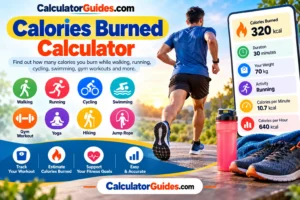
Calories Burned Calculator-Want to know how many calories you burn while walking, running, cycling, swimming, or working out?,Our Calories Burned Calculator gives you a quick estimate based on your body weight, activity, and exercise duration. Simply choose an activity, enter your weight and time, and the calculator estimates how many calories you burned.Make fitness calculations simple with One Rep Max Calculator and body measurement calculators.
🔥 Calories Burned Calculator
You can use it for common activities such as walking, running, jogging, cycling, swimming, hiking, weight training, gym workouts, yoga, rowing, dancing, and more.
The result is an estimate, not an exact measurement, because the number of calories you burn can change with your pace, intensity, fitness level, body composition, terrain, and other factors.
What Is a Calories Burned Calculator?
A Calories Burned Calculator is an online tool that estimates how much energy your body uses during physical activity.
The calculation usually considers three main things:
- Your body weight
- The activity you perform
- How long you perform it
For example, a person who weighs more will generally use more energy to perform the same activity for the same amount of time than a lighter person. The CDC also notes that people who weigh more generally burn more calories during the same physical activity.
A calories burned calculator is useful when you want a quick estimate without using a fitness watch or doing the calculation yourself.
How to Use the Calories Burned Calculator
Using the calculator is simple.
Step 1: Enter your weight
Enter your body weight in kilograms or pounds, depending on the calculator settings.
Step 2: Choose your activity
Select the activity you performed.
For example:
- Walking
- Running
- Jogging
- Cycling
- Swimming
- Hiking
- Weight training
- Yoga
- Rowing
- Dancing
- Jump rope
- Sports
Step 3: Enter your duration
Enter how long you exercised.
For example:
30 minutes
Step 4: Calculate
Click the calculate button.
The calculator will estimate your calories burned.
You may also see calories burned per minute, calories burned per hour, and the MET value used for the estimate.
How Are Calories Burned Calculated?
Many exercise calorie calculators use MET, which stands for Metabolic Equivalent of Task.
A MET is a standardized way of describing the energy cost of physical activities. The 2024 Adult Compendium of Physical Activities contains MET values for 1,114 physical activities and is widely used to describe energy expenditure.
A commonly used formula is:
Calories burned = MET × 3.5 × body weight (kg) ÷ 200 × minutes
For example, if a 70 kg person performs a 4 MET activity for 30 minutes:
4 × 3.5 × 70 ÷ 200 × 30 = 147 calories
This is an estimate because the actual energy used by an individual can be different.
The Compendium itself explains that its standard MET values are useful for describing physical activity energy costs but are not designed to precisely measure the energy cost for one individual.
What Is a MET?
MET means Metabolic Equivalent of Task.
In simple words, it is a way to compare how much energy an activity requires compared with resting.
A value of about 1 MET represents resting energy expenditure under the standard MET definition.
Higher MET values generally represent activities that require more energy.
For example, a relaxed activity will generally have a lower MET value than vigorous running.
The 2024 Adult Compendium uses MET values to classify thousands of activities, including exercise, sports, transportation, household activities, and work-related activities.
Calories Burned While Walking
Walking is one of the easiest activities to include in a daily routine.
The calories burned while walking depend on:
- Body weight
- Walking speed
- Walking duration
- Incline or terrain
- Walking style
A slow walk and a brisk walk do not require the same amount of energy.
For example, the CDC lists approximately 140 calories in 30 minutes for a 154-pound person walking at 3.5 mph. This is only a general reference value, not a personalized result.
Calories Burned Walking for 30 Minutes
Your actual number will depend on your weight and walking speed.
A heavier person will generally burn more calories than a lighter person doing the same walk.
For a better estimate, enter your own weight and walking duration into the calculator.
Calories Burned Running
Running generally uses more energy per minute than walking because it is a more intense activity.
The calories burned while running depend on:
- Running speed
- Body weight
- Duration
- Terrain
- Running efficiency
For example, the CDC gives an approximate figure of 295 calories for 30 minutes of running/jogging at 5 mph for a 154-pound person.
This does not mean every person will burn exactly 295 calories.
Your personal calorie burn may be higher or lower.
Calories Burned Running for 1 Hour
If you run for an hour, your total calorie burn will generally be higher than running for 30 minutes.
However, you should not simply assume that every person’s result will be the same.
Your weight, running speed, fitness level, terrain, and other factors can affect the actual energy cost.
Calories Burned Jogging
Jogging is usually performed at a slower pace than running.
The calories burned while jogging depend mainly on:
- Body weight
- Jogging speed
- Duration
- Terrain
A calories burned calculator can give you a quick estimate by combining your weight, activity intensity, and workout time.
Calories Burned Cycling
Cycling can range from an easy ride to a very intense workout.
The energy used during cycling depends on:
- Cycling speed
- Resistance
- Hills
- Body weight
- Duration
- Riding intensity
The 2024 Adult Compendium includes different cycling activities and intensity levels rather than treating every cycling session as exactly the same.
This is important because a relaxed bicycle ride and a hard cycling workout can have very different calorie costs.
Calories Burned Swimming
Swimming is another activity where intensity can make a big difference.
Your calorie burn can change depending on:
- Swimming stroke
- Speed
- Continuous swimming time
- Rest periods
- Body weight
Swimming laps at a moderate or vigorous pace will generally use more energy than simply being in the water.
For a personalized estimate, enter your body weight and swimming duration into the calculator.
Calories Burned Cycling vs. Running
People often ask whether cycling or running burns more calories.
There is no single answer for everyone.
The result depends on the intensity and duration of each activity.
A hard cycling session can burn a large number of calories, while an easy cycling session may burn fewer calories than a faster run.
Instead of comparing the activities only by name, compare the actual intensity, duration, and your body weight.
Calories Burned by Weight Training
Strength training also uses energy.
The calorie burn depends on:
- Exercise selection
- Weight used
- Workout intensity
- Rest periods
- Workout duration
- Body weight
A light weight-training session and a fast-paced resistance workout should not be expected to burn the same number of calories.
Weight training is also useful for building and maintaining muscle, so calories burned during the workout are not the only reason to include strength training in a fitness routine.
Calories Burned at the Gym
A gym workout can include many different activities.
For example:
- Treadmill walking
- Running
- Cycling
- Elliptical
- Rowing
- Weight training
- Circuit training
- Stair climbing
- HIIT
Because these exercises have different intensities, there is no single calorie number for a “gym workout.”
Choose the activity that best matches what you actually did.
Calories Burned by Exercise
Different exercises have different energy costs.
Some common activities include:
| Activity | What can affect calorie burn |
|---|---|
| Walking | Speed, incline, weight |
| Running | Speed, terrain, weight |
| Cycling | Speed, resistance, hills |
| Swimming | Stroke, speed, duration |
| Hiking | Terrain, incline, backpack |
| Rowing | Stroke rate, resistance |
| Jump rope | Speed and intensity |
| Weight training | Exercise, weight, rest time |
| Yoga | Style and intensity |
| Dancing | Style and pace |
The 2024 Adult Compendium provides separate MET values for many different activities because physical activities vary widely in intensity.
Calories Burned Per Minute
Some calculators show your estimated calorie burn per minute.
For example, if your estimated workout burn is 300 calories over 30 minutes:
300 ÷ 30 = 10 calories per minute
This number can help you understand the average rate of energy use during the activity.
It is still an estimate rather than a direct measurement.
Calories Burned Per Hour
You can also estimate your calorie burn over an hour.
If an activity burns approximately 8 calories per minute:
8 × 60 = 480 calories per hour
However, this does not mean you will necessarily burn exactly 480 calories during every hour.
Your pace and intensity can change during the workout.
Calories Burned by Body Weight
Body weight is an important part of many calorie-burn calculations.
For the same activity and duration, a heavier person generally uses more energy than a lighter person.
For example, walking for 30 minutes at the same pace will not necessarily burn the same number of calories for two people who have very different body weights.
This is one reason a personalized calories burned calculator asks for your weight.
Calories Burned by Steps
Many people search for calories burned from steps rather than exercise duration.
Steps can be useful for tracking daily movement, but converting steps directly into calories is only an estimate.
The result can change based on:
- Body weight
- Height
- Stride length
- Walking speed
- Terrain
- Total distance
For example, 10,000 steps does not represent exactly the same distance or calorie burn for every person.
If you know your walking distance and pace, an activity-based calculation can provide a more useful estimate than using steps alone.
How Many Calories Does 10,000 Steps Burn?
There is no universal calorie number for 10,000 steps.
Two people can take the same number of steps and burn different amounts of energy.
A person’s weight, height, walking pace, stride length, and terrain can all affect the result.
So rather than assuming that 10,000 steps always equals a fixed number of calories, use your own information for a better estimate.
Calories Burned From Walking 5,000 Steps
The same idea applies to 5,000 steps.
Your calorie burn depends on how far you actually walked and how much you weigh.
If you want a more useful estimate, enter your walking activity, weight, and duration into the calculator.
Gross Calories vs. Active Calories
You may sometimes see two different calorie numbers:
Gross calories and active or net calories.
Gross calories include the energy your body would have used during that period, including resting energy.
Net or active calories attempt to show the energy used above resting.
This difference can explain why a calorie estimate from one calculator may not exactly match a fitness watch or another website.
Why Does My Fitness Tracker Show a Different Number?
It is normal for two calorie estimates to be different.
A fitness watch may use information such as:
- Heart rate
- Movement
- GPS
- Body weight
- Height
- Age
- Activity type
A simple online calculator may mainly use body weight, duration, and an average MET value.
The 2024 Compendium provides standardized activity intensity values, but it does not precisely measure the energy expenditure of each individual person.
Therefore, treat calorie-burn numbers as estimates, not exact measurements.
Does Body Weight Affect Calories Burned?
Yes.
Body weight can affect the amount of energy needed to move your body during physical activity.
For this reason, a calculator normally asks you to enter your current weight.
If your weight changes, the estimated calorie burn for the same activity may also change.
Does Exercise Intensity Affect Calories Burned?
Yes.
Intensity is one of the most important factors.
For example, walking slowly and walking briskly are different activities from an energy-cost perspective.
The same applies to cycling, swimming, running, rowing, and other exercises.
Increasing intensity generally increases energy expenditure, although the exact amount varies between individuals.
Calories Burned and Weight Loss
Physical activity uses calories, and increasing physical activity can contribute to a calorie deficit.
The CDC explains that using calories through physical activity, together with reducing calorie intake when appropriate, creates a calorie deficit that can result in weight loss. It also notes that regular physical activity is important for maintaining weight loss.
However, exercise calories should not be viewed in isolation.
Your total daily energy needs also include the energy your body uses at rest and the energy used for normal daily activities.
Weight management is influenced by many factors, including food intake, activity, sleep, age, genetics, and medications.
How Many Calories Should You Burn a Day?
There is no single calorie-burn target that is right for everyone.
Your daily energy needs depend on factors such as:
- Age
- Body size
- Sex
- Activity level
- Muscle mass
- Daily movement
- Exercise
Instead of trying to burn a fixed number of calories every day, focus on regular physical activity and an overall healthy routine.
For general health, the CDC recommends adults get at least 150 minutes of moderate-intensity aerobic activity each week, or an equivalent amount of vigorous activity, plus muscle-strengthening activity on at least 2 days per week.
Is the Calories Burned Calculator Accurate?
The calculator provides an estimate.
It cannot know exactly how much energy your body uses during every workout.
Actual calorie expenditure can vary because of:
- Exercise intensity
- Fitness level
- Body composition
- Technique
- Terrain
- Temperature
- Individual metabolism
- Rest periods
The Compendium of Physical Activities itself warns that standardized MET values should not be treated as precise measurements of an individual’s energy cost.
For this reason, the result should be used as a helpful estimate rather than an exact number.
Calories Burned Calculator Example
Suppose a person weighs:
70 kg
They go for a brisk walk for:
30 minutes
If the activity is assigned a MET value of 4, the estimate using the common MET formula is:
Calories = 4 × 3.5 × 70 ÷ 200 × 30
Calories ≈ 147 kcal
This example shows how body weight, activity intensity, and duration work together.
Your calculator result may be different if it uses a different activity or MET value.
Tips for Getting a Better Calorie Burn Estimate
For a more useful result:
Use your current weight
Your weight can change over time, so update the calculator when needed.
Choose the closest activity
Select the activity that best matches what you actually did.
Use the correct duration
Only include the time you were actually active if the calculator is designed for active duration.
Choose the correct intensity
A slow walk and a brisk walk should not be treated as exactly the same activity.
Do not treat the result as exact
Use the number as a guide rather than assuming it is a laboratory measurement.
Frequently Asked Questions
What is a Calories Burned Calculator?
A Calories Burned Calculator estimates how many calories you use during an activity based on information such as your body weight, activity type, and exercise duration.
How does a calorie burn calculator work?
Many calculators use MET values to estimate energy expenditure. A common formula is:
Calories = MET × 3.5 × weight in kg ÷ 200 × minutes
The MET value represents the estimated intensity of the activity.
How many calories do I burn walking?
The answer depends on your weight, walking speed, duration, and terrain. A calculator can provide a more personalized estimate.
How many calories does running burn?
Running can burn a substantial number of calories, but the exact amount depends on your weight, running speed, duration, and other factors.
How many calories does 30 minutes of exercise burn?
There is no single answer. Thirty minutes of easy walking, running, cycling, swimming, and weight training can all produce different results.
How many calories does 1 hour of walking burn?
It depends on your body weight, walking speed, terrain, and other factors. Enter your weight and walking pace into the calculator for an estimate.
How many calories does 10,000 steps burn?
There is no fixed number. Calories burned from 10,000 steps depend on factors such as weight, height, stride length, pace, and terrain.
Does a heavier person burn more calories?
Generally, yes. For the same activity and duration, a heavier person will usually use more energy than a lighter person.
Does running burn more calories than walking?
Running generally has a higher energy cost per minute than walking at an ordinary pace, but the actual result depends on speed, body weight, duration, and other factors.
What is MET in a calorie calculator?
MET stands for Metabolic Equivalent of Task. It is a standardized measure used to describe the energy cost of physical activities.
Are calories burned calculators accurate?
They provide estimates rather than exact measurements. Actual energy expenditure varies from person to person.
Can I use this calculator for weight loss?
Yes, it can help you understand the estimated energy used during exercise. However, weight loss depends on your overall energy balance and other lifestyle factors, not just calories burned during a workout.
Can I calculate calories burned from walking?
Yes. Enter your body weight, walking activity, and duration to get an estimated calorie burn.
Can I calculate calories burned from running?
Yes. Choose running, enter your weight and workout duration, and the calculator can estimate the calories used.
Can I calculate calories burned from cycling?
Yes. Select cycling and enter your weight and duration. For a better estimate, choose an activity intensity that closely matches your ride.
Can I calculate calories burned from swimming?
Yes. Select swimming and enter your weight and swimming time. Different swimming speeds and strokes can have different energy costs.
Final Thoughts
The Calories Burned Calculator is a simple way to estimate how much energy you use during exercise and everyday physical activities.
Whether you want to calculate calories burned walking, running, cycling, swimming, hiking, weight training, gym workouts, yoga, or other activities, the calculator can give you a quick estimate.
Your body weight, activity, duration, and exercise intensity all matter. Remember that calorie-burn numbers are estimates, not exact measurements.
Use the calculator as a helpful guide to understand your workouts, compare different activities, and keep track of your overall fitness routine.