
ELSS Calculator-An ELSS Calculator helps you estimate how much your Equity Linked Savings Scheme (ELSS) investment could grow over time and how much you may be able to claim as a tax deduction under Section 80C, subject to the applicable tax rules.Calculate everyday measurements with our easy Dividend Yield Calculator, NPV Calculator online conversion calculators.
Investment Calculator
ELSS mutual funds are popular among investors who want to combine tax-saving and equity market investment in one product. Unlike traditional tax-saving options, ELSS invests mainly in equities, so its value can rise or fall with the stock market.
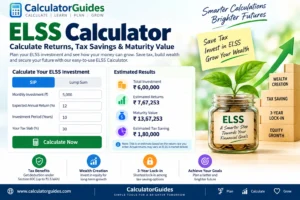
With an ELSS Calculator, you can enter your investment amount, expected return, investment period, and investment type to get an estimated future value, total investment, estimated profit, and possible tax-saving amount.
This guide explains how the ELSS Calculator works, how to calculate ELSS returns, how ELSS SIP calculations work, the 80C tax benefit, the three-year lock-in period, and the taxes that may apply when you sell your investment.
Important: ELSS returns are market-linked. Calculator results are estimates based on the return rate you enter and are not guaranteed.
What Is an ELSS Calculator?
An ELSS Calculator is an online financial tool that estimates the future value of an ELSS mutual fund investment.
You can normally use it to calculate:
- Total amount invested
- Estimated ELSS returns
- Estimated profit
- Future value or maturity value
- Monthly SIP investment value
- Lump-sum investment value
- Estimated tax deduction under Section 80C
- Estimated tax saving based on your applicable tax rate
- Investment growth over different periods
For example, suppose you invest ₹10,000 per month in an ELSS fund and assume an average annual return of 12%.
Instead of manually calculating the value every year, you can enter these details into an ELSS Calculator and get an estimated future value within seconds.
The calculator does not predict what your ELSS fund will actually earn. It simply uses the assumptions you provide to show a possible investment outcome.
What Is ELSS?
ELSS stands for Equity Linked Savings Scheme.
It is a type of equity mutual fund that qualifies for a tax deduction under the applicable Section 80C rules. AMFI states that ELSS schemes invest at least 80% in stocks and have a three-year lock-in period.
ELSS has two important characteristics:
- It is linked to equity markets.
- It can provide a tax deduction under the applicable 80C rules.
Because ELSS invests in stocks, it can provide higher long-term growth potential than some traditional fixed-income tax-saving products, but it also carries market risk.
The value of an ELSS investment can move up or down depending on the performance of the underlying stocks and the overall market.
How Does an ELSS Calculator Work?
An ELSS Calculator generally works by using a few basic inputs.
Common ELSS Calculator Inputs
You may need to enter:
- Investment type: SIP or lump sum
- Monthly SIP amount: For regular investments
- Lump-sum amount: For one-time investment
- Expected annual return: Your assumed return rate
- Investment period: Number of years
- Tax rate: If you want to estimate tax savings
The calculator then uses these inputs to estimate your investment value.
For example:
Monthly SIP: ₹5,000
Investment period: 10 years
Expected return: 12%
The calculator estimates the amount invested and the potential future value based on the assumed rate.
The actual value can be different because mutual fund returns are not fixed.
ELSS Calculator Formula
The calculation depends on whether you are investing through SIP or a lump sum.
ELSS Lump Sum Formula
For a lump-sum investment, the basic compound growth formula is:
Future Value = P × (1 + r)^n
Where:
- P = Initial investment
- r = Expected annual return
- n = Investment period in years
Example
Suppose you invest:
- Initial amount = ₹1,00,000
- Expected return = 12%
- Period = 5 years
The estimated value can be calculated as:
₹1,00,000 × (1.12)^5
The result is an estimated future value based on a constant 12% annual growth assumption.
Actual ELSS returns will not normally grow at exactly the same rate every year.
ELSS SIP Calculator Formula
If you invest a fixed amount every month, the ELSS Calculator uses an SIP-style future value calculation.
A commonly used formula is:
FV = P × [((1 + r)^n – 1) / r] × (1 + r)
Where:
- FV = Future value
- P = Monthly investment
- r = Monthly expected return
- n = Number of monthly investments
The annual expected return is converted into a monthly rate for the calculation.
Example
Suppose:
- Monthly SIP = ₹5,000
- Investment period = 10 years
- Expected return = 12%
Your total contribution would be:
₹5,000 × 120 = ₹6,00,000
The remaining amount shown by the calculator represents estimated growth.
Again, the final value is only an illustration because market returns change over time.
ELSS Tax Saving Calculator
One of the main reasons people search for an ELSS Tax Saving Calculator is to estimate the tax benefit available from an eligible ELSS investment.
Under the current rules, eligible investments under Section 80C form part of an aggregate deduction limit of ₹1.5 lakh. The Income Tax Department lists several qualifying payments and investments under this limit.
This means investing ₹1.5 lakh in ELSS does not automatically mean you receive ₹1.5 lakh as a cash refund.
Instead, the eligible investment can reduce taxable income under the applicable tax regime, subject to the rules and the remaining 80C limit available to you.
Simple Example
Suppose:
ELSS investment = ₹1,00,000
If you have enough unused 80C limit and are eligible to claim the deduction, the ₹1,00,000 may qualify as a deduction.
The actual tax saved depends on your applicable tax situation.
For example, a person in a hypothetical 20% marginal tax rate could estimate:
₹1,00,000 × 20% = ₹20,000
This is only a simplified illustration. Cess, surcharge, other deductions, income level, and the tax regime can change the final tax calculation.
Is ELSS Tax Saving Available Under the New Tax Regime?
This is an important question when using an ELSS Calculator.
The tax deduction under the old Section 80C framework is associated with the old tax regime. The Income Tax Department’s current guidance lists the ₹1.5 lakh combined 80C deduction under the old tax regime.
Therefore, you should not assume that buying ELSS automatically gives you a tax deduction regardless of which tax regime you use.
Before investing specifically for tax-saving purposes, check which tax regime you are using and whether the applicable rules allow the deduction.
ELSS Investment Limit
There is generally no maximum investment limit that prevents you from investing more than ₹1.5 lakh in an ELSS fund.
However, the tax deduction available under the 80C framework is limited by the applicable aggregate limit.
For example:
Investment: ₹2,00,000
You may invest ₹2 lakh in ELSS.
But you cannot simply assume that the entire ₹2 lakh will qualify for an 80C deduction.
The applicable deduction limit and your other eligible 80C investments have to be considered.
If you already have:
- EPF
- PPF
- Life insurance premium
- Home-loan principal
- Tuition fees
- Other eligible investments
they may already use part or all of the available 80C limit.
ELSS 3-Year Lock-In Period
One of the most important features of ELSS is its three-year lock-in period.
AMFI states that ELSS has a three-year lock-in period, which is the shortest among the commonly listed tax-saving options.
You cannot normally redeem the units before the applicable lock-in period ends.
Example
Suppose you purchase ELSS units on:
1 April 2026
The relevant units have a three-year lock-in period based on their allotment date.
This is important for SIP investors because each SIP instalment is treated separately for lock-in purposes.
ELSS SIP Lock-In Explained
A common misunderstanding is that investing in ELSS through SIP means the entire SIP becomes available after three years from the date you started the SIP.
That is not how the lock-in works.
Each investment instalment has its own lock-in period.
Example
Suppose you invest:
- ₹5,000 in April 2026
- ₹5,000 in May 2026
- ₹5,000 in June 2026
The April investment completes its three-year lock-in at a different time from the May and June investments.
This is why an ELSS SIP can have multiple different unlock dates.
An ELSS Calculator can help you understand the investment growth, but you should also keep track of the lock-in period of individual investments.
ELSS Calculator for SIP
An ELSS SIP Calculator is useful when you want to invest a fixed amount every month.
For example:
| Monthly SIP | Investment Period | Assumed Return |
|---|---|---|
| ₹1,000 | 10 years | 10% |
| ₹5,000 | 10 years | 12% |
| ₹10,000 | 15 years | 12% |
| ₹20,000 | 15 years | 12% |
The calculator can show how the estimated value changes when you increase:
- Monthly investment
- Investment period
- Expected return
One of the biggest benefits of using the calculator is that you can compare different investment amounts before starting your SIP.
ELSS Lump Sum Calculator
An ELSS lump-sum investment means investing a larger amount at one time.
For example:
Investment = ₹1,00,000
You can enter:
- ₹1,00,000 investment
- 5-year period
- 10% expected return
The calculator will estimate the future value.
A lump-sum calculator can be useful when you receive:
- Bonus
- Annual savings
- Business income
- Maturity proceeds
- Other available investment money
However, equity markets can fluctuate, so investing a lump sum carries market timing risk.
ELSS Return Calculator
An ELSS Return Calculator helps estimate the potential return on your investment.
You can compare:
Total investment vs estimated current/future value
For example:
Total invested: ₹6,00,000
Estimated value: ₹11,00,000
Then:
Estimated profit = ₹11,00,000 − ₹6,00,000
Estimated profit = ₹5,00,000
The calculator can also show the estimated return percentage based on the inputs.
Remember that an assumed return rate is not a promise from the fund.
How to Calculate ELSS Returns Manually
For a simple lump-sum calculation, you can use:
Future Value = Investment × (1 + Return)^Years
For example:
Investment = ₹1,00,000
Return = 10%
Period = 5 years
The calculation becomes:
₹1,00,000 × (1.10)^5
The result is the estimated value after five years under the assumed constant annual return.
For SIP investments, the calculation is more complex because money is invested at different times.
That is why an ELSS SIP Calculator is easier and more practical.
ELSS Calculator Example
Let’s take a simple example.
Suppose you invest:
₹10,000 per month
for:
10 years
and assume:
12% annual return
Total Investment
₹10,000 × 120 months
= ₹12,00,000
The calculator then estimates the future value using the assumed return.
The difference between the estimated future value and ₹12 lakh represents estimated investment growth.
This example is not a guarantee of 12% returns.
Actual returns can be:
- Higher
- Lower
- Negative in some periods
because ELSS is an equity-oriented mutual fund.
What Is the Difference Between ELSS and SIP?
ELSS and SIP are not exactly the same thing.
ELSS is a type of mutual fund scheme.
SIP is a method of investing.
You can invest in an ELSS fund through a SIP.
For example:
ELSS = the investment product
SIP = the investment method
This is why people often search for an ELSS SIP Calculator.
ELSS vs PPF
ELSS and PPF are both commonly used for tax-saving purposes, but they work differently.
| Feature | ELSS | PPF |
|---|---|---|
| Investment type | Equity mutual fund | Government-backed savings scheme |
| Market-linked | Yes | No |
| Lock-in | 3 years | Long-term |
| Return | Not guaranteed | Rate-based under applicable rules |
| Tax deduction | Eligible under applicable 80C rules | Eligible under applicable 80C rules |
| Risk | Higher | Lower |
| Liquidity | After lock-in | Subject to PPF rules |
ELSS can be more market-sensitive because it invests primarily in equities.
PPF has different rules and a much longer structure.
The right option depends on your goals, risk tolerance, tax situation, and investment horizon.
ELSS vs Tax-Saving FD
A tax-saving fixed deposit and ELSS are also different.
A tax-saving FD generally provides a fixed interest structure according to the bank’s terms.
ELSS is market-linked.
ELSS
- Equity exposure
- Market risk
- Three-year lock-in
- Potential for long-term capital growth
- Eligible 80C benefit under applicable rules
Tax-Saving FD
- Fixed-income product
- Interest rate known according to the deposit terms
- Five-year tax-saving lock-in generally applies
- Lower market risk than equity funds
Do not compare only the expected return. Risk, liquidity, tax treatment, and investment horizon are also important.
ELSS Taxation on Withdrawal
ELSS is an equity-oriented mutual fund, so taxation on redemption is an important part of your calculation.
For current rules, the Income Tax Department’s Finance Bill materials state a 12.5% long-term capital gains rate for the relevant long-term capital gains and a 20% short-term capital gains rate for specified short-term gains.
For equity-oriented investments, the long-term capital gains framework also includes the applicable annual exemption threshold. Tax rules can change, so check the rules applicable to the financial year in which you sell your units.
Important Point
The three-year ELSS lock-in does not mean your entire maturity value is tax-free.
The investment can qualify for the applicable 80C deduction when eligible, but gains on redemption can be subject to capital-gains taxation under the applicable rules.
ELSS Long-Term Capital Gains
After the applicable ELSS lock-in period, you can normally redeem eligible units.
If the investment qualifies as a long-term capital asset under the applicable equity mutual fund rules, long-term capital gains taxation applies.
For current rules, the long-term capital gains rate relevant to specified equity investments is 12.5%, subject to the applicable exemption threshold and conditions.
Because tax rules can change, use the calculator as an estimate and verify the current tax rules before filing your return.
Does ELSS Give Guaranteed Returns?
No.
ELSS returns are not guaranteed.
ELSS invests primarily in equity, so the value of your investment depends on market performance and the securities held by the fund.
For example, if you enter:
Expected return = 12%
the ELSS Calculator assumes 12% for the purpose of the illustration.
It does not mean that your fund will actually deliver 12% every year.
You should treat the calculator result as an estimate rather than a promise.
What Return Should You Enter in an ELSS Calculator?
There is no single correct return rate to enter.
You can test multiple scenarios.
For example:
Conservative scenario
8%
Moderate illustration
10%
Higher illustration
12%
Instead of relying on one number, compare several scenarios.
For example:
| Expected Return | Investment Period |
|---|---|
| 8% | 10 years |
| 10% | 10 years |
| 12% | 10 years |
| 14% | 10 years |
This gives you a better understanding of how sensitive your projected value is to the assumed return.
ELSS Calculator for ₹1.5 Lakh Investment
Many investors search for:
“ELSS calculator 1.5 lakh”
This is because ₹1.5 lakh is the current aggregate limit associated with Section 80C deductions under the applicable old-regime rules.
Suppose you invest ₹1.5 lakh in an eligible ELSS fund.
You can use the calculator to estimate:
- Investment amount
- Expected growth
- Future value
- Estimated profit
- Potential tax deduction
However, remember that the ₹1.5 lakh limit is an aggregate 80C limit, not an ELSS-only limit.
If you already use 80C through EPF, PPF, insurance, home-loan principal, or other eligible payments, your remaining available limit may be lower.
ELSS Calculator for ₹50,000 Investment
Suppose you invest:
₹50,000
You can enter the amount into the ELSS Calculator along with an expected return and investment period.
For example:
- Investment = ₹50,000
- Expected return = 10%
- Period = 5 years
The calculator will estimate the future value using compound growth.
The actual result can be different because the fund’s NAV changes with the market.
ELSS Calculator for ₹1,000 Monthly SIP
A ₹1,000 monthly SIP is another common calculation.
For example:
Monthly investment = ₹1,000
Investment period = 10 years
Total amount invested:
₹1,000 × 120 = ₹1,20,000
The calculator then estimates how much this investment could potentially grow based on your assumed return.
Small regular investments can become meaningful over long periods because of compounding and regular contributions, although returns are not guaranteed.
How Much Should You Invest in ELSS?
There is no universal amount that is suitable for everyone.
Your investment amount can depend on:
- Income
- Existing savings
- Monthly expenses
- Emergency fund
- Existing 80C investments
- Financial goals
- Risk tolerance
- Investment horizon
If you are investing in ELSS only because of tax savings, first calculate how much of your 80C limit you have already used.
For example:
80C limit = ₹1,50,000
Existing eligible investments:
₹90,000
Potential remaining amount:
₹60,000
This is only a simplified example. Your actual eligible amount depends on your tax circumstances and the applicable rules.
Benefits of Using an ELSS Calculator
An ELSS Calculator can make investment planning easier.
1. Quick calculations
You do not need to manually perform complex SIP calculations.
2. Compare investment amounts
You can compare ₹2,000, ₹5,000, ₹10,000, or any other monthly SIP.
3. Understand compounding
The calculator helps show how investment growth can build over time.
4. Estimate tax-saving eligibility
You can estimate the amount that may qualify under the applicable 80C limit.
5. Plan long-term investments
You can compare different investment periods before starting an investment.
6. Test different return assumptions
You can test 8%, 10%, 12%, or other assumed rates instead of relying on one projection.
Limitations of an ELSS Calculator
An ELSS Calculator is useful, but it has limitations.
Returns are not guaranteed
The actual fund return may be different from your assumed rate.
Markets fluctuate
Equity markets can experience both gains and losses.
Tax rules can change
Tax calculations should be checked against the rules applicable for the relevant financial year.
Calculator results are estimates
The final investment value can be different from the calculator projection.
Lock-in matters
You cannot treat an ELSS investment like a normal open-ended equity fund because the applicable three-year lock-in applies.
Common Mistakes When Using an ELSS Calculator
Mistake 1: Assuming 12% return is guaranteed
Entering 12% into a calculator does not mean the fund will provide 12%.
Mistake 2: Forgetting existing 80C investments
Your EPF, PPF, insurance, home-loan principal, and other eligible investments may already use part of your 80C limit.
Mistake 3: Ignoring the lock-in period
ELSS is not suitable for money that you may need immediately.
Mistake 4: Looking only at tax savings
Tax benefits are only one part of an investment decision.
Mistake 5: Treating projected value as actual value
A calculator uses assumptions. Markets do not follow a fixed mathematical path.
Mistake 6: Confusing SIP with ELSS
SIP is a method of investing, while ELSS is the type of mutual fund.
How to Use Our ELSS Calculator
Using an ELSS Calculator is simple.
Step 1: Choose the investment type
Select:
- SIP
- Lump sum
Step 2: Enter your investment amount
For SIP, enter your monthly amount.
For lump sum, enter the amount you want to invest once.
Step 3: Enter the expected return
Enter an assumed annual return.
For example:
10%
Step 4: Enter the investment period
Choose the number of years.
For example:
10 years
Step 5: Check the result
The calculator can show:
- Total investment
- Estimated returns
- Estimated profit
- Future value
- Potential tax deduction
You can then change the inputs to compare different scenarios.
ELSS Calculator – Quick Example
Let’s take a simple example:
Monthly SIP: ₹5,000
Period: 10 years
Expected return: 10%
Total investment
₹5,000 × 120 months
= ₹6,00,000
The calculator estimates the potential future value using the assumed 10% return.
Now change the return assumption to 12%.
You will see a different projected value.
This demonstrates why expected return has a significant impact on long-term calculations.
It also shows why you should not select an unrealistic return simply to produce a larger projected number.
Frequently Asked Questions About ELSS Calculator
What is an ELSS Calculator?
An ELSS Calculator is an online tool that estimates the future value, investment growth, and potential tax-saving benefit of an ELSS mutual fund investment.
Is ELSS tax-free?
ELSS itself does not make all investment gains automatically tax-free. Eligible investments can provide a tax deduction under the applicable 80C rules, while capital gains on redemption may be taxable under the applicable equity mutual fund tax rules.
What is the ELSS lock-in period?
ELSS has a three-year lock-in period. AMFI identifies three years as the ELSS lock-in period.
Can I withdraw ELSS before three years?
Generally, ELSS units cannot be redeemed before completing the applicable three-year lock-in period.
Is ELSS better than PPF?
ELSS and PPF have different features, risks, liquidity rules, and return structures. Your choice depends on your financial goals and circumstances.
Is ELSS better than a tax-saving FD?
They are different investment products. ELSS is equity-linked and market-sensitive, while a tax-saving FD follows a fixed-deposit structure.
Can I invest ₹1.5 lakh in ELSS?
Yes, you can invest ₹1.5 lakh, subject to the scheme’s investment rules. The applicable tax deduction is subject to the overall 80C limit and your tax regime.
Can I invest more than ₹1.5 lakh in ELSS?
Yes, you may invest more than ₹1.5 lakh, but you should not assume that the additional amount will qualify for an 80C deduction.
Can I invest in ELSS through SIP?
Yes. Many ELSS schemes allow SIP investments, subject to the particular scheme’s terms.
Is ELSS SIP locked for three years?
Each ELSS SIP instalment has its own applicable lock-in period. The entire SIP does not become unlocked on one common date.
Does ELSS guarantee 10% or 12% returns?
No. ELSS is market-linked and does not guarantee a fixed return.
What return should I use in an ELSS Calculator?
You can test different assumptions, such as 8%, 10%, or 12%, to understand different possible outcomes. Do not treat any assumed rate as guaranteed.
Does ELSS qualify for Section 80C?
ELSS is currently listed by AMFI as eligible for a deduction under Section 80C up to the applicable ₹1.5 lakh limit, subject to the tax rules and regime applicable to you.
What is the maximum tax benefit from ELSS?
The tax benefit depends on your eligible investment, remaining 80C limit, applicable tax regime, and tax position. The aggregate 80C deduction limit is ₹1.5 lakh under the applicable old-regime framework.
Is ELSS suitable for short-term investment?
ELSS has a three-year lock-in and invests in equities. Investors should consider their ability to remain invested through market fluctuations rather than choosing it only for a short-term goal.
Does ELSS have market risk?
Yes. Since ELSS invests predominantly in equities, its value can fluctuate with the market.
Final Thoughts
An ELSS Calculator is a simple way to understand how your tax-saving investment could grow over time.
Instead of guessing how much you need to invest, you can enter your monthly SIP or lump-sum amount, expected return, and investment period and see an estimated future value.
The calculator can also help you understand the relationship between your investment and the applicable Section 80C deduction.
However, the most important thing to remember is that ELSS is an equity-linked investment. The return shown by a calculator is only a projection. It is not a guarantee.
Before investing, look at your financial goal, risk tolerance, existing tax-saving investments, available 80C limit, and the applicable tax regime.
Use the ELSS Calculator to compare different scenarios, understand the numbers, and make your investment planning easier.