
Gas Mileage Calculator-Use our free Gas Mileage Calculator to calculate MPG, km/L, fuel consumption, trip fuel cost, and fuel economy. Convert between MPG, km/L and L/100 km with easy examples.Explore our complete collection of Engine Horsepower Calculator, Tire Size Calculator , Mileage Calculator,Dividend Calculator,Horsepower Calculator, conversion, and everyday calculators at CalculatorGuides.com to find the right tool for your needs.
⛽ Gas Mileage Calculator - CalculatorGuides
Fuel Economy:
Total Fuel Cost ($):
Knowing how much fuel your vehicle uses can help you understand your driving costs and plan trips more accurately.
A Gas Mileage Calculator helps you calculate your vehicle’s fuel economy using the distance you travel and the amount of fuel you use.
You can use it to calculate:
- Miles per gallon (MPG)
- Kilometres per litre (km/L)
- Litres per 100 kilometres (L/100 km)
- Fuel consumed
- Fuel cost
- Trip fuel cost
- Distance possible with a full tank
- Cost per kilometre
- Cost per mile
- Estimated fuel needed for a trip
Whether you drive a car, SUV, pickup truck, motorcycle, or another petrol-powered vehicle, a mileage calculator can make fuel costs easier to understand.
Note: Your actual mileage can change because of traffic, speed, tyre pressure, vehicle load, weather, road conditions, driving style, air-conditioning use, and vehicle maintenance.
What Is a Gas Mileage Calculator?
A Gas Mileage Calculator is a tool that measures how efficiently a vehicle uses fuel.
The basic idea is simple:
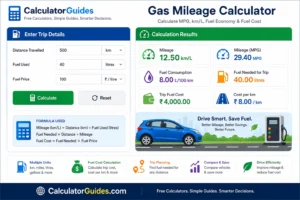
Fuel Economy = Distance Travelled ÷ Fuel Used
For example, if a car travels:
500 kilometres
using:
40 litres of petrol
its fuel economy is:
500 ÷ 40 = 12.5 km/L
That means the vehicle travels approximately 12.5 kilometres on one litre of fuel.
What Is Gas Mileage?
Gas mileage describes how far a vehicle can travel using a certain amount of fuel.
In the United States, it is commonly expressed as:
MPG – Miles Per Gallon
In India and many other countries, vehicle mileage is commonly expressed as:
km/L – kilometres per litre
Another widely used measurement is:
L/100 km – litres per 100 kilometres
The three measurements describe the same basic idea but use different units.
Gas Mileage Formula
The basic formula is:
Mileage = Distance ÷ Fuel Used
For example:
Distance:
600 km
Fuel:
50 litres
Mileage:
600 ÷ 50 = 12 km/L
So the vehicle’s fuel economy is:
12 km/L
MPG Formula
For US measurements:
MPG = Miles Driven ÷ Gallons Used
For example:
Miles driven:
300 miles
Fuel used:
10 gallons
MPG:
300 ÷ 10 = 30 MPG
The vehicle travels approximately 30 miles for every gallon of fuel.
km/L Formula
For metric measurements:
km/L = Kilometres Driven ÷ Litres Used
Example:
Distance:
450 km
Fuel:
30 litres
Mileage:
450 ÷ 30 = 15 km/L
L/100 km Formula
L/100 km works differently from MPG and km/L because a lower number means better fuel efficiency.
Formula:
L/100 km = Litres Used ÷ Kilometres Driven × 100
Example:
Fuel used:
40 litres
Distance:
500 km
L/100 km:
40 ÷ 500 × 100 = 8 L/100 km
So the vehicle consumes approximately 8 litres of fuel per 100 kilometres.
MPG vs km/L vs L/100 km
| Measurement | Meaning | Higher Number |
|---|---|---|
| MPG | Miles per gallon | Generally better |
| km/L | Kilometres per litre | Generally better |
| L/100 km | Litres used per 100 km | Lower is better |
This difference is important when comparing vehicle specifications.
A car with 20 km/L is more fuel-efficient than one with 12 km/L.
But a car using 6 L/100 km is more efficient than one using 10 L/100 km.
US MPG vs UK MPG
There are two common gallon measurements:
- US gallon
- Imperial gallon
Therefore, US MPG and UK MPG are not the same.
One US gallon is approximately:
3.785 litres
One Imperial gallon is approximately:
4.546 litres
This means the same vehicle can have a different MPG number depending on which gallon is being used.
Always check whether a fuel-economy figure uses US MPG or Imperial MPG.
Convert MPG to km/L
For US MPG:
km/L = MPG × 0.425144
Example:
30 US MPG:
30 × 0.425144
≈ 12.75 km/L
So 30 US MPG is approximately 12.75 km/L.
Convert km/L to US MPG
Formula:
US MPG = km/L × 2.35215
Example:
15 km/L:
15 × 2.35215
≈ 35.28 US MPG
Convert MPG to L/100 km
For US MPG:
L/100 km = 235.215 ÷ MPG
Example:
30 US MPG:
235.215 ÷ 30
≈ 7.84 L/100 km
Convert L/100 km to MPG
For US MPG:
US MPG = 235.215 ÷ L/100 km
Example:
8 L/100 km:
235.215 ÷ 8
≈ 29.40 MPG
Convert km/L to L/100 km
Formula:
L/100 km = 100 ÷ km/L
Example:
20 km/L:
100 ÷ 20
= 5 L/100 km
So a vehicle delivering 20 km/L uses approximately 5 litres of fuel per 100 km.
Convert L/100 km to km/L
Formula:
km/L = 100 ÷ L/100 km
Example:
6 L/100 km:
100 ÷ 6
≈ 16.67 km/L
Gas Mileage Example
Suppose you drive:
800 km
and use:
50 litres
Fuel economy:
800 ÷ 50
= 16 km/L
The same result in L/100 km is:
100 ÷ 16
= 6.25 L/100 km
This means the vehicle uses approximately 6.25 litres for every 100 km.
How to Calculate Your Real Mileage
The most reliable way to calculate your real-world mileage is to use the full-tank method.
Step 1: Fill the Tank
Fill your fuel tank to the same practical level.
Step 2: Reset the Trip Meter
Record the trip-meter reading.
Step 3: Drive Normally
Drive your usual routes.
Step 4: Fill the Tank Again
At the next refill, record how many litres were added.
Step 5: Record the Distance
Use the distance shown on the trip meter.
Step 6: Calculate
Mileage = Distance ÷ Fuel Added
Example:
Distance:
600 km
Fuel added:
40 litres
Mileage:
15 km/L
This method gives you a useful real-world estimate.
Gas Mileage Calculator for a Road Trip
Suppose you are planning a:
1,200 km trip
Your vehicle gives:
15 km/L
Estimated fuel required:
1,200 ÷ 15
= 80 litres
If petrol costs:
₹100 per litre
Estimated fuel cost:
80 × ₹100
= ₹8,000
This does not include tolls, parking, maintenance, food, or other travel expenses.
Fuel Cost Formula
To calculate fuel cost:
Fuel Cost = Fuel Used × Price Per Litre
First calculate fuel required:
Fuel Required = Distance ÷ Mileage
Then:
Trip Fuel Cost = Distance ÷ Mileage × Fuel Price
Fuel Cost Example
Suppose:
Distance:
500 km
Mileage:
15 km/L
Fuel price:
₹100/L
Fuel required:
500 ÷ 15
≈ 33.33 litres
Fuel cost:
33.33 × ₹100
≈ ₹3,333
Cost Per Kilometre
Formula:
Cost per km = Fuel Price per Litre ÷ km/L
Example:
Fuel price:
₹100/L
Mileage:
15 km/L
Cost per km:
₹100 ÷ 15
≈ ₹6.67/km
Cost Per 100 Kilometres
Formula:
Cost per 100 km = L/100 km × Fuel Price
Example:
Fuel consumption:
8 L/100 km
Fuel price:
₹100/L
Cost:
8 × ₹100
= ₹800 per 100 km
Fuel Needed for a Trip
Formula:
Fuel Needed = Distance ÷ Mileage
Example:
Trip distance:
900 km
Mileage:
18 km/L
Fuel needed:
900 ÷ 18
= 50 litres
If the vehicle has a 45-litre fuel tank, you would need to plan at least one additional refuelling stop, depending on actual conditions and available fuel range.
Driving Range
Driving range is the approximate distance a vehicle can travel using the available fuel.
Formula:
Range = Fuel Tank Capacity × Mileage
Example:
Fuel tank:
50 litres
Mileage:
15 km/L
Estimated range:
50 × 15
= 750 km
Actual range can be lower because drivers generally do not use every last litre of fuel.
Gas Mileage Calculator for Petrol
For petrol vehicles:
Mileage = Distance ÷ Petrol Used
Example:
Distance:
500 km
Petrol:
35 litres
Mileage:
14.29 km/L
You can then use the petrol price to calculate the approximate trip cost.
Gas Mileage Calculator for Diesel
The same basic calculation works for diesel vehicles:
Mileage = Distance ÷ Diesel Used
Example:
Distance:
700 km
Diesel:
40 litres
Mileage:
17.5 km/L
The difference is that diesel prices and vehicle characteristics can differ from petrol vehicles.
Gas Mileage Calculator for CNG
CNG vehicles can use different units depending on how consumption is recorded.
If your fuel data is available in kilograms, use:
Distance ÷ CNG Used in kg
For example:
Distance:
300 km
CNG:
20 kg
Efficiency:
15 km/kg
The calculator should use the appropriate unit rather than treating kilograms as litres.
Hybrid Vehicle Fuel Economy
Hybrid vehicles can use fuel more efficiently, especially in certain urban driving conditions.
Actual efficiency depends on:
- Hybrid system
- Battery charge
- Driving conditions
- Traffic
- Speed
- Temperature
- Driving style
Use real fuel consumption over several refills for a more meaningful comparison.
EV vs Gas Mileage
Electric vehicles do not use petrol or diesel, so traditional MPG or km/L is not the best measurement.
EV efficiency is often expressed as:
- kWh/100 km
- km/kWh
- miles/kWh
For EV running-cost comparisons, you can calculate:
Electricity Cost = Electricity Used × Electricity Price
This can then be compared with petrol or diesel fuel costs.
City Mileage vs Highway Mileage
A vehicle often gets different fuel economy in city and highway driving.
City Driving
Fuel consumption can increase because of:
- Traffic
- Frequent stops
- Idling
- Acceleration
- Short trips
Highway Driving
Fuel economy can improve because of:
- More consistent speed
- Fewer stops
- Less idling
However, very high speeds can also reduce fuel efficiency.
Why Your Mileage Changes
Real-world fuel economy can vary because of:
- Driving style
- Traffic
- Speed
- Tyre pressure
- Vehicle load
- Road conditions
- Weather
- Air conditioning
- Engine condition
- Fuel quality
- Vehicle age
- Maintenance
Therefore, one tank of fuel may not represent your vehicle’s normal average.
Does Speed Affect Mileage?
Yes.
Driving at higher speeds can increase aerodynamic drag and fuel consumption.
Rapid acceleration and frequent braking can also reduce efficiency.
Smooth acceleration and maintaining a suitable steady speed can help improve fuel economy.
Does Tyre Pressure Affect Mileage?
Incorrect tyre pressure can affect rolling resistance and handling.
Under-inflated tyres can increase resistance and may reduce fuel efficiency.
Always follow the vehicle manufacturer’s recommended tyre-pressure specification rather than using a random pressure value.
Does Air Conditioning Affect Mileage?
Air conditioning can increase fuel consumption, particularly in some driving conditions.
The effect depends on:
- Vehicle
- Outside temperature
- AC system
- Driving speed
- Driving conditions
In hot weather, the effect can be more noticeable.
Does Vehicle Load Affect Mileage?
Yes.
Carrying additional weight means the engine has more work to do.
Removing unnecessary heavy items from the vehicle can help reduce fuel consumption.
How to Improve Gas Mileage
You can often improve fuel economy by:
- Maintaining correct tyre pressure
- Avoiding unnecessary idling
- Accelerating smoothly
- Avoiding excessive speed
- Removing unnecessary weight
- Maintaining the vehicle properly
- Planning routes
- Combining short trips
- Using cruise control where appropriate
Small improvements in fuel economy can add up over thousands of kilometres.
Gas Mileage and Fuel Price
Your vehicle’s mileage and the fuel price together determine the cost of driving.
For example:
Vehicle A:
20 km/L
Vehicle B:
12 km/L
At a fuel price of ₹100/L:
Vehicle A:
₹100 ÷ 20
= ₹5/km
Vehicle B:
₹100 ÷ 12
≈ ₹8.33/km
The difference becomes significant over a long distance.
Annual Fuel Cost
You can estimate annual fuel expenses using:
Annual Fuel Cost = Annual Distance ÷ Mileage × Fuel Price
Example:
Annual distance:
15,000 km
Mileage:
15 km/L
Fuel price:
₹100/L
Fuel required:
15,000 ÷ 15
= 1,000 litres
Annual fuel cost:
1,000 × ₹100
= ₹1,00,000
Fuel Cost Comparison
Suppose you drive:
20,000 km per year
Vehicle A
Mileage:
20 km/L
Fuel:
1,000 litres
At ₹100/L:
₹1,00,000
Vehicle B
Mileage:
12 km/L
Fuel:
1,666.67 litres
At ₹100/L:
approximately ₹1,66,667
Difference:
approximately ₹66,667 per year
This shows why fuel economy can have a meaningful effect on long-term vehicle costs.
Gas Mileage Calculator for Used Cars
If you are considering a used vehicle, do not rely only on the manufacturer’s mileage claim.
Ask about:
- Actual city mileage
- Highway mileage
- Fuel type
- Service history
- Tyre condition
- Engine condition
- Driving pattern
A test drive and several fuel records can provide a better real-world picture.
Manufacturer Mileage vs Real Mileage
Official fuel-economy figures are produced under specified testing conditions.
Real-world mileage can be different because your:
- Traffic
- Speed
- Route
- Weather
- Driving style
- Vehicle load
may not match the test conditions.
Therefore, treat official mileage as a reference rather than a guarantee.
Gas Mileage Calculator Formula Summary
Mileage in km/L
km/L = Kilometres Driven ÷ Litres Used
US MPG
MPG = Miles Driven ÷ US Gallons Used
L/100 km
L/100 km = Litres Used ÷ Kilometres Driven × 100
Fuel Needed
Fuel Needed = Distance ÷ Mileage
Fuel Cost
Fuel Cost = Fuel Needed × Fuel Price
Cost Per km
Cost/km = Fuel Price ÷ km/L
Driving Range
Range = Tank Capacity × Mileage
How to Use the Gas Mileage Calculator
Step 1: Enter Distance
Enter the distance travelled.
Step 2: Enter Fuel Used
Enter the amount of petrol, diesel, or other applicable fuel consumed.
Step 3: Select Units
Choose:
- Miles and gallons
- Kilometres and litres
- L/100 km
Step 4: Enter Fuel Price
If you want to calculate fuel cost, enter the current fuel price.
Step 5: Calculate
The calculator can show:
- Mileage
- MPG
- km/L
- L/100 km
- Fuel needed
- Fuel cost
- Cost per kilometre
Frequently Asked Questions
What is a Gas Mileage Calculator?
A Gas Mileage Calculator calculates how efficiently your vehicle uses fuel based on distance travelled and fuel consumed.
How do I calculate gas mileage?
Divide the distance travelled by the amount of fuel used.
For metric units:
km/L = kilometres ÷ litres
What is a good gas mileage?
There is no single number. It depends on the vehicle, engine, fuel type, size, weight, driving conditions, and purpose.
Is higher MPG better?
Yes. A higher MPG means the vehicle travels more miles using one gallon of fuel.
Is higher km/L better?
Yes. A higher km/L means the vehicle travels farther using one litre of fuel.
Is lower L/100 km better?
Yes. A lower L/100 km means the vehicle uses less fuel to travel 100 kilometres.
How do I convert km/L to MPG?
For US MPG:
US MPG = km/L × 2.35215
How do I convert MPG to km/L?
For US MPG:
km/L = MPG × 0.425144
What is the difference between US MPG and UK MPG?
US and Imperial gallons have different volumes, so MPG figures are not directly interchangeable.
How do I calculate fuel cost for a trip?
First calculate fuel required:
Distance ÷ Mileage
Then multiply the result by the fuel price.
How do I calculate cost per kilometre?
Divide the fuel price per litre by your km/L.
How do I calculate fuel needed for 1,000 km?
Divide 1,000 by your vehicle’s km/L.
For example, at 20 km/L:
1,000 ÷ 20
= 50 litres
How do I calculate my real-world mileage?
Use the full-tank method: record the distance between refuelling and divide it by the litres added at the next refill.
Does city driving reduce mileage?
It can. Traffic, idling, stopping, and frequent acceleration can increase fuel consumption.
Does highway driving improve mileage?
It often can, particularly at steady moderate speeds, but very high speeds can reduce fuel efficiency.
Does AC reduce mileage?
Air conditioning can increase fuel consumption, although the effect varies by vehicle and conditions.
Does tyre pressure affect mileage?
Yes. Incorrect tyre pressure can increase rolling resistance and affect fuel economy.
Can I use this calculator for diesel?
Yes. The same distance-and-fuel formula applies to diesel vehicles.
Can I use this calculator for CNG?
Yes, but use the correct CNG unit, such as kg, rather than treating CNG as litres.
Can I use this calculator for an electric car?
Traditional gas mileage measurements do not apply to EVs. EV efficiency is normally measured using electricity consumption such as kWh/100 km or km/kWh.
Is the Gas Mileage Calculator accurate?
The calculation is accurate for the information entered. Your actual future mileage can change because of driving conditions and vehicle factors.
Is the Gas Mileage Calculator free?
Yes. The CalculatorGuides.com Gas Mileage Calculator is free to use.
Gas Mileage Calculator – Important Things to Check
For the most useful result, record:
- Distance travelled
- Fuel used
- Fuel type
- Fuel price
- City/highway driving
- Vehicle load
- Tyre pressure
- Driving conditions
For real-world mileage, use several refuelling records and calculate the average instead of relying on a single trip.
Conclusion
A Gas Mileage Calculator makes it easy to understand your vehicle’s fuel efficiency and driving costs.
The basic calculation is:
Mileage = Distance ÷ Fuel Used
You can then convert the result into MPG, km/L, or L/100 km, depending on the measurement system you use.
The calculator can also estimate fuel needed for a trip, fuel cost, cost per kilometre, annual fuel expenses, and driving range. These calculations can help you compare vehicles and understand how changes in fuel prices or mileage affect your budget.
Remember that your actual mileage can change because of traffic, speed, tyre pressure, vehicle load, weather, air conditioning, maintenance, and driving style. For the most reliable personal result, use several full-tank measurements and calculate your average.
Use the CalculatorGuides.com Gas Mileage Calculator to quickly calculate fuel economy, trip fuel requirements, MPG, km/L, L/100 km, and estimated fuel costs.