
GPA Calculator-Use our free GPA Calculator to calculate your GPA from grades and credit hours. Learn how semester GPA, cumulative GPA, weighted GPA, and grade points are calculated.Explore our complete collection of Bra Size Calculator , Grade Calculator,Dividend Calculator,Shoe Size Conversion, Tip Calculator,conversion, and everyday calculators at CalculatorGuides.com to find the right tool for your needs.
🎓 GPA Calculator & Target Planner - CalculatorGuides
Course (optional)
Credits
Grade
Action
Your Calculated Semester GPA:
A GPA Calculator helps students calculate their Grade Point Average (GPA) using course grades and credit hours.
Instead of calculating each course manually, you can enter:
- Course name
- Grade
- Grade points
- Credit hours
The calculator can estimate your:
- Semester GPA
- Overall GPA
- Cumulative GPA
- Total credit hours
- Quality points
- Grade-point average
GPA systems differ between schools, colleges, universities, and countries. Always use the grading scale provided by your institution for an official result.
What Is GPA?
GPA stands for Grade Point Average.
It is a numerical representation of your academic performance.
Instead of showing every course as a letter grade, GPA converts grades into grade points and calculates an average.
For example, on a common 4.0 scale:
- A = 4.0
- B = 3.0
- C = 2.0
- D = 1.0
- F = 0.0
The exact grade-point values can differ by institution.
GPA Calculator Formula
The basic GPA formula is:
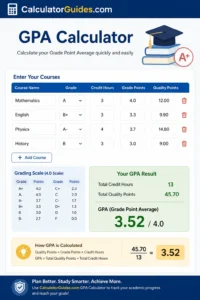
GPA = Total Quality Points ÷ Total Credit Hours
Quality points are calculated as:
Quality Points = Grade Points × Credit Hours
For example:
| Course | Grade Points | Credits | Quality Points |
|---|---|---|---|
| Mathematics | 4.0 | 3 | 12.0 |
| English | 3.0 | 3 | 9.0 |
| Science | 3.7 | 4 | 14.8 |
Total quality points:
35.8
Total credits:
10
GPA:
35.8 ÷ 10 = 3.58
How Does a GPA Calculator Work?
A GPA calculator uses the credit value of each course to determine how much that course contributes to your overall GPA.
A 4-credit course has more influence on your GPA than a 1-credit course.
For example:
- Course A: 4.0 GPA, 4 credits
- Course B: 2.0 GPA, 1 credit
A simple average would be:
(4.0 + 2.0) ÷ 2 = 3.0
But the credit-weighted GPA is:
(4.0 × 4 + 2.0 × 1) ÷ 5
= 3.60
This is why credit hours matter.
4.0 GPA Calculator
A 4.0 GPA scale is widely used, particularly in the United States, but institutions can use different systems.
A common unweighted scale is:
| Letter Grade | Grade Points |
|---|---|
| A | 4.0 |
| A− | 3.7 |
| B+ | 3.3 |
| B | 3.0 |
| B− | 2.7 |
| C+ | 2.3 |
| C | 2.0 |
| C− | 1.7 |
| D+ | 1.3 |
| D | 1.0 |
| F | 0.0 |
This is an example scale rather than a universal standard.
GPA Calculator With A, B, C, D & F Grades
If your institution uses a basic 4.0 scale:
A = 4.0
B = 3.0
C = 2.0
D = 1.0
F = 0.0
You can convert each letter grade into its corresponding grade points and then calculate the credit-weighted average.
GPA Calculator With Plus and Minus Grades
Some institutions distinguish between grades such as:
- A+
- A
- A−
- B+
- B
- B−
- C+
- C
- C−
The grade-point value assigned to each letter can vary.
For example, one institution might use:
A− = 3.7
while another could use a different value.
Always use your institution’s official grading scale.
Semester GPA Calculator
Semester GPA measures your academic performance for a particular semester or term.
Suppose you take four courses:
| Course | Credits | Grade Points |
|---|---|---|
| Math | 3 | 3.7 |
| History | 3 | 3.0 |
| Biology | 4 | 4.0 |
| English | 3 | 3.3 |
Quality points:
- Math: 3 × 3.7 = 11.1
- History: 3 × 3.0 = 9.0
- Biology: 4 × 4.0 = 16.0
- English: 3 × 3.3 = 9.9
Total:
46.0 quality points
Total credits:
13
Semester GPA:
46 ÷ 13 = 3.54
Cumulative GPA Calculator
Cumulative GPA represents your academic performance across multiple semesters.
The calculation is:
Cumulative GPA = Total Quality Points Across All Terms ÷ Total Credits Across All Terms
You should not simply average semester GPAs when the semesters contain different numbers of credits.
Cumulative GPA Example
Suppose:
Semester 1
GPA:
3.2
Credits:
15
Semester 2
GPA:
3.8
Credits:
12
The cumulative GPA is:
(3.2 × 15 + 3.8 × 12) ÷ (15 + 12)
= 3.47
So the cumulative GPA is approximately:
3.47
GPA Calculator From Percentage
There is no universal formula for converting a percentage directly into GPA.
For example, an 85% score can correspond to different GPA values depending on:
- Country
- School
- University
- Grading scale
- Course
- Conversion policy
A percentage-to-GPA conversion should therefore use the official conversion table provided by your institution.
GPA Calculator for India
Indian institutions use several different grading systems.
You may encounter:
- Percentage
- CGPA
- GPA
- Letter grades
- 10-point scales
- 4-point scales
Because universities can use different conversion methods, there is no single GPA formula that is correct for every Indian institution.
If your university provides a specific conversion table, use that table.
CGPA vs GPA
GPA usually refers to the grade-point average for a particular term or a defined set of courses.
CGPA generally refers to the cumulative grade-point average across multiple terms or the entire program.
However, institutions may use these terms differently.
Always check your institution’s academic regulations.
GPA vs CGPA
| Feature | GPA | CGPA |
|---|---|---|
| Meaning | Grade Point Average | Cumulative Grade Point Average |
| Typical period | One semester/term | Multiple semesters |
| Calculation | Credits and grade points for selected courses | Credits and grade points across multiple terms |
| Purpose | Measure term performance | Measure overall academic performance |
GPA Calculator for College
College GPA calculations usually depend on:
- Letter grades
- Grade points
- Credit hours
- Course weighting
For example, a 4-credit course can have a larger effect on your GPA than a 2-credit course.
This is why entering the correct credit hours is important.
GPA Calculator for High School
High schools can use either:
- Unweighted GPA
- Weighted GPA
An unweighted GPA usually treats courses according to a standard scale.
A weighted GPA may give additional points for courses such as:
- Honors
- Advanced
- AP
- IB
The exact weighting system varies by school.
Weighted GPA Calculator
A weighted GPA gives different grade-point values depending on the difficulty or type of course.
For example, a school might use:
Regular A = 4.0
Honors A = 4.5
Advanced A = 5.0
These are only examples.
There is no universal weighted GPA scale.
Unweighted GPA Calculator
An unweighted GPA generally uses the standard grade-point scale without adding extra points for advanced courses.
For example:
A = 4.0
B = 3.0
C = 2.0
D = 1.0
F = 0.0
The school’s official scale should be used.
GPA Calculator With Credit Hours
Credit hours determine how much each course affects your GPA.
For example:
Course 1:
4.0 × 4 credits = 16 quality points
Course 2:
3.0 × 2 credits = 6 quality points
Total:
22 quality points
Total credits:
6
GPA:
22 ÷ 6 = 3.67
GPA Calculator Without Credit Hours
If every course has the same number of credits, you can calculate a simple average of the grade points.
For example:
Grades:
4.0, 3.0, 3.0, 4.0
GPA:
(4 + 3 + 3 + 4) ÷ 4 = 3.50
But if courses have different credit values, use a weighted calculation instead.
What Is a Good GPA?
There is no universal definition of a “good” GPA.
It depends on:
- Institution
- Degree program
- Major
- Scholarship requirements
- Graduate-school requirements
- Employer
- Country
- Competition for admission
For example, a GPA that is competitive for one program may not be considered equally competitive for another.
Is a 4.0 GPA Good?
On a standard 4.0 unweighted scale, 4.0 represents the maximum GPA under that particular scale.
It generally indicates that the student earned the highest grade-point value in all applicable courses.
Some schools use weighted scales above 4.0, so a 4.0 is not necessarily the maximum GPA everywhere.
Is a 3.5 GPA Good?
A 3.5 GPA on a 4.0 scale is generally a strong academic result.
However, whether it is sufficient for a particular scholarship, college, graduate program, or job depends on the relevant requirements.
Is a 3.0 GPA Good?
A 3.0 GPA represents a solid average on a common 4.0 scale.
Its competitiveness depends on the program and institution.
Some programs may require a minimum GPA higher than 3.0.
Is a 2.5 GPA Good?
A 2.5 GPA is below the average of a 4.0 scale but can still meet the minimum requirements of some institutions or programs.
Always check the specific requirement rather than relying on a general label.
What GPA Do I Need?
A GPA Calculator can also help determine what GPA you need in future semesters to reach a target cumulative GPA.
Suppose:
Current GPA:
3.2
Current credits:
60
Target GPA:
3.5
Future credits:
30
Required future GPA:
(3.5 × 90 − 3.2 × 60) ÷ 30
= 4.1
If your maximum GPA is 4.0, a 3.5 cumulative GPA would therefore not be mathematically achievable after only those 30 additional credits without other changes.
This type of calculation helps set realistic academic targets.
How to Calculate Required GPA
The general formula is:
Required Future GPA = (Target GPA × Total Future Credits + Current Quality Points Adjustment) ÷ Future Credits
More simply:
Required Future GPA = (Target GPA × Total Final Credits − Current GPA × Current Credits) ÷ Future Credits
Example:
Current GPA:
3.0
Current credits:
60
Target:
3.3
Final total:
120 credits
Future credits:
60
Required future GPA:
(3.3 × 120 − 3.0 × 60) ÷ 60
= 3.6
You would need approximately a 3.6 GPA across the remaining 60 credits.
GPA Calculator for Scholarships
Scholarships may require a minimum GPA.
For example, a scholarship could specify:
Minimum GPA = 3.5
Your GPA calculator can help you monitor your current academic average.
However, always check whether the scholarship uses:
- Cumulative GPA
- Semester GPA
- Weighted GPA
- Unweighted GPA
- A specific conversion method
GPA Calculator for Graduate School
Graduate programs may have their own minimum GPA requirements.
Some may evaluate:
- Overall GPA
- Major GPA
- Last 60 credits
- Last two years
- Specific prerequisite grades
Therefore, your overall GPA may not tell the entire story.
GPA Calculator and Failed Courses
A failed course may affect your GPA depending on your institution’s rules.
Some schools:
- Include the F in GPA
- Allow course replacement
- Allow grade forgiveness
- Exclude certain repeated-course grades
Because policies vary, check how your institution handles repeated or failed courses.
GPA Calculator With Retaken Courses
If you retake a course, the effect on GPA depends on institutional policy.
For example, a school might:
- Replace the original grade
- Average both grades
- Keep both grades in the GPA
- Count only the latest attempt
Do not assume that retaking a course automatically removes the original grade.
GPA Calculator for Pass/Fail Courses
Pass/fail courses may not affect GPA in the same way as letter-graded courses.
Some institutions award:
- Pass = no GPA points
- Fail = 0 GPA points
Others may exclude both from GPA calculations.
Use your school’s official policy.
GPA Calculator for Transfer Credits
Transfer credits can be handled differently by different institutions.
A university may:
- Transfer the credits but not the original grade points
- Include transfer grades in GPA
- Exclude certain courses
- Apply its own equivalency rules
Your institution’s transfer-credit policy should be used for an official cumulative GPA.
GPA Calculator Formula Summary
Quality Points
Quality Points = Grade Points × Credit Hours
GPA
GPA = Total Quality Points ÷ Total Credit Hours
Cumulative GPA
Cumulative GPA = Total Quality Points From All Applicable Courses ÷ Total Applicable Credits
Required Future GPA
Required GPA = (Target GPA × Final Credits − Current GPA × Current Credits) ÷ Future Credits
How to Use the GPA Calculator
Step 1: Enter Your Course
Add the course name if you want to keep your calculation organized.
Step 2: Enter Your Grade
Choose your letter grade or grade points.
Step 3: Enter Credit Hours
Enter the number of credits for the course.
Step 4: Add All Courses
Repeat the process for every applicable course.
Step 5: Calculate
The calculator can determine:
- Total credits
- Quality points
- GPA
Step 6: Check Your Scale
Make sure the calculator uses the same grading scale as your school or university.
Common GPA Calculation Mistakes
Treating Every Course Equally
A 4-credit course and a 1-credit course do not necessarily have the same GPA impact.
Using the Wrong Grade Scale
A 3.7 on one institution’s scale may not correspond exactly to another institution’s system.
Averaging Semester GPAs Directly
If semesters have different credit totals, calculate cumulative GPA using total quality points and total credits.
Assuming Percentage Converts Directly to GPA
There is no universal conversion.
Ignoring Retaken Courses
Grade-replacement policies can significantly change the calculation.
Including Courses That Your Institution Excludes
Pass/fail, transfer, and repeated courses may have special treatment.
Frequently Asked Questions
What is a GPA Calculator?
A GPA Calculator calculates your grade-point average using grades and credit hours.
What is the GPA formula?
GPA = Total Quality Points ÷ Total Credit Hours
What are quality points?
Quality points are calculated by multiplying a course’s grade points by its credit hours.
What is a 4.0 GPA?
A 4.0 is the highest grade-point value on many standard unweighted 4.0 scales.
Is a 3.5 GPA good?
A 3.5 on a 4.0 scale is generally a strong GPA, but the importance of the number depends on the specific school, program, and requirement.
Is GPA the same as CGPA?
Not always. GPA often refers to a specific term, while CGPA generally represents cumulative performance across multiple terms.
Can I calculate GPA without credit hours?
Yes, if every course has equal weight. Otherwise, credit hours should be included.
How do I calculate cumulative GPA?
Add all applicable quality points and divide them by all applicable credit hours.
How do I calculate semester GPA?
Calculate the quality points for the courses in that semester and divide by the semester’s total credits.
Can I convert percentage to GPA?
Yes, but you need the appropriate conversion table or formula from your institution. There is no universal percentage-to-GPA conversion.
How do I calculate GPA in India?
Use the grading scale and conversion rules provided by your Indian school, college, university, or examination board.
Is CGPA the same as percentage?
No. CGPA and percentage are different measures. A conversion may be possible under a specific institution’s rules.
Can an F lower my GPA?
Usually, an F contributes zero grade points and can lower GPA, but the exact treatment depends on institutional policy.
Does retaking a class replace the old grade?
Not always. Some institutions replace the grade, while others count both attempts.
Do pass/fail courses affect GPA?
It depends on your institution’s rules.
Can transfer credits affect GPA?
It depends on how your institution handles transfer grades.
What GPA do I need to reach my target?
You can calculate the required future GPA using your current GPA, completed credits, target GPA, and remaining credits.
Is the GPA Calculator accurate?
The mathematics is accurate for the inputs provided. Your official GPA depends on your institution’s grading scale and academic policies.
Is the GPA Calculator free?
Yes. The CalculatorGuides.com GPA Calculator is free to use.
GPA Calculator – Important Things to Remember
Before calculating your GPA, check:
- Your institution’s grading scale
- Grade-point values
- Credit hours
- Plus/minus rules
- Weighted-course rules
- Retake policies
- Pass/fail policies
- Transfer-credit policies
- Rounding rules
For an official academic GPA, your school’s or university’s transcript and calculation rules take priority.
Conclusion
A GPA Calculator provides a simple way to calculate your Grade Point Average from course grades and credit hours.
The basic formula is:
GPA = Total Quality Points ÷ Total Credit Hours
Because courses can have different credit values, a credit-weighted calculation is usually more appropriate than simply averaging your grades.
You can also use a GPA Calculator to estimate semester GPA, cumulative GPA, required future GPA, and the effect of additional courses.
Remember that GPA systems are not universal. A 4.0 scale, 10-point CGPA scale, percentage system, and weighted high-school GPA can all work differently.
Use the CalculatorGuides.com GPA Calculator to calculate your GPA quickly, then compare the result with your institution’s official grading policy for the final academic figure.