
Lean Body Mass Calculator-Use our Lean Body Mass Calculator to estimate your lean body mass (LBM) from your height and weight. If you know your body fat percentage, you can also calculate your lean mass directly.Make fitness calculations simple with Healthy Weight Calculator and body measurement calculators.
💪 Lean Body Mass Calculator
Date
Lean Mass
Body Fat %
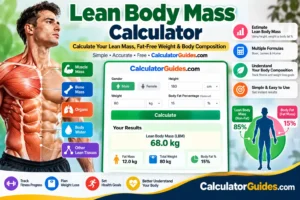
Your lean body mass is an important part of your total body weight. It includes things such as muscle, bones, organs, body water, and other non-fat tissues.
This calculator is useful for people who want to understand their body composition, track fitness progress, plan weight-loss goals, or simply learn more about their current weight.
What Is Lean Body Mass?
Lean body mass (LBM) is the part of your body weight that is not stored body fat.
It includes:
- Muscle
- Bones
- Organs
- Body water
- Skin
- Connective tissues
- Blood and other lean tissues
For example, if you weigh 80 kg and have 20% body fat, approximately 16 kg of your weight is fat.
The remaining 64 kg is your estimated lean body mass.
So:
Lean Body Mass = Total Body Weight − Fat Mass
Lean body mass is sometimes also called lean mass or fat-free mass.
How Does the Lean Body Mass Calculator Work?
Our calculator can estimate LBM using your:
- Height
- Weight
- Sex
- Body fat percentage, if known
When body fat percentage is available, lean body mass can be calculated directly:
LBM = Body Weight × (1 − Body Fat Percentage ÷ 100)
For example, if you weigh 80 kg and your body fat is 20%:
LBM = 80 × (1 − 20 ÷ 100)
LBM = 80 × 0.80
LBM = 64 kg
So your estimated lean body mass is 64 kg.
When your body fat percentage is not known, published equations such as the Boer, James, and Hume formulas can be used to estimate lean body mass from height and weight.
How to Use the Lean Body Mass Calculator
Using the calculator is easy.
Step 1: Enter Your Height
Enter your height in centimeters or feet and inches, depending on the calculator settings.
Step 2: Enter Your Weight
Enter your current body weight in kilograms or pounds.
Step 3: Select Your Sex
Choose the option required by the formula used by the calculator.
Step 4: Enter Body Fat Percentage
If you know your body fat percentage from a reliable measurement, enter it.
This can give you a more direct estimate of lean body mass.
Step 5: Calculate
Click the calculate button to see your estimated lean body mass.
You can use the result to better understand your overall body composition.
Lean Body Mass Formula
There is not just one formula for estimating lean body mass.
Several published equations are commonly used.
The most common ones include:
- Boer formula
- James formula
- Hume formula
- Body-fat percentage method
Different formulas can produce slightly different results because they were developed using different populations and methods.
Boer Lean Body Mass Formula
The Boer formula is one of the commonly used equations for estimating lean body mass.
For men:
LBM = 0.407 × Weight (kg) + 0.267 × Height (cm) − 19.2
For women:
LBM = 0.252 × Weight (kg) + 0.473 × Height (cm) − 48.3
Example
Suppose a man weighs 80 kg and is 180 cm tall.
Using the Boer formula:
LBM = 0.407 × 80 + 0.267 × 180 − 19.2
The result is approximately:
61.4 kg
This is an estimate, not a direct measurement of your actual muscle or lean tissue.
James Lean Body Mass Formula
The James formula is another method used to estimate lean body mass.
For men:
LBM = 1.1 × Weight − 128 × (Weight ÷ Height)²
For women:
LBM = 1.07 × Weight − 148 × (Weight ÷ Height)²
Weight is entered in kilograms and height in centimeters.
The James formula can give a different result from the Boer formula, which is why some calculators show more than one estimate.
Hume Lean Body Mass Formula
The Hume formula is another older equation for estimating lean body mass.
For men:
LBM = 0.32810 × Weight + 0.33929 × Height − 29.5336
For women:
LBM = 0.29569 × Weight + 0.41813 × Height − 43.2933
Again, weight is measured in kilograms and height in centimeters.
Lean Body Mass From Body Fat Percentage
If you already know your body fat percentage, you can calculate lean body mass more directly.
The formula is:
Lean Body Mass = Weight × (1 − Body Fat % ÷ 100)
Example
Weight = 90 kg
Body fat = 25%
Fat mass:
90 × 0.25 = 22.5 kg
Lean body mass:
90 − 22.5 = 67.5 kg
So:
LBM = 67.5 kg
This method uses your actual body-fat estimate, so the result depends on how accurately your body-fat percentage was measured.
Lean Body Mass vs. Muscle Mass
Lean body mass and muscle mass are not the same thing.
This is an important point.
Lean body mass includes much more than muscle.
For example, LBM includes:
- Muscle
- Bone
- Water
- Organs
- Skin
- Connective tissue
So if your lean body mass is 65 kg, it does not mean you have 65 kg of muscle.
Your actual muscle mass is only one part of your lean body mass.
Lean Body Mass vs. Fat-Free Mass
The terms lean body mass and fat-free mass are often used in a similar way, but they can have slightly different definitions depending on the measurement method.
For everyday fitness calculations, they are commonly used to describe the part of body weight that is not body fat.
If you are tracking your progress, it is more useful to focus on consistent measurements rather than worrying about small differences in terminology.
Lean Body Mass vs. Body Weight
Body weight tells you how much your entire body weighs.
Lean body mass tells you how much of that weight is estimated to be non-fat tissue.
For example:
Body weight = 100 kg
Body fat = 30%
Fat mass:
30 kg
Estimated lean body mass:
70 kg
So two people can have the same body weight but very different amounts of lean body mass.
Lean Body Mass vs. Body Fat
Body fat and lean body mass are two different parts of your total body weight.
A simple way to understand it is:
Total Weight = Fat Mass + Lean Body Mass
For example:
| Measurement | Value |
|---|---|
| Body weight | 80 kg |
| Body fat | 20% |
| Fat mass | 16 kg |
| Lean body mass | 64 kg |
This is why looking only at the weighing scale does not always tell the full story about changes in your body.
Why Is Lean Body Mass Important?
Lean body mass can be useful when tracking changes in body composition.
For example, if your body weight decreases, you may want to know whether the change is mostly coming from fat, lean tissue, or both.
Tracking body weight together with body-fat estimates and other measurements can give you a better picture of your progress.
LBM can also be useful when comparing people with different body weights because it separates fat mass from the rest of the body weight.
Does Lean Body Mass Include Water?
Yes.
A large part of your lean body mass consists of water.
This is one reason your estimated lean mass can change from day to day.
Changes in hydration, food intake, exercise, and other normal factors can affect body weight and body-composition measurements.
So you should not assume that every small change on the scale represents a real change in muscle.
Does Lean Body Mass Mean Muscle?
No.
Lean body mass is not the same as muscle mass.
Muscle is only one component of lean body mass.
Your lean body mass also includes bones, organs, water, skin, and other tissues.
If you want to estimate muscle mass specifically, you need a measurement method that is designed to assess muscle or body composition.
What Is a Good Lean Body Mass?
There is no single LBM number that is ideal for everyone.
Lean body mass depends on several factors, including:
- Height
- Body weight
- Sex
- Age
- Body composition
- Muscle mass
- Genetics
- Activity level
A taller person will normally have a different lean body mass from a shorter person.
For this reason, it is better to use LBM as a personal body-composition measurement rather than trying to reach one universal number.
How Accurate Is a Lean Body Mass Calculator?
A calculator provides an estimate.
Height-and-weight formulas cannot directly see how much muscle, bone, water, and other lean tissue you actually have.
For example, two people can have the same height and weight but very different body compositions.
A muscular person and a less muscular person may therefore receive similar LBM estimates from a height-and-weight formula.
If you need a more accurate body-composition measurement, methods such as DEXA, Bod Pod, hydrostatic weighing, or properly performed body-fat assessments can provide more information.
Even a body-fat-based LBM calculation is only as good as the body-fat measurement you enter.
Lean Body Mass Calculator in kg
If you use the metric system, enter:
- Weight in kilograms
- Height in centimeters
For example:
Weight: 80 kg
Height: 180 cm
The calculator can then estimate your lean body mass in kilograms.
Lean Body Mass Calculator in Pounds
If you normally use pounds, you can enter your weight in pounds if the calculator supports imperial units.
Many calculators convert pounds and inches into kilograms and centimeters before applying the formulas.
For example:
Weight: 176 lb
Height: 5 ft 11 in
The calculator can convert these measurements and estimate your LBM.
Lean Body Mass Calculator for Men
Men and women can have different coefficients in several published LBM equations.
For this reason, a calculator using the Boer, James, or Hume equation may ask you to select the appropriate sex option.
Enter your height and weight accurately before calculating your result.
Lean Body Mass Calculator for Women
Women can also use an LBM calculator to estimate lean body mass.
The formula coefficients are different from the male versions in the Boer, James, and Hume equations.
If you know your body-fat percentage, you can also use the direct body-fat method.
Lean Body Mass and Weight Loss
When losing weight, many people want to reduce body fat while maintaining as much lean tissue as possible.
Your scale weight alone cannot tell you exactly what type of tissue has changed.
For example, a drop in body weight can include changes in:
- Body fat
- Water
- Food stored in the digestive system
- Glycogen
- Lean tissue
That is why it can be helpful to look at several measurements over time instead of focusing on one day’s weight.
Lean Body Mass and Muscle Building
If you are trying to build muscle, tracking lean body mass can be one part of your progress tracking.
However, a calculator estimate should not be treated as a direct measurement of muscle growth.
You can also track:
- Body weight
- Waist measurement
- Strength
- Training performance
- Progress photos
- Body-fat estimates
Looking at several measurements gives you a better idea of how your body is changing.
Example: Calculate Lean Body Mass
Let’s say a person weighs:
90 kg
and has:
25% body fat
First calculate fat mass:
90 × 25% = 22.5 kg
Then calculate lean body mass:
90 − 22.5 = 67.5 kg
Therefore:
Lean Body Mass = 67.5 kg
This person has approximately 67.5 kg of lean mass based on the given body-fat percentage.
Frequently Asked Questions
What is lean body mass?
Lean body mass is the part of your body weight that is not body fat. It includes muscle, bones, organs, water, skin, and other lean tissues.
What is LBM?
LBM stands for Lean Body Mass.
It is an estimate of your non-fat body weight.
How do I calculate lean body mass?
If you know your body-fat percentage, use:
LBM = Weight × (1 − Body Fat % ÷ 100)
If you do not know your body-fat percentage, published formulas such as Boer, James, and Hume can estimate LBM from height and weight.
What is the most common lean body mass formula?
The Boer, James, and Hume equations are commonly used for estimating lean body mass. Different formulas can produce different results.
Is lean body mass the same as muscle mass?
No. Muscle is only one part of lean body mass. LBM also includes water, bones, organs, skin, and other tissues.
Does lean body mass include water?
Yes. Body water is part of lean body mass.
Can I calculate LBM without body fat percentage?
Yes. Height-and-weight equations can estimate lean body mass without knowing your body-fat percentage.
Is LBM the same as fat-free mass?
The terms are often used similarly in general fitness discussions, although technical definitions can vary depending on the measurement method.
How accurate is an LBM calculator?
It gives an estimate, not a direct measurement. Accuracy depends on the formula and your individual body composition.
Can athletes use a lean body mass calculator?
Yes, but athletes and highly muscular people should understand that height-and-weight equations may not accurately represent their actual body composition.
Can I use pounds and inches?
Yes, if the calculator supports imperial units. The measurements can be converted before applying the formula.
Can I use kilograms and centimeters?
Yes. Most published LBM formulas use kilograms for weight and centimeters for height.
What is the difference between fat mass and lean body mass?
Fat mass is the amount of body weight that is fat. Lean body mass is the remaining non-fat portion.
Together, they make up total body weight.
Can lean body mass change?
Yes. Changes in muscle, body water, glycogen, and other lean tissues can affect your lean body mass.
What is a healthy lean body mass?
There is no single healthy LBM number for everyone. It depends on factors such as height, sex, body composition, age, and muscle mass.
Final Thoughts
The Lean Body Mass Calculator is a simple way to estimate how much of your body weight comes from lean tissue rather than body fat.
You can calculate LBM using your height and weight, or use your body-fat percentage when you have a reliable measurement.
Remember that lean body mass is not the same as muscle mass, and calculator results are estimates. Use the number as a useful reference when tracking your body composition rather than treating it as an exact measurement.
For the best picture of your progress, look at LBM together with body weight, body-fat percentage, measurements, strength, and other fitness changes over time.