
Ohms Law Calculator-Use our free Ohm’s Law Calculator to calculate voltage, current, resistance, and electrical power. Learn Ohm’s Law formulas with simple examples and explanations, Grade Calculator,Electricity Calculator.The Ohm’s Law Calculator is a simple tool for calculating the relationship between voltage, current, and resistance in an electrical circuit.
⚡ Ohm's Law Calculator
📊 Calculation Results
Ohm’s Law is one of the most useful formulas in basic electrical engineering and electronics. If you know any two of the three values, you can calculate the third.
You can use the calculator to find:
- Voltage (V)
- Current (A)
- Resistance (Ω)
- Electrical power (W)
It is useful for students, electricians, electronics hobbyists, engineers, and anyone learning how electrical circuits work.
What Is Ohm’s Law?
Ohm’s Law describes the relationship between voltage, current, and resistance.
genui{“learning_viz”:{“type_id”:”OHMS_LAW”}}
Where:
- V = Voltage in volts
- I = Current in amperes
- R = Resistance in ohms
The relationship can be rearranged depending on which value you need to calculate.
Ohm’s Law Formulas
Calculate Voltage
V = I × R
Calculate Current
I = V ÷ R
Calculate Resistance
R = V ÷ I
These three formulas are different forms of the same relationship.
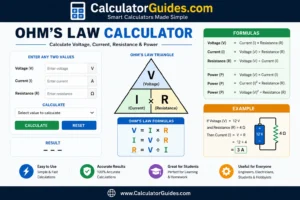
Ohm’s Law Triangle
A common way to remember the formulas is the Ohm’s Law triangle:
V
I × R
Cover the value you want to calculate.
- Cover V → I × R
- Cover I → V ÷ R
- Cover R → V ÷ I
This makes Ohm’s Law easier to remember when solving basic circuit problems.
What Is Voltage?
Voltage is the electrical potential difference between two points.
It is measured in:
Volts (V)
Voltage can be thought of as the electrical force that drives current through a circuit.
Examples include:
- 1.5 V battery
- 9 V battery
- 12 V power supply
- 24 V control circuit
- 230 V household supply
The actual voltage used in a circuit depends on the application.
What Is Current?
Current is the flow of electric charge through a circuit.
It is measured in:
Amperes (A)
Smaller currents are often expressed as:
milliamps (mA)
where:
1 A = 1,000 mA
For example:
0.5 A = 500 mA
What Is Resistance?
Resistance is the opposition to the flow of electric current.
It is measured in:
Ohms (Ω)
A higher resistance generally results in less current for the same voltage.
For example, with a fixed 12 V supply:
- 2 Ω → 6 A
- 4 Ω → 3 A
- 6 Ω → 2 A
This follows:
I = V ÷ R
Ohm’s Law Example
Suppose a circuit has:
Voltage = 12 V
Resistance = 4 Ω
To calculate current:
I = V ÷ R
I = 12 ÷ 4
I = 3 A
So the circuit current is:
3 amperes
Calculate Voltage Example
Suppose:
Current = 2 A
Resistance = 10 Ω
Use:
V = I × R
V = 2 × 10
V = 20 V
Therefore, the voltage is:
20 volts
Calculate Resistance Example
Suppose:
Voltage = 24 V
Current = 3 A
Use:
R = V ÷ I
R = 24 ÷ 3
R = 8 Ω
Therefore, the resistance is:
8 ohms
Ohm’s Law and Power
Ohm’s Law can also be combined with the electrical power formula.
The basic power relationship is:
P = V × I
Where:
- P = Power in watts
- V = Voltage in volts
- I = Current in amps
Using Ohm’s Law, power can also be written as:
P = I²R
or:
P = V²/R
These formulas are useful for calculating the power dissipated by a resistor.
Power Calculation Example
Suppose:
V = 12 V
I = 2 A
Then:
P = V × I
P = 12 × 2
P = 24 W
The circuit uses or dissipates:
24 watts
of electrical power under the stated conditions.
Resistance and Power Example
Suppose a resistor has:
R = 10 Ω
and:
I = 2 A
Power:
P = I²R
P = 2² × 10
P = 40 W
So the resistor would dissipate:
40 W
under these conditions.
A real resistor would need an appropriate power rating to safely handle that dissipation.
Voltage, Current, Resistance and Power
| Quantity | Symbol | Unit |
|---|---|---|
| Voltage | V | Volt (V) |
| Current | I | Ampere (A) |
| Resistance | R | Ohm (Ω) |
| Power | P | Watt (W) |
These four values are closely related in basic electrical calculations.
Ohm’s Law Calculator Example Table
| Voltage | Resistance | Current |
|---|---|---|
| 5 V | 10 Ω | 0.5 A |
| 12 V | 6 Ω | 2 A |
| 24 V | 12 Ω | 2 A |
| 120 V | 60 Ω | 2 A |
| 230 V | 115 Ω | 2 A |
The current is calculated using:
I = V ÷ R
Ohm’s Law for DC Circuits
Ohm’s Law is commonly applied to resistive DC circuits.
For example:
A 12 V battery connected to a 6 Ω resistor gives:
I = 12 ÷ 6
= 2 A
The resistor’s power is:
P = 12 × 2
= 24 W
Ohm’s Law for Resistors
For an ideal resistor, the relationship between voltage and current follows:
V = I × R
If resistance stays constant:
- Increasing voltage increases current.
- Decreasing voltage decreases current.
- Increasing resistance decreases current.
- Decreasing resistance increases current.
This relationship is fundamental to understanding simple circuits.
Ohm’s Law and Series Circuits
In a basic series circuit, the same current flows through each series component.
For example, if two resistors are connected in series:
R₁ = 10 Ω
R₂ = 20 Ω
Total resistance is:
Rtotal = R₁ + R₂
= 30 Ω
If the supply voltage is:
12 V
then:
I = 12 ÷ 30
= 0.4 A
Ohm’s Law and Parallel Circuits
For resistors in parallel, the total resistance is calculated differently.
For two resistors:
1/Rtotal = 1/R₁ + 1/R₂
For example:
R₁ = 10 Ω
R₂ = 10 Ω
Then:
Rtotal = 5 Ω
With a 10 V supply:
I = 10 ÷ 5
= 2 A
Why Resistance Matters
Resistance affects how much current flows through a circuit.
With the same voltage:
Higher resistance → Lower current
Lower resistance → Higher current
This is why choosing the correct resistor is important in electronic circuits.
Ohm’s Law and Resistor Selection
Suppose you have:
5 V supply
and want:
10 mA
of current.
Convert:
10 mA = 0.01 A
Then:
R = V ÷ I
R = 5 ÷ 0.01
R = 500 Ω
A resistor around 500 Ω would produce approximately 10 mA under ideal conditions.
In a real circuit, you would choose an available resistor value and check the resulting current and power.
Resistor Power Rating
Calculating resistance alone is not always enough.
You should also check the resistor’s power dissipation.
Use:
P = V × I
or:
P = I²R
or:
P = V²/R
For example, a resistor dissipating 0.8 W should not normally be selected as a tiny component rated for only 0.25 W.
A suitable component rating and appropriate engineering margin are important.
Ohm’s Law Calculator for LEDs
Ohm’s Law is often used when designing simple LED circuits.
Suppose:
Supply voltage:
9 V
LED forward voltage:
2 V
Desired current:
20 mA
The resistor must handle:
9 − 2 = 7 V
Convert current:
20 mA = 0.020 A
Then:
R = 7 ÷ 0.020
= 350 Ω
A practical circuit would use an appropriate standard resistor value and verify the LED and resistor ratings.
Ohm’s Law for Batteries
Ohm’s Law can help estimate current in simple resistive battery circuits.
For example:
Battery:
12 V
Load resistance:
6 Ω
Current:
12 ÷ 6 = 2 A
However, real batteries have internal resistance and voltage can change under load, so measured current may differ from the ideal calculation.
Ohm’s Law and Short Circuits
A short circuit has very low resistance.
The simple equation:
I = V ÷ R
shows why a very low resistance can produce a very high theoretical current.
For example, with a 12 V source and an idealized resistance of 0.1 Ω:
I = 12 ÷ 0.1 = 120 A
Real circuits are limited by source resistance, wiring, protection devices, and other factors.
Never intentionally create a short circuit to test this calculation.
Ohm’s Law for Household Electricity
Ohm’s Law can be used for basic calculations involving household electrical systems, but working on mains electricity is different from solving a classroom problem.
Household AC systems can involve:
- Alternating current
- Power factor
- Reactive loads
- RMS voltage
- Inductive or capacitive components
- Safety hazards
Do not work on live mains circuits unless you are properly qualified and following applicable electrical safety requirements.
Ohm’s Law and AC Circuits
The simple resistance equation works directly for resistive loads.
For AC circuits containing inductors or capacitors, the more general concept is impedance.
Instead of simply using:
R
AC circuit analysis may require:
Z = Impedance
The relationship is then expressed using phasors or complex quantities.
Therefore, the basic Ohm’s Law calculator should not be treated as a complete AC circuit analyzer.
Ohm’s Law vs Power Formula
These formulas answer different questions.
Ohm’s Law
V = I × R
Relates:
- Voltage
- Current
- Resistance
Electrical Power
P = V × I
Relates:
- Voltage
- Current
- Power
They can be combined to derive:
P = I²R
and:
P = V²/R
How to Use the Ohm’s Law Calculator
Step 1: Enter Known Values
Enter any two known values:
- Voltage
- Current
- Resistance
Step 2: Select the Value to Calculate
Choose the value you want the calculator to find.
Step 3: Calculate
The calculator applies the appropriate Ohm’s Law formula.
Step 4: Check the Units
Make sure you are using:
- Volts
- Amps
- Ohms
Convert units when necessary.
For example:
500 mA = 0.5 A
Common Ohm’s Law Mistakes
Forgetting Unit Conversion
100 mA is:
0.1 A
not 100 A.
Using the Wrong Formula
To calculate current:
I = V ÷ R
To calculate voltage:
V = I × R
To calculate resistance:
R = V ÷ I
Confusing Resistance With Power
Resistance is measured in ohms.
Power is measured in watts.
Ignoring Power Rating
A mathematically correct resistor value may still be unsuitable if its power rating is too low.
Applying Simple Ohm’s Law to Every AC Circuit
Circuits containing reactive components require impedance-based analysis.
Frequently Asked Questions
What is Ohm’s Law?
Ohm’s Law describes the relationship between voltage, current, and resistance in an electrical circuit.
What is the Ohm’s Law formula?
The main formula is:
V = I × R
How do I calculate current?
Use:
I = V ÷ R
How do I calculate voltage?
Use:
V = I × R
How do I calculate resistance?
Use:
R = V ÷ I
What is the unit of resistance?
Resistance is measured in ohms (Ω).
What is the unit of current?
Current is measured in amperes (A).
What is the unit of voltage?
Voltage is measured in volts (V).
What is the unit of power?
Power is measured in watts (W).
How is Ohm’s Law related to power?
Electrical power can be calculated using:
P = V × I
and, using Ohm’s Law:
P = I²R
or:
P = V²/R
Can I use Ohm’s Law for AC circuits?
The basic resistance form applies to resistive loads. AC circuits with inductance or capacitance require impedance-based calculations.
Can Ohm’s Law calculate resistor power?
Yes. Once voltage, current, and resistance are known, power can be calculated using the appropriate power formula.
Can I use the calculator for an LED resistor?
Yes, for a basic resistor calculation, provided you know the supply voltage, LED forward voltage, and desired current. The LED and resistor ratings should also be checked.
Is the Ohm’s Law Calculator accurate?
The mathematical result is accurate for the values and assumptions entered. Real circuits can differ because of component tolerances, source resistance, temperature, power-factor effects, and other factors.
Is the Ohm’s Law Calculator free?
Yes. The CalculatorGuides.com Ohm’s Law Calculator is free to use.
Ohm’s Law Calculator – Important Things to Remember
Before using the calculator:
- Use the correct units.
- Convert mA to A when necessary.
- Convert kΩ to Ω when necessary.
- Check component power ratings.
- Remember that real components have tolerances.
- Use impedance for appropriate AC circuits.
- Never use a basic calculator as a substitute for proper electrical safety procedures.
Conclusion
The Ohm’s Law Calculator makes it easy to calculate voltage, current, resistance, and electrical power in basic circuits.
The central relationship is:
V = I × R
From this, you can calculate:
I = V ÷ R
and:
R = V ÷ I
Power can also be calculated using:
P = V × I
For simple resistive circuits, these formulas provide a quick way to understand how voltage, current, resistance, and power are related.
Use the CalculatorGuides.com Ohm’s Law Calculator to solve electrical calculations quickly and check your circuit values without doing the math manually.