
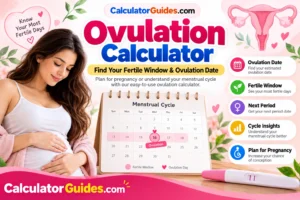
Ovulation Calculator-Use our Ovulation Calculator to estimate your ovulation date, fertile window, and most fertile days based on your menstrual cycle.Simply enter the first day of your last period and your usual cycle length. The calculator gives you an estimated ovulation date and fertile window.Use our Fitness & Health Calculators to make everyday fitness calculations easier
🌸 Ovulation Calculator
If you are trying to get pregnant, understanding your menstrual cycle can help you know when you are most likely to conceive. If you are trying to avoid pregnancy, remember that a calendar-based ovulation calculator is only an estimate and should not be used as your only method of birth control.
What Is an Ovulation Calculator?
An ovulation calculator is an online tool that estimates when ovulation may happen during your menstrual cycle.
Ovulation is the time when an ovary releases an egg. Pregnancy can happen when sperm fertilizes the egg around this time.
The calculator usually uses two main pieces of information:
- The first day of your last menstrual period
- Your average menstrual cycle length
It then estimates your next period, ovulation date, and fertile window.
Every person’s cycle can be different, so the result should be treated as an estimate rather than an exact date.
How to Use the Ovulation Calculator
Using the ovulation date calculator is simple.
Step 1: Enter the first day of your last period
Day 1 is the first day of your menstrual bleeding.
For example, if your period started on January 1, January 1 is cycle day 1.
Step 2: Enter your average cycle length
Enter the usual number of days from the first day of one period to the first day of the next period.
For example:
28 days
Step 3: Calculate
Click the calculate button.
The calculator will estimate:
- Ovulation date
- Fertile window
- Most fertile days
- Estimated next period
- Cycle information
Remember that these dates are estimates because ovulation does not always happen on exactly the same cycle day.
What Is Ovulation?
Ovulation is when an egg is released from one of the ovaries.
The egg can then travel through the fallopian tube. If sperm is present and fertilizes the egg, pregnancy can occur.
Ovulation usually happens once during a menstrual cycle, although the exact timing can vary.
For someone with a regular 28-day cycle, ovulation is often around the middle of the cycle, but it is not always exactly on day 14.
A better way to think about ovulation is that it commonly happens around 10 to 16 days before the next period, rather than always being on one fixed day.
What Is the Fertile Window?
The fertile window is the part of the menstrual cycle when pregnancy is most likely to happen.
Sperm can survive for several days inside the reproductive tract, while the egg remains available for fertilization for a much shorter time.
Because of this, the fertile window includes several days before ovulation as well as the time around ovulation.
If you are trying to conceive, having sex regularly during the fertile window can improve the chance of pregnancy.
Ovulation Date Calculator
An ovulation date calculator estimates the day you are most likely to ovulate.
A simple calendar-based estimate often starts with the expected date of the next period and works backward.
For example, suppose someone has a regular 28-day cycle.
Their estimated ovulation may be around the middle of the cycle.
However, cycle length can change from month to month, so the actual ovulation date may be earlier or later.
This is why tracking your periods over several months can give you more useful information than relying on one calculation.
Fertile Window Calculator
A fertile window calculator estimates the days when conception may be more likely.
For example, if your estimated ovulation is around the middle of your cycle, your fertile days may begin several days before ovulation.
The exact fertile window is not identical for everyone.
Factors such as cycle variation, illness, stress, medication, breastfeeding, and hormonal changes can affect ovulation timing.
Ovulation Calculator for a 28-Day Cycle
A 28-day menstrual cycle is often used as an example when explaining ovulation.
If your cycle is consistently around 28 days, ovulation may occur around the middle of the cycle.
However, not everyone has a 28-day cycle.
A normal menstrual cycle can be shorter or longer than 28 days. Regular cycles from about 21 to 35 days are common.
For this reason, your own cycle history is more useful than simply assuming that everyone ovulates on day 14.
Ovulation Calculator for a 30-Day Cycle
If your average cycle is 30 days, your estimated ovulation date may be later than it would be in a 28-day cycle.
A calendar calculator uses your cycle length to make an estimate.
For example:
Cycle length: 30 days
The calculator estimates when your next period may arrive and works backward to estimate ovulation.
The actual date can still vary.
Ovulation Calculator for a 32-Day Cycle
A 32-day cycle may also have ovulation later than a typical 28-day example.
If your cycle is regularly around 32 days, entering 32 as your average cycle length can give a more personalized estimate.
However, the calculation is still not a guarantee of exactly when ovulation occurs.
Ovulation Calculator for Irregular Periods
An ovulation calculator for irregular periods can be less accurate.
If your cycle length changes significantly from one month to another, it becomes harder to predict ovulation using dates alone.
For example:
- One cycle may be 25 days
- Another may be 30 days
- Another may be 35 days
In this situation, tracking your cycle over several months can help identify patterns.
You can also look for physical signs of ovulation or use an ovulation predictor kit.
If your periods are frequently irregular or you have concerns about your fertility, talking with a healthcare professional can be helpful.
How to Calculate Ovulation
A simple calendar approach uses the expected next period to estimate ovulation.
One common estimate is:
Ovulation date ≈ 10 to 16 days before the next period
This is why cycle length matters.
For example, someone with a shorter cycle may ovulate earlier than someone with a longer cycle.
The calculation is only an estimate because the time between ovulation and the next period can vary.
How Many Days After Your Period Do You Ovulate?
There is no single answer that applies to everyone.
Ovulation depends on the length and timing of your menstrual cycle.
Someone with a shorter cycle may ovulate earlier, while someone with a longer cycle may ovulate later.
This is why saying that everyone ovulates exactly 14 days after their period is not accurate.
A cycle calculator can give you an estimated date based on your own cycle length.
What Are the Signs of Ovulation?
Some people notice physical changes around ovulation.
Possible signs include:
- Clearer or more slippery vaginal discharge
- Increased vaginal discharge
- A slight rise in basal body temperature after ovulation
- Mild lower abdominal discomfort
- Breast tenderness
- Bloating
- Changes in sexual desire
Not everyone experiences noticeable symptoms.
Also, symptoms such as breast tenderness or mild abdominal discomfort are not reliable enough by themselves to confirm exactly when ovulation is happening.
Cervical Mucus and Ovulation
One useful fertility sign is a change in cervical mucus.
Around the time of ovulation, vaginal discharge may become:
- Clear
- Thin
- Wet
- Slippery
- Stretchy
Some people compare the texture to raw egg white.
Tracking cervical mucus together with your cycle dates can provide more information than using a calendar alone.
Basal Body Temperature and Ovulation
Basal body temperature (BBT) is your body’s resting temperature.
After ovulation, basal body temperature usually rises slightly because of hormonal changes.
To track it, take your temperature at about the same time each morning before getting out of bed and record the results.
A temperature rise can help show that ovulation has already happened, but it does not always predict ovulation in advance.
Ovulation Predictor Kits
An ovulation predictor kit, often called an OPK, can help identify the hormone rise that happens before ovulation.
These tests usually check urine for a rise in luteinizing hormone (LH).
A positive test suggests that ovulation may be approaching, but it does not guarantee that ovulation will definitely occur.
Using an ovulation calculator together with cycle tracking and an ovulation test may give you more information than using dates alone.
Best Time to Get Pregnant
If you are trying to get pregnant, the highest chance of conception is around the fertile window.
Because sperm can survive for several days, having sex in the days leading up to ovulation can be important.
The egg remains available for fertilization for a much shorter time after ovulation.
Instead of focusing on one exact day, many people trying to conceive choose to have sex regularly during the fertile part of the cycle.
Can You Get Pregnant Outside the Fertile Window?
Pregnancy is less likely outside the fertile window, but predicting the fertile window from dates alone is not perfectly reliable.
Ovulation can happen earlier or later than expected.
Sperm can also survive for several days inside the reproductive tract.
Therefore, if you do not want pregnancy, do not rely on an ovulation calculator alone as contraception.
Ovulation and Pregnancy
Ovulation is important for natural conception because an egg must be available for fertilization.
When sperm meets an egg and fertilization occurs, pregnancy can begin.
However, knowing your estimated ovulation date does not guarantee pregnancy.
Many factors can affect fertility, including:
- Age
- Ovulation problems
- Sperm health
- Fallopian tube problems
- Hormonal conditions
- Certain medications
- Overall health
- Timing and frequency of sex
If you have been trying to conceive without success, a healthcare professional can help determine whether further evaluation is needed.
Ovulation Calculator vs. Period Calculator
An ovulation calculator focuses on estimating ovulation and fertile days.
A period calculator focuses mainly on estimating when your next period may begin.
Both use menstrual cycle information.
For example:
| Calculator | Main purpose |
|---|---|
| Ovulation Calculator | Estimate ovulation and fertile days |
| Period Calculator | Estimate the next period |
| Fertility Calculator | Estimate the fertile window |
| Menstrual Cycle Calculator | Track and understand cycle dates |
| Due Date Calculator | Estimate a pregnancy due date |
These tools can be useful for tracking, but calendar estimates are not perfect.
Can an Ovulation Calculator Tell If I Am Pregnant?
No.
An ovulation calculator cannot diagnose pregnancy.
It estimates when ovulation may have occurred and when your fertile window may have been.
If you think you may be pregnant, a pregnancy test is the appropriate way to check.
If you have questions about a missed period, pregnancy symptoms, or a pregnancy test result, speak with a healthcare professional.
Can an Ovulation Calculator Predict a Baby’s Gender?
No.
An ovulation calculator cannot reliably predict whether a baby will be a boy or a girl.
The timing of ovulation may help with understanding fertility, but it should not be used as a reliable method for choosing a baby’s sex.
Why Can My Ovulation Date Change?
Ovulation does not always happen on exactly the same day every month.
Possible factors that may affect cycle timing include:
- Stress
- Illness
- Changes in sleep
- Weight changes
- Travel
- Hormonal changes
- Breastfeeding
- Certain medicines
- Irregular cycles
This is why an estimated ovulation date should not be treated as an exact prediction.
Is an Ovulation Calculator Accurate?
An ovulation calculator can be useful for estimating fertile days, especially when your menstrual cycles are regular.
However, it cannot confirm exactly when ovulation occurs.
Calendar calculations become less reliable when cycles are irregular.
For better tracking, you can combine your estimated dates with other fertility signs, such as cervical mucus, basal body temperature, or an ovulation predictor kit.
When Should You Talk to a Doctor?
Consider speaking with a healthcare professional if:
- Your periods are consistently very irregular
- You frequently miss periods
- You have severe or repeated pelvic pain
- You are concerned that you are not ovulating
- You have been trying to conceive for a long time without success
- You have questions about fertility or contraception
Severe or persistent abdominal pain, especially if pregnancy is possible, should be medically evaluated.
Frequently Asked Questions
What is an ovulation calculator?
An ovulation calculator is an online tool that estimates your ovulation date and fertile window using information such as your last period and average cycle length.
How does an ovulation calculator work?
It uses your menstrual cycle information to estimate when your next period may occur and then estimates when ovulation may happen before that period.
When is ovulation?
Ovulation commonly occurs around 10 to 16 days before the next period, but the exact timing varies between people and from cycle to cycle.
When is the fertile window?
The fertile window is the part of the menstrual cycle when pregnancy is more likely, including the days leading up to ovulation and the time around ovulation.
What is the best day to get pregnant?
Pregnancy is most likely when sperm are present around the time of ovulation. Having sex regularly during the fertile window can improve the chance of conception.
Can I use an ovulation calculator with irregular periods?
You can use it as an estimate, but results may be less accurate when cycles vary significantly.
Is ovulation always on day 14?
No. Day 14 is only a common example for a 28-day cycle. Ovulation timing varies depending on the individual and the cycle.
How many days after my period will I ovulate?
It depends on your cycle length and when your next period is expected. There is no single day that applies to everyone.
Can I get pregnant right after my period?
Yes, pregnancy can be possible if you ovulate early, especially with shorter cycles, because sperm can survive for several days.
How long does an egg live after ovulation?
An egg can generally be fertilized for about 12 to 24 hours after it is released.
How long can sperm survive?
Sperm can survive for several days in the female reproductive tract under favorable conditions. This is one reason the fertile window begins before ovulation.
Does an ovulation calculator guarantee the fertile days?
No. It provides an estimate and cannot guarantee exactly when ovulation or fertility occurs.
What is an ovulation predictor kit?
An ovulation predictor kit is a home urine test that detects a rise in luteinizing hormone associated with approaching ovulation.
Can ovulation cause pain?
Some people experience mild one-sided lower abdominal pain around ovulation. Persistent or severe pain should be checked by a healthcare professional.
Can I use an ovulation calculator to avoid pregnancy?
A calendar-based calculator should not be relied on as the only method of contraception because ovulation can vary.
Final Thoughts
An Ovulation Calculator can be a simple way to understand your menstrual cycle and estimate your ovulation date, fertile window, and most fertile days.
For the best estimate, enter the first day of your last period and your usual cycle length.
Remember that every cycle is different. The calculator provides an estimate, not a medical diagnosis or a guarantee of pregnancy or fertility.
If you are trying to conceive, tracking your cycle along with other fertility signs can give you a better picture of when ovulation may occur. If you are trying to avoid pregnancy or have concerns about your periods or fertility, talk with a qualified healthcare professional.