
Risk Reward Calculator-A Risk Reward Calculator is an essential tool for traders and investors who want to evaluate the potential profit and loss of a trade before entering the market. It helps you determine whether a trade is worth taking by comparing the amount you are willing to risk with the potential reward.Looking for more free online calculators? Explore our complete collection of SWP Calculator, Stock Return Calculator,Dividend Calculator, conversion, and everyday calculators at CalculatorGuides.com to find the right tool for your needs.
⚖️ CalculatorGuides - Risk Reward Calculator
📊 Calculation Results
Whether you trade stocks, forex, cryptocurrencies, commodities, or indices, understanding your risk-reward ratio is one of the most important principles of successful trading.
At CalculatorGuides.com, our free Risk Reward Calculator allows you to calculate your risk, reward, and risk-reward ratio in seconds with accurate results.
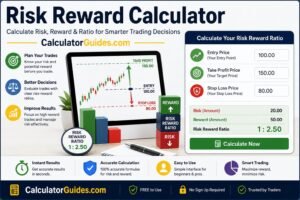
What Is a Risk Reward Calculator?
A Risk Reward Calculator is an online financial tool that measures the relationship between the money you could lose (risk) and the money you could gain (reward) on a trade.
By entering your:
- Entry Price
- Stop Loss Price
- Take Profit Price
the calculator instantly displays:
- Risk Amount
- Reward Amount
- Risk-Reward Ratio
This helps traders manage their capital more effectively and avoid poor trading decisions.
Why Is the Risk-Reward Ratio Important?
The risk-reward ratio helps traders decide whether a trade offers enough potential profit compared to the possible loss.
For example:
- Risk $20
- Potential Reward $60
Risk-Reward Ratio = 1:3
This means you are risking $1 to potentially earn $3.
Many professional traders look for trades with a ratio of 1:2 or better.
Risk Reward Formula
Risk Amount
Risk = Entry Price − Stop Loss Price
Reward Amount
Reward = Take Profit Price − Entry Price
Risk-Reward Ratio
Risk-Reward Ratio = Reward ÷ Risk
How to Use the Risk Reward Calculator
Using the calculator is simple:
Step 1
Enter your Entry Price.
Step 2
Enter your Stop Loss Price.
Step 3
Enter your Take Profit Price.
Step 4
Click Calculate.
The calculator instantly shows:
- Risk Amount
- Reward Amount
- Risk-Reward Ratio
Example Calculation
Suppose you plan the following trade:
- Entry Price = $100
- Stop Loss = $90
- Take Profit = $130
Step 1
Risk
100 − 90 = $10
Step 2
Reward
130 − 100 = $30
Step 3
Risk-Reward Ratio
30 ÷ 10 = 3
Final Ratio:
1 : 3
You are risking $10 to potentially earn $30.
What Is a Good Risk-Reward Ratio?
Although trading strategies differ, these ratios are commonly used:
| Risk-Reward Ratio | Interpretation |
|---|---|
| 1:1 | Equal risk and reward |
| 1:2 | Good for many traders |
| 1:3 | Excellent if supported by a sound strategy |
| 1:4 or Higher | Higher potential reward but often lower probability of success |
A higher ratio is not always better. The quality of the trade setup and your win rate also matter.
Benefits of Using a Risk Reward Calculator
Using a calculator can help you:
- Plan trades with confidence.
- Improve risk management.
- Avoid emotional decisions.
- Maintain trading discipline.
- Compare multiple trade setups quickly.
- Protect your trading capital.
- Build a consistent trading strategy.
Who Should Use This Calculator?
This calculator is ideal for:
- Stock Traders
- Forex Traders
- Cryptocurrency Traders
- Commodity Traders
- Swing Traders
- Day Traders
- Long-Term Investors
- Beginner Traders
Common Trading Mistakes
Avoid these common mistakes:
- Trading without a stop loss.
- Ignoring the risk-reward ratio.
- Taking oversized positions.
- Chasing losing trades.
- Letting emotions control decisions.
- Failing to follow a trading plan.
Tips for Better Risk Management
- Never risk more than a small percentage of your trading capital on a single trade.
- Always use a stop loss.
- Aim for trades with a favorable risk-reward ratio.
- Keep a trading journal.
- Review your strategy regularly.
- Stay disciplined and avoid emotional trading.
Advantages of a Risk Reward Calculator
- Fast calculations
- Accurate results
- Easy to use
- Suitable for all financial markets
- Helps improve trading discipline
- Supports better decision-making
- Completely free
Frequently Asked Questions (FAQs)
What is a Risk Reward Calculator?
A Risk Reward Calculator helps traders calculate the potential risk, reward, and risk-reward ratio before placing a trade.
What is a good risk-reward ratio?
Many traders consider 1:2 or 1:3 to be attractive, but the best ratio depends on your strategy, market conditions, and win rate.
Can I use this calculator for stocks?
Yes. It works for stocks, ETFs, forex, cryptocurrencies, commodities, and other markets.
Why is the risk-reward ratio important?
It helps you evaluate whether the potential reward justifies the possible loss before entering a trade.
Is a higher risk-reward ratio always better?
Not necessarily. A higher ratio can be attractive, but it may come with a lower probability of reaching the profit target.
Is this calculator free?
Yes. The CalculatorGuides.com Risk Reward Calculator is completely free to use.
Conclusion
A Risk Reward Calculator is one of the most valuable tools for traders who want to manage risk and make smarter decisions. By calculating your potential loss, expected profit, and overall risk-reward ratio before entering a trade, you can build a more disciplined and consistent trading approach.
Use the CalculatorGuides.com Risk Reward Calculator to evaluate every trade with confidence, improve your risk management, and make more informed trading decisions.