
Rounding Calculator-Use our Rounding Calculator to quickly round numbers to the nearest whole number, tenth, hundredth, thousandth, ten, hundred, thousand, or a chosen number of significant figures.Convert units quickly with our free measurement and Matrix Calculator conversion calculators.
Round numbers to specified decimals, place values, or fractions🔢 Rounding Calculator
• Target Precision:
• Applied Mode:
Rounding numbers makes them easier to read, compare, and use in calculations.
For example, you can turn 3.14159 into 3.14 when rounding to two decimal places, or round 347 to 350 when rounding to the nearest ten.
Simply enter your number, choose how you want to round it, and get the result.
What Is a Rounding Calculator?
A rounding calculator is an online tool that changes a number to a simpler value while keeping it close to the original number.
You can use it to:
- Round decimals
- Round whole numbers
- Round to the nearest whole number
- Round to the nearest tenth
- Round to the nearest hundredth
- Round to the nearest thousandth
- Round to the nearest 10
- Round to the nearest 100
- Round to the nearest 1,000
- Round to significant figures
- Round numbers up
- Round numbers down
Rounding is commonly used in mathematics, schoolwork, science, statistics, money calculations, measurements, and everyday situations.
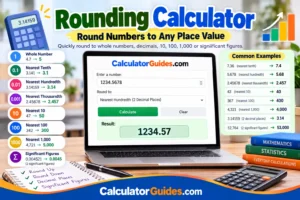
How to Use the Rounding Calculator
Using our round number calculator is simple.
Step 1: Enter your number
Type the number you want to round.
For example:
27.8465
Step 2: Choose the rounding option
Choose whether you want to round to:
- Whole number
- Tenth
- Hundredth
- Thousandth
- Ten
- Hundred
- Thousand
- Significant figures
Step 3: Calculate
Click the calculate button.
Step 4: Check your answer
The calculator gives you the rounded number.
You can also use the result to understand which digit was used to make the rounding decision.
How Does Rounding Work?
The basic rounding rule is easy.
Look at the digit immediately after the place you want to keep.
- If the next digit is 0, 1, 2, 3, or 4, keep the rounding digit the same.
- If the next digit is 5, 6, 7, 8, or 9, increase the rounding digit by 1.
This is the common school-style rounding rule.
Example
Round 7.36 to the nearest tenth.
The tenths digit is 3.
The next digit is 6.
Because 6 is greater than 5, increase 3 to 4.
7.36 → 7.4
Round to the Nearest Whole Number
When you round to the nearest whole number, you remove the decimal part.
Example 1
4.2
The decimal digit is 2, so round down.
4.2 → 4
Example 2
4.8
The decimal digit is 8, so round up.
4.8 → 5
Example 3
12.5
Using the common half-up rule:
12.5 → 13
Round to the Nearest Tenth
The nearest tenth means keeping one digit after the decimal point.
Example
Round:
18.746
The tenths digit is 7.
The next digit is 4.
Because 4 is less than 5, the 7 stays the same.
18.746 → 18.7
Another example:
18.76 → 18.8
because the hundredths digit is 6.
Round to the Nearest Hundredth
The nearest hundredth means keeping two digits after the decimal point.
Example
Round:
5.678
The hundredths digit is 7.
The next digit is 8.
Because 8 is 5 or greater, round 7 up.
5.678 → 5.68
Another example:
3.14159 → 3.14
because the third decimal digit is 1.
Round to the Nearest Thousandth
The nearest thousandth means keeping three digits after the decimal point.
Example
Round:
2.45678
The thousandths digit is 6.
The next digit is 7.
So 6 becomes 7.
2.45678 → 2.457
Round to 2 Decimal Places
Rounding to 2 decimal places means keeping two digits after the decimal point.
For example:
15.496
Look at the third decimal digit.
The number is:
15.49 6
The 6 tells us to increase the hundredths digit.
So:
15.496 → 15.50
The trailing zero is important because the answer is being shown to two decimal places.
Round to 3 Decimal Places
Rounding to 3 decimal places means keeping three digits after the decimal point.
Example:
8.2746
The first three decimal digits are 274.
The next digit is 6.
So:
8.2746 → 8.275
Round to the Nearest 10
When rounding to the nearest 10, look at the ones digit.
Example
43
The ones digit is 3.
Because 3 is less than 5:
43 → 40
Another example:
47
The ones digit is 7.
Because 7 is greater than 5:
47 → 50
Round to the Nearest 100
When rounding to the nearest 100, look at the tens digit.
Example
342
The tens digit is 4.
So:
342 → 300
Another example:
367
The tens digit is 6.
So:
367 → 400
Round to the Nearest 1,000
When rounding to the nearest 1,000, look at the hundreds digit.
Example
4,321
The hundreds digit is 3.
So:
4,321 → 4,000
Another example:
4,721
The hundreds digit is 7.
So:
4,721 → 5,000
Rounding to Significant Figures
Significant figures, also called significant digits, are the digits that carry meaningful information about a number.
Rounding to significant figures is different from rounding to decimal places.
With decimal places, you count digits after the decimal point.
With significant figures, you start counting from the first non-zero digit. Leading zeros do not count as significant figures.
Example
Round 0.004521 to 2 significant figures.
The first two significant digits are:
4 and 5
The next digit is 2, so we do not round up.
Answer:
0.0045
Another example:
52,764 to 2 significant figures becomes:
53,000
Significant Figures vs. Decimal Places
These two types of rounding are easy to confuse.
| Type | What You Count | Example |
|---|---|---|
| Decimal places | Digits after decimal point | 3.14159 → 3.14 |
| Significant figures | Meaningful digits from first non-zero digit | 0.004521 → 0.0045 |
If your teacher asks for 2 decimal places, count two digits after the decimal.
If the question asks for 2 significant figures, start counting from the first non-zero digit.
Round Up Calculator
Sometimes you do not want normal rounding. You may need to always move a number upward.
This is called ceiling or rounding up.
For example:
4.1 → 5
4.9 → 5
The number always moves upward to the next whole number.
This can be useful when you need a complete number of items, boxes, people, or units.
Round Down Calculator
Rounding down means moving to the lower whole number.
For example:
4.1 → 4
4.9 → 4
This is also called the floor function.
The exact behavior for negative numbers is important: mathematical floor moves toward negative infinity rather than simply removing the decimal portion.
What Is the Difference Between Rounding and Truncation?
Rounding and truncation are not the same.
Rounding
Rounding looks at the next digit and decides whether to increase the retained digit.
Example:
4.78 → 4.8
Truncation
Truncation simply removes the unwanted digits.
Example:
4.78 → 4.7
No rounding decision is made.
Common Rounding Examples
Here are some quick examples using the standard rounding rule.
| Number | Rounding | Answer |
|---|---|---|
| 3.14159 | Nearest whole number | 3 |
| 3.14159 | Nearest tenth | 3.1 |
| 3.14159 | Nearest hundredth | 3.14 |
| 3.14159 | Nearest thousandth | 3.142 |
| 47 | Nearest 10 | 50 |
| 283 | Nearest 100 | 300 |
| 2,675 | Nearest 100 | 2,700 |
| 48.078 | Nearest tenth | 48.1 |
| 5.8917 | Nearest hundredth | 5.89 |
These examples follow the standard rule where digits 5–9 cause the retained digit to increase and digits 0–4 leave it unchanged.
How to Round Numbers Step by Step
You can round almost any number by following these three steps.
Step 1: Decide where to round
Choose the place value.
For example:
nearest tenth
Step 2: Find the next digit
Look at the digit immediately to the right.
Step 3: Apply the rounding rule
If the next digit is:
0–4 → stay
5–9 → increase by 1
Example
Round 24.67 to the nearest tenth.
The tenths digit is 6.
The next digit is 7.
Because 7 is greater than 5:
24.67 → 24.7
Rounding in Science
Scientists often use rounding to avoid showing more precision than a measurement supports.
For example:
9.80665
might be reported as:
9.81
when two decimal places are needed.
Significant figures are also commonly used when reporting measurements.
The important thing is to follow the precision required by the question, measurement, or scientific convention.
Rounding in Statistics
Rounding is also common in statistics.
For example, an average might be:
74.666666…
If the answer needs two decimal places, it can be written as:
74.67
The same idea can be used for percentages, averages, probabilities, standard deviations, and other statistical results.
It is usually best to keep the full value during calculations and round the final answer when appropriate.
What Happens When the Next Digit Is 5?
This is one of the most common rounding questions.
Under the standard round-half-up rule, a 5 causes the retained digit to increase.
For example:
2.35 → 2.4
when rounding to one decimal place.
However, there are other rounding rules. For example, round half to even, or banker’s rounding, handles exact halfway cases differently. This is why software, financial systems, and textbooks can sometimes give different results for the same halfway number.
If your assignment specifies a rounding method, always follow that method.
Rounding Negative Numbers
Negative numbers can also be rounded.
For example:
-3.74
rounded to the nearest tenth using the usual nearest-value rule is:
-3.7
But special rounding modes such as floor, ceiling, and half-away-from-zero can behave differently with negative numbers.
This is why it is important to know which rounding method you are using.
Why Use a Rounding Calculator?
Doing simple rounding by hand is easy, but an online rounding calculator can save time when you have many numbers or need several types of rounding.
A calculator can help you:
- Check homework answers
- Round decimals quickly
- Round large numbers
- Find significant figures
- Round to a specific decimal place
- Round to the nearest 10, 100, or 1,000
- Compare different rounding methods
- Avoid simple calculation mistakes
It is especially useful when you need the same number rounded in several different ways.
Common Rounding Mistakes
Looking at the wrong digit
Always look at the digit immediately to the right of the place you are rounding.
Confusing tenths and hundredths
The first digit after the decimal is the tenths place.
The second digit is the hundredths place.
For example:
7.58
5 = tenths
8 = hundredths
Confusing decimal places with significant figures
They are two different ways of measuring precision.
Rounding too early
When doing several calculations, rounding every intermediate result can slightly change the final answer.
When possible, keep extra digits during the calculation and round the final result.
Forgetting trailing zeros
If the question asks for two decimal places, write both places.
For example:
15.5 → 15.50
when the answer must be shown to two decimal places.
Frequently Asked Questions
What is a rounding calculator?
A rounding calculator is an online tool that rounds numbers to a selected place value, decimal place, or number of significant figures.
How do I round a number?
Choose the place you want to keep, look at the next digit, and round up if that digit is 5 or more. If it is 4 or less, leave the retained digit unchanged.
What does round to the nearest tenth mean?
It means keeping one digit after the decimal point.
For example:
5.67 → 5.7
What does round to the nearest hundredth mean?
It means keeping two digits after the decimal point.
For example:
5.678 → 5.68
What does round to the nearest thousandth mean?
It means keeping three digits after the decimal point.
For example:
5.6789 → 5.679
What is 2 decimal places?
Two decimal places means two digits are kept after the decimal point.
For example:
3.14159 → 3.14
How do I round to the nearest 10?
Look at the ones digit. If it is 5 or greater, increase the tens digit. If it is less than 5, keep the tens digit unchanged.
For example:
47 → 50
How do I round to the nearest 100?
Look at the tens digit.
For example:
342 → 300
and:
367 → 400
What are significant figures?
Significant figures are the meaningful digits in a number. They are counted starting from the first non-zero digit.
Is rounding the same as truncation?
No. Rounding checks the next digit and may increase the retained digit. Truncation simply removes the unwanted digits.
Can I round negative numbers?
Yes. Negative numbers can be rounded, but the result can depend on the rounding method being used.
What is rounding half to even?
Rounding half to even is also called banker’s rounding. When a value falls exactly halfway between two choices, the result is selected based on which neighboring value has the even last digit.
Should I round before or after calculating?
In most calculations, it is better to keep the extra digits during the calculation and round the final answer unless the instructions specifically say otherwise.
Is a rounding calculator useful for school?
Yes. Students can use it to check decimal places, place values, significant figures, and homework calculations.
Final Thoughts
Rounding numbers does not have to be difficult.
The main idea is simple: choose the place you want to keep, look at the next digit, and apply the correct rounding rule.
Our Rounding Calculator makes this process faster by letting you round numbers to the nearest whole number, tenth, hundredth, thousandth, 10, 100, 1,000, or significant figures.
Whether you are a student, teacher, researcher, or simply working with numbers, CalculatorGuides.com can help you get a quick and easy rounded result.