
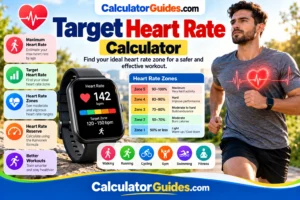
Target Heart Rate Calculator-Our Target Heart Rate Calculator helps you find your estimated heart rate range for exercise based on your age and resting heart rate.Knowing your target heart rate can help you understand how hard you are working during walking, running, cycling, gym workouts, and other cardio exercises.Use our Fitness & Health Calculators to make everyday fitness calculations easier.
❤️ Target Heart Rate Calculator
Enter your age and resting heart rate to estimate your maximum heart rate, heart rate zones, heart rate reserve, and target heart rate.
This calculator is useful for beginners, regular gym users, runners, cyclists, and anyone who wants to better understand exercise intensity.
What Is a Target Heart Rate?
Your target heart rate is a range of heartbeats per minute that can be used as a general guide for exercise intensity.
When you exercise, your heart beats faster because your muscles need more oxygen.
Your target heart rate can help you understand whether your workout is relatively easy, moderate, or vigorous.
For many adults, a commonly used general estimate is:
Maximum Heart Rate = 220 − Age
The American Heart Association uses this as a general estimate and notes that these numbers are averages, not exact limits for every person.
How to Use the Target Heart Rate Calculator
Using our heart rate calculator is simple.
Step 1: Enter your age
Enter your age in years.
For example:
Age = 40
Step 2: Enter your resting heart rate
Your resting heart rate is your pulse when you are relaxed.
For example:
Resting heart rate = 70 bpm
Step 3: Calculate
Click the calculate button.
The calculator can estimate your:
- Maximum heart rate
- Resting heart rate
- Heart rate reserve
- Moderate exercise zone
- Vigorous exercise zone
- Target heart rate
The result gives you a simple range that you can use while exercising.
Target Heart Rate Formula
One simple method for estimating target heart rate starts with your estimated maximum heart rate.
Maximum Heart Rate Formula
Maximum Heart Rate = 220 − Age
For example, if you are 40 years old:
220 − 40 = 180 bpm
Your estimated maximum heart rate is therefore 180 beats per minute.
This is only an estimate. Your actual maximum heart rate can be different.
Target Heart Rate Zones
Target heart rate zones are commonly expressed as a percentage of estimated maximum heart rate.
Moderate Intensity
A common general range for moderate-intensity exercise is:
50% to 70% of maximum heart rate
For a 40-year-old:
Maximum heart rate = 180 bpm
50% of 180 = 90 bpm
70% of 180 = 126 bpm
So the estimated moderate target zone is:
90–126 bpm
Vigorous Intensity
A common general range for vigorous exercise is:
70% to 85% of maximum heart rate
For a 40-year-old:
70% of 180 = 126 bpm
85% of 180 = 153 bpm
Estimated vigorous zone:
126–153 bpm
These ranges are general guides and should not be treated as exact limits for everyone.
Target Heart Rate by Age
Here is a simple estimated target heart rate chart using the 220-minus-age method.
| Age | Estimated Max HR | 50%–70% Moderate | 70%–85% Vigorous |
|---|---|---|---|
| 20 | 200 bpm | 100–140 bpm | 140–170 bpm |
| 25 | 195 bpm | 98–137 bpm | 137–166 bpm |
| 30 | 190 bpm | 95–133 bpm | 133–162 bpm |
| 35 | 185 bpm | 93–130 bpm | 130–157 bpm |
| 40 | 180 bpm | 90–126 bpm | 126–153 bpm |
| 45 | 175 bpm | 88–123 bpm | 123–149 bpm |
| 50 | 170 bpm | 85–119 bpm | 119–145 bpm |
| 55 | 165 bpm | 83–116 bpm | 116–140 bpm |
| 60 | 160 bpm | 80–112 bpm | 112–136 bpm |
| 65 | 155 bpm | 78–109 bpm | 109–132 bpm |
| 70 | 150 bpm | 75–105 bpm | 105–128 bpm |
| 75 | 145 bpm | 73–102 bpm | 102–123 bpm |
| 80 | 140 bpm | 70–98 bpm | 98–119 bpm |
These are estimates, not personalized medical targets.
What Is Maximum Heart Rate?
Maximum heart rate is the highest heart rate your heart can reach during very hard exercise.
A commonly used estimate is:
Maximum Heart Rate = 220 − Age
For example:
Age = 30
220 − 30 = 190 bpm
Age = 50
220 − 50 = 170 bpm
Age = 60
220 − 60 = 160 bpm
The formula is convenient, but it does not predict the exact maximum heart rate for every person.
What Is Resting Heart Rate?
Your resting heart rate is the number of times your heart beats per minute while you are relaxed.
A good time to check it is when you are calm and rested, such as in the morning before getting up.
For many adults, a resting heart rate between 60 and 100 bpm is considered typical.
Fitness level, stress, medications, illness, caffeine, and other factors can affect heart rate.
What Is Heart Rate Reserve?
Heart rate reserve (HRR) is the difference between your estimated maximum heart rate and your resting heart rate.
Formula
Heart Rate Reserve = Maximum Heart Rate − Resting Heart Rate
For example:
Age = 40
Estimated maximum heart rate = 180 bpm
Resting heart rate = 70 bpm
Heart rate reserve:
180 − 70 = 110 bpm
Heart rate reserve is useful when calculating target heart rate using the Karvonen method.
Karvonen Formula
The Karvonen formula, also called the heart-rate-reserve method, takes your resting heart rate into account.
The basic formula is:
Target Heart Rate = Resting Heart Rate + (Heart Rate Reserve × Exercise Intensity)
For example:
Age = 40
Resting heart rate = 70 bpm
Maximum heart rate = 180 bpm
Heart rate reserve:
180 − 70 = 110
If you use 50% intensity:
70 + (110 × 0.50)
70 + 55 = 125 bpm
Estimated target heart rate:
125 bpm
Using resting heart rate can give a different result from simply multiplying maximum heart rate by a percentage.
Target Heart Rate Calculator Using the Karvonen Method
If your calculator includes the Karvonen method, you normally need three pieces of information:
- Age
- Resting heart rate
- Exercise intensity
The calculator first estimates maximum heart rate.
Then it calculates heart rate reserve.
Finally, it uses the selected intensity to estimate the target heart rate.
This method is often useful when you want your resting heart rate included in the calculation.
Heart Rate Zones Explained
Heart rate zones are simply ranges that describe exercise intensity.
Zone 1 – Very Light Activity
This is an easy level of activity.
Examples include:
- Easy walking
- Light movement
- Warm-up exercises
- Cool-down exercises
You should generally be able to talk comfortably.
Zone 2 – Light to Moderate Activity
This zone is commonly associated with steady aerobic activity.
Examples include:
- Brisk walking
- Easy cycling
- Light jogging
- Easy cardio
You can usually talk, although you may notice your breathing becoming faster.
Zone 3 – Moderate to Hard Activity
Your breathing becomes more noticeable and maintaining a conversation becomes harder.
Examples include:
- Faster cycling
- Jogging
- Continuous cardio
- Faster uphill walking
Zone 4 – Hard Activity
This is a higher-intensity zone.
Examples include:
- Fast running
- Hard cycling
- Interval training
You may only be able to say a few words before needing another breath.
Zone 5 – Very Hard Activity
This represents very high effort.
It is generally used for short periods rather than long continuous exercise.
Not everyone should train at very high intensity, especially if they are new to exercise.
Target Heart Rate for Weight Loss
Many people search for a target heart rate for fat burning or a fat burning heart rate calculator.
Heart rate can be useful for measuring exercise intensity, but there is not one magic heart rate that automatically causes weight loss.
Weight loss depends on your overall energy balance, food intake, physical activity, sleep, and other factors.
A moderate-intensity workout can still be an excellent choice because it is often easier to maintain consistently.
The most useful target is usually one that matches your fitness level and allows you to exercise safely and consistently.
Target Heart Rate for Running
Runners often use a target heart rate calculator for running to understand workout intensity.
For example:
- Easy runs may use a lower intensity.
- Steady runs may use a moderate intensity.
- Hard intervals may use a higher intensity.
- Recovery runs should generally feel easier.
Your running pace can change because of weather, hills, fatigue, fitness, and other factors, so heart rate can provide another way to monitor effort.
Target Heart Rate for Walking
Walking can also raise your heart rate.
A brisk walk may put you into a moderate-intensity range.
The CDC notes that during moderate-intensity activity, you can generally talk but not sing comfortably. During vigorous activity, you will usually only be able to say a few words before pausing for breath.
This is called the talk test and can be useful when you do not have a heart-rate monitor.
Target Heart Rate for Cycling
Cyclists can also use target heart rate zones to control workout intensity.
For example:
Easy cycling: lower intensity
Steady cycling: moderate intensity
Hard cycling: higher intensity
Your target range can help you avoid starting a workout too hard and make it easier to keep a consistent effort.
How to Check Your Heart Rate
You can check your pulse manually or use a fitness tracker.
To check your pulse manually:
- Stop or slow down safely.
- Place your index and middle fingers over the pulse on your wrist.
- Count your heartbeats.
- Count for 60 seconds for a direct beats-per-minute reading.
You can also use a smartwatch, fitness band, chest strap, or exercise machine that measures heart rate.
Wearable readings are convenient, but they are not always perfectly accurate.
Target Heart Rate vs. Maximum Heart Rate
These two terms are different.
Maximum heart rate is an estimate of the highest heart rate you might reach during maximum effort.
Target heart rate is a range used to guide exercise intensity.
For example, a 40-year-old may have:
Estimated maximum heart rate:
180 bpm
Moderate target range:
90–126 bpm
Vigorous target range:
126–153 bpm
So 180 bpm is the estimated maximum, while the target ranges are lower exercise-intensity ranges.
What Is a Good Heart Rate During Exercise?
There is no single heart rate that is perfect for everyone.
Your age, fitness level, medications, health conditions, exercise type, and other factors can affect your heart rate.
That is why a target heart rate calculator should be used as a general guide rather than a medical diagnosis.
Your perceived effort also matters.
If an exercise feels unusually difficult, you feel unwell, or something does not feel right, stop and seek appropriate medical advice.
Target Heart Rate Calculator for Beginners
If you are new to exercise, you do not need to immediately train at a high heart rate.
Start at a comfortable intensity and gradually increase your activity as your fitness improves.
Walking is a simple starting point for many people.
You can then progress to:
- Brisk walking
- Cycling
- Jogging
- Swimming
- Cardio workouts
The CDC recommends that adults aim for at least 150 minutes of moderate-intensity aerobic activity per week, or 75 minutes of vigorous activity, along with muscle-strengthening activity on at least two days each week.
Why Is My Heart Rate Higher Than Normal During Exercise?
Your heart rate can change from day to day.
Factors that can raise heart rate include:
- Hard exercise
- Heat
- Stress
- Anxiety
- Dehydration
- Lack of sleep
- Caffeine
- Illness
- Some medications
Because of this, do not assume that one heart-rate reading tells you everything about your health.
Is a Lower Heart Rate Always Better?
Not necessarily.
A lower resting heart rate can be normal in some physically fit people, but heart rate needs to be considered in context.
The goal during exercise is not simply to get your heart rate as high as possible.
Instead, choose an intensity that fits your workout and fitness level.
Frequently Asked Questions
What is a target heart rate?
Target heart rate is an estimated range of beats per minute that can be used to guide exercise intensity.
How do I calculate my target heart rate?
One simple method is to estimate maximum heart rate using:
220 − age
Then multiply the maximum heart rate by the desired exercise-intensity percentage.
Another method is the Karvonen formula, which also uses resting heart rate.
What is my target heart rate by age?
Your target heart rate generally becomes lower with age when using age-based maximum-heart-rate estimates. Use the age chart above as a general guide.
What is a normal target heart rate during exercise?
There is no single normal number for everyone. A common general guide is 50–70% of estimated maximum heart rate for moderate activity and 70–85% for vigorous activity.
What is the 220 minus age formula?
The formula estimates maximum heart rate:
Maximum Heart Rate = 220 − Age
It is a simple estimate and not an exact measurement.
What is the Karvonen formula?
The Karvonen formula uses resting heart rate and heart rate reserve to estimate a target heart rate at a selected exercise intensity.
What is heart rate reserve?
Heart rate reserve is the difference between estimated maximum heart rate and resting heart rate.
HRR = Maximum Heart Rate − Resting Heart Rate
What should my heart rate be when walking?
It depends on your age, fitness, walking speed, and other factors. A brisk walk is generally considered moderate-intensity activity when it makes you breathe harder and raises your heart rate.
What should my heart rate be when running?
Running is generally vigorous-intensity activity, but the appropriate heart rate depends on your individual fitness and workout. Use the calculator as a general guide rather than trying to reach your maximum heart rate.
Is 170 bpm too high during exercise?
It depends on your age, fitness, activity, and individual health. A heart rate that may be expected during hard exercise for one person may be inappropriate for another. If you experience concerning symptoms, stop exercising and seek medical help.
Can I use this calculator for weight loss?
Yes, you can use it to understand exercise intensity. However, there is no single heart rate that guarantees fat loss. Weight management depends on overall diet, activity, and other lifestyle factors.
Can I use a smartwatch to check my target heart rate?
Yes. Many smartwatches and fitness trackers can measure heart rate during exercise. Their readings can be useful for general exercise tracking but may not always be exact.
Final Thoughts
Our Target Heart Rate Calculator gives you a simple way to estimate your exercise heart rate zones.
You can use it to find your maximum heart rate, target heart rate, resting heart rate, heart rate reserve, moderate-intensity zone, vigorous-intensity zone, and Karvonen target heart rate.
Whether you are walking, running, cycling, doing cardio, or working out at the gym, understanding your heart rate can help you better understand exercise intensity.
Use the calculator as a general guide, listen to your body, and focus on building a workout routine that you can maintain consistently.
Important: This calculator is for general educational and fitness purposes only. It does not provide medical advice or diagnose heart problems. If you have a heart or other medical condition, take medications that affect heart rate, have been inactive for a long time, or are unsure about starting vigorous exercise, speak with a qualified healthcare professional before changing your exercise routine.