
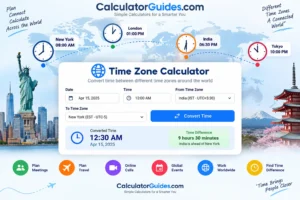
Time Zone Calculator-A Time Zone Calculator helps you find the correct time in another city or country. Enter a date and time, choose the starting time zone and the destination time zone, and you can see the converted time. Make calculations simple with our Concrete Calculator, Time Duration Calculator and easy-to-use online tools.
🌐 Time Zone Calculator
CalculatorGuides
This tool is useful when you need to plan a meeting, call, online class, interview, flight, event, or work with someone in another country.
What Is a Time Zone?
A time zone is an area that uses the same standard time.
The world is divided into different time zones because the Earth rotates and different places experience daylight at different times.
For example, when it is daytime in one country, it may already be nighttime in another country.
Time zones are commonly described using an offset from UTC (Coordinated Universal Time).
Examples include:
- UTC−5
- UTC−4
- UTC
- UTC+1
- UTC+5:30
- UTC+8
- UTC+10
India uses Indian Standard Time (IST), which is UTC+5:30.
What Is UTC?
UTC stands for Coordinated Universal Time.
It is the main reference used for comparing time around the world.
UTC does not change because of daylight saving time.
For example:
UTC+5:30 means the local time is 5 hours and 30 minutes ahead of UTC.
UTC−5 means the local time is 5 hours behind UTC.
UTC is widely used in:
- Computers
- Websites
- Servers
- Aviation
- Science
- International business
- Online services
How Does a Time Zone Calculator Work?
A time zone calculator uses the time zone rules for the selected locations.
For example, suppose you want to convert a meeting time from New York to India.
The calculator considers:
- The date
- The starting time
- The starting time zone
- The destination time zone
- Any daylight saving time rules
It then shows the corresponding local time.
This is important because the time difference between two locations can change during the year when daylight saving time is used.
Time Zone Conversion Formula
A simple way to understand a time zone conversion is:
Target Time = UTC Time + Target UTC Offset
For example, if the UTC time is:
12:00
and the destination time zone is:
UTC+5:30
then:
12:00 + 5 hours 30 minutes = 17:30
So the local time is:
5:30 PM
Real-world time zone conversion can be more complicated because some locations change their UTC offset during the year.
Time Zone Difference Calculator
A time zone difference calculator tells you how many hours and minutes separate two locations.
For example, if one location is:
UTC+5:30
and another is:
UTC+1
the difference is:
4 hours 30 minutes
The location with UTC+5:30 is 4 hours 30 minutes ahead of the location with UTC+1.
How to Calculate Time Difference
You can calculate the difference between two UTC offsets by comparing them.
For example:
UTC+5:30 − UTC−4
The difference is:
9 hours 30 minutes
So the UTC+5:30 location is 9 hours and 30 minutes ahead.
However, always check the actual date because daylight saving time can change the offset in some regions.
Time Zone Converter
A time zone converter changes a specific time from one time zone to another.
For example:
9:00 AM in India
may correspond to a different local time in:
- London
- New York
- Los Angeles
- Dubai
- Singapore
- Sydney
- Tokyo
The exact result depends on the date because some locations change their clocks during the year.
UTC to Local Time Converter
To convert UTC to local time, add or subtract the location’s UTC offset.
For example:
UTC = 10:00
For a location at:
UTC+5:30
the local time is:
3:30 PM
For a location at:
UTC−5
the local time is:
5:00 AM
The correct offset should always be checked for the specific date.
Local Time to UTC
You can also convert local time back to UTC.
For example, if a location uses:
UTC+5:30
and the local time is:
6:00 PM
subtract 5 hours and 30 minutes:
6:00 PM − 5:30 = 12:30 PM UTC
So:
6:00 PM IST = 12:30 PM UTC
India Time Zone
India uses a single official time zone:
Indian Standard Time (IST)
IST is:
UTC+5:30
India does not currently use daylight saving time.
This means the standard time difference between India and UTC remains 5 hours and 30 minutes throughout the year.
India Time to USA Time
The United States has several time zones, so there is no single USA time difference from India.
For example, the difference between India and a US location depends on:
- The US city
- The date
- Whether daylight saving time is active
For this reason, it is better to select a specific city rather than simply choosing “USA.”
India Time to UK Time
The UK uses different UTC offsets during the year.
During the UK’s standard-time period, the UK is on:
UTC+0
India is:
UTC+5:30
The difference is:
5 hours 30 minutes
During the UK’s daylight-saving period, the UK moves to:
UTC+1
and the difference from India becomes:
4 hours 30 minutes
India Time to Australia
Australia has multiple time zones, and some areas use daylight saving time while others do not.
Therefore, the time difference between India and Australia depends on the specific city and date.
For example, Sydney and Perth do not always have the same time relative to India.
India Time to Canada
Canada also has several time zones.
The time difference between India and Canada depends on the city and date.
For accurate conversion, choose a specific location such as Toronto, Vancouver, Calgary, or another city.
Common Time Zones
Here are some commonly used time zones and abbreviations:
| Time Zone | Common Name | UTC Offset |
|---|---|---|
| UTC | Coordinated Universal Time | UTC+0 |
| IST | India Standard Time | UTC+5:30 |
| GMT | Greenwich Mean Time | UTC+0 |
| EST | Eastern Standard Time | UTC−5 |
| EDT | Eastern Daylight Time | UTC−4 |
| CST | Central Standard Time | UTC−6 |
| CDT | Central Daylight Time | UTC−5 |
| MST | Mountain Standard Time | UTC−7 |
| MDT | Mountain Daylight Time | UTC−6 |
| PST | Pacific Standard Time | UTC−8 |
| PDT | Pacific Daylight Time | UTC−7 |
| JST | Japan Standard Time | UTC+9 |
| AEST | Australian Eastern Standard Time | UTC+10 |
Some abbreviations can be ambiguous, so using a specific city or IANA time zone name is often safer.
Time Zone Abbreviations
You may see abbreviations such as:
- UTC
- GMT
- IST
- EST
- EDT
- CST
- CDT
- MST
- MDT
- PST
- PDT
- JST
- AEST
A common problem is that some abbreviations are used for more than one region.
For example, IST can refer to different time zones in different contexts.
For accurate international scheduling, a city or named time zone is usually better than relying only on an abbreviation.
What Is GMT?
GMT stands for Greenwich Mean Time.
GMT is associated with the time at the prime meridian and is often used informally as a reference for UTC+0.
UTC and GMT are extremely close for everyday timekeeping, but they are based on different standards.
For modern technical applications, UTC is generally preferred.
What Is Daylight Saving Time?
Daylight Saving Time (DST) is a system where clocks are moved forward by one hour during part of the year in some regions.
For example, a location may use:
UTC−5
during standard time and:
UTC−4
during daylight saving time.
Not every country uses DST.
India, for example, does not currently observe daylight saving time.
Why Does the Time Difference Change?
The time difference between two locations can change when one location changes its clock for daylight saving time.
For example, suppose one location stays at:
UTC+5:30
all year.
Another location may move between:
UTC−5
and:
UTC−4
Because of that change, the difference between the two locations also changes.
This is why a time zone calculator should use the date as well as the time.
Time Zone Calculator for Meetings
International meetings can become confusing when participants live in different countries.
A time zone calculator helps you find a meeting time that works for everyone.
For example, you might need to compare:
- India
- United Kingdom
- United States
- Germany
- Australia
- Singapore
Instead of manually calculating each time, enter the meeting time and compare the local times for each participant.
Best Time for an International Meeting
There is no single best meeting time for every group.
A good meeting time should consider:
- Working hours
- Local holidays
- Time zone differences
- Daylight saving time
- Lunch hours
- Weekends
For a global team, a time that is convenient for one country may be very early or very late for another.
Time Zone Calculator for Business
Businesses often work with customers and employees around the world.
A time zone converter can help with:
- Client calls
- Interviews
- Online meetings
- Customer support
- Project deadlines
- Webinars
- International appointments
- Remote teams
Always include the time zone when sending an important meeting invitation.
For example, writing:
3:00 PM IST
is clearer than simply writing:
3:00 PM
Time Zone Calculator for Travel
Time zones are especially important when traveling internationally.
Your phone may automatically update its local time after you arrive in another country, but it is still useful to know the time difference before traveling.
A time zone calculator can help you plan:
- Flight departure times
- Flight arrival times
- Hotel check-in
- Airport transfers
- Calls with family
- Online appointments
Remember that airline schedules normally show local departure and arrival times.
Time Zone and Date Changes
Sometimes a time zone conversion changes not only the time but also the date.
For example:
11:30 PM
in one location might become:
5:00 AM the next day
in another location.
This is why a good time zone calculator should show both the local time and date.
International Date Line
The International Date Line is an imaginary line in the Pacific Ocean where the calendar date changes.
Traveling across the line can cause the local date to move forward or backward by one day.
This is another reason that international time conversion should consider both the time and date.
Time Zone Offset
A UTC offset tells you how far a local time is ahead of or behind UTC.
Examples:
UTC+5:30 → 5 hours 30 minutes ahead of UTC
UTC+2 → 2 hours ahead of UTC
UTC−7 → 7 hours behind UTC
Offsets can sometimes include 30-minute or 45-minute differences rather than only whole hours.
Half-Hour Time Zones
Not every time zone differs from UTC by a whole number of hours.
Examples include:
India: UTC+5:30
Newfoundland Standard Time: UTC−3:30
Some locations also use 45-minute offsets.
This is why manually assuming that every time zone differs by a whole hour can lead to errors.
Time Zones With 45-Minute Offsets
Some locations use unusual offsets such as:
UTC+5:45
This means the local time is 5 hours and 45 minutes ahead of UTC.
A time zone calculator is useful because it handles these less common offsets automatically.
12-Hour and 24-Hour Time
Time can be displayed in two common formats.
12-Hour Format
Uses:
- AM
- PM
Example:
7:30 PM
24-Hour Format
Uses:
19:30
Both represent the same time.
A time zone calculator may allow you to choose your preferred display format.
AM and PM
In the 12-hour clock:
12:00 AM = midnight
12:00 PM = noon
This can sometimes cause confusion when scheduling international meetings.
Using the 24-hour format can make the time easier to understand.
Time Zone Calculator for Online Events
If you are hosting an online event for people in different countries, it is helpful to provide the event time with a clear time zone.
For example:
6:00 PM IST
You can then provide converted times for other major locations.
This reduces the chance that attendees arrive at the wrong time.
Time Zone Calculator for Remote Workers
Remote workers may work with teams in several countries.
A time zone calculator can help them:
- Schedule calls
- Plan work hours
- Track deadlines
- Coordinate projects
- Avoid calling someone outside working hours
For recurring meetings, always check whether daylight saving time could change the local meeting time during the year.
How to Use the Time Zone Calculator
Step 1: Enter the Date
Select the date of the event or meeting.
Step 2: Enter the Time
Enter the starting local time.
Step 3: Select the Starting Time Zone
Choose the city or time zone where the original time applies.
Step 4: Select the Destination
Choose the city or time zone you want to compare.
Step 5: Convert
The calculator shows the corresponding local time.
Step 6: Check the Date
If the conversion crosses midnight, the destination date may be different.
Why Should You Enter the Date?
The date is important because some locations use daylight saving time.
For example, a location may have one UTC offset in January and another in July.
If you only enter the time but not the date, the conversion may not reflect the correct seasonal offset.
Time Zone Calculator vs World Clock
A world clock normally shows the current local time in different cities.
A time zone calculator is more useful when you want to convert a specific date and time.
For example:
World clock: What time is it in Tokyo right now?
Time zone calculator: If my meeting is at 4:00 PM in India on a specific date, what time is it in Tokyo?
Both tools are useful, but they solve different problems.
Time Zone Calculator vs Time Difference Calculator
These tools are closely related.
A time difference calculator focuses on the number of hours and minutes between locations.
A time zone calculator converts a specific time from one location to another.
For international planning, the conversion tool is usually more useful because it also considers the date and seasonal time changes.
Common Time Zone Conversion Mistakes
Forgetting Daylight Saving Time
The time difference can change during the year.
Using the Wrong City
A country can have multiple time zones.
Confusing AM and PM
12 AM and 12 PM are easy to mix up.
Forgetting the Date
The destination may be on the previous or next day.
Assuming Every Time Zone Uses Whole Hours
Some locations use 30-minute or 45-minute offsets.
Relying Only on an Abbreviation
Abbreviations such as IST can be ambiguous.
Using a city or full time zone name is safer.
Frequently Asked Questions
What is a Time Zone Calculator?
A Time Zone Calculator converts a specific date and time from one time zone to another.
How do I calculate the time difference between two countries?
Compare their UTC offsets for the specific date. A time zone calculator can do this automatically.
What time zone does India use?
India uses Indian Standard Time (IST), which is UTC+5:30.
Does India use daylight saving time?
India does not currently observe daylight saving time.
What is UTC?
UTC stands for Coordinated Universal Time and is the main reference used for international timekeeping.
What is GMT?
GMT stands for Greenwich Mean Time. It is commonly associated with UTC+0, although UTC and GMT are based on different standards.
What is UTC+5:30?
It means the local time is 5 hours and 30 minutes ahead of UTC.
What is UTC−5?
It means the local time is 5 hours behind UTC.
Why does the time difference change?
In many cases, daylight saving time causes one location’s UTC offset to change during part of the year.
Can two cities have the same time zone?
Yes. Many cities share the same time zone rules and UTC offset.
Can a country have multiple time zones?
Yes. Large countries can span several time zones.
Does every country use daylight saving time?
No. Many countries do not change their clocks during the year.
Can a time zone be 30 minutes different?
Yes. India is one example with an offset of UTC+5:30.
Can a time zone be 45 minutes different?
Yes. Some locations use 45-minute UTC offsets.
Why does the date change during time conversion?
If the converted time passes midnight, the destination can be on the previous or next calendar day.
What is the difference between a time zone and UTC offset?
A time zone is a set of rules for local time, including changes that may occur during the year. A UTC offset is the specific difference from UTC at a particular time.
Is IST always the same?
India’s IST remains UTC+5:30 throughout the year. However, the abbreviation “IST” can be ambiguous in other contexts.
What is the best time zone format for international meetings?
Using a city or full time zone name along with the date and time is usually clearer than giving only an abbreviation.
Can I use a Time Zone Calculator for flight planning?
Yes, it can help you understand local departure and arrival times, but always rely on the airline or booking confirmation for the official flight schedule.
Is the Time Zone Calculator accurate?
A time zone calculator can provide accurate conversions when it uses the correct time zone rules, date, and location. Time zone rules can change, so current time zone data is important.
Is the Time Zone Calculator free?
Yes. The CalculatorGuides.com Time Zone Calculator is free to use.
Time Zone Calculator – Quick Reference
| Need | What to Use |
|---|---|
| Convert a specific time | Time Zone Calculator |
| Compare two locations | Time Difference Calculator |
| Check current time | World Clock |
| Convert UTC | UTC Converter |
| Plan international meetings | Time Zone Calculator |
| Check daylight saving changes | Time Zone Calculator |
| Convert India time | IST Converter |
| Convert US time | Select the specific US city |
| Check date changes | Time Zone Calculator |
Conclusion
A Time Zone Calculator is a simple way to convert a date and time between different locations around the world.
The most important things to remember are:
- UTC is the main reference for comparing time zones.
- India uses IST (UTC+5:30).
- Some countries have multiple time zones.
- Some locations use daylight saving time.
- Some time zones use 30-minute or 45-minute offsets.
- A time conversion can also change the calendar date.
For important meetings, interviews, flights, and international events, always include the date, local time, and time zone rather than giving a time alone.
Use the CalculatorGuides.com Time Zone Calculator to convert times between cities, compare time zones, check time differences, and plan international schedules with less confusion.