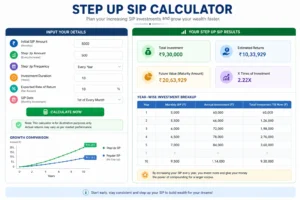
Step Up SIP Calculator-Use our free Step Up SIP Calculator to calculate increasing SIP investments, total investment, estimated returns, and future value. Learn Step Up SIP formula, examples, benefits, and how it works.A Step Up SIP Calculator helps you estimate how your mutual fund investment may grow when you increase your SIP amount regularly over time.Explore our complete collection of Dividend Calculator, Stock Return, Calculator, PE Ratio Calculator,XIRR Calculator,conversion, and everyday calculators at CalculatorGuides to find the right tool for your needs.
📈 CalculatorGuides - Step Up SIP Calculator
₹
📊 Step Up SIP Computation Results
A normal SIP keeps the investment amount fixed. For example, you may invest ₹5,000 every month for 10 years. With a Step Up SIP, you increase that monthly investment at a fixed interval, such as every year.
For example, you could start with a ₹5,000 monthly SIP and increase it by ₹500 every year. Your investment would then become ₹5,500 in the second year, ₹6,000 in the third year, and so on.
This can be useful when your income or savings capacity increases over time.
At CalculatorGuides.com, our Step Up SIP Calculator helps you estimate your total investment, estimated returns, and future value while showing how increasing your SIP can change the projected outcome.
Important: Mutual fund returns are market-linked and are not guaranteed. Calculator results are illustrations, not promises of future returns. SEBI also notes that SIP calculators are for illustration because market returns do not have a fixed rate.
Step Up SIP Calculator
What Is a Step Up SIP?
A Step Up SIP, also called a SIP Top-Up, allows an investor to increase the SIP installment by a predetermined amount or percentage at specified intervals.
For example:
Starting SIP: ₹5,000 per month
Annual increase: ₹1,000
Investment period: 10 years
Your monthly SIP could progress like this:
Year
Monthly SIP
Year 1
₹5,000
Year 2
₹6,000
Year 3
₹7,000
Year 4
₹8,000
Year 5
₹9,000
Year 6
₹10,000
The exact Step Up facility available can vary by mutual fund or platform. Some schemes offer increases at yearly or half-yearly intervals, while the increase may be a fixed amount or percentage depending on the facility.
What Is a Step Up SIP Calculator?
A Step Up SIP Calculator is an online financial calculator that estimates the potential value of an SIP when your contribution increases over time.
Instead of calculating every year’s SIP manually, you enter a few details:
Initial SIP amount
Step-up amount or percentage
Step-up frequency
Investment duration
Expected annual return
The calculator can then estimate:
Total amount invested
Estimated returns
Future value
Increase in SIP amount
Year-by-year investment
Difference between regular SIP and Step Up SIP
Step Up SIP vs Regular SIP
The biggest difference is simple.
Regular SIP
You invest the same amount throughout the selected period.
Example:
₹5,000 every month
Step Up SIP
You increase the SIP amount at regular intervals.
Example:
₹5,000 → ₹6,000 → ₹7,000 → ₹8,000
AMFI describes SIP as a method of investing a fixed amount periodically, while Step Up SIP is an optional feature that allows the installment to increase at predefined intervals.
Why Use a Step Up SIP?
Your income may not remain the same for the next 10 or 20 years.
As your salary, business income, or savings increase, you may be able to invest more.
A Step Up SIP lets your investment contribution grow along with your financial capacity.
For example
You start your career with a ₹3,000 monthly SIP.
After a few years, your income increases.
Instead of keeping your SIP at ₹3,000, you increase it to ₹4,000, then ₹5,000, and so on.
This can allow you to invest more without starting a completely new investment plan.
How Does a Step Up SIP Calculator Work?
The calculator generally uses five main inputs.
1. Initial SIP Amount
This is the amount you invest at the beginning.
Example:
₹5,000 per month
2. Step-Up Amount
This is how much your SIP increases at each step.
Example:
₹500 every year
Your SIP becomes:
₹5,000 → ₹5,500 → ₹6,000 → ₹6,500
3. Step-Up Percentage
Instead of increasing by a fixed rupee amount, you can increase your SIP by a percentage.
For example:
10% annual step-up
Starting SIP:
₹5,000
After one increase:
₹5,500
After another 10% increase:
₹6,050
The exact calculation depends on the step-up method selected.
4. Investment Duration
This is how long you plan to continue investing.
Examples:
5 years
10 years
15 years
20 years
25 years
A longer investment period gives your contributions more time to potentially compound, but it also means your results depend on market performance over a longer period.
5. Expected Rate of Return
This is the annual return assumption used for the illustration.
For example:
10% per year
This does not mean the investment will actually earn 10% every year.
Market-linked investments can go up and down.
Step Up SIP Formula
A Step Up SIP calculation is more complex than a standard fixed SIP because the investment amount changes over time.
For a simple fixed-amount annual step-up:
SIP in a given year = Initial SIP + (Step-Up Amount × Number of Previous Increases)
For example:
Initial SIP = ₹5,000
Annual increase = ₹1,000
Year 1
₹5,000
Year 2
₹5,000 + ₹1,000 = ₹6,000
Year 3
₹5,000 + (₹1,000 × 2) = ₹7,000
Year 4
₹5,000 + (₹1,000 × 3) = ₹8,000
The calculator then applies the investment timing and assumed return to estimate the future value.
Step Up SIP Example
Let’s take a simple example.
Suppose you invest:
Initial SIP: ₹5,000/month
Step-up: ₹1,000/year
Investment period: 10 years
Expected return: 10% per year
Your SIP starts at ₹5,000 per month.
It increases every year:
Year
Monthly SIP
1
₹5,000
2
₹6,000
3
₹7,000
4
₹8,000
5
₹9,000
6
₹10,000
7
₹11,000
8
₹12,000
9
₹13,000
10
₹14,000
Your total investment will therefore be considerably higher than a fixed ₹5,000 SIP.
The calculator can then estimate the potential value of these increasing contributions.
Step Up SIP Example With a Percentage Increase
Suppose your starting SIP is:
₹10,000 per month
You choose a:
10% annual step-up
Your approximate monthly SIP could become:
Year
Monthly SIP
1
₹10,000
2
₹11,000
3
₹12,100
4
₹13,310
5
₹14,641
6
₹16,105
This approach increases the contribution based on the previous SIP amount.
A percentage step-up can therefore grow faster than a fixed ₹1,000 increase.
Fixed Step Up vs Percentage Step Up
There are two common ways to increase an SIP.
Fixed Amount Step Up
You increase the SIP by the same amount each time.
Example:
₹5,000
→ ₹6,000
→ ₹7,000
→ ₹8,000
This is easy to understand and plan.
Percentage Step Up
You increase the SIP by a percentage.
Example:
₹5,000 with a 10% increase:
₹5,000
→ ₹5,500
→ ₹6,050
→ ₹6,655
The increase becomes larger as the SIP amount grows.
Which Step Up Method Is Better?
Neither method is automatically better for everyone.
A fixed increase can be easier if you know approximately how much extra money you can invest each year.
A percentage increase may work better if you want your investment to grow along with your income.
The important point is to choose an increase that you can comfortably maintain.
Step Up SIP vs SIP: Example
Imagine two investors.
Investor A – Regular SIP
Invests:
₹5,000 every month
The amount never changes.
Investor B – Step Up SIP
Starts with:
₹5,000 per month
and increases the SIP by:
₹1,000 every year
Investor B contributes more over time.
If both investments earn the same assumed return, the Step Up SIP will generally have a larger projected value because more money is being invested.
The difference comes from the additional contributions, along with any investment growth on those contributions.
How Step Up SIP Helps With Rising Income
A common reason people use Step Up SIP is to increase investments as their income grows.
For example:
Starting Salary
₹40,000/month
SIP:
₹5,000
Later Salary
₹50,000/month
SIP:
₹6,000
Later Salary
₹60,000/month
SIP:
₹7,000
This creates a simple connection between your earning capacity and investment contribution.
However, you should only increase the SIP when your budget can comfortably support the higher contribution.
Benefits of a Step Up SIP
1. Increases Investment Over Time
Your investment does not remain fixed.
2. Can Help With Long-Term Goals
Increasing contributions may help build a larger investment corpus for goals such as:
Retirement
Children’s education
Home purchase
Financial independence
Long-term wealth creation
3. Matches Income Growth
If your income increases over time, you can increase your investment gradually.
4. Encourages Investment Discipline
The planned increase can reduce the need to manually decide how much more to invest each year.
5. Makes Higher Contributions Easier
Increasing an SIP gradually can feel easier than making a large jump all at once.
Disadvantages of Step Up SIP
A Step Up SIP also has limitations.
Higher Monthly Commitment
Your investment amount will increase.
You need to make sure your future income can support the higher installments.
More Money Is Invested
A larger projected corpus generally requires larger contributions.
Returns Are Not Guaranteed
Increasing the SIP does not guarantee higher returns.
Market Risk Remains
Mutual fund investments are subject to market risk, and the value of investments can rise or fall.
Does Step Up SIP Guarantee Higher Returns?
No.
A Step Up SIP increases the amount you invest. It does not guarantee a particular investment return.
If the underlying mutual fund performs poorly, increasing your contribution does not remove the investment risk.
SEBI’s SIP calculator specifically states that market returns do not have a fixed rate and that calculator results are illustrations rather than actual-return predictions.
Step Up SIP and Compounding
Compounding means that investment growth can itself generate further growth over time.
With a Step Up SIP, you are doing two things:
Increasing your investment contributions.
Giving those contributions time to potentially grow.
The earlier increased contributions are invested, the longer they have to participate in market growth.
However, compounding is not a guaranteed profit mechanism. The actual result depends on investment performance.
Step Up SIP for Long-Term Goals
A Step Up SIP can be useful when your financial goal is many years away.
Examples include:
Retirement
You may start with a manageable SIP and increase it as your income rises.
Children’s Education
You can gradually increase contributions as your career progresses.
Home Down Payment
A rising SIP may help you build a larger investment corpus over time.
Financial Independence
Increasing contributions can support a long-term wealth-building plan.
The correct amount depends on your goal, time horizon, income, expenses, and risk tolerance.
How Much Should You Increase Your SIP?
There is no universal percentage that works for everyone.
Before choosing a step-up amount, consider:
Salary growth
Monthly expenses
Existing investments
Loans
Emergency savings
Family responsibilities
Financial goals
For example, someone with a stable income may be comfortable with a higher annual increase, while someone with irregular income may prefer a smaller fixed increase.
What Is a Good Step Up Percentage?
There is no single “best” step-up percentage.
Some investors may choose 5%, 10%, or another rate based on their expected income growth and financial capacity.
The right percentage is the one you can realistically continue without putting pressure on your monthly budget.
Do not choose a high step-up percentage simply because it produces a larger calculator result.
Step Up SIP for Beginners
If you’re new to investing, keep the process simple.
Start With a Comfortable SIP
Do not choose an amount that makes your monthly budget difficult.
Choose a Manageable Increase
A smaller annual increase that you can maintain may be better than an aggressive increase that you later have to stop.
Review Your Budget
Check your income and expenses before increasing your SIP.
Understand the Investment
A Step Up SIP is only the investment method. You still need to understand the mutual fund or investment product you’re choosing.
Step Up SIP vs Lump Sum Investment
A Step Up SIP spreads investments over time and gradually increases contributions.
A lump-sum investment puts a larger amount into the investment at once.
Neither approach is automatically best for every person or market condition.
The choice depends on:
Available cash
Investment horizon
Risk tolerance
Financial goals
Cash-flow needs
Step Up SIP vs Recurring Deposit
A SIP and a bank recurring deposit are different products.
A SIP invests in a mutual fund scheme, whose value can fluctuate with the market.
A recurring deposit generally involves depositing a fixed amount with a bank and earning interest according to the applicable terms.
Do not assume that the projected SIP return is guaranteed.
What Happens If I Stop the Step Up?
The exact process depends on the mutual fund and the Step Up facility selected.
You may be able to cancel the step-up while continuing the basic SIP, but the available options and rules can vary by fund house or platform.
Always check the applicable scheme or platform terms before making a change.
Can I Change the Step Up Amount?
This depends on the mutual fund, AMC, and platform.
Some Step Up facilities allow changes or cancellation, while specific notice periods, frequencies, or minimum amounts may apply.
For example, different AMCs can have different Step Up rules, so investors should check their specific scheme documentation rather than assuming every SIP works the same way.
Common Step Up SIP Mistakes
Starting With an Uncomfortable Amount
Your SIP should fit your current budget.
Choosing an Unrealistic Increase
A 20% or 30% annual increase may look attractive on a calculator but may not fit your future cash flow.
Looking Only at the Final Corpus
A larger projected value usually comes with larger contributions. Always check how much money you actually invest.
Assuming the Return Is Guaranteed
The return entered into a calculator is only an assumption.
Ignoring Inflation
A future corpus may look large in rupee terms, but its purchasing power may be lower because prices can rise over time.
Stopping Investments During Market Volatility Without a Plan
Market-linked investments can fluctuate. Your investment decisions should be based on your goals and risk tolerance rather than short-term emotions.
Step Up SIP and Inflation
Inflation reduces the purchasing power of money over time.
For example, ₹10 lakh today will not necessarily buy the same amount of goods and services 15 or 20 years from now.
That is why long-term financial planning should consider both:
Expected investment growth
Future cost of living
A Step Up SIP can increase contributions over time, but you should still consider inflation when setting your financial goals.
How to Compare Regular SIP and Step Up SIP
When comparing the two, don’t look only at the final amount.
Compare:
Factor
Regular SIP
Step Up SIP
Monthly contribution
Usually fixed
Increases over time
Investment amount
Lower if starting SIP is same
Usually higher
Income adjustment
Not automatic
Designed to increase
Planning
Simple
Requires future increases
Potential corpus
Depends on return and contributions
Can be higher due to larger contributions
Cash-flow requirement
More predictable
Increases over time
The comparison should always use the same investment duration and return assumption.
How Accurate Is a Step Up SIP Calculator?
A calculator can be mathematically accurate based on the numbers you enter.
However, the future return is only an assumption.
For example, if you enter 12% expected annual return, the calculator can calculate a projection using 12%, but it cannot guarantee that the investment will actually earn 12%.
This distinction is important when using any investment calculator.
What Information Should You Enter?
For a useful calculation, have these details ready:
Current monthly SIP
Step-up amount or percentage
Step-up frequency
Investment period
Expected annual return
SIP frequency
Using realistic assumptions gives you a more useful illustration.
How to Read Your Step Up SIP Calculator Results
After calculating, focus on three main numbers.
Total Investment
This is the amount you contribute over the entire period.
Estimated Returns
This is the projected growth based on the return assumption.
Future Value
This is the estimated total value of your investment at the end of the selected period.
Remember that the future value is an estimate, not a guaranteed amount.
A Simple Way to Plan Your Step Up SIP
You can follow this basic process:
1. Set Your Financial Goal
Decide what you are investing for.
2. Decide Your Starting SIP
Choose an amount that fits your current budget.
3. Estimate Your Income Growth
Think realistically about how your income may change.
4. Select a Step-Up Amount
Choose a fixed amount or percentage that you can maintain.
5. Choose Your Time Horizon
Long-term goals may require a longer investment period.
6. Review the Plan Regularly
Your income, expenses, and goals can change.
Frequently Asked Questions
What is a Step Up SIP?
A Step Up SIP is a SIP where the investment amount increases by a predetermined amount or percentage at specified intervals.
What is a Step Up SIP Calculator?
It is a calculator that estimates the total investment and potential future value of an increasing SIP.
What is the difference between SIP and Step Up SIP?
A regular SIP generally keeps the contribution fixed, while a Step Up SIP increases the contribution at predefined intervals.
Can I increase my SIP every year?
Many Step Up facilities allow periodic increases, but the available frequency depends on the specific mutual fund or platform.
What is a 10% Step Up SIP?
A 10% Step Up SIP means the SIP amount increases by 10% at the selected step-up interval.
What is a ₹1,000 Step Up SIP?
It means the SIP contribution increases by ₹1,000 at each selected step-up interval.
For example:
₹5,000 → ₹6,000 → ₹7,000 → ₹8,000.
Is Step Up SIP better than normal SIP?
It can be useful for investors whose income and investment capacity increase over time. However, it requires higher contributions in future years.
Does Step Up SIP give higher returns?
It can produce a higher projected corpus because you invest more money, but it does not guarantee a higher investment return.
Is Step Up SIP risky?
The Step Up feature itself does not determine the investment risk. The risk depends largely on the underlying investment product and market movements.
Can I use a Step Up SIP for mutual funds?
Yes. Step Up SIP facilities are available for eligible mutual fund schemes, subject to the applicable AMC and scheme rules.
Can I use a Step Up SIP for retirement planning?
Yes. It can be considered as part of a long-term retirement investment strategy, provided the contribution level and underlying investment are suitable for your circumstances.
Can I stop a Step Up SIP?
The available cancellation or modification options depend on the AMC or investment platform. Check the applicable terms before making changes.
What happens if my income does not increase?
You should make sure the Step Up amount is affordable. If your financial situation changes, review your SIP rather than taking on an investment commitment you cannot comfortably maintain.
Does Step Up SIP protect against market losses?
No. Increasing your SIP does not remove market risk. Mutual fund investments are subject to market fluctuations.
Can I calculate Step Up SIP manually?
Yes, but it becomes more complicated as the SIP amount changes. An online calculator makes the process much faster and reduces calculation errors.
Is the Step Up SIP Calculator free?
Yes. The CalculatorGuides.com Step Up SIP Calculator is free to use.
Step Up SIP Calculator vs SIP Calculator
A standard SIP calculator is useful when your contribution remains fixed.
A Step Up SIP Calculator is more useful when your contribution increases over time.
For example:
Regular SIP
₹5,000 every month for the entire period.
Step Up SIP
₹5,000 initially, followed by a planned increase every year.
If you expect your income to grow, the Step Up version can give you a more realistic illustration of a rising investment contribution.
Past performance does not guarantee future results.
Your investment choice matters as much as your contribution strategy.
Review your financial plan when your circumstances change.
Conclusion
A Step Up SIP Calculator is a useful tool for investors who want their monthly investments to grow as their income and savings capacity increase. Instead of keeping your SIP fixed for many years, you can plan regular increases and see how those additional contributions may affect your projected investment value.
The biggest advantage of a Step Up SIP is not a special return rate. It is the ability to gradually invest more money as your financial capacity grows.
Use the CalculatorGuides.com Step Up SIP Calculator to compare a regular SIP with an increasing SIP, understand your total contributions, estimate potential future value, and create a more realistic long-term investment plan.
Always remember that calculator results are illustrations. Actual mutual fund returns can be higher or lower, and market-linked investments carry risk.