
Stock Lending Calculator Lending-Use our Stock Lending Calculator to estimate lending income from your shares. Calculate stock lending fees, days, expected income, annualized return and net earnings.Explore our complete collection of Gold Rate Calculator, NPS Calculator ,Long Term Capital Gain Tax Calculator, Short Term Capital Gain Tax Calculator,Gold Loan Calculator,conversion and everyday calculators at CalculatorGuides to find the right tool for your needs.
Calculate your potential interest earnings from lending out your shares. Calculator Guides - Stock Lending
Stock Lending Return Calculator
If you own shares for the long term, you may be able to earn additional income by lending eligible shares through a stock-lending facility.
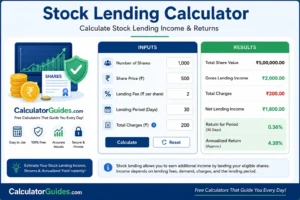
A Stock Lending Calculator helps you estimate how much you could earn by lending your shares for a specific period.
You can use it to calculate:
- Number of shares lent
- Lending price or fee
- Lending period
- Gross lending income
- Estimated charges
- Net income
- Return on the value of shares
- Annualized lending return
Stock lending is different from selling your shares. You remain the owner of the securities, subject to the rules of the applicable stock-lending system and the transaction.
Important: Actual lending income depends on the lending fee, demand for the security, available borrowers, broker/exchange charges, taxes, settlement rules, and the period for which the shares are successfully lent.
What Is Stock Lending?
Stock lending is a process in which an investor lends eligible securities to another market participant for a specified period.
The borrower generally pays a lending fee for using those securities.
The investor can therefore potentially earn an additional return from shares that they already own.
In India, stock lending is carried out through the Securities Lending and Borrowing (SLB) framework, subject to applicable exchange, clearing corporation, SEBI, and broker rules.
What Is a Stock Lending Calculator?
A Stock Lending Calculator estimates the potential income from lending shares.
For example, suppose you have:
1,000 shares
and the lending fee is:
₹5 per share
for:
30 days
A simple gross-income calculation would be:
1,000 × ₹5 = ₹5,000
The actual amount you receive can differ depending on how the lending fee is quoted and the applicable transaction charges.
This is why the calculator should clearly distinguish between:
- Lending fee per share
- Total lending fee
- Number of days
- Gross income
- Charges
- Net income
Stock Lending Formula
If the lending fee is quoted as an amount per share:
Gross Lending Income = Number of Shares × Lending Fee Per Share
Example:
Shares:
2,000
Fee:
₹3 per share
Gross income:
2,000 × ₹3 = ₹6,000
Stock Lending Return Formula
To estimate the return relative to the value of the shares:
Lending Return (%) = Lending Income ÷ Share Value × 100
Example:
Share value:
₹10,00,000
Lending income:
₹10,000
Return:
₹10,000 ÷ ₹10,00,000 × 100
= 1%
This is the return for the period being measured, not automatically an annual return.
Annualized Stock Lending Return
If you want to compare lending income across different periods, you can annualize the return.
A simple annualized approximation is:
Annualized Return = Period Return × 365 ÷ Number of Days
Example:
30-day lending return:
0.50%
Annualized approximation:
0.50% × 365 ÷ 30
≈ 6.08%
Annualized returns are estimates and assume the same lending conditions could continue, which may not happen in practice.
Stock Lending Example
Suppose you own:
1,000 shares
Current share price:
₹500
Total share value:
₹5,00,000
Suppose the shares are lent for:
30 days
and the lending fee is:
₹2 per share
Gross lending income:
1,000 × ₹2
= ₹2,000
Lending return for the period:
₹2,000 ÷ ₹5,00,000 × 100
= 0.40%
Approximate annualized return:
0.40% × 365 ÷ 30
≈ 4.87%
This is only an illustration. It does not mean you will actually earn 4.87% annually.
Stock Lending Calculator Inputs
A useful calculator can include the following inputs:
Number of Shares
Enter the number of shares you want to lend.
Share Price
Enter the current or relevant market price.
Lending Fee
Enter the applicable lending fee.
Lending Period
Enter the number of days the securities are expected to be lent.
Charges
Enter applicable brokerage, exchange, clearing, GST, or other charges if you want a net-income estimate.
Gross vs Net Stock Lending Income
It is important to understand the difference.
Gross Income
The amount calculated before applicable charges and taxes.
Net Income
The amount remaining after applicable charges and taxes.
For example:
Gross lending income:
₹10,000
Applicable charges:
₹1,000
Estimated net income:
₹9,000
The actual tax treatment depends on the investor’s circumstances and applicable tax rules.
Stock Lending Fee
The lending fee is the amount paid for borrowing the security.
The fee can vary significantly between stocks and over time.
Demand is one of the factors that can affect the lending fee.
Stocks with high borrowing demand can sometimes command higher lending fees than securities with low demand.
Therefore, there is no single fixed stock-lending rate for every share.
Why Do Investors Borrow Shares?
Market participants may borrow shares for different reasons, including:
- Short-selling strategies
- Settlement requirements
- Arbitrage
- Hedging
- Market-making activities
- Other permitted trading strategies
The exact purpose depends on the participant and applicable market rules.
Why Lend Your Shares?
Stock lending can potentially provide an additional source of income from shares you already hold.
Potential benefits include:
- Additional income
- Keeping exposure to the underlying security
- Using idle eligible shares
- Potentially improving overall portfolio returns
However, stock lending is not risk-free and should not be treated as guaranteed income.
Is Stock Lending the Same as Selling Shares?
No.
When you sell shares, you dispose of your position.
When you lend shares, the transaction is governed by the applicable securities-lending framework and is designed around lending and returning securities.
The exact rights, collateral arrangements, settlement process, corporate-action treatment, and risks depend on the applicable rules and broker/exchange setup.
Stock Lending in India
In India, stock lending is generally carried out through the Securities Lending and Borrowing (SLB) mechanism.
The framework allows eligible securities to be lent and borrowed through approved market infrastructure.
Investors should check the latest rules of:
- SEBI
- Stock exchanges
- Clearing corporations
- Their broker
before using an SLB facility.
How Stock Lending Works
A simplified process looks like this:
Step 1: Own Eligible Shares
You hold shares that are eligible for lending.
Step 2: Place a Lending Order
You submit the shares for lending through your broker or supported platform.
Step 3: Borrower Takes the Securities
If there is demand, a borrower can take the securities according to the applicable SLB process.
Step 4: Lending Fee Is Earned
You receive the applicable lending consideration according to the transaction terms.
Step 5: Securities Are Returned
At the end of the applicable lending period, the securities are returned according to the settlement rules.
The actual process can vary by broker and market infrastructure.
Stock Lending Period
The lending period depends on the applicable SLB contract and market rules.
A calculator should allow the user to enter the relevant number of days rather than assuming every lending transaction lasts the same amount of time.
A longer lending period does not automatically mean a higher annualized return because lending fees can change.
Stock Lending and Dividend
Corporate actions can affect stock-lending transactions.
Dividends, bonuses, rights issues, splits, mergers, and other corporate actions may have specific treatment under the applicable lending and settlement framework.
Do not assume that a corporate action will be handled exactly like a normal shareholding position.
Check the current rules and broker documentation.
Stock Lending and Capital Gains
Stock lending should not be confused with selling the shares.
The tax treatment of lending income and transactions can depend on the applicable tax rules and the specific transaction structure.
If you are making a large transaction or have a complex tax situation, consult a qualified tax professional.
Stock Lending Charges
Your gross lending income may not equal the amount credited to you.
Potential costs can include:
- Brokerage
- Exchange charges
- Clearing charges
- GST
- Applicable taxes
- Other broker-specific charges
The exact charges vary by broker and transaction.
Stock Lending Calculator With Charges
Suppose:
Shares:
2,000
Lending fee:
₹4/share
Gross income:
₹8,000
Charges:
₹1,200
Estimated net income:
₹6,800
The calculator can therefore show both:
Gross Lending Income: ₹8,000
Estimated Net Income: ₹6,800
Stock Lending Return on Share Value
Suppose:
Shares:
1,000
Share price:
₹800
Share value:
₹8,00,000
Lending income:
₹4,000
Return:
₹4,000 ÷ ₹8,00,000 × 100
= 0.50%
This makes it easier to compare lending income with the value of the capital tied to the shares.
Stock Lending vs Dividend Income
Dividend income and stock-lending income are different.
Dividend
Paid by a company to eligible shareholders according to the company’s dividend declaration and applicable rules.
Stock Lending Income
Earned from lending eligible securities to a borrower under the securities-lending framework.
A stock can potentially provide both forms of income, but corporate actions and lending rules can affect the treatment.
Stock Lending vs Fixed Deposit
These investments have very different risk and return characteristics.
| Feature | Stock Lending | Fixed Deposit |
|---|---|---|
| Income | Lending fee | Fixed interest |
| Return certainty | Not guaranteed | Contractual rate subject to bank terms |
| Market exposure | Underlying shares remain relevant | No equity exposure |
| Fee | Depends on demand | Interest rate set by bank |
| Liquidity | Depends on lending contract | Depends on FD terms |
| Risk | Market and lending-related risks | Bank/deposit-related risks |
Stock lending should not be treated as a substitute for a fixed deposit.
Stock Lending vs Dividend
| Feature | Stock Lending | Dividend |
|---|---|---|
| Source of income | Borrower/lending transaction | Company |
| Frequency | Depends on lending activity | Depends on company declaration |
| Amount | Depends on lending demand and fee | Depends on declared dividend |
| Guarantee | No | No |
| Requires lending transaction | Yes | No |
Stock Lending Calculator for Long-Term Investors
Long-term investors may consider lending eligible shares that they do not intend to sell immediately.
However, before lending, consider:
- Lending fee
- Contract period
- Liquidity requirements
- Corporate actions
- Broker charges
- Tax implications
- Risks
- Availability of borrowers
If the expected lending income is very small, the additional complexity may not be worthwhile.
Stock Lending Risk
Stock lending has risks.
Potential issues include:
- Borrower-related risks
- Settlement risks
- Market risks
- Liquidity considerations
- Corporate-action complications
- Regulatory changes
- Fees and charges
- Opportunity costs
The lending framework generally includes collateral and settlement mechanisms, but investors should understand the specific protections and risks applicable to their transaction.
Can Stock Lending Guarantee Income?
No.
You cannot assume that your shares will always be borrowed.
Lending demand can change.
The lending fee can also change from one security or period to another.
Therefore:
Potential lending income ≠ Guaranteed income
What Determines Stock Lending Fees?
Several factors can influence lending fees, including:
- Borrowing demand
- Available supply
- Short interest
- Market conditions
- Corporate actions
- Liquidity
- Stock-specific events
- Contract duration
A security with limited lendable supply and high borrowing demand may attract a higher fee.
Stock Lending and Short Selling
Stock lending is closely connected with short selling.
A participant who wants to short a stock may need to borrow the security under the applicable market framework.
The lender receives lending income while the borrower obtains temporary access to the securities.
This is one reason borrowing demand can influence lending fees.
How to Use the Stock Lending Calculator
Step 1: Enter Number of Shares
Enter the quantity you plan to lend.
Step 2: Enter Share Price
Enter the relevant market price.
Step 3: Enter Lending Fee
Enter the expected fee per share or the applicable fee format.
Step 4: Enter Lending Period
Enter the number of days.
Step 5: Add Charges
If available, enter your estimated brokerage and other charges.
Step 6: Calculate
The calculator can estimate:
- Share value
- Gross lending income
- Charges
- Net income
- Period return
- Annualized return
Stock Lending Calculator Formula Summary
Share Value
Share Value = Number of Shares × Share Price
Gross Lending Income
Gross Income = Number of Shares × Lending Fee Per Share
Net Income
Net Income = Gross Income − Charges
Period Return
Return (%) = Net Income ÷ Share Value × 100
Annualized Return
Annualized Return (%) = Period Return × 365 ÷ Lending Days
These formulas are simplified and should be adjusted if your broker quotes lending fees using a different convention.
Stock Lending Example for ₹10 Lakh
Suppose you hold:
2,000 shares
Share price:
₹500
Total value:
₹10,00,000
Lending fee:
₹2 per share
Gross income:
₹4,000
Period return:
₹4,000 ÷ ₹10,00,000 × 100
= 0.40%
If the lending period is 30 days, the simple annualized equivalent would be approximately:
0.40% × 365 ÷ 30
= 4.87%
Again, this does not mean the same fee can be earned continuously for a full year.
Stock Lending Calculator for 1,000 Shares
Suppose:
Shares:
1,000
Lending fee:
₹5/share
Gross lending income:
₹5,000
If charges are ₹500:
Net income:
₹4,500
The actual amount depends on the transaction’s fee structure and applicable charges.
Stock Lending Calculator for 10,000 Shares
Suppose:
Shares:
10,000
Lending fee:
₹1/share
Gross lending income:
₹10,000
If applicable charges are ₹1,500:
Estimated net income:
₹8,500
This is only an example to demonstrate the calculation.
Common Stock Lending Calculation Mistakes
Assuming the Lending Fee Is Guaranteed
The fee depends on actual demand and transaction conditions.
Ignoring Charges
Brokerage and other charges can reduce net income.
Confusing Lending Income With Dividend
They are separate sources of income.
Using Annualized Return as a Guaranteed Return
Annualization is only a comparison tool.
Ignoring the Share Value
A ₹5,000 lending income means something different on ₹1 lakh of shares than on ₹20 lakh of shares.
Ignoring Corporate Actions
Corporate actions can have specific treatment during lending transactions.
Frequently Asked Questions
What is stock lending?
Stock lending is a mechanism through which an investor lends eligible securities to another market participant for a specified period in exchange for lending income.
What is a Stock Lending Calculator?
It estimates potential income from lending shares based on share quantity, lending fee, share value, period, and charges.
How do I calculate stock lending income?
If the fee is quoted per share:
Income = Number of Shares × Lending Fee Per Share
Is stock lending profitable?
It can generate additional income, but profitability depends on the lending fee, charges, demand, taxes, risks, and the value of the shares.
Is stock lending guaranteed?
No. Shares may not always be successfully lent, and lending fees can change.
Can I lend shares that I want to keep long term?
Potentially, if the shares are eligible and you use an applicable lending facility. Check your broker’s current rules.
Is stock lending the same as selling?
No. Lending and selling are different transactions.
Can I earn dividends while lending shares?
Corporate actions such as dividends have specific treatment under the applicable securities-lending rules. Check the current rules before assuming how a particular dividend will be handled.
What happens when the lending period ends?
The securities are returned according to the applicable settlement and SLB rules.
Can I lend all stocks?
No. Only eligible securities can be lent through the applicable securities-lending framework.
Why are some stocks expensive to lend?
High borrowing demand and limited available supply can increase lending fees.
Why do people borrow stocks?
Borrowers may need securities for short selling, settlement, arbitrage, hedging, or other permitted strategies.
Is stock lending risky?
Yes. It involves risks and should not be treated as guaranteed income.
What is annualized stock lending return?
It is an estimate that converts a short-period return into an annual equivalent for comparison.
Does annualized return mean I will earn that return every year?
No. Lending fees and demand can change, so an annualized figure is not a guaranteed future return.
Are stock lending fees taxable?
Tax treatment depends on applicable tax rules and the nature of the transaction. Check current tax rules or consult a tax professional.
Can I use the calculator for Indian stocks?
Yes. The calculator can estimate lending income for Indian stocks when you have the applicable lending fee and transaction details.
Is the Stock Lending Calculator free?
Yes. The CalculatorGuides.com Stock Lending Calculator is free to use.
Stock Lending Calculator – Important Things to Check
Before lending shares, check:
- Whether the security is eligible
- Current lending demand
- Expected lending fee
- Lending period
- Broker charges
- Taxes
- Corporate-action treatment
- Settlement rules
- Collateral and risk arrangements
- Your need for liquidity
Never treat the calculator’s estimated income as guaranteed.
Conclusion
A Stock Lending Calculator helps investors estimate the potential income they could earn by lending eligible shares.
The basic calculation is straightforward:
Gross Lending Income = Number of Shares × Lending Fee Per Share
You can then subtract applicable charges to estimate net income and compare that income with the value of the shares being lent.
For example, lending 1,000 shares at ₹2 per share would produce a gross lending income of ₹2,000, before applicable charges and taxes.
However, stock lending income is not guaranteed. Lending demand, fees, contract periods, charges, corporate actions, settlement rules, and market conditions can all affect the final result.
Use the CalculatorGuides.com Stock Lending Calculator to estimate gross income, net income, period return, and annualized return before evaluating whether lending your shares makes sense for your investment strategy.