
Reverse CAGR Calculator-Use our free Reverse CAGR Calculator to find the CAGR required to grow an investment from an initial value to a target value over a specific number of years.Explore our complete collection of Stock Lending Calculator Lending, ETF Return Calculator ,Position Size Calculator, Yearly SIP Calculator,Gold Loan Calculator,conversion and everyday calculators at CalculatorGuides to find the right tool for your needs.
Determine required principal investment to hit target returns at given compounding rates. Calculator Guides - Reverse CAGR
Reverse CAGR Calculator
A Reverse CAGR Calculator helps you find the annual growth rate required to increase an investment from a starting value to a specific target value over a given period.
A normal CAGR calculator answers:
“What annual growth rate did my investment achieve?”
A Reverse CAGR Calculator answers:
“What CAGR do I need to reach my target?”
This can be useful when planning:
- Investment goals
- Retirement targets
- Stock investments
- Mutual funds
- ETFs
- Business growth
- Revenue targets
- Long-term wealth goals
You only need three main inputs:
- Initial value
- Target value
- Investment period
The calculator then estimates the required CAGR.
What Is Reverse CAGR?
CAGR stands for Compound Annual Growth Rate.
Reverse CAGR works backward from a target value to determine the annual compounded growth rate needed to reach it.
For example, suppose you invest:
₹1,00,000
and want it to become:
₹2,00,000
in:
10 years
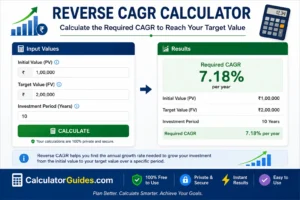
The Reverse CAGR Calculator determines the annual growth rate required to double your money over those 10 years.
The answer is approximately:
7.18% per year
This assumes a constant compounded annual growth rate and does not represent a guaranteed investment return.
Reverse CAGR Formula
The standard CAGR formula is:
genui{“finance_accounting_operations”:{“type_id”:”COMPOUND_INTEREST”,”content”:”FV=PV(1+r)^n”,”locale_override”:”en-IN”}}
For reverse CAGR, rearrange the formula:
Required CAGR = (Final Value ÷ Initial Value)^(1 ÷ Years) − 1
To express the answer as a percentage:
Required CAGR (%) = [(Final Value ÷ Initial Value)^(1 ÷ Years) − 1] × 100
Where:
- Initial Value = starting amount
- Final Value = target amount
- Years = investment period
Reverse CAGR Example
Suppose:
Initial investment:
₹1,00,000
Target value:
₹2,00,000
Period:
10 years
Calculation:
CAGR = (₹2,00,000 ÷ ₹1,00,000)^(1/10) − 1
Required CAGR:
≈ 7.18%
So the investment would need to grow at approximately 7.18% per year, compounded annually, to reach ₹2 lakh after 10 years.
Reverse CAGR Calculator for Investments
Suppose you have:
₹5,00,000
and your target is:
₹10,00,000
within:
8 years
The calculator works backward from the target and determines the annual compounded growth rate required.
This can help you compare your target with the return assumptions you are considering.
Required CAGR for Different Goals
Suppose your initial investment is:
₹1,00,000
| Target | Period | Required CAGR |
|---|---|---|
| ₹1,50,000 | 5 years | 8.45% |
| ₹2,00,000 | 5 years | 14.87% |
| ₹2,00,000 | 10 years | 7.18% |
| ₹3,00,000 | 10 years | 11.61% |
| ₹5,00,000 | 10 years | 17.46% |
| ₹10,00,000 | 20 years | 12.20% |
These are mathematical calculations based on constant annual compounding.
How to Calculate Required CAGR
The calculation involves three steps.
Step 1: Divide the Target by the Starting Value
Target Value ÷ Initial Value
Step 2: Take the Power of 1 ÷ Number of Years
This converts the total growth requirement into an annual growth rate.
Step 3: Subtract 1 and Convert to Percentage
The result is your required CAGR.
Reverse CAGR Example: ₹1 Lakh to ₹5 Lakh
Suppose:
Initial value:
₹1,00,000
Target:
₹5,00,000
Period:
10 years
Required CAGR:
≈ 17.46%
This means the investment would need to compound at about 17.46% annually to reach ₹5 lakh in 10 years.
This is an assumption, not a prediction.
Reverse CAGR Example: ₹10 Lakh to ₹25 Lakh
Suppose:
Initial value:
₹10,00,000
Target:
₹25,00,000
Period:
10 years
Required CAGR:
≈ 9.60%
The calculator can help you determine whether your target requires a relatively modest or aggressive growth assumption.
Reverse CAGR for Stock Investments
You can use Reverse CAGR to evaluate a stock investment goal.
For example:
Current investment:
₹2,00,000
Target:
₹5,00,000
Time:
10 years
The calculator tells you the annual compounded return required to reach the target.
However, stock returns are not normally constant every year.
A stock might produce:
- +20% one year
- −10% the next year
- +15% another year
CAGR summarizes the overall growth into an equivalent annual rate.
Reverse CAGR for Mutual Funds
Reverse CAGR can also be useful for long-term mutual-fund planning.
For example:
Initial investment:
₹3,00,000
Target:
₹10,00,000
Period:
12 years
The calculator determines the annual compounded rate required to reach the target.
Actual mutual-fund returns can fluctuate, so the required CAGR should be treated as a planning benchmark rather than an expected guaranteed return.
Reverse CAGR for ETFs
Suppose you invest:
₹2,00,000
and want:
₹5,00,000
after:
10 years
Reverse CAGR tells you the annualized growth rate required.
For ETF investments, actual returns can be affected by:
- Market performance
- Fund expenses
- Tracking difference
- Dividends or distributions
- Taxes
- Currency movements for international ETFs
Reverse CAGR for Retirement Planning
Reverse CAGR can help answer questions such as:
“If I have ₹20 lakh today, what annual return would I need to reach ₹1 crore in 15 years?”
Instead of choosing a return assumption first, you start with your actual goal and work backward.
This can make financial planning easier to understand.
However, retirement planning should also account for inflation and future contributions.
Reverse CAGR and Inflation
A target amount in the future may not have the same purchasing power as it has today.
Suppose your target is:
₹1 crore
20 years from now.
₹1 crore in 20 years may buy considerably less than ₹1 crore today if inflation continues.
Therefore, when setting a long-term target, consider both:
- Investment return
- Inflation
A target should ideally be based on the amount of purchasing power you expect to need, not just today’s nominal amount.
Reverse CAGR vs CAGR
These calculators work in opposite directions.
CAGR Calculator
You know:
- Initial value
- Final value
- Time
You calculate:
Historical or implied annual growth rate
Reverse CAGR Calculator
You know:
- Initial value
- Target value
- Time
You calculate:
Required annual growth rate
Mathematically, they use the same relationship.
Reverse CAGR vs Future Value Calculator
A Future Value Calculator usually starts with:
- Initial investment
- Expected return
- Time
and calculates:
Future value
A Reverse CAGR Calculator starts with:
- Initial investment
- Target value
- Time
and calculates:
Required return
So one works forward and the other works backward.
Reverse CAGR vs SIP
Reverse CAGR is most appropriate for a lump-sum starting value.
If you are adding money every month or year, a simple Reverse CAGR calculation is not sufficient because each contribution has a different investment period.
For regular investments, consider using:
- SIP Calculator
- Yearly SIP Calculator
- Step-Up SIP Calculator
These calculators account for recurring contributions.
Reverse CAGR With Additional Investments
Suppose you start with:
₹1,00,000
and also add:
₹50,000 every year
A standard Reverse CAGR formula cannot directly calculate the required return because the investment has multiple cash flows.
For multiple contributions, an internal rate of return or cash-flow-based calculation is more appropriate.
This distinction is important because treating recurring investments as a single lump sum can produce an incorrect result.
Reverse CAGR for Business Growth
Reverse CAGR is not limited to investments.
Businesses can use it to calculate the annual growth required to reach a revenue target.
Example:
Current revenue:
₹10 crore
Target revenue:
₹25 crore
Period:
5 years
The Reverse CAGR Calculator can determine the annual compounded revenue growth needed to reach the target.
The same calculation can be applied to:
- Revenue
- Sales
- Customers
- Profit
- Website traffic
- Assets
- Business valuation
Reverse CAGR for Website Traffic
You can even use Reverse CAGR for growth planning.
Suppose a website currently receives:
10,000 monthly visitors
and the target is:
50,000 monthly visitors
within:
3 years
Reverse CAGR tells you the average annual growth rate required to reach that target.
Actual traffic will rarely grow at exactly the same percentage every year, but the figure provides a useful benchmark.
Reverse CAGR for Revenue
Suppose a company has:
₹50 lakh revenue
and wants to reach:
₹1 crore
in:
5 years
The required CAGR is approximately:
14.87%
That means revenue would need to grow at about 14.87% annually on a compounded basis to reach ₹1 crore.
Why Reverse CAGR Is Useful
Reverse CAGR can help you:
- Set realistic goals
- Evaluate investment targets
- Compare return requirements
- Plan long-term growth
- Understand compounding
- Work backward from a financial target
Instead of asking only:
“What will my investment become?”
you can ask:
“What return do I need to reach my goal?”
Required CAGR and Risk
A very high required CAGR can indicate that your target may require significant investment risk.
For example:
A target requiring 5% annual growth is very different from one requiring 25% annual growth.
A higher required return generally means you may need to accept greater uncertainty.
Do not increase investment risk simply because a calculator shows a high required return.
Reverse CAGR With Negative Growth
If the final value is lower than the initial value, the calculated CAGR will be negative.
Example:
Initial value:
₹1,00,000
Final value:
₹80,000
Period:
5 years
Required CAGR:
approximately −4.36%
A negative CAGR means the investment declined over the period.
What Happens If Initial and Final Values Are Equal?
Suppose:
Initial value:
₹1,00,000
Final value:
₹1,00,000
The required CAGR is:
0%
No growth is required to maintain the same value, before considering inflation, taxes, fees, or withdrawals.
What Happens If the Target Is Lower?
If the target is below the starting value, the required CAGR is negative.
For example:
Starting value:
₹5,00,000
Target:
₹4,00,000
Period:
5 years
The required CAGR is negative because the target represents a decline from the starting value.
Reverse CAGR Calculator Formula Summary
Required CAGR = [(Final Value ÷ Initial Value)^(1 ÷ Years) − 1] × 100
Example
Initial value:
₹1,00,000
Final value:
₹2,00,000
Years:
10
Required CAGR:
≈ 7.18%
How to Use the Reverse CAGR Calculator
Step 1: Enter Initial Value
Enter the amount you currently have or the starting value.
Step 2: Enter Target Value
Enter the amount you want to reach.
Step 3: Enter Investment Period
Enter the number of years available to reach your target.
Step 4: Calculate
The calculator will show the required CAGR.
Step 5: Evaluate the Result
Compare the required CAGR with a reasonable return assumption for the type of investment or growth target you are considering.
Common Reverse CAGR Calculation Mistakes
Ignoring Inflation
A future target may have lower purchasing power than it appears.
Using CAGR for SIP Contributions
Regular investments require a cash-flow-based calculation.
Treating CAGR as a Guaranteed Return
CAGR is a mathematical growth rate, not a promise.
Ignoring Taxes and Fees
Actual investment growth can be reduced by costs.
Choosing an Unrealistic Target
A target that requires an extremely high CAGR may not be realistic for your chosen investment.
Confusing CAGR With Annual Returns
CAGR is an equivalent compounded annual rate. Actual yearly returns can be very different.
Frequently Asked Questions
What is a Reverse CAGR Calculator?
It calculates the annual compounded growth rate required to grow an initial value to a specific target over a set number of years.
What is the Reverse CAGR formula?
Required CAGR = [(Final Value ÷ Initial Value)^(1 ÷ Years) − 1] × 100
What is the difference between CAGR and Reverse CAGR?
CAGR calculates the annual growth rate from known historical values. Reverse CAGR calculates the growth rate required to reach a future target.
Can I use Reverse CAGR for stocks?
Yes. It can show the annualized return a stock investment would need to reach a target value.
Can I use Reverse CAGR for mutual funds?
Yes. It can be used as a planning benchmark for a lump-sum mutual-fund investment.
Can I use Reverse CAGR for ETFs?
Yes. It can calculate the required annual growth rate for an ETF investment.
Can I use Reverse CAGR for SIP?
Not directly when you are making regular contributions. A SIP calculator is more appropriate because each contribution has a different investment period.
Does Reverse CAGR guarantee my target?
No. It only tells you the constant annual compounded return mathematically required to reach the target.
Can Reverse CAGR be negative?
Yes. If the target value is lower than the starting value, the required CAGR will be negative.
Does Reverse CAGR account for inflation?
No. The standard formula does not automatically account for inflation.
Does Reverse CAGR include taxes?
No. Unless you specifically adjust the values for taxes, the standard calculation does not include them.
Can I use Reverse CAGR for business growth?
Yes. You can calculate the annual growth required for revenue, sales, customers, profits, or other measurable values.
Is CAGR the same as average annual return?
No. CAGR represents a compounded annual growth rate. It is different from a simple arithmetic average of yearly returns.
Is the Reverse CAGR Calculator accurate?
The mathematical calculation is accurate for the values entered. It does not predict whether the required return will actually be achieved.
Is the Reverse CAGR Calculator free?
Yes. The CalculatorGuides.com Reverse CAGR Calculator is free to use.
Reverse CAGR Calculator – Important Things to Remember
Before using the result for financial planning, consider:
- Initial investment
- Target amount
- Time period
- Inflation
- Taxes
- Fees
- Investment risk
- Additional contributions
- Market volatility
If you are making regular contributions, use a calculator designed for recurring investments rather than relying on a simple Reverse CAGR formula.
Conclusion
A Reverse CAGR Calculator is useful when you know where you are starting, where you want to finish, and how much time you have.
The key formula is:
Required CAGR = [(Final Value ÷ Initial Value)^(1 ÷ Years) − 1] × 100
For example, turning ₹1,00,000 into ₹2,00,000 over 10 years requires a compounded annual growth rate of approximately 7.18%.
The calculator is useful for investment planning, retirement goals, business growth, revenue targets, and other long-term objectives.
Remember that the required CAGR is a mathematical target, not a guaranteed return. Actual investment performance can vary from year to year, and inflation, taxes, fees, and additional contributions can change the final outcome.
Use the CalculatorGuides.com Reverse CAGR Calculator to work backward from your target and understand what annual compounded growth rate would be required to reach it.