
ETF Return Calculator-Use our free ETF Return Calculator to calculate ETF investment returns, profit, CAGR, dividends, and total return. Estimate how much your ETF investment may grow.Get quick and convenient results using our financial, mathematical, fitness, conversion, and Stock Lending Calculator Lending everyday calculators.
Calculate your future investment growth with SIP or Lumpsum contributions. Calculator Guides - ETF Return
ETF Return Calculator
An ETF Return Calculator helps you estimate how much your investment in an Exchange-Traded Fund (ETF) has grown or could grow over time.
ETFs can track different assets, including:
- Stock market indexes
- Gold
- Bonds
- Commodities
- International markets
- Specific sectors
- Other investment themes
Because ETF returns can come from both price appreciation and distributions, simply looking at the change in the ETF’s price does not always show the complete investment return.
Our ETF Return Calculator can help estimate:
- Initial investment
- Final ETF value
- Investment profit
- Total return
- Return percentage
- Annualized return
- CAGR
- Dividend or distribution income
- Future ETF value
Important: ETF returns are not guaranteed. The calculation is an estimate based on the numbers you enter. Actual returns can be affected by market prices, expenses, taxes, brokerage, tracking difference, currency movements, and distributions.
What Is an ETF?
ETF stands for Exchange-Traded Fund.
An ETF is an investment fund whose units can generally be bought and sold on a stock exchange during market hours.
An ETF may hold a basket of securities or track a particular index, commodity, or other asset.
For example, an ETF could track:
- Nifty 50
- S&P 500
- Gold
- Government bonds
- A specific sector
Instead of buying every security individually, an investor can buy units of an ETF that provides exposure to the underlying portfolio or asset according to the fund’s objective.
What Is an ETF Return Calculator?
An ETF Return Calculator estimates the return generated by an ETF investment over a specific period.
The simplest calculation is:
Profit = Final Value − Initial Investment
Then:
Return (%) = Profit ÷ Initial Investment × 100
For example:
Initial investment:
₹1,00,000
Final value:
₹1,25,000
Profit:
₹25,000
Return:
₹25,000 ÷ ₹1,00,000 × 100 = 25%
ETF Return Formula
The basic ETF return formula is:
ETF Return = (Final Value − Initial Value) ÷ Initial Value × 100
Example:
Initial value:
₹2,00,000
Final value:
₹2,40,000
Profit:
₹40,000
Return:
20%
This calculation does not include additional investments or distributions unless you specifically include them.
ETF Profit Calculator
To calculate your ETF profit:
Profit = Current ETF Value − Total Investment
Example:
You invest:
₹1,50,000
Your ETF investment is now worth:
₹1,80,000
Profit:
₹1,80,000 − ₹1,50,000 = ₹30,000
Return:
₹30,000 ÷ ₹1,50,000 × 100 = 20%
ETF Return Percentage
Return percentage tells you how much your investment has increased or decreased relative to the original investment.
Formula:
Return % = (Final Value − Initial Value) ÷ Initial Value × 100
If you invested ₹1 lakh and the investment became ₹90,000:
Profit:
−₹10,000
Return:
−10%
A negative return means the investment has lost value over the period.
ETF CAGR Calculator
If you hold an ETF for several years, the total return does not tell you how fast the investment grew each year.
For that, you can use CAGR.
CAGR means:
Compound Annual Growth Rate
Formula:
CAGR = (Final Value ÷ Initial Value)^(1 ÷ Years) − 1
Multiply by 100 to express it as a percentage.
ETF CAGR Example
Suppose:
Initial investment:
₹1,00,000
Final value:
₹1,50,000
Holding period:
5 years
CAGR:
(1,50,000 ÷ 1,00,000)^(1/5) − 1
≈ 8.45% per year
This means the investment’s equivalent annual compounded growth rate was approximately 8.45%.
ETF Return With Dividends
Some ETFs distribute income to investors.
If you receive distributions, your total return can be higher than the increase in the ETF’s market price.
A simplified total-return calculation is:
Total Profit = Final Value − Initial Investment + Distributions Received
Example:
Initial investment:
₹1,00,000
Final value:
₹1,20,000
Distributions received:
₹5,000
Total profit:
₹20,000 + ₹5,000
= ₹25,000
Total return:
25%
This is a simplified calculation and does not account for reinvestment timing, taxes, or transaction costs.
ETF Total Return
There are two important concepts:
Price Return
Measures only the change in the ETF’s market price.
Total Return
Includes price changes plus distributions, assuming the calculation methodology appropriately accounts for them.
For investors, total return can provide a more complete picture of investment performance.
ETF Return With Reinvested Dividends
If distributions are reinvested, those additional units can generate further returns.
For example:
You receive:
₹2,000
as a distribution.
Instead of withdrawing it, you use it to buy additional ETF units.
Those additional units can then participate in future price changes and distributions.
This creates a compounding effect.
A simple ETF calculator may not model every distribution and reinvestment automatically, so a detailed total-return calculation should account for the dates and prices of each distribution.
ETF Investment Calculator
Suppose you invest:
₹5,00,000
and the ETF grows by:
10%
Estimated value:
₹5,50,000
Estimated profit:
₹50,000
If the investment grows by another 10% the following year, the value would become:
₹6,05,000
The second year’s growth is calculated on the larger amount, which demonstrates compounding.
ETF Future Value Calculator
If you assume an annual return, a simplified future-value formula is:
Future Value = Initial Investment × (1 + Annual Return)^Years
Example:
Initial investment:
₹1,00,000
Expected annual return:
10%
Period:
10 years
Future value:
₹1,00,000 × (1.10)^10
≈ ₹2,59,374
This is a mathematical projection, not a prediction of actual ETF performance.
ETF Monthly Investment Return
If you invest a fixed amount every month, the calculation becomes different from a one-time investment.
For example:
Monthly investment:
₹10,000
Investment period:
10 years
Total contributions:
₹12,00,000
If the investment grows over time, the final value depends on:
- Monthly contribution
- Investment date
- ETF price
- Return assumption
- Distribution
- Fees
For regular investing, an ETF SIP-style calculator can provide a more appropriate estimate.
ETF SIP Calculator
A regular investment calculator can estimate the future value of periodic ETF investments.
A simplified future-value formula for monthly investing is:
FV = P × [((1 + r)^n − 1) ÷ r]
Where:
- P = monthly investment
- r = monthly expected return
- n = number of months
- FV = future value
Actual market returns will vary, so this formula is useful for planning rather than predicting.
ETF Return After Fees
ETFs generally have operating expenses.
The expense ratio represents the fund’s ongoing operating expenses as a percentage of assets, although the exact effect on investor returns can depend on the fund structure and other factors.
For example:
Gross return:
10%
Annual fund expenses:
0.20%
A simplified net-return assumption could be approximately:
9.80%
But actual ETF performance is not calculated simply by subtracting the expense ratio from the market return. Tracking difference, trading costs, cash holdings, taxes, and other factors can also affect results.
ETF Tracking Difference
An ETF that tracks an index may not exactly match the index’s return.
The difference can result from:
- Fund expenses
- Trading costs
- Cash holdings
- Rebalancing
- Taxes
- Corporate actions
- Index methodology
- Portfolio management
Therefore, when comparing an ETF with its benchmark, look at the ETF’s actual historical performance rather than assuming it will exactly match the index.
ETF Return After Tax
Your final investment return can be different after taxes.
Tax treatment depends on:
- ETF type
- Country
- Holding period
- Investor status
- Applicable tax rules
- Capital gains
- Distributions
For Indian investors, the tax treatment can differ between equity-oriented ETFs and other types of ETFs.
Always check the current tax rules applicable to your ETF before making an investment decision.
ETF Capital Gain
A capital gain occurs when you sell an ETF for more than your cost basis, subject to the applicable tax rules.
Example:
Purchase value:
₹1,00,000
Sale value:
₹1,30,000
Capital gain:
₹30,000
The taxable amount and tax rate depend on the applicable rules.
ETF Return vs Index Return
An ETF may track an index, but the ETF’s return can differ from the index return.
For example:
Index return:
12%
ETF return:
11.6%
The difference may be related to:
- Expenses
- Tracking difference
- Transaction costs
- Cash holdings
Therefore, compare an ETF’s actual performance with its benchmark over the same period.
Gold ETF Return Calculator
Gold ETFs provide exposure to gold-related prices through an exchange-traded fund structure.
For a simple return calculation:
Return = (Current Value − Investment Value) ÷ Investment Value × 100
Example:
Investment:
₹2,00,000
Current value:
₹2,40,000
Profit:
₹40,000
Return:
20%
Gold prices, fund expenses, tracking difference, and market conditions can affect the actual ETF return.
Index ETF Return Calculator
For an index ETF:
Initial investment:
₹1,00,000
Final ETF value:
₹1,30,000
Profit:
₹30,000
Return:
30%
This calculation is based on the ETF investment itself and should not automatically be treated as the index’s exact return.
International ETF Returns
International ETFs can have another important factor:
Currency movement
For example, an Indian investor buying a US ETF is exposed not only to changes in the ETF’s underlying investments but potentially also to changes in the INR/USD exchange rate.
A currency movement can increase or reduce the return measured in Indian rupees.
ETF Return and Currency Conversion
Suppose a US ETF increases by:
10% in USD terms
If the US dollar also strengthens against the Indian rupee, the return measured in INR can be different.
Likewise, if the rupee strengthens against the dollar, the INR return may be lower.
Therefore, international ETF returns should be evaluated in the investor’s reporting currency.
ETF Return Comparison
You can compare ETFs using:
- Total return
- CAGR
- Expense ratio
- Tracking difference
- Volatility
- Dividend/distribution history
- Fund size
- Liquidity
- Bid-ask spread
Do not choose an ETF based only on its past return.
ETF Return vs Mutual Fund Return
ETFs and mutual funds can provide similar exposure but operate differently.
| Feature | ETF | Mutual Fund |
|---|---|---|
| Trading | Exchange during market hours | Usually bought/redeemed through fund mechanism |
| Price | Market price | NAV-based |
| Intraday trading | Yes | Generally no |
| Expense ratio | Varies | Varies |
| Brokerage | May apply | Depends on platform/product |
| Bid-ask spread | Relevant | Not generally applicable in the same way |
The best choice depends on your investment strategy and the specific fund.
ETF Return and Volatility
A high historical return does not necessarily mean a better investment.
Volatility measures how much an investment’s price moves over time.
Two ETFs could have:
- Similar returns
- Very different volatility
Investors should consider both return and risk.
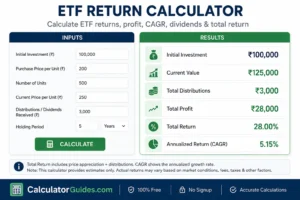
ETF Return Calculator Example
Suppose you buy:
500 ETF units
at:
₹200 per unit
Initial investment:
500 × ₹200
= ₹1,00,000
Later, the ETF price becomes:
₹250
Final value:
500 × ₹250
= ₹1,25,000
Profit:
₹25,000
Return:
25%
If you also received ₹3,000 in distributions:
Total profit:
₹28,000
Total return:
28%
This is a simplified example.
ETF Loss Calculator
The same calculator can show losses.
Suppose:
Initial investment:
₹1,00,000
Current value:
₹85,000
Loss:
₹15,000
Return:
−15%
A negative percentage indicates that the investment has fallen below the initial value.
How Much Does an ETF Need to Recover?
Losses and gains are not symmetrical.
If an ETF falls:
20%
from ₹100:
₹80
To return from ₹80 to ₹100, it needs a:
25% gain
This is because the second percentage is calculated from the reduced value.
This is an important concept when evaluating investment losses.
ETF Return Calculator Formula Summary
Profit
Profit = Final Value − Initial Investment
Return
Return (%) = Profit ÷ Initial Investment × 100
CAGR
CAGR = (Final Value ÷ Initial Value)^(1 ÷ Years) − 1
Future Value
Future Value = Initial Investment × (1 + Return)^Years
Total Return With Distributions
Total Profit = Final Value − Initial Investment + Distributions
These are simplified formulas. A complete portfolio return calculation may need transaction dates, cash flows, taxes, fees, and reinvested distributions.
How to Use the ETF Return Calculator
Step 1: Enter Initial Investment
Enter the amount invested.
Step 2: Enter Purchase Price
Enter the ETF price when you bought it.
Step 3: Enter Number of Units
Enter how many ETF units you purchased.
Step 4: Enter Current or Selling Price
Enter the current ETF price or expected selling price.
Step 5: Add Distributions
If applicable, enter dividends or distributions received.
Step 6: Enter Investment Period
Enter the number of years if you want to calculate CAGR.
Step 7: Calculate
The calculator can show:
- Initial investment
- Current value
- Profit/loss
- Return %
- CAGR
- Total return
Common ETF Return Calculation Mistakes
Looking Only at Price
Distributions can also contribute to total return.
Ignoring Fees
Brokerage, fund expenses, taxes, and other costs can reduce actual returns.
Confusing Index Return With ETF Return
An ETF may not perfectly match its benchmark.
Ignoring Currency
International ETF returns can be affected by exchange-rate movements.
Treating CAGR as a Guaranteed Return
CAGR describes historical or assumed growth. It does not guarantee future performance.
Ignoring Taxes
Your after-tax return can be lower than your pre-tax return.
Frequently Asked Questions
What is an ETF Return Calculator?
An ETF Return Calculator estimates the profit, return percentage, CAGR, and potential future value of an ETF investment.
How do I calculate ETF returns?
Use:
Return = (Final Value − Initial Investment) ÷ Initial Investment × 100
How do I calculate ETF profit?
Profit = Final Value − Initial Investment
What is ETF CAGR?
CAGR is the annualized compounded growth rate of an investment over a specified period.
Does ETF return include dividends?
A simple price-return calculation does not. A total-return calculation can include distributions.
Are ETF dividends included in total return?
They can be included when calculating total return, especially when distributions are reinvested or otherwise accounted for.
Is ETF return the same as index return?
No. An ETF can differ from its benchmark because of expenses, tracking difference, trading costs, taxes, and other factors.
Can I calculate ETF returns for monthly investments?
Yes, but periodic investments require a cash-flow-based calculation rather than a simple one-time investment formula.
Can I calculate gold ETF returns?
Yes. Enter the initial investment and current or selling value of the gold ETF.
Can I calculate international ETF returns?
Yes. However, consider currency movements when measuring the return in your home currency.
Does expense ratio reduce ETF returns?
ETF expenses can reduce the fund’s net performance relative to its underlying benchmark.
Is a higher ETF return always better?
No. Risk, volatility, fees, liquidity, diversification, and investment objectives also matter.
Can an ETF lose money?
Yes. ETF prices can fall, and investors can lose part or all of their invested capital depending on the investment.
What is the difference between ETF price return and total return?
Price return measures the change in the ETF’s price. Total return also accounts for distributions according to the calculation methodology.
Is ETF investment risk-free?
No. ETFs are investments and their value can rise or fall.
Is the ETF Return Calculator accurate?
The mathematical calculation is accurate for the information entered. It cannot predict future ETF performance.
Is the ETF Return Calculator free?
Yes. The CalculatorGuides.com ETF Return Calculator is free to use.
ETF Return Calculator – What to Check
Before evaluating an ETF’s return, consider:
- Purchase price
- Current price
- Number of units
- Holding period
- Distributions
- Expense ratio
- Tracking difference
- Brokerage
- Taxes
- Currency movement
- Inflation
Looking at total return and CAGR together can provide a more useful picture than looking at price appreciation alone.
Conclusion
An ETF Return Calculator makes it easy to estimate how much an ETF investment has gained or lost.
The basic formula is:
Return (%) = (Final Value − Initial Investment) ÷ Initial Investment × 100
For longer holding periods, CAGR can help express the investment’s growth as an annual compounded rate.
However, ETF performance is not determined by price movement alone. Distributions, fund expenses, tracking difference, taxes, brokerage costs, and currency movements can affect your actual return.
For regular monthly investments, a simple one-time return formula is not enough because each contribution is invested at a different price and date.
Use the CalculatorGuides.com ETF Return Calculator to estimate your ETF profit, return percentage, CAGR, and total return, then compare those results with your investment goals and risk level