
Day Counter-A Day Counter is a simple tool that tells you how many days are between two dates. You can use it to count the days between a past date and today, find the number of days until a future date, or calculate the length of a period.Find the right calculator tool for your needs, from Concrete Calculator, Day of the Week Calculator, financial and investment calculations to math and unit conversions.
📅 Day Counter & Holiday Finder
CalculatorGuidesPreset Holiday Lists (0/365 Loaded)
| # | Holiday Name | Month | Day | Action |
|---|
For example, you may want to know:
- How many days are between two dates?
- How many days are left until a birthday?
- How many days until a holiday?
- How many days have passed since an important event?
- How many days are between two calendar dates?
- How many working days are in a period?
- How many weeks and months are between two dates?
Instead of counting dates manually on a calendar, the Day Counter does the calculation for you.
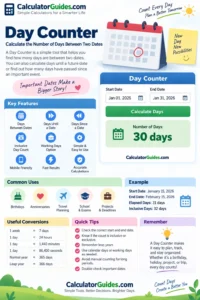
What Is a Day Counter?
A Day Counter calculates the number of days between two dates.
You enter a start date and an end date, and the calculator shows the number of days in the selected period.
For example:
Start Date: January 1, 2026
End Date: January 31, 2026
The number of elapsed days between these dates is:
30 days
If you want to count both January 1 and January 31, the inclusive count is 31 days.
This difference is important because some date calculations count only the time between dates, while others include both the starting and ending dates.
How Does a Day Counter Work?
A basic day counter finds the difference between two calendar dates.
The calculation takes into account:
- Different numbers of days in each month
- Leap years
- February having 28 or 29 days
- Different lengths of calendar years
- The selected start and end dates
This makes a date calculator more reliable than manually counting days across several months or years.
How to Calculate Days Between Two Dates
The basic idea is:
Number of Days = End Date − Start Date
For example:
March 1 to March 10
There are:
9 elapsed days
If both March 1 and March 10 are included in the count, there are:
10 calendar days
Always check whether you need an exclusive or inclusive day count.
What Is an Inclusive Day Count?
An inclusive day count includes both the start date and the end date.
For example:
June 1 through June 5
Counting every date:
- June 1
- June 2
- June 3
- June 4
- June 5
The inclusive total is:
5 days
The elapsed difference between June 1 and June 5 is:
4 days
This is useful for things such as leave periods, event schedules, booking periods, and project timelines.
Days Between Dates Calculator Example
Suppose you want to calculate the days between:
January 15, 2026
and:
February 15, 2026
The elapsed difference is:
31 days
If you are counting both dates as calendar days, the inclusive count is:
32 days
The correct answer depends on how the period is being defined.
Day Counter From a Date to Today
A Day Counter can also tell you how many days have passed since a particular date.
For example, you could enter:
Start Date: January 1, 2026
and use today’s date as the end date.
The calculator can then show how many days have passed.
This can be useful for:
- Tracking projects
- Counting time since an event
- Tracking anniversaries
- Monitoring habits
- Personal milestones
- Historical date calculations
Days Until a Future Date
You can also use a Day Counter as a countdown.
For example:
How many days until December 31?
Enter today’s date as the start date and December 31 as the end date.
The calculator returns the remaining number of days.
This can help you count down to:
- Birthdays
- Holidays
- Vacations
- Weddings
- Exams
- Events
- Travel dates
- Project deadlines
- Important appointments
Day Counter for Birthdays
A Day Counter can be useful for birthday planning.
You can enter today’s date and the next birthday date to find out how many days remain.
You can also calculate the number of days between a birth date and another date.
For age calculations, however, a dedicated Age Calculator is usually more appropriate because it can show the result in years, months, and days.
Day Counter for Anniversaries
You can calculate the number of days between an anniversary date and today.
For example, couples may use a day counter to find:
- Days together
- Days since a wedding
- Days until an anniversary
- Number of days between important relationship dates
The same basic date-difference calculation applies.
Day Counter for Work and Projects
A Day Counter can help with project planning.
Suppose a project starts on:
April 1
and ends on:
April 30
You can calculate the total calendar-day period and use the result to plan deadlines.
It can also help answer questions such as:
- How many days is the project?
- How many days remain?
- How many days have passed?
- How long is the gap between two milestones?
For business planning, remember that calendar days and working days are not always the same.
Calendar Days vs Working Days
A calendar day includes every day:
- Monday
- Tuesday
- Wednesday
- Thursday
- Friday
- Saturday
- Sunday
A working day calculator usually excludes weekends and may also exclude holidays.
For example, a period of 10 calendar days may contain fewer than 10 working days.
If you need to calculate business days, use a calculator specifically designed for working days.
Day Counter for School and Exams
Students can use a Day Counter to calculate:
- Days until an exam
- Days until school starts
- Days until vacation
- Days between assignments
- Length of a semester
- Days remaining before a deadline
A simple countdown can make it easier to plan study time.
Day Counter for Travel
When planning a trip, you may want to know the exact length of your stay.
For example:
Arrival: July 5
Departure: July 12
The elapsed difference is:
7 days
But if you are counting the dates you are physically present, July 5 through July 12 covers:
8 calendar dates
This is why hotel stays and travel bookings may use different counting rules than a simple date difference.
Day Counter for Pregnancy and Due Dates
Date calculations are sometimes used to estimate dates related to pregnancy.
However, pregnancy dates involve medical assumptions and should not be treated as exact predictions. A medical professional’s guidance should be used for pregnancy-related questions.
A general date calculator can still perform the underlying calendar calculation, but it should not replace medical advice.
Day Counter for Age
A Day Counter can calculate the total number of days between a birth date and another date.
For example, if you know:
Date of birth
and:
Today’s date
the calculator can determine the total elapsed days.
For a person’s normal age, a dedicated age calculator is easier because it can show:
Years + Months + Days
rather than only a total number of days.
Day Counter for Contracts and Deadlines
Date calculations are often useful for:
- Contract periods
- Payment deadlines
- Notice periods
- Subscription dates
- Warranty periods
- Renewal dates
- Project deadlines
When a legal or financial deadline is involved, always check the specific rules that apply. Some deadlines count calendar days, while others count business days or use special rules.
Day Counter and Leap Years
Leap years are important when calculating dates across February.
A normal year has:
365 days
A leap year has:
366 days
A leap year generally occurs when the year is divisible by 4, except century years that are not divisible by 400.
For example:
2024 was a leap year.
2028 will be a leap year.
But:
2100 will not be a leap year.
2000 was a leap year.
A good Day Counter automatically handles these calendar rules.
Why February Can Change the Result
February normally has:
28 days
During a leap year, it has:
29 days
This matters when counting days across February.
For example, a calculation covering February in a leap year can differ by one day from the same calculation in a normal year.
Days in Each Month
Here is a quick reference:
| Month | Days |
|---|---|
| January | 31 |
| February | 28 or 29 |
| March | 31 |
| April | 30 |
| May | 31 |
| June | 30 |
| July | 31 |
| August | 31 |
| September | 30 |
| October | 31 |
| November | 30 |
| December | 31 |
A date calculator uses these differences automatically.
How Many Days Are in a Year?
A normal calendar year has:
365 days
A leap year has:
366 days
This is why calculating a period of exactly one calendar year can sometimes involve 365 days and sometimes 366 days.
How Many Weeks Are in a Year?
A normal year has:
365 days
Since:
365 ÷ 7 ≈ 52.14
a year contains 52 complete weeks plus one extra day.
A leap year contains:
366 ÷ 7 ≈ 52.29
weeks.
So a calendar year is not exactly 52 weeks.
Converting Days Into Weeks
To convert days into weeks:
Weeks = Days ÷ 7
For example:
28 days ÷ 7 = 4 weeks
For:
45 days
you get:
6 weeks and 3 days
Converting Days Into Hours
One day contains:
24 hours
Therefore:
Days × 24 = Hours
For example:
5 days × 24 = 120 hours
Converting Days Into Minutes
One day contains:
1,440 minutes
because:
24 × 60 = 1,440
Therefore:
3 days = 4,320 minutes
Converting Days Into Seconds
One day contains:
86,400 seconds
because:
24 × 60 × 60 = 86,400
Therefore:
2 days = 172,800 seconds
Days Between Dates in Months and Years
A date difference can also be described in:
- Days
- Weeks
- Months
- Years
However, months do not all have the same number of days.
For example:
- January has 31 days
- April has 30 days
- February has 28 or 29 days
Because of this, saying that a period is a certain number of months is not always the same as dividing the total number of days by a fixed number.
For precise calendar calculations, the actual dates should be used.
Day Counter Tips
1. Check the Start Date
Make sure the starting date is correct before calculating.
2. Check the End Date
A one-day mistake in either date changes the result.
3. Know Whether the Count Is Inclusive
Ask whether both dates should be included.
4. Remember Leap Years
Periods involving February can be affected by leap years.
5. Use Calendar Days or Working Days Correctly
A standard Day Counter counts calendar time unless otherwise specified.
6. Avoid Manual Counting for Long Periods
For dates spanning months or years, use a calculator to reduce mistakes.
7. Check the Time Zone When Time Is Also Involved
A date-only calculation is different from calculating the exact number of hours between two timestamps.
Day Counter Features
A useful Day Counter can include several features to make date calculations easier.
Days Between Dates
Find the number of days between two dates.
Days Until a Date
Calculate how many days remain until a future date.
Days Since a Date
Find how many days have passed since a selected date.
Inclusive Day Count
Count both the starting and ending dates.
Week Conversion
Show the result in weeks and days.
Month and Year Information
Provide an easy-to-understand breakdown of longer periods.
Leap Year Support
Automatically account for February 29 when required.
Multiple Date Formats
Support common date formats so users can enter dates easily.
Mobile-Friendly Design
A simple calculator should work well on phones, tablets, and computers.
Why Use a Day Counter Instead of Counting Manually?
Manual counting can become confusing when dates cross:
- Different months
- February
- Leap years
- Multiple years
A calculator can process the dates consistently and provide the result immediately.
It is especially helpful when the period is several months or years long.
Day Counter Example: One Month
Start date:
May 1
End date:
June 1
Elapsed difference:
31 days
This represents one calendar month, but not every calendar month has 31 days.
That is why date-based calculations are better than assuming every month has the same length.
Day Counter Example: One Year
Start date:
January 1, 2026
End date:
January 1, 2027
The elapsed period is:
365 days
If the period crosses a leap day, the number may be:
366 days
depending on the dates involved.
Day Counter Example Across a Leap Day
Suppose a date range includes:
February 29, 2024
That extra calendar day must be included in the calculation.
A manual calculation that assumes every year has 365 days could therefore be incorrect.
A reliable Day Counter automatically handles the leap year.
Day Counter vs Date Calculator
The terms are sometimes used interchangeably.
A Day Counter mainly focuses on counting the number of days between dates.
A broader Date Calculator may also calculate:
- A future date after a number of days
- A past date before a number of days
- Working days
- Age
- Business days
- Date differences
Both tools are useful, but their features can be different.
Day Counter vs Countdown
A Day Counter can calculate the difference between any two dates.
A countdown normally focuses on how much time remains until a specific future event.
For example:
Days until New Year
is a countdown.
Days between January 1 and June 1
is a date difference.
How to Use the Day Counter
Using the calculator is simple.
Step 1: Select the Start Date
Choose the date when the period begins.
Step 2: Select the End Date
Choose the date when the period ends.
Step 3: Choose the Counting Method
If available, select whether you want:
- Elapsed days
- Inclusive days
- Calendar days
- Working days
Step 4: Calculate
The calculator displays the result.
Step 5: Review the Answer
For longer periods, check the dates and whether the result is inclusive or exclusive.
Common Day Counter Mistakes
Counting Both Dates Automatically
The difference between two dates usually excludes the starting date from the elapsed-day count.
If both dates should be counted, use an inclusive count.
Forgetting February 29
Leap years can add an extra day.
Assuming Every Month Has 30 Days
Months have 28, 29, 30, or 31 days.
Confusing Calendar Days With Business Days
Weekends and holidays may matter for working-day calculations.
Treating a Month as a Fixed Number of Days
A calendar month can contain different numbers of days.
Ignoring the Year
The same month and day can produce different results depending on the year.
Frequently Asked Questions
What is a Day Counter?
A Day Counter calculates the number of days between two dates.
How do I calculate days between two dates?
Enter the starting date and ending date and calculate the difference between them.
How many days are between January 1 and January 31?
The elapsed difference is 30 days. An inclusive count from January 1 through January 31 is 31 days.
Does a Day Counter include the start date?
Usually, a standard date difference measures elapsed days and does not count the start date as an additional day. An inclusive option can count both dates.
How many days are in a normal year?
365 days.
How many days are in a leap year?
366 days.
How many days are in February?
February has 28 days in a normal year and 29 days in a leap year.
Can I calculate days until a future date?
Yes. Enter today’s date as the start date and the future date as the end date.
Can I calculate days since a past date?
Yes. Enter the past date and today’s date to calculate the elapsed number of days.
Can I count working days?
A basic Day Counter counts calendar days. For weekdays only, use a working-day or business-day calculator if available.
Can I calculate weeks from days?
Yes. Divide the number of days by 7.
How many hours are in one day?
There are 24 hours in one day.
How many minutes are in one day?
There are 1,440 minutes in one day.
How many seconds are in one day?
There are 86,400 seconds in one day.
Can a Day Counter calculate years and months?
It can calculate the total number of days between dates. A dedicated date or age calculator may be better when you need a calendar breakdown in years, months, and days.
Does a Day Counter account for leap years?
A properly designed date calculator should account for leap years automatically.
Can I use a Day Counter for deadlines?
Yes, but check whether the deadline is based on calendar days, business days, or another specific rule.
Is a Day Counter useful for travel?
Yes. It can help calculate the length of a trip and the number of days between arrival and departure dates.
Is the Day Counter free?
Yes. The CalculatorGuides.com Day Counter is free to use.
Day Counter Quick Reference
| Conversion | Result |
|---|---|
| 1 week | 7 days |
| 1 day | 24 hours |
| 1 day | 1,440 minutes |
| 1 day | 86,400 seconds |
| Normal year | 365 days |
| Leap year | 366 days |
Conclusion
A Day Counter is a simple way to find the number of days between two dates. It can help with everyday questions such as how many days are left until an event, how many days have passed since a date, or how long a project or trip lasts.
The basic calculation is:
Days Between Dates = End Date − Start Date
For accurate results, remember the difference between elapsed days and inclusive days, and make sure leap years and February 29 are handled correctly.
A Day Counter is useful for birthdays, anniversaries, travel, school deadlines, projects, events, contracts, countdowns, and general date calculations.
Use the CalculatorGuides.com Day Counter to quickly calculate the number of days between two dates without counting them manually.