
Day of the Week Calculator-Our Day of the Week Calculator makes it easy to find the weekday for any date. Enter a date, and the calculator tells you whether it falls on Monday, Tuesday, Wednesday, Thursday, Friday, Saturday, or Sunday.Find quick and easy calculators for conversions,Tile Calculator,Square Footage Calculator, numbers, and everyday needs.
📅 Day of the Week Calculator
CalculatorGuides
You can use it for birthdays, anniversaries, historical events, future plans, school dates, work schedules, and many other everyday questions.
For example:
January 1, 2000 → Saturday
July 4, 2020 → Saturday
January 1, 2025 → Wednesday
You don’t need to work out the calendar manually. Just enter the date and let the calculator do it.
What Is a Day of the Week Calculator?
A Day of the Week Calculator determines which weekday corresponds to a specific calendar date.
For example, you may want to know:
- What day was I born?
- What day was a certain date?
- What day will a future date fall on?
- What day was Christmas in a particular year?
- Was a date a weekday or weekend?
- What day of the week was a historical event?
- What day will my anniversary fall on this year?
The calculator can answer these questions quickly.
How Does the Day of the Week Calculator Work?
The calculator uses the calendar date you enter and determines its corresponding weekday.
The seven days of the week are:
- Monday
- Tuesday
- Wednesday
- Thursday
- Friday
- Saturday
- Sunday
The calculation takes the day, month, and year into account.
Leap years are also important because they change the number of days in February and can affect the weekday of dates later in the year.
What Day Was I Born?
One of the most common reasons people use a day-of-the-week calculator is to find their birth day.
Simply enter your:
- Birth day
- Birth month
- Birth year
For example:
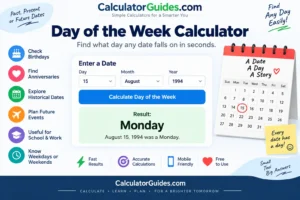
Date of birth: August 15, 1994
The calculator will return the corresponding day of the week.
This can be useful if you know your date of birth but have never checked which weekday you were born on.
Find the Day for Any Date
You can use the calculator for almost any valid calendar date.
For example:
December 25, 2024
The calculator can tell you the exact weekday without requiring you to search through an old calendar.
This is useful for both recent and historical dates.
Find the Day for a Future Date
The calculator can also be used for future dates.
For example, you might want to know:
- What day will my birthday be next year?
- What day will January 1 fall on?
- What weekday is a future appointment?
- What day will a particular holiday fall on?
- What day of the week will a planned event occur?
Enter the future date and the calculator gives you the corresponding weekday.
Weekday vs Weekend
The seven days can generally be divided into:
Weekdays
- Monday
- Tuesday
- Wednesday
- Thursday
- Friday
Weekend
- Saturday
- Sunday
Once the calculator identifies the day, it is easy to determine whether the date falls on a weekday or weekend.
Why Is Knowing the Day of the Week Useful?
Knowing the weekday for a date can be helpful in many situations.
Birthdays
Find the weekday on which you were born or check what day your birthday will fall on in a particular year.
Anniversaries
Check the weekday of an anniversary or another important date.
Historical Research
Find the weekday associated with a historical event.
Planning
Check future dates before making travel, work, school, or event plans.
School and Work
Determine whether a date falls on a weekday or weekend.
Personal Records
Check old dates in documents, photographs, certificates, or diaries.
Day of the Week for Historical Dates
The calculator can also be useful when researching historical dates.
For example, you might want to know which day of the week an important event happened.
Simply enter the date.
For very old historical dates, the calendar system being used matters. Modern calculations commonly use the Gregorian calendar, while historical records may have used the Julian calendar or another local calendar.
Gregorian Calendar
The Gregorian calendar is the calendar system widely used today.
It was introduced in 1582 as a reform of the Julian calendar.
Today, it is the standard civil calendar used in most countries.
When using dates from before the Gregorian calendar was adopted in a particular country, historical calendar conventions should be considered.
Julian Calendar and Historical Dates
The Julian calendar was introduced before the Gregorian calendar.
Because the two calendars use different leap-year rules, the same historical date can correspond to different weekdays depending on which calendar system is being used.
For ordinary modern dates, this usually isn’t an issue.
For historical research, however, it is important to know which calendar the original source used.
What Is a Leap Year?
A leap year contains 366 days instead of the usual 365.
The extra day is added to February:
February 29
Under the Gregorian calendar, a year is generally a leap year if:
- It is divisible by 4,
- except years divisible by 100 are not leap years,
- unless they are also divisible by 400.
For example:
2024 → Leap year
2028 → Leap year
1900 → Not a leap year
2000 → Leap year
Leap years are important when calculating weekdays because the additional day changes the calendar sequence.
Why Does the Day Change Every Year?
A normal year has:
365 days
A week has:
7 days
Since 365 is not evenly divisible by 7, the same date usually moves forward by one weekday from one year to the next.
For example, if January 1 falls on a Monday one year, January 1 will normally fall on Tuesday the following year.
A leap year adds an extra day, which can cause a two-day shift for dates after February 29.
How Many Days Are in a Week?
There are:
7 days
in a week:
- Monday
- Tuesday
- Wednesday
- Thursday
- Friday
- Saturday
- Sunday
The seven-day cycle repeats continuously.
How Many Days Are in a Year?
A standard Gregorian calendar year has:
365 days
A leap year has:
366 days
This difference is important when calculating dates and weekdays across years.
How Many Days Are in a Month?
The number of days depends on the month.
| Month | Days in a Normal Year |
|---|---|
| January | 31 |
| February | 28 |
| March | 31 |
| April | 30 |
| May | 31 |
| June | 30 |
| July | 31 |
| August | 31 |
| September | 30 |
| October | 31 |
| November | 30 |
| December | 31 |
In a leap year, February has:
29 days
Day of the Week Calculator for Birthdays
Your birthday date stays the same each year, but the weekday changes.
For example, your birthday might be on:
Monday
one year and:
Tuesday
the next year.
This happens because a calendar year is not an exact multiple of seven days.
A Day of the Week Calculator makes it easy to check the weekday of your birthday in any year.
Day of the Week Calculator for Anniversaries
You can use the same method for:
- Wedding anniversaries
- Business anniversaries
- Work anniversaries
- Important milestones
- Special occasions
Enter the date and year to see the corresponding weekday.
Day of the Week Calculator for Holidays
Many holidays occur on fixed calendar dates, while others are based on rules involving weekdays, weeks, or other calendar calculations.
A day-of-week calculator can help you check the weekday for a specific holiday date.
For example:
December 25, 2026
can be entered to determine its weekday.
Day of the Week Calculator for Work
If you are planning a project, meeting, deadline, or event, knowing the weekday can make scheduling easier.
For example:
March 15, 2027
may be entered to check whether it falls on a Monday, Tuesday, or another day.
This is especially useful when working with dates several months or years ahead.
Day of the Week Calculator for School
Students can use the calculator to check:
- Exam dates
- Assignment deadlines
- School events
- Holidays
- Historical dates
- Birthdays
It can also be a useful way to learn how calendars work.
Day of the Week Calculator for Historical Research
Researchers may use a weekday calculator when working with:
- Birth records
- Newspaper archives
- Historical documents
- Old diaries
- Family history
- Genealogy
- Important events
For older dates, remember that the calendar system used at the time may affect the result.
Day of the Week Calculator and Genealogy
When researching family history, you may have a date from an old document but not know the weekday.
A calculator can help determine the weekday associated with the date.
For older records, always check whether the document uses the Gregorian calendar, Julian calendar, or another calendar system.
How to Calculate the Day of the Week Manually
There are several mathematical methods for finding the weekday of a date.
Some well-known methods include:
- Zeller’s Congruence
- Doomsday algorithm
- Counting from a known reference date
These methods use mathematical rules involving the year, month, and day.
For example, Zeller’s Congruence is a formula that can determine the day of the week for a given date.
A calculator is easier for most people because it performs these calculations automatically.
Zeller’s Congruence
Zeller’s Congruence is a mathematical algorithm for finding the weekday of a given date.
The formula uses:
- Day of the month
- Month number
- Year
- Century
It also requires special treatment of January and February.
Although it is useful for learning calendar mathematics, you do not need to perform the formula manually when using an online calculator.
Doomsday Algorithm
The Doomsday algorithm is another method for finding the weekday of a date.
It was developed by mathematician John Conway.
The method identifies a specific weekday known as the Doomsday for each year and then uses known calendar dates to determine the weekday of other dates.
It can be learned as a mental calculation technique, but an online calculator is much faster for everyday use.
Day of the Week Calculator vs Date Calculator
These tools are related but serve different purposes.
Day of the Week Calculator
Answers:
“What day of the week is this date?”
Date Calculator
Can answer questions such as:
“What date is 45 days from today?”
or:
“How many days are between these two dates?”
If you only need the weekday, a Day of the Week Calculator is the simpler tool.
Day of the Week vs Day Number
A day of the week is:
Monday, Tuesday, Wednesday, Thursday, Friday, Saturday, or Sunday.
A day number can refer to something different, such as the position of a date within a year.
For example:
January 1 = Day 1
A date’s day-of-year number is not the same thing as its weekday.
How to Use the Day of the Week Calculator
Using the calculator is simple.
Step 1: Enter the Date
Choose the:
- Day
- Month
- Year
Step 2: Check the Date Format
Make sure the date is entered correctly.
For example:
04/07/2026
could mean different dates depending on whether the format is:
DD/MM/YYYY
or:
MM/DD/YYYY
Step 3: Calculate
Click the calculate button.
Step 4: Read the Result
The calculator displays the corresponding day of the week.
Date Format Matters
Different countries use different date formats.
For example:
05/06/2026
could mean:
5 June 2026
in a DD/MM/YYYY format.
In an MM/DD/YYYY format, it could mean:
May 6, 2026
To avoid mistakes, it is better to display dates with the month written out when possible:
June 5, 2026
Day of the Week Calculator for Any Year
You can calculate weekdays for:
- Past years
- Current dates
- Future years
The important thing is to enter a valid calendar date.
For example, the calculator can be used for:
January 1, 1990
August 15, 2005
December 31, 2026
January 1, 2030
Invalid Dates
Not every combination of day, month, and year is valid.
For example:
February 30
does not exist in the standard Gregorian calendar.
Similarly:
April 31
is not a valid date because April has 30 days.
A good calculator should identify invalid dates rather than returning a misleading weekday.
Why February Is Different
February normally has:
28 days
but during a leap year it has:
29 days
This makes February especially important when working with date calculations.
Day of the Week Calculator Examples
Here are some example dates:
| Date | Day |
|---|---|
| January 1, 2000 | Saturday |
| January 1, 2020 | Wednesday |
| January 1, 2024 | Monday |
| January 1, 2025 | Wednesday |
| January 1, 2026 | Thursday |
These examples can help you understand how weekdays shift from year to year.
What Day Was January 1, 2000?
January 1, 2000 was a Saturday.
This is a commonly checked date because the year 2000 marked the beginning of a new millennium in popular usage and was also a leap year.
What Day Was January 1, 2024?
January 1, 2024 was a Monday.
Because 2024 was a leap year, dates after February experienced the additional calendar shift caused by February 29.
What Day Was January 1, 2025?
January 1, 2025 was a Wednesday.
This illustrates how the weekday can move across years.
Day of the Week Calculator Tips
Use a Complete Date
Enter the full day, month, and year.
Check the Date Format
Avoid confusion between DD/MM/YYYY and MM/DD/YYYY.
Check Leap Years
February 29 exists only in applicable leap years.
Use the Correct Calendar
For historical dates, check whether the Gregorian or Julian calendar is appropriate.
Don’t Count Weeks Manually
For dates far in the past or future, manual counting can easily lead to mistakes.
Use the Calculator for Quick Checks
A calculator can provide the weekday in seconds.
Features of a Good Day of the Week Calculator
A useful calculator should be:
Simple
You should be able to enter a date without complicated settings.
Fast
The result should appear immediately.
Accurate
The calculation should correctly handle leap years and valid dates.
Easy to Understand
The result should clearly display the weekday.
Useful for Past and Future Dates
It should allow users to check dates across different years.
Mobile Friendly
The tool should work comfortably on phones, tablets, and computers.
Common Mistakes When Finding a Weekday
Entering the Wrong Date
Always check the day, month, and year.
Confusing Date Formats
03/04/2026 can mean different dates depending on the format.
Forgetting Leap Years
February has 29 days during a leap year.
Using the Wrong Calendar for Historical Dates
Older dates may require a specific calendar convention.
Assuming the Same Date Has the Same Weekday Every Year
The weekday changes from year to year.
Frequently Asked Questions
What is a Day of the Week Calculator?
It is an online tool that tells you which weekday corresponds to a specific calendar date.
How do I find what day I was born?
Enter your complete birth date into the calculator. It will show the weekday on which you were born.
Can I calculate the day for a future date?
Yes. You can enter a future date to find its weekday.
Can I calculate the day for a past date?
Yes. Past dates can also be checked.
How many days are in a week?
There are 7 days in a week.
What are the seven days of the week?
Monday, Tuesday, Wednesday, Thursday, Friday, Saturday, and Sunday.
How many days are in a normal year?
A normal Gregorian year has 365 days.
How many days are in a leap year?
A leap year has 366 days.
What is a leap year?
A leap year is a year containing an extra calendar day, February 29, under the applicable calendar rules.
Why does the weekday change every year?
A normal year has 365 days, which is one day more than 52 complete weeks. A leap year has two extra days compared with 52 weeks.
What day was January 1, 2000?
January 1, 2000 was Saturday.
What day was January 1, 2024?
January 1, 2024 was Monday.
What day was January 1, 2025?
January 1, 2025 was Wednesday.
Can I use the calculator for birthdays?
Yes. Birthdays are one of the most common uses.
Can I use it for historical dates?
Yes, but very old dates may require attention to the calendar system used at that time.
Does the Gregorian calendar affect the calculation?
Yes. The Gregorian calendar has specific rules for leap years and is the standard calendar used for most modern date calculations.
Can the calculator tell me if a date is a weekend?
Yes. Once the weekday is known, Saturday and Sunday are generally considered weekend days.
Can it calculate the weekday without a calendar?
Yes. The calculator uses a date calculation method rather than requiring you to look through a physical calendar.
Is the Day of the Week Calculator free?
Yes. The CalculatorGuides.com Day of the Week Calculator is free to use.
Conclusion
The Day of the Week Calculator is a quick way to find the weekday for almost any valid date.
Whether you want to know what day you were born, which weekday a birthday falls on, what day a historical event happened, or what day a future date will be, the calculator can give you the answer without manual calendar calculations.
The most important things to remember are:
- A week has 7 days.
- A normal year has 365 days.
- A leap year has 366 days.
- February has 28 days normally and 29 days in a leap year.
- Date format matters.
- Historical dates may require the correct calendar system.
Use the CalculatorGuides.com Day of the Week Calculator to check any past, present, or future date and quickly find its exact day of the week.