
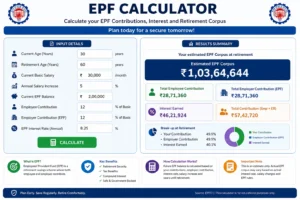
EPF Calculator-An EPF Calculator helps you estimate how much money you may accumulate in your Employees’ Provident Fund (EPF) account over time.EPF is an important part of retirement planning for many salaried employees in India. Every month, a portion of your salary is contributed to the provident fund, and the employer also makes a contribution according to the applicable EPF rules. The accumulated amount can grow through the interest declared for EPF.Looking for more free online calculators? Explore our complete collection of IPO Return Calculator, APY Return Calculator,Step Up SIP Calculator, Currency Converter,conversion, and everyday calculators at CalculatorGuides to find the right tool for your needs.
🛡️ CalculatorGuides - EPF Calculator
📊 EPF Computation Results
Instead of calculating your contribution and future balance manually, an EPF Calculator can give you a quick estimate of your potential retirement corpus.
At CalculatorGuides , our EPF Calculator is designed in simple language so that you can understand where your EPF money comes from, how interest affects the balance, and how your savings may grow over many years.
Important: EPF rules, interest rates, contribution limits, tax treatment, and withdrawal rules can change. Calculator results are estimates. Always verify the latest information with EPFO or your employer before making a financial decision.
What Is EPF?
EPF stands for Employees’ Provident Fund.
It is a retirement savings scheme for eligible employees covered under the EPF system.
In a typical EPF contribution structure, both the employee and employer contribute based on eligible wages and applicable rules. However, the employer’s contribution is not necessarily credited entirely to the EPF balance because a portion may go toward the Employees’ Pension Scheme (EPS), subject to the applicable rules.
This is one reason an EPF calculation can be more complicated than simply adding the employee’s and employer’s monthly contributions.
What Is an EPF Calculator?
An EPF Calculator is an online financial tool that estimates your future EPF balance using information such as:
- Basic Salary
- Dearness Allowance, where applicable
- Employee Contribution
- Employer Contribution
- Current EPF Balance
- Annual Salary Increase
- Expected EPF Interest Rate
- Remaining Service Period
Depending on the calculator, it may show:
- Employee contribution
- Employer contribution
- Estimated interest
- Current EPF balance
- Future EPF corpus
- Total contributions
- Estimated retirement balance
Why Use an EPF Calculator?
Calculating EPF manually for several years can become difficult because your salary, contributions, and accumulated balance may change over time.
An EPF Calculator helps you:
- Estimate your retirement savings
- Understand monthly contributions
- See the effect of salary increases
- Estimate long-term EPF growth
- Compare different retirement scenarios
- Plan your future finances
How Does EPF Contribution Work?
The employee generally contributes a percentage of eligible wages toward EPF.
The employer also contributes according to the applicable EPF rules.
A key point is that the employer contribution may be divided between:
- EPF
- EPS
Therefore, the employer contribution shown on your salary structure and the amount actually credited to your EPF account are not always the same.
The exact treatment depends on the employee’s circumstances and applicable EPFO rules.
EPF Contribution Example
Suppose the eligible monthly wage used for the calculation is:
₹30,000
If the applicable employee EPF contribution is 12%:
₹30,000 × 12% = ₹3,600
So the employee contribution would be approximately:
₹3,600 per month
The employer also makes its applicable contribution, but the allocation between EPF and EPS must be considered.
This is why an EPF calculator should not simply assume that the entire employer contribution goes into your EPF balance.
What Is Basic Salary in EPF?
For EPF purposes, the relevant wage components are important.
Employees often confuse their gross salary, basic salary, and CTC.
These are not the same.
For a basic EPF calculation, the relevant salary generally includes basic wages and applicable dearness allowance, subject to EPF rules.
Your total CTC should not automatically be entered as the EPF salary.
EPF Interest
EPF savings earn interest at the rate declared by the government for the relevant financial year.
The EPF interest rate can change over time.
For example, the rate applicable to one financial year may not be the same as the rate in another year.
Therefore, an online EPF calculator normally asks you to enter an assumed or applicable interest rate.
The result is an estimate based on that rate.
How Is EPF Interest Calculated?
EPF interest is not as simple as taking your final yearly balance and multiplying it by the annual rate.
Interest is calculated according to the EPF interest-crediting rules, with monthly balances playing an important role.
A simplified illustration is:
Interest ≈ Eligible Balance × Annual Interest Rate
However, actual EPF interest calculation and crediting follow EPFO rules.
For a calculator, the monthly contribution pattern and interest calculation method should be handled consistently to produce a useful estimate.
EPF Interest Example
Suppose an EPF balance is:
₹5,00,000
and you use an assumed annual interest rate of:
8.25%
A simple annual illustration would be:
₹5,00,000 × 8.25%
= ₹41,250
This is only a simplified example.
Actual EPF interest depends on the applicable rules and monthly balance calculations.
EPF Corpus Calculation
Your future EPF balance can come from several components:
Future EPF Corpus = Existing Balance + Future Contributions + Interest
As your contributions continue, the accumulated balance can grow over time.
This is why starting retirement savings earlier can make a significant difference.
Example of EPF Growth
Suppose an employee has:
- Current EPF Balance: ₹2,00,000
- Monthly Employee Contribution: ₹4,000
- Employer EPF Contribution: ₹4,000
- Remaining Service: 20 years
- Assumed Interest Rate: 8.25%
The employee does not simply accumulate:
₹2,00,000 + monthly contributions.
The accumulated balance can also earn interest over time.
The calculator estimates this growth using the selected assumptions.
EPF and Salary Increase
Your EPF contribution may increase when your eligible salary increases.
For example:
Year 1
Basic + applicable DA:
₹30,000
Year 2
Basic + applicable DA:
₹32,000
Year 3
Basic + applicable DA:
₹34,000
If the contribution is based on a percentage of eligible wages, the contribution can increase as the applicable salary increases.
This is why an EPF calculator with a salary growth option can be more useful for long-term planning than a calculator that assumes the salary stays unchanged.
EPF Calculator With Annual Salary Growth
Suppose:
- Starting eligible salary = ₹30,000/month
- Annual salary increase = 5%
The estimated salary could progress approximately as:
| Year | Monthly Eligible Salary |
|---|---|
| 1 | ₹30,000 |
| 2 | ₹31,500 |
| 3 | ₹33,075 |
| 4 | ₹34,729 |
| 5 | ₹36,466 |
The actual salary structure may differ, but this type of assumption helps illustrate how increasing contributions can affect long-term EPF savings.
EPF vs EPS
EPF and EPS are related but different.
EPF
EPF is the provident fund component that builds a retirement savings balance.
EPS
EPS stands for Employees’ Pension Scheme.
A portion of the employer’s contribution can be allocated toward EPS according to the applicable rules.
EPS provides pension-related benefits subject to eligibility and scheme conditions.
Therefore, you should not assume that the entire employer contribution appears in your EPF passbook as EPF balance.
EPF vs NPS
EPF and NPS are both used for retirement planning, but they work differently.
EPF
- Primarily associated with eligible salaried employment
- Contributions are linked to applicable wages and EPF rules
- Interest is declared according to the EPF framework
- Employer contribution can be part of the structure
NPS
- A retirement investment system
- Investment returns are market-linked
- Contributions can be invested across permitted asset classes
- Final corpus depends on contributions and investment performance
Many people use more than one retirement product as part of a broader financial plan.
EPF vs PPF
EPF and PPF are also different.
EPF
Generally linked to employment and employer/employee contributions.
PPF
A separate government-backed long-term savings scheme available to eligible individuals under its own rules.
The contribution limits, withdrawal rules, tenure, and tax treatment differ.
EPF Withdrawal
EPF is primarily intended for retirement savings, but withdrawals and advances may be permitted in certain situations under applicable EPFO rules.
Depending on the situation, rules can apply to:
- Partial withdrawals
- Advances
- Final settlement
- Unemployment
- Specific financial needs
- Retirement
Do not assume that you can withdraw the entire EPF balance whenever you want.
Always check the current EPFO rules for your specific situation.
What Happens If You Change Jobs?
Changing jobs does not necessarily mean that you need to withdraw your EPF money.
If you move to another covered employer, your EPF account can generally continue through the applicable transfer process.
Keeping retirement savings invested instead of withdrawing them unnecessarily can help preserve long-term compounding.
Your UAN and employment records are important when managing EPF across jobs.
What Is UAN?
UAN stands for Universal Account Number.
It helps connect a member’s different EPF member IDs across employment.
For employees who change jobs, the UAN system can make EPF management and transfer processes easier.
EPF Tax Benefits
EPF can have tax advantages, but tax treatment depends on factors such as:
- Employee contribution
- Employer contribution
- Interest
- Length of service
- Withdrawal circumstances
- Applicable tax rules
Tax laws can change, so do not rely on an old calculator or article for a current tax decision.
For the latest tax treatment, check official income-tax and EPFO guidance.
Is EPF Interest Tax-Free?
EPF interest can have specific tax rules and thresholds.
Certain contributions or interest amounts may receive different tax treatment depending on the circumstances and applicable law.
Therefore, it is safer to treat the calculator’s tax result as an estimate unless it is based on the current official rules and your specific situation.
EPF and Retirement Planning
EPF can become an important retirement asset because contributions may continue for many years.
A long investment period gives your accumulated balance more time to earn interest.
For retirement planning, consider:
- Current EPF balance
- Monthly contribution
- Salary growth
- Years until retirement
- EPF interest assumptions
- Inflation
- Other investments
- Expected retirement expenses
Looking only at the final EPF balance without considering inflation can give an incomplete picture.
EPF and Inflation
Suppose your EPF balance grows to ₹50 lakh many years from now.
That ₹50 lakh will not necessarily have the same purchasing power as ₹50 lakh today.
As prices increase, the amount needed for retirement expenses also increases.
Therefore, a good retirement plan should consider both:
Future EPF Corpus
and
Future Cost of Living
How to Use the EPF Calculator
Follow these steps:
Step 1: Enter Your Current Age
Enter your current age.
Step 2: Enter Retirement Age
Enter the age at which you expect to retire.
Step 3: Enter Current EPF Balance
If you already have an EPF balance, enter it.
Step 4: Enter Monthly Basic Salary
Enter the applicable basic salary and other relevant wage components used for EPF.
Step 5: Enter Salary Growth
If available, enter an estimated annual salary increase.
Step 6: Enter EPF Interest Rate
Use the applicable rate or an assumption for planning.
Step 7: Calculate
The calculator estimates your future EPF corpus.
What Does the EPF Calculator Show?
Depending on the calculator, you may see:
Employee Contribution
Your estimated monthly or yearly EPF contribution.
Employer EPF Contribution
The estimated employer contribution credited toward EPF after applicable allocation.
Total Contribution
Employee and employer contributions over the selected period.
Estimated Interest
The estimated growth from EPF interest.
Future EPF Balance
The projected retirement corpus.
Who Should Use an EPF Calculator?
An EPF Calculator is useful for:
- Salaried Employees
- Private-Sector Employees
- Government Employees Covered by EPF
- HR Professionals
- Young Professionals
- Retirement Planners
- Employees Changing Jobs
- People Planning Early Retirement
Common EPF Calculation Mistakes
Using CTC Instead of Basic Salary
CTC is not automatically the same as EPF wages.
Assuming the Entire Employer Contribution Goes to EPF
Part of the employer contribution can be allocated toward EPS according to applicable rules.
Using an Old Interest Rate
EPF interest rates can change.
Ignoring Existing EPF Balance
Your current balance can make a large difference over a long period.
Ignoring Salary Growth
Your future contributions may change as your eligible salary changes.
Treating the Result as Guaranteed
A calculator result depends on the assumptions entered and applicable EPF rules.
EPF Calculator Example
Suppose you have:
- Current EPF Balance: ₹3,00,000
- Monthly employee contribution: ₹4,000
- Monthly employer EPF contribution: ₹4,000
- Remaining period: 20 years
- Assumed annual interest: 8.25%
The calculator estimates the future corpus by considering:
- Existing balance
- Future monthly contributions
- Employer contribution
- Interest accumulation
- Time remaining
Because interest can compound over many years, the projected balance can become significantly larger than the total amount directly contributed.
How to Increase Your Retirement Corpus
Your EPF balance can potentially grow faster when:
- Your eligible salary increases
- Your contributions increase where applicable
- You remain invested for longer
- You avoid unnecessary withdrawals
- You maintain other retirement investments
However, EPF contribution rules and limits should always be considered before assuming that a higher salary will automatically produce a proportionally higher EPF contribution.
Frequently Asked Questions
What is an EPF Calculator?
An EPF Calculator estimates your future Employees’ Provident Fund balance based on salary, contributions, current balance, interest, and investment period.
How is EPF calculated?
EPF contributions are generally based on applicable wages and EPF contribution rules. The employee contribution and employer contribution are treated according to the EPF/EPS structure.
How much does an employee contribute to EPF?
For many covered employees, the employee contribution is 12% of applicable wages, subject to the relevant EPF rules.
Does the employer contribute to EPF?
Yes. The employer generally contributes according to the applicable EPF rules, with part of the contribution potentially allocated toward EPS.
Does the entire employer contribution go into EPF?
Not necessarily. A portion may be allocated to EPS under the applicable rules.
How is EPF interest calculated?
EPF interest is calculated according to EPFO rules using the applicable interest rate and monthly balance methodology.
Can I withdraw my EPF before retirement?
Withdrawals and advances may be allowed in certain situations under applicable EPFO rules. The exact conditions depend on the reason for withdrawal and your circumstances.
What happens to EPF when I change jobs?
Your EPF can generally be transferred to the EPF account associated with your new employment rather than withdrawn, subject to the applicable process and rules.
What is UAN?
UAN means Universal Account Number. It helps link a member’s EPF accounts across different covered employment periods.
Is EPF better than NPS?
They are different retirement products. EPF has a provident fund structure, while NPS is market-linked. Your financial goals and circumstances determine which combination is appropriate.
Is EPF interest guaranteed?
The EPF interest rate is declared under the applicable government/EPFO framework and can change between financial years. Do not assume that today’s rate will remain unchanged indefinitely.
Is EPF taxable?
EPF has specific tax rules covering contributions, interest, and withdrawals. The treatment depends on the applicable rules and individual circumstances.
Can I use the EPF Calculator for retirement planning?
Yes. It can help estimate your potential EPF corpus, but a complete retirement plan should also consider inflation, other investments, and future expenses.
Is the EPF Calculator free?
Yes. The CalculatorGuides.com EPF Calculator is free to use.
EPF Calculator vs Gratuity Calculator
EPF and gratuity are separate employment benefits.
EPF
A retirement savings account built through applicable employee and employer contributions.
Gratuity
A separate employment benefit governed by the applicable gratuity law and eligibility conditions.
If you’re planning your total retirement benefits, it can be useful to calculate both separately.
EPF Calculator vs PPF Calculator
An EPF Calculator estimates employment-linked provident fund savings.
A PPF Calculator estimates the growth of a Public Provident Fund investment based on its own contribution and interest rules.
They should not be treated as the same investment.
Important Things to Remember
Before relying on an EPF projection:
- Check the latest EPFO rules.
- Use the correct salary components.
- Check the current applicable interest rate.
- Include your existing EPF balance.
- Consider future salary changes.
- Do not assume the employer contribution is entirely EPF.
- Consider inflation when planning retirement.
- Review tax rules separately.
- Treat calculator results as estimates.
Conclusion
An EPF Calculator is a useful retirement-planning tool that helps you understand how employee contributions, employer contributions, existing savings, salary growth, and EPF interest can affect your future corpus.
The most important advantage of EPF is the ability to build retirement savings gradually through regular contributions over your working years. The longer the money remains invested, the more opportunity the accumulated balance has to earn interest.
Use the CalculatorGuides.com EPF Calculator to estimate your contribution, interest, and potential retirement balance. For actual contribution, withdrawal, transfer, and tax decisions, always verify the latest rules with EPFO and the relevant official authorities.