
GDP Calculator-Use our free GDP Calculator to calculate gross domestic product, GDP growth rate, real GDP, nominal GDP, and GDP per capita with simple formulas and examples.A GDP Calculator helps you calculate Gross Domestic Product (GDP) ,CalculatorGuides, and related economic measures such as GDP growth, GDP per capita, and real GDP.
Total GDP: $0.00📊 Gross Domestic Product (GDP) Calculator | CalculatorGuides
📊 Calculation Result
GDP is one of the most widely used measures of economic activity. It represents the monetary value of final goods and services produced within an economy during a specific period.
This calculator can help you understand:
- GDP
- GDP growth rate
- GDP per capita
- Nominal GDP
- Real GDP
- GDP using the expenditure approach
- GDP using income components
- Changes in GDP over time
What Is GDP?
GDP stands for Gross Domestic Product.
It measures the value of final goods and services produced within a country’s borders during a particular period, usually a quarter or a year.
GDP is commonly used to understand the size and performance of an economy.
For example, if the value of final goods and services produced by an economy increases from one year to the next, its GDP may increase.
GDP can be measured using several approaches, with the expenditure approach being one of the most commonly taught formulas.
GDP Formula
The expenditure approach is:
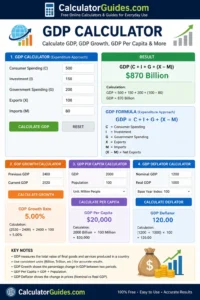
GDP = C + I + G + (X − M)
Where:
- C = Consumer spending
- I = Investment
- G = Government spending
- X = Exports
- M = Imports
The term:
X − M
is called net exports.
GDP Calculator Example
Suppose an economy has:
- Consumer spending = $500 billion
- Investment = $150 billion
- Government spending = $200 billion
- Exports = $100 billion
- Imports = $80 billion
GDP:
GDP = 500 + 150 + 200 + (100 − 80)
GDP = 870 billion
Therefore:
GDP = $870 billion
What Does GDP Measure?
GDP measures economic production within a defined geographic area and period.
It includes the market value of final goods and services.
Examples can include:
- Cars
- Computers
- Food
- Construction
- Transportation
- Healthcare services
- Financial services
- Software services
- Education services
GDP does not simply equal the total value of every transaction because counting intermediate goods multiple times would result in double counting.
GDP Growth Calculator
GDP growth shows how GDP changes between two periods.
The basic formula is:
GDP Growth Rate = [(New GDP − Old GDP) ÷ Old GDP] × 100
For example:
Previous GDP:
$1 trillion
Current GDP:
$1.05 trillion
Growth:
[(1.05 − 1.00) ÷ 1.00] × 100
= 5%
So GDP increased by:
5%
GDP Growth Example
Suppose GDP was:
$2.4 trillion
last year and:
$2.52 trillion
this year.
GDP growth:
(2.52 − 2.40) ÷ 2.40 × 100
= 5%
The economy’s GDP increased by approximately 5%.
Negative GDP Growth
GDP can also decrease.
Suppose:
Previous GDP:
$800 billion
Current GDP:
$760 billion
Growth rate:
(760 − 800) ÷ 800 × 100
= −5%
A negative growth rate means GDP decreased compared with the previous period.
A single quarter of declining GDP does not, by itself, provide a complete picture of an economy’s overall condition.
GDP Per Capita Calculator
GDP per capita is GDP divided by the population.
Formula:
GDP Per Capita = GDP ÷ Population
For example:
GDP:
$2 trillion
Population:
100 million
GDP per capita:
$2,000,000,000,000 ÷ 100,000,000
= $20,000
GDP per capita is a useful statistical measure, but it is not the same as average income.
GDP Per Capita Example
Suppose a country has:
GDP = $500 billion
Population:
50 million
Then:
GDP per capita = $500 billion ÷ 50 million
= $10,000
This means GDP divided by population equals $10,000 per person.
It does not mean every person earns $10,000.
Nominal GDP
Nominal GDP measures economic output using prices prevailing during the period being measured.
Because prices can change due to inflation, nominal GDP can increase even if the physical quantity of goods and services produced has not increased by the same amount.
Therefore, nominal GDP alone is not always sufficient for comparing real changes in production over time.
Real GDP
Real GDP adjusts GDP for changes in prices.
It is designed to make comparisons across time more meaningful by separating changes in production from changes caused by price levels.
For example, if prices rise significantly while actual production remains similar, nominal GDP may increase while real GDP changes much less.
Nominal GDP vs Real GDP
| Feature | Nominal GDP | Real GDP |
|---|---|---|
| Uses current-period prices | Yes | No |
| Adjusts for price changes | No | Yes |
| Useful for measuring current monetary value | Yes | Yes |
| Useful for comparing production over time | Limited | More useful |
The exact method used to calculate real GDP depends on the statistical framework used by the relevant national statistical agency.
GDP Deflator
The GDP deflator is a price index associated with GDP.
A simplified formula is:
GDP Deflator = (Nominal GDP ÷ Real GDP) × 100
For example:
Nominal GDP:
$1.2 trillion
Real GDP:
$1.0 trillion
GDP deflator:
1.2 ÷ 1.0 × 100
= 120
A deflator of 120 indicates that the relevant price level is 20% above the reference level represented by 100.
GDP Using the Expenditure Approach
The expenditure approach adds spending on final output:
GDP = C + I + G + NX
where:
NX = X − M
Consumption
Spending by households on goods and services.
Investment
Business investment, residential construction, and changes in inventories, depending on the national accounting framework.
Government Spending
Government expenditure on qualifying goods and services.
Net Exports
Exports minus imports.
Why Are Imports Subtracted?
Imports are subtracted because they are included in consumption, investment, or government spending but are produced outside the domestic economy.
For example, if consumers spend money on an imported smartphone, that spending may appear in consumption, but the imported production should not be counted as domestic GDP.
Therefore, imports are subtracted.
Exports are added because they represent domestically produced goods and services purchased by foreign buyers.
GDP and Exports
Exports increase GDP through the expenditure formula because they represent domestic production sold outside the country.
If:
Exports = $300 billion
and:
Imports = $250 billion
then:
Net exports = $50 billion
GDP and Government Spending
Government spending is one component of the expenditure approach.
However, not every government payment is treated as government consumption or investment in GDP accounting.
For example, transfer payments such as certain social benefits are generally not counted directly as government purchases of currently produced goods and services.
This distinction is important when using official GDP data.
GDP and Consumer Spending
Consumer spending, represented by C, includes household expenditure on many final goods and services.
Examples include:
- Food
- Clothing
- Transportation
- Entertainment
- Healthcare
- Household services
Consumption is often a major component of GDP.
GDP and Investment
In GDP accounting, investment does not simply mean buying stocks or bonds.
It generally refers to spending on productive assets and certain inventory changes.
Examples include:
- Business equipment
- Buildings
- Residential construction
- Inventory investment
Buying an existing financial asset is not itself counted as GDP production.
GDP vs GNP
GDP measures production within a country’s borders.
GNP (Gross National Product) focuses on production associated with a country’s residents or nationals, depending on the accounting framework.
A country’s GDP and GNP can differ because of income and production relationships with the rest of the world.
GDP vs GNI
GNI (Gross National Income) measures income received by residents of an economy, including relevant income from abroad and excluding income flowing to non-residents, according to national accounting definitions.
GDP focuses on production within the domestic territory, while GNI focuses on income accruing to residents.
GDP vs Personal Income
GDP is not the same as the income received by households.
GDP measures production.
Personal income measures income received by individuals and households under a different accounting concept.
A country can therefore have a high GDP without every individual receiving a high income.
GDP and Standard of Living
GDP can provide useful information about economic activity, but it is not a complete measure of living standards.
GDP does not fully capture:
- Income distribution
- Leisure
- Household production
- Environmental quality
- Health outcomes
- Unpaid care work
- Quality of life
GDP per capita is useful for comparison, but it should be considered alongside other economic and social indicators.
GDP Growth vs GDP Level
These are two different concepts.
GDP Level
The total measured value of economic production.
GDP Growth
The percentage change in GDP between periods.
For example:
Country A may have GDP of:
$10 trillion
but grow at:
2%
Country B may have GDP of:
$1 trillion
but grow at:
8%
The smaller economy is growing faster, but it still has a much smaller GDP level.
Annualized GDP Growth
Some countries or statistical agencies report quarterly GDP growth at an annualized rate.
An annualized quarterly growth rate is not necessarily the same thing as simply multiplying quarterly growth by four.
For precise calculations, use the methodology specified by the statistical agency providing the data.
GDP Growth Over Multiple Years
If GDP grows at a constant annual rate, the future GDP can be estimated using:
Future GDP = Current GDP × (1 + Growth Rate)ⁿ
Where:
- n = number of years
For example:
Current GDP:
$1 trillion
Annual growth:
5%
Period:
3 years
Then:
1 × (1.05)³
≈ $1.1576 trillion
This is a mathematical projection, not a forecast of actual economic performance.
GDP Calculator for India
When calculating GDP for India, use GDP figures from an appropriate official statistical source and make sure you know whether the figure represents:
- Nominal GDP
- Real GDP
- Current prices
- Constant prices
- Annual GDP
- Quarterly GDP
- GDP in rupees
- GDP in another currency
Currency conversions can also affect comparisons between countries.
GDP Calculator for Countries
To compare countries, make sure the GDP figures use comparable definitions and periods.
You may encounter:
- Nominal GDP
- Real GDP
- GDP per capita
- PPP-adjusted GDP
- GDP growth
These measures answer different questions.
GDP and Purchasing Power Parity
Purchasing Power Parity (PPP) adjusts comparisons to account for differences in price levels between countries.
A country’s GDP measured using market exchange rates and its GDP measured using PPP can therefore be very different.
PPP-adjusted GDP can be useful for comparing the relative size of economies or living standards, depending on the purpose of the analysis.
How to Use the GDP Calculator
Step 1: Choose the Calculation
You can calculate:
- GDP
- GDP growth
- GDP per capita
- GDP deflator
- Projected GDP
Step 2: Enter the Required Values
For example, for GDP growth:
- Previous GDP
- Current GDP
Step 3: Check Units
Use consistent units such as:
- Million
- Billion
- Trillion
- Local currency
Step 4: Calculate
The calculator applies the appropriate formula.
Step 5: Interpret the Result
Remember that GDP figures are statistical measures and need context when comparing economies or periods.
Common GDP Calculation Mistakes
Confusing GDP With GDP Per Capita
GDP is the total economic output measure.
GDP per capita divides GDP by population.
Mixing Nominal and Real GDP
Do not calculate a growth rate using nominal GDP for one period and real GDP for another.
Ignoring the Time Period
GDP figures should be compared over equivalent periods.
Forgetting Imports
The expenditure formula includes:
Exports − Imports
not exports alone.
Assuming GDP Equals Income
GDP and household income are different economic measures.
Assuming GDP Growth Means Everyone Is Better Off
GDP growth can occur alongside unequal income distribution or other economic challenges.
Frequently Asked Questions
What is a GDP Calculator?
A GDP Calculator helps calculate GDP, GDP growth, GDP per capita, and other related economic measures.
What does GDP stand for?
GDP stands for Gross Domestic Product.
What is the GDP formula?
Using the expenditure approach:
GDP = C + I + G + (X − M)
What is GDP growth?
GDP growth measures the percentage change in GDP between two periods.
Growth = [(New GDP − Old GDP) ÷ Old GDP] × 100
What is GDP per capita?
GDP per capita is:
GDP ÷ Population
It represents GDP divided by the number of people, not the actual income earned by each person.
What is nominal GDP?
Nominal GDP measures output using prices applicable to the period being measured.
What is real GDP?
Real GDP adjusts for price changes to provide a better measure of changes in production over time.
Why are imports subtracted from GDP?
Imports are subtracted because they are included in spending but represent production outside the domestic economy.
Are exports included in GDP?
Yes. Exports are included because they represent domestic production purchased by foreign buyers.
Is buying stocks included in GDP?
The purchase of an existing financial asset is generally not itself counted as production in GDP.
Is GDP the same as national income?
No. GDP measures domestic production, while national-income measures capture income concepts under a different accounting framework.
Is GDP per capita the average salary?
No. GDP per capita is GDP divided by population and should not be interpreted as the average wage or salary.
What is the GDP deflator?
A broad price index associated with GDP. A simplified calculation is:
GDP Deflator = Nominal GDP ÷ Real GDP × 100
Can GDP be negative?
GDP itself is normally reported as a level and is not usually described as “negative.” However, GDP growth can be negative when GDP decreases from one period to another.
Is the GDP Calculator accurate?
The mathematical calculations are accurate for the values entered. The quality of the result depends on the underlying GDP, population, price, and economic data used.
Is the GDP Calculator free?
Yes. The CalculatorGuides.com GDP Calculator is free to use.
GDP Calculator – Quick Reference
| Calculation | Formula |
|---|---|
| GDP | C + I + G + (X − M) |
| GDP Growth | (New GDP − Old GDP) ÷ Old GDP × 100 |
| GDP Per Capita | GDP ÷ Population |
| GDP Deflator | Nominal GDP ÷ Real GDP × 100 |
| Future GDP | Current GDP × (1 + Growth Rate)ⁿ |
Conclusion
The GDP Calculator provides a simple way to understand and calculate important economic measures.
The expenditure approach is:
GDP = C + I + G + (X − M)
GDP growth can be calculated using:
[(New GDP − Old GDP) ÷ Old GDP] × 100
And GDP per capita is:
GDP ÷ Population
Remember that nominal GDP, real GDP, GDP per capita, PPP-adjusted GDP, and GDP growth are different measures. Each is useful for a different type of economic comparison.
GDP is an important indicator of economic activity, but it does not by itself measure income equality, individual prosperity, environmental quality, or overall quality of life.
Use the CalculatorGuides.com GDP Calculator to calculate GDP, growth rates, GDP per capita, and other common GDP-related values quickly and understand what each result actually means.