
Density Calculator-Use our free Density Calculator to calculate density, mass, or volume. Learn the density formula, common units, material examples, Weight Calculator, and easy step-by-step calculations.
Calculated Value: 0⚖️ Density Calculator | CalculatorGuides
📊 Result
Density Calculator-Use our free Density Calculator to calculate density, mass, or volume. Learn the density formula, common units, material examples, and easy step-by-step calculations.
A Density Calculator helps you calculate the density of an object or substance when its mass and volume are known. It can also calculate mass or volume when the other two values are available.
Density is an important concept in physics, chemistry, engineering, and everyday science.
You can use a density calculator to calculate:
- Density
- Mass
- Volume
- Density in g/cm³
- Density in kg/m³
- Density in g/mL
- Relative density
- Common material density
- Mass from density and volume
- Volume from density and mass
What Is Density?
Density describes how much mass is contained in a given volume.
The basic formula is:
Density = Mass ÷ Volume
or:
ρ = m ÷ V
Where:
- ρ = density
- m = mass
- V = volume
For example, if an object has a mass of:
200 g
and a volume of:
100 cm³
then:
Density = 200 ÷ 100
= 2 g/cm³
Density Formula
The three related formulas are:
Calculate Density
ρ = m ÷ V
Calculate Mass
m = ρ × V
Calculate Volume
V = m ÷ ρ
If you know any two of these quantities, you can calculate the third.
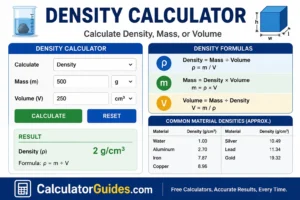
Density Calculator Example
Suppose:
Mass = 500 g
Volume = 250 cm³
Then:
ρ = 500 ÷ 250
= 2 g/cm³
Therefore, the density is:
2 g/cm³
Calculate Mass From Density
If density and volume are known:
Mass = Density × Volume
For example:
Density = 7.85 g/cm³
Volume = 10 cm³
Mass:
7.85 × 10 = 78.5 g
Calculate Volume From Density
If mass and density are known:
Volume = Mass ÷ Density
For example:
Mass = 500 g
Density = 2.5 g/cm³
Volume:
500 ÷ 2.5 = 200 cm³
Density Units
Common density units include:
- g/cm³
- g/mL
- kg/m³
- kg/L
- g/L
The correct unit depends on the mass and volume units being used.
g/cm³ and g/mL
For many calculations:
1 g/cm³ = 1 g/mL
This is because:
1 mL = 1 cm³
For example:
Water ≈ 1 g/cm³
is also approximately:
1 g/mL
at suitable reference conditions.
Density Conversion: g/cm³ to kg/m³
A useful conversion is:
1 g/cm³ = 1,000 kg/m³
Therefore:
2.5 g/cm³ = 2,500 kg/m³
To convert:
g/cm³ × 1,000 = kg/m³
Density Conversion: kg/m³ to g/cm³
To convert from kg/m³ to g/cm³:
g/cm³ = kg/m³ ÷ 1,000
For example:
7,850 kg/m³ ÷ 1,000
= 7.85 g/cm³
Density of Water
The density of water is approximately:
1 g/cm³
or:
1,000 kg/m³
under commonly used reference conditions.
Water’s density actually changes with temperature, so the exact value is not always exactly 1 g/cm³.
This approximation is useful for many basic calculations.
Common Material Densities
Approximate densities can help you understand how different materials compare.
| Material | Approx. Density |
|---|---|
| Water | 1.00 g/cm³ |
| Ice | 0.92 g/cm³ |
| Aluminum | 2.70 g/cm³ |
| Iron | 7.87 g/cm³ |
| Steel | ~7.85 g/cm³ |
| Copper | 8.96 g/cm³ |
| Silver | 10.49 g/cm³ |
| Gold | 19.32 g/cm³ |
Actual density can vary with composition, temperature, pressure, and material grade.
Why Does Density Matter?
Density helps explain why some materials feel heavier than others even when they have the same size.
Suppose two cubes have exactly the same volume:
- Cube A has density 2 g/cm³.
- Cube B has density 8 g/cm³.
Cube B contains four times as much mass for the same volume.
Therefore, it will also have four times the mass under the same volume conditions.
Density and Mass
For a fixed volume:
Higher density → Higher mass
Lower density → Lower mass
For example, a 100 cm³ sample with a density of:
8 g/cm³
has a mass of:
800 g
while the same volume at:
2 g/cm³
has a mass of:
200 g
Density and Volume
For a fixed mass:
Higher density → Smaller volume
Lower density → Larger volume
For example, suppose the mass is:
1,000 g
A material with density:
10 g/cm³
has a volume of:
100 cm³
A material with density:
2 g/cm³
has a volume of:
500 cm³
Density Example: Aluminum
Suppose an aluminum block has:
Volume = 100 cm³
Using an approximate density of:
2.70 g/cm³
Mass:
m = 2.70 × 100
= 270 g
Therefore, the block has an estimated mass of:
270 g
Density Example: Copper
Suppose a copper object has a volume of:
50 cm³
Copper density:
8.96 g/cm³
Mass:
8.96 × 50
= 448 g
So the estimated mass is:
448 g
Density Example: Gold
Suppose a gold sample has:
Volume = 10 cm³
Approximate gold density:
19.32 g/cm³
Mass:
19.32 × 10
= 193.2 g
Therefore, a 10 cm³ sample would have an estimated mass of:
193.2 g
assuming the stated density.
Density of an Irregular Object
Density can also be determined for an irregularly shaped object.
First, determine its volume.
One common method for a suitable solid object is water displacement.
For example:
Initial water level:
100 mL
Water level with object:
150 mL
Object volume:
150 − 100 = 50 mL
If the object’s mass is:
100 g
then:
Density = 100 ÷ 50
= 2 g/mL
Density of a Liquid
For a liquid, measure its mass and volume.
Suppose:
Mass = 250 g
Volume = 200 mL
Then:
Density = 250 ÷ 200
= 1.25 g/mL
The same basic formula applies:
ρ = m/V
Density of a Gas
Gas density depends strongly on conditions such as:
- Temperature
- Pressure
- Gas composition
Unlike many solids and liquids, gases can change volume substantially with changes in temperature and pressure.
For a gas, density can be calculated from mass and volume:
ρ = m/V
or determined using an equation of state such as the ideal gas law when appropriate.
Density and the Ideal Gas Law
For an ideal gas:
PV = nRT
Where:
- P = pressure
- V = volume
- n = amount in moles
- R = gas constant
- T = absolute temperature
If molar mass is known, gas density can be related to these quantities.
This is useful when density is not directly measured.
Density vs Specific Gravity
Density is an absolute property with units such as:
g/cm³
or:
kg/m³
Specific gravity is a ratio comparing the density of a substance with the density of a reference substance.
For many liquids and solids, water is commonly used as the reference.
Specific gravity has no units because it is a ratio.
Density vs Weight Density
Density describes:
mass per unit volume
Weight density describes:
weight per unit volume
Since weight is a force, weight density is expressed using force units per volume.
This distinction matters in physics and engineering.
Density and Buoyancy
Density is closely related to whether an object floats or sinks in a fluid.
For an object placed in water:
- If its average density is less than water, it can float.
- If its average density is greater than water, it tends to sink.
- If its average density is approximately equal to water, it can be neutrally buoyant under suitable conditions.
The shape and displaced fluid also matter when analyzing real objects.
Why Does Ice Float?
Ice has a lower density than liquid water under ordinary conditions.
Approximate densities:
Ice ≈ 0.92 g/cm³
Water ≈ 1.00 g/cm³
Because ice is less dense, it can float on liquid water.
This is an important example of how density affects buoyancy.
Density and Temperature
Density can change when temperature changes because materials can expand or contract.
For many substances:
Temperature increases → Volume may increase → Density may decrease
Water is more complicated because its density behaves unusually near freezing.
Therefore, if high accuracy is required, use density data measured at the relevant temperature.
Density and Pressure
Pressure has a relatively small effect on many solids and liquids compared with gases.
For gases, pressure can have a significant effect on density.
Therefore, gas-density calculations should specify the relevant pressure and temperature.
Density Calculator for Science Students
A density calculator is useful for:
- Physics homework
- Chemistry assignments
- Laboratory work
- Material identification
- Mass calculations
- Volume calculations
- Buoyancy problems
- Science experiments
It is also useful for checking manual calculations.
How to Use the Density Calculator
Step 1: Enter the Known Values
You can enter:
- Mass
- Volume
Step 2: Select Units
For example:
- grams
- kilograms
- milliliters
- liters
- cubic centimeters
- cubic meters
Step 3: Calculate
The calculator applies:
Density = Mass ÷ Volume
Step 4: Check the Result
Make sure the resulting density unit matches your selected units.
Common Density Calculation Mistakes
Mixing Units
Do not divide grams by cubic meters and label the result g/cm³.
The units must match the actual calculation.
Confusing Mass With Weight
Density uses mass, not gravitational weight.
Forgetting Volume Conversion
Remember:
1 mL = 1 cm³
and:
1 L = 1,000 cm³
Using an Approximate Material Density as an Exact Value
Real materials can vary based on composition and temperature.
Ignoring Temperature
Density can change with temperature, especially for liquids and gases.
Frequently Asked Questions
What is a Density Calculator?
A Density Calculator calculates density, mass, or volume using the relationship between these three quantities.
What is the density formula?
ρ = m ÷ V
where mass is divided by volume.
How do I calculate mass from density?
Use:
m = ρ × V
How do I calculate volume from density?
Use:
V = m ÷ ρ
What is the SI unit of density?
The SI unit is:
kg/m³
What is the density of water?
Water is approximately 1 g/cm³ or 1,000 kg/m³ under commonly used reference conditions.
Is g/cm³ the same as g/mL?
Yes, numerically:
1 g/cm³ = 1 g/mL
because 1 cm³ equals 1 mL.
How do I convert g/cm³ to kg/m³?
Multiply by:
1,000
For example:
5 g/cm³ = 5,000 kg/m³
What is the difference between density and specific gravity?
Density has units and measures mass per volume. Specific gravity is a dimensionless ratio comparing a substance’s density with a reference density.
Does temperature affect density?
Yes. Changes in temperature can change volume and therefore density.
Can I calculate the density of an irregular object?
Yes. Determine its mass and volume, such as by measuring volume through water displacement when appropriate, then use:
ρ = m/V
Why does an object float?
An object can float when its average density is lower than the density of the surrounding fluid, under appropriate conditions.
Can I calculate gas density?
Yes, but gas density depends on conditions such as temperature and pressure.
Is the Density Calculator accurate?
The mathematical calculation is accurate for the entered values. Real-world density measurements can vary because of temperature, pressure, material composition, and measurement uncertainty.
Is the Density Calculator free?
Yes. The CalculatorGuides.com Density Calculator is free to use.
Density Calculator – Quick Reference
| What You Know | Formula |
|---|---|
| Mass + Volume | ρ = m ÷ V |
| Density + Volume | m = ρ × V |
| Mass + Density | V = m ÷ ρ |
| g/cm³ → kg/m³ | × 1,000 |
| kg/m³ → g/cm³ | ÷ 1,000 |
| g → kg | ÷ 1,000 |
| kg → g | × 1,000 |
Conclusion
The Density Calculator makes it easy to calculate density, mass, and volume using a simple relationship:
Density = Mass ÷ Volume
If density and volume are known:
Mass = Density × Volume
If mass and density are known:
Volume = Mass ÷ Density
Density is useful for understanding materials, calculating the mass of objects, studying buoyancy, and solving physics and chemistry problems.
Always make sure your mass and volume units are compatible before calculating. For example, g/cm³ should be paired with cm³, while kg/m³ should be paired with m³.
Use the CalculatorGuides.com Density Calculator to quickly solve density, mass, and volume calculations and check your results.