
Golf Handicap Calculator-A Golf Handicap Calculator helps golfers estimate their Handicap Index from recent golf scores and course information.A handicap allows golfers with different playing abilities to compete more fairly. Under the World Handicap System (WHS), the Handicap Index is based on a golfer’s demonstrated ability using score differentials from acceptable rounds.Explore our complete collection of Fuel Cost Calculator , Mileage Calculator,Dividend Calculator,Horsepower Calculator, Dew Point Calculator,conversion, and everyday calculators at CalculatorGuides.com to find the right tool for your needs.
⛳ Golf Handicap & Course Calculator - CalculatorGuides
Calculated Course Handicap:
You may need:
- Adjusted gross score
- Course Rating
- Slope Rating
- Playing Conditions Calculation, when applicable
- Recent score differentials
- Number of scores available
This calculator is useful for golfers who want to understand how handicap calculations work and estimate their handicap before checking their official handicap record.
Important: An online estimate should not be treated as an official Handicap Index. Your official handicap is maintained by your authorized golf association or handicap provider under the rules applicable to your jurisdiction.
What Is a Golf Handicap?
A golf handicap is a numerical measure of a golfer’s demonstrated playing ability.
The lower the handicap, generally, the stronger the golfer.
For example:
- A golfer with a 5 Handicap Index generally has a lower handicap than a golfer with a 20 Handicap Index.
- A higher-handicap golfer receives more strokes in a handicap competition.
The modern handicap system used in many countries is the World Handicap System (WHS).
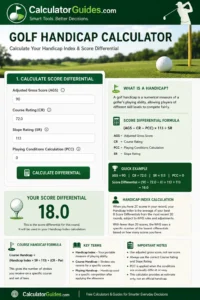
What Is a Handicap Index?
A Handicap Index represents a golfer’s demonstrated ability based on their recent acceptable scores.
It is not simply the average number of strokes over par.
Instead, the WHS uses Score Differentials, which consider the score relative to the difficulty of the course.
This means two identical scores can produce different differentials if they were played on courses with different ratings and slopes.
Golf Handicap Calculator Formula
A basic Score Differential calculation under the WHS is:
Score Differential = (Adjusted Gross Score − Course Rating − PCC) × 113 ÷ Slope Rating
Where:
- Adjusted Gross Score = score after applying the applicable maximum-score and other adjustments
- Course Rating = expected score for a scratch golfer under normal conditions
- PCC = Playing Conditions Calculation
- Slope Rating = relative difficulty for bogey golfers compared with scratch golfers
- 113 = standard Slope Rating used in the WHS formula
When PCC is zero, the formula becomes:
Score Differential = (Adjusted Gross Score − Course Rating) × 113 ÷ Slope Rating
The exact calculation can depend on the applicable WHS rules and score type.
Golf Handicap Example
Suppose you have:
Adjusted Gross Score: 90
Course Rating: 72.0
Slope Rating: 113
PCC: 0
Then:
Score Differential = (90 − 72.0 − 0) × 113 ÷ 113
= 18.0
So the Score Differential for that round is:
18.0
This does not automatically mean your Handicap Index is 18 because the Handicap Index uses a selection of recent score differentials.
What Is Course Rating?
Course Rating represents the expected score for a scratch golfer playing a course under normal conditions.
It is expressed as a number, such as:
72.0
A course with a higher Course Rating is expected to be more difficult for a scratch golfer than a course with a lower rating.
Course Rating is different from par.
For example:
Par = 72
does not necessarily mean:
Course Rating = 72.0
What Is Slope Rating?
Slope Rating measures the relative difficulty of a course for a bogey golfer compared with a scratch golfer.
The standard Slope Rating is:
113
A course can have a Slope Rating above or below 113.
For example:
- Slope 100
- Slope 113
- Slope 130
- Slope 140
The higher the Slope Rating, generally, the greater the relative difficulty for higher-handicap golfers.
Why Does Slope Rating Matter?
Suppose two golfers shoot the same score on two different courses.
The course with the higher Slope Rating may produce a different Score Differential because the WHS calculation adjusts for the relative difficulty of the course.
This makes handicap calculations more comparable across courses.
What Is Playing Conditions Calculation?
The Playing Conditions Calculation (PCC) is an adjustment that can account for unusually difficult or easy playing conditions on a particular day.
Conditions can include:
- Wind
- Course setup
- Weather
- Green conditions
- Other factors affecting scoring
PCC is calculated through the handicap system rather than simply being chosen by the golfer.
It can affect the Score Differential for eligible scores.
What Is Adjusted Gross Score?
Your Adjusted Gross Score is the score used for handicap purposes after applicable adjustments.
It may differ from the raw number of strokes you actually took.
The WHS includes rules that limit the score recorded for a hole for handicap purposes.
This prevents one unusually high hole from having an excessive effect on your handicap.
Maximum Score
Under the WHS, the maximum score for a hole for handicap purposes is generally Net Double Bogey.
The calculation is based on:
Par + 2 strokes + any handicap strokes received on that hole
For example, if a hole is:
Par 4
and you receive:
1 handicap stroke
your maximum score for handicap purposes would be:
4 + 2 + 1 = 7
This is one reason your handicap score can be different from your actual gross score.
How Is a Handicap Index Calculated?
The WHS uses Score Differentials from a golfer’s recent acceptable scores.
When enough scores are available, the system generally uses the best 8 Score Differentials from the most recent 20 to calculate the Handicap Index.
The exact calculation also includes applicable safeguards and exceptional-score adjustments.
Handicap Index From 20 Scores
If you have 20 acceptable scores, the basic calculation generally uses your:
8 lowest Score Differentials
Then:
Handicap Index ≈ Average of the 8 lowest differentials
For example, suppose your eight best differentials average:
12.4
Your Handicap Index would be approximately:
12.4
The official calculation may include additional rules or adjustments.
What If You Have Fewer Than 20 Scores?
The WHS has specific procedures for golfers with fewer than 20 scores.
The number of Score Differentials used depends on how many acceptable scores are available.
This means you should not simply average all your rounds.
A WHS-compatible calculator should use the applicable score-selection table rather than a basic average.
Golf Handicap Calculator With 5 Scores
If you have only a small number of scores, the WHS has special provisions for calculating an initial Handicap Index.
The applicable number of differentials used depends on the number of acceptable scores in your scoring record.
Therefore, entering five scores does not simply mean averaging all five scores.
Golf Handicap Calculator With 10 Scores
With 10 acceptable scores, the WHS uses a specified number of the lowest Score Differentials rather than averaging all 10.
This allows the handicap to reflect demonstrated ability rather than simply average every round equally.
Golf Handicap Calculator With 15 Scores
With 15 acceptable scores, the WHS again selects the specified number of lowest Score Differentials according to its calculation table.
Once you reach 20 scores, the standard calculation uses the best 8 of the most recent 20, subject to applicable rules.
Why Doesn’t Handicap Equal Average Score Over Par?
Suppose you usually shoot:
90 on a par-72 course
It may be tempting to say:
90 − 72 = 18 handicap
But that is not necessarily correct.
The WHS also considers:
- Course Rating
- Slope Rating
- Playing Conditions Calculation
- Your best recent Score Differentials
Therefore, handicap is more sophisticated than simply subtracting par from your average score.
Golf Handicap vs Average Score
These are different measurements.
Average Score
The average number of strokes you take.
Handicap Index
A measure of demonstrated playing ability based on Score Differentials.
A golfer can have an average score that is considerably higher than their Handicap Index because the handicap calculation focuses on the better portion of recent scores.
Handicap Index vs Course Handicap
These terms are not interchangeable.
Handicap Index
Your portable measure of playing ability.
Course Handicap
The number of handicap strokes you receive for a specific set of tees or course.
Course Handicap depends on your Handicap Index and the course’s rating information.
Course Handicap Formula
A commonly used WHS formula is:
Course Handicap = Handicap Index × Slope Rating ÷ 113 + (Course Rating − Par)
The result is then rounded according to the applicable rules.
For example:
Handicap Index:
10.0
Slope:
130
Course Rating:
72.5
Par:
72
Course Handicap:
10 × 130 ÷ 113 + (72.5 − 72)
≈ 12.0
The exact result depends on the applicable rounding rules.
Playing Handicap
A Playing Handicap can be used in competitions after applying the appropriate allowance to the Course Handicap.
For example, a competition format may use a specific percentage allowance.
The allowance depends on the format and applicable rules.
Therefore:
Handicap Index → Course Handicap → Playing Handicap
are not always the same number.
Golf Handicap Calculator for 9 Holes
Nine-hole scores can be acceptable for handicap purposes under the WHS when the applicable requirements are met.
The handicap system can combine nine-hole scores or otherwise calculate an equivalent Score Differential according to the applicable rules.
Do not simply double your nine-hole score and assume that is your official handicap score.
Golf Handicap Calculator for 18 Holes
An 18-hole acceptable score can be used to produce a Score Differential.
The Score Differential is then added to your scoring record and may contribute to your future Handicap Index.
Golf Handicap and Net Score
A net score adjusts your gross score based on the handicap strokes you receive.
For example:
Gross score:
90
Course Handicap:
18
Net score:
72
However, net score is different from Score Differential.
The Score Differential is the figure used in the WHS handicap calculation.
Golf Handicap Calculator Example
Suppose a golfer records:
Adjusted Gross Score = 92
Course Rating = 71.5
Slope Rating = 125
PCC = 0
Then:
Score Differential = (92 − 71.5) × 113 ÷ 125
= 18.532
Rounded according to the applicable WHS rules:
18.5
That differential becomes part of the golfer’s scoring record.
Another Handicap Example
Suppose:
Adjusted Gross Score:
85
Course Rating:
72.0
Slope:
120
PCC:
0
Calculation:
(85 − 72) × 113 ÷ 120
= 12.24
The Score Differential is approximately:
12.2
This one round does not automatically establish a 12.2 Handicap Index.
Your recent scoring record is considered.
Golf Handicap Calculator and Exceptional Scores
The WHS includes safeguards for unusually strong scores.
If a Score Differential is significantly better than the golfer’s Handicap Index, an Exceptional Score Reduction (ESR) may apply under the applicable rules.
This is designed to make the handicap system responsive when a golfer produces an unusually strong round.
A simple calculator that only averages differentials may therefore produce a different result from an official handicap system.
Soft Cap and Hard Cap
The WHS also includes limits designed to prevent a Handicap Index from increasing too quickly compared with a golfer’s demonstrated ability.
These safeguards are generally referred to as:
- Soft Cap
- Hard Cap
They can affect certain handicap increases.
Because these calculations depend on the golfer’s handicap history, a simple standalone calculator may not be able to reproduce every official adjustment.
Golf Handicap Calculator for Beginners
A beginner may not have 20 scores available.
The WHS provides a method for establishing a Handicap Index using a smaller scoring record.
Once more scores are submitted, the handicap becomes based on a larger recent scoring history.
The exact requirements for acceptable scores depend on the applicable WHS rules and local golf association.
How to Use a Golf Handicap Calculator
Step 1: Enter Your Score
Enter the adjusted gross score from your round.
Step 2: Enter Course Rating
Enter the Course Rating for the tees you played.
Step 3: Enter Slope Rating
Enter the Slope Rating.
Step 4: Add PCC
If applicable, enter the Playing Conditions Calculation.
Step 5: Calculate Score Differential
The calculator estimates your Score Differential.
Step 6: Add Recent Differentials
For a Handicap Index estimate, enter your recent Score Differentials.
The calculator can then apply the relevant selection method.
Golf Handicap Calculator Formula Summary
Score Differential
Score Differential = (Adjusted Gross Score − Course Rating − PCC) × 113 ÷ Slope Rating
Course Handicap
Course Handicap = Handicap Index × Slope Rating ÷ 113 + (Course Rating − Par)
The official WHS calculation includes specific rounding, score-selection, adjustment, and safeguard rules.
Common Golf Handicap Calculation Mistakes
Using Gross Score Instead of Adjusted Gross Score
The handicap calculation can require hole-score adjustments.
Ignoring Slope Rating
A score is not evaluated only against par.
Assuming Handicap Equals Average Over Par
The WHS uses Score Differentials and a selection of recent scores.
Averaging All 20 Scores
The standard calculation generally uses the best 8 of the most recent 20.
Ignoring PCC
When applicable, Playing Conditions Calculation can affect the differential.
Confusing Handicap Index With Course Handicap
They are different measurements.
Assuming an Online Calculator Is Official
Your official Handicap Index comes from your authorized handicap provider.
Frequently Asked Questions
What is a Golf Handicap Calculator?
It is a tool that estimates a golfer’s Score Differential or Handicap Index using golf scores and course information.
What is the WHS?
WHS stands for World Handicap System, the global framework used to provide a consistent handicap system across participating golf jurisdictions.
How is a golf handicap calculated?
The WHS uses Score Differentials calculated from adjusted scores, Course Rating, Slope Rating, and applicable playing-condition adjustments.
What is the Score Differential formula?
(Adjusted Gross Score − Course Rating − PCC) × 113 ÷ Slope Rating
What is Slope Rating?
Slope Rating represents the relative difficulty of a course for a bogey golfer compared with a scratch golfer.
What is Course Rating?
Course Rating represents the expected score of a scratch golfer under normal conditions.
What is PCC?
PCC stands for Playing Conditions Calculation. It can adjust Score Differentials when scores indicate that playing conditions were unusually difficult or easy.
How many scores are used for a Handicap Index?
When a golfer has 20 scores in their scoring record, the standard calculation generally uses the best 8 Score Differentials from the most recent 20, subject to applicable WHS rules and adjustments.
Can I calculate my handicap with fewer than 20 scores?
Yes. The WHS provides specific procedures for golfers with fewer than 20 acceptable scores.
Is handicap the same as average score?
No. Handicap Index is based on Score Differentials and does not simply equal your average score over par.
What is Course Handicap?
Course Handicap is the number of strokes a golfer receives for a specific course and set of tees based on their Handicap Index.
What is Playing Handicap?
Playing Handicap is the handicap used in a particular competition after applying the relevant allowance.
Can I calculate a handicap for 9 holes?
Yes, when the round meets the applicable requirements. The WHS has procedures for nine-hole scores.
Can a golfer have a negative handicap?
Yes. Highly skilled golfers can have a Handicap Index below zero.
Does a lower handicap mean a better golfer?
Generally, yes. A lower Handicap Index indicates a lower demonstrated scoring ability under the handicap system.
Does handicap guarantee my average score?
No. Handicap is a measure of demonstrated ability, not a prediction that you will shoot exactly that number every round.
Is the Golf Handicap Calculator official?
No. It is an estimation and educational tool. Your official Handicap Index should come from your authorized golf association or handicap provider.
Is the Golf Handicap Calculator free?
Yes. The CalculatorGuides.com Golf Handicap Calculator is free to use.
Golf Handicap Calculator – Important Things to Remember
For a reliable estimate, use:
- Correct adjusted gross score
- Correct Course Rating
- Correct Slope Rating
- Applicable PCC
- Recent Score Differentials
- Correct WHS calculation rules
The official handicap system can also apply safeguards and adjustments that a basic online calculator may not reproduce.
Conclusion
A Golf Handicap Calculator makes it easier to understand how golf handicap calculations work.
The key part of the WHS calculation is the Score Differential, which considers your adjusted score, Course Rating, Slope Rating, and, when applicable, the Playing Conditions Calculation.
For golfers with 20 recent acceptable scores, the standard Handicap Index calculation generally uses the best 8 Score Differentials from the most recent 20, along with the applicable WHS safeguards and adjustments.
Remember that your Handicap Index is not simply your average score over par, and it is different from your Course Handicap and Playing Handicap.
Use the CalculatorGuides.com Golf Handicap Calculator to estimate your Score Differential and understand your handicap, but use your official handicap record for competition and official play.