
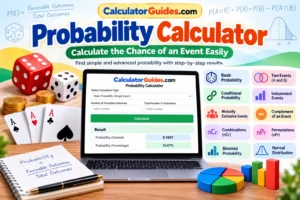
Probability Calculator-Use our Probability Calculator to find the chance of an event happening quickly and easily. You can calculate basic probability, probability of two events, conditional probability, independent events, mutually exclusive events, combinations, permutations, binomial probability, and more.Use our online calculators to save time when solving common mathematical and financial calculations.
Probability of Two Events Calculator
Probability Solver for Two Events
Probability of Series of Independent Events
Probability of Normal Distribution Calculator
Probability of Two Events Calculator
Probability Solver for Two Events
Probability of Series of Independent Events
Probability of Normal Distribution Calculator
Whether you are a student solving a math problem, working on statistics homework, checking a probability question, or simply trying to understand the chance of an event, this calculator can save you time.
Enter your values, choose the type of probability you need, and get your result in seconds.
What Is a Probability Calculator?
A Probability Calculator is an online tool that helps you calculate the likelihood of an event happening.
Probability is usually written as a number between 0 and 1 or as a percentage between 0% and 100%.
- 0 means the event is impossible.
- 1 means the event is certain.
- A value between 0 and 1 shows the chance of the event happening.
For example, the probability of getting heads when tossing a fair coin is:
1 ÷ 2 = 0.5 = 50%
A probability calculator can make these calculations much easier, especially when the problem has multiple events or several possible outcomes.
How to Use the Probability Calculator
Using our online probability calculator is simple.
Step 1: Enter your values
Enter the numbers required for your probability problem.
Depending on the calculation, you may need:
- Favorable outcomes
- Total outcomes
- Probability of Event A
- Probability of Event B
- Number of trials
- Number of successes
- Mean
- Standard deviation
- Number of items
- Number of selections
Step 2: Choose the calculation
Select the type of probability you want to calculate.
For example:
- Basic probability
- Two events
- Conditional probability
- Binomial probability
- Combinations
- Permutations
- Normal distribution
Step 3: Calculate
Click the calculate button.
The calculator will show your probability as a decimal and, when applicable, as a percentage.
Basic Probability Formula
The most basic probability formula is:
P(E) = Favorable Outcomes ÷ Total Possible Outcomes
Here, P(E) means the probability of event E happening.
Example
Suppose you roll a fair six-sided die.
There are 6 possible outcomes:
1, 2, 3, 4, 5, 6
What is the probability of rolling a 4?
There is one favorable outcome.
So:
P(4) = 1 ÷ 6
P(4) ≈ 0.1667
As a percentage:
16.67%
So, the probability of rolling a 4 is approximately 16.67%.
Probability as a Percentage
Probability can be written in different ways.
For example:
0.25 = 25% = 1/4
To convert a decimal probability into a percentage, multiply it by 100.
Example
0.75 × 100 = 75%
To convert a percentage into a decimal, divide it by 100.
Example
40% ÷ 100 = 0.40
Our probability calculator online can display the result in an easy-to-understand format.
Probability of Two Events
Many probability questions involve two events.
For example:
- What is the probability of A and B?
- What is the probability of A or B?
- What is the probability that neither happens?
- What is the probability that exactly one happens?
These questions require different probability rules.
Probability of A and B
The notation for both events happening is:
P(A ∩ B)
If A and B are independent events:
P(A and B) = P(A) × P(B)
Example
Suppose the probability of Event A is 0.5 and the probability of Event B is 0.4.
Then:
P(A and B) = 0.5 × 0.4
P(A and B) = 0.20
So the probability is:
20%
Probability of A or B
The probability of A or B is called the union of two events.
It is written as:
P(A ∪ B)
For two independent events:
P(A or B) = P(A) + P(B) − P(A and B)
The subtraction is important because the overlap would otherwise be counted twice.
Example
Suppose:
P(A) = 0.5
P(B) = 0.4
P(A and B) = 0.2
Then:
P(A or B) = 0.5 + 0.4 − 0.2
P(A or B) = 0.7
So there is a 70% probability that A or B or both will happen.
Probability of Neither A Nor B
Sometimes you want to know the probability that neither event occurs.
For independent events:
P(neither A nor B) = P(not A) × P(not B)
Since:
P(not A) = 1 − P(A)
and:
P(not B) = 1 − P(B)
If P(A) = 0.5 and P(B) = 0.4:
P(neither) = (1 − 0.5) × (1 − 0.4)
= 0.5 × 0.6
= 0.30
So the probability is 30%.
Probability of Exactly One Event
Sometimes the question asks for A or B, but not both.
This is called exclusive OR.
For independent events:
P(exactly one) = P(A and not B) + P(B and not A)
For example, if:
P(A) = 0.5
P(B) = 0.4
then:
P(exactly one) = 0.5 × 0.6 + 0.4 × 0.5
= 0.30 + 0.20
= 0.50
So the probability of exactly one event happening is 50%.
Conditional Probability Calculator
Conditional probability means the probability of one event happening when you already know that another event has happened.
It is written as:
P(A | B)
This means:
Probability of A given B
The basic conditional probability formula is:
P(A | B) = P(A and B) ÷ P(B)
Example
Suppose:
P(A and B) = 0.20
P(B) = 0.40
Then:
P(A | B) = 0.20 ÷ 0.40
= 0.50
So:
P(A | B) = 50%
A conditional probability calculator can be helpful when a question includes words such as:
- Given that
- If
- Assuming that
- Knowing that
- When
Independent Events
Two events are independent when one event does not change the probability of the other event.
A simple example is tossing a coin twice.
The result of the first toss does not change the probability of heads on the second toss.
For independent events:
P(A and B) = P(A) × P(B)
Another way to describe independence is:
P(A | B) = P(A)
Examples of independent events can include separate coin tosses and separate rolls of a fair die.
Dependent Events
Two events are dependent when one event can affect the probability of the other.
For example, imagine drawing two cards from a deck without replacing the first card.
The number of cards remaining changes after the first draw.
Therefore, the probability of the second event can change.
For dependent events, conditional probability is often required.
This is an important difference when solving probability problems.
Mutually Exclusive Events
Two events are mutually exclusive when they cannot happen at the same time.
For example, when rolling one die, you cannot roll both a 2 and a 5 on the same roll.
If two events are mutually exclusive:
P(A and B) = 0
Therefore:
P(A or B) = P(A) + P(B)
This is different from independent events, so it is important to identify what the question is asking before choosing a formula.
Complement of an Event
The complement of an event means that the event does not happen.
The complement of A is written as:
P(A’)
or sometimes:
P(not A)
The formula is:
P(A’) = 1 − P(A)
Example
If the probability of rain is 0.30:
P(no rain) = 1 − 0.30
= 0.70
So the probability of no rain is 70%.
The complement rule is also useful for calculating the probability of at least one event.
Probability of At Least One
Questions that say at least one can often be easier to solve using the complement rule.
For independent repeated events:
P(at least one) = 1 − P(none)
Example
Suppose the probability of success on one attempt is 0.20.
The probability of failure is:
1 − 0.20 = 0.80
If the event is tried twice:
P(no success) = 0.80 × 0.80
= 0.64
Therefore:
P(at least one success) = 1 − 0.64
= 0.36
So the probability of at least one success is 36%.
Combinations and Probability
Some probability problems require you to count how many possible outcomes exist.
This is where combinations can be useful.
A combination is used when the order of the selected items does not matter.
The combination formula is:
C(n, r) = n! ÷ [r!(n − r)!]
Here:
- n = total number of items
- r = number of items selected
- ! = factorial
Example
Suppose you have 5 people and want to choose 2.
The number of combinations is:
C(5, 2) = 10
So there are 10 different groups of 2.
Permutations and Probability
A permutation is used when the order matters.
The permutation formula is:
P(n, r) = n! ÷ (n − r)!
For example, if you have 5 people and want to arrange 2 of them in different positions:
P(5, 2) = 5 × 4
= 20
So there are 20 possible ordered arrangements.
The difference is simple:
- Combination: order does not matter
- Permutation: order matters
Binomial Probability Calculator
A binomial probability calculator is useful when an experiment has a fixed number of trials and each trial has two possible outcomes, such as success or failure.
A binomial problem generally has:
- A fixed number of trials
- Two possible outcomes
- The same probability of success for each trial
- Independent trials
The binomial probability formula for exactly k successes is:
P(X = k) = C(n, k) × pᵏ × (1 − p)ⁿ⁻ᵏ
Where:
- n = number of trials
- k = number of successes
- p = probability of success
- 1 − p = probability of failure
Example
Suppose a fair coin is flipped 5 times.
What is the probability of getting exactly 3 heads?
Here:
n = 5
k = 3
p = 0.5
The result is:
31.25%
A binomial probability calculator can perform this calculation quickly.
Normal Distribution Probability
Probability questions can also involve a normal distribution.
A normal distribution is often shown as a bell-shaped curve.
For a normal probability calculation, you may need:
- Mean
- Standard deviation
- Lower value
- Upper value
A normal distribution calculator can help find the probability that a value falls within a particular range.
For example, you may want to know the probability that a test score is between two values.
The z-score formula is:
z = (x − μ) ÷ σ
Where:
- x = value
- μ = mean
- σ = standard deviation
Bayes’ Theorem
Another important probability concept is Bayes’ theorem.
It is used to update the probability of an event when new information becomes available.
The formula is:
P(A | B) = [P(B | A) × P(A)] ÷ P(B)
Bayes’ theorem can be useful in areas such as statistics, data analysis, medical testing, machine learning, and decision analysis.
For simple probability questions, you may not need Bayes’ theorem. But for problems involving updated information or conditional evidence, it can be very useful.
Dice Probability
Dice are one of the easiest ways to understand probability.
A standard six-sided die has six equally likely outcomes:
1, 2, 3, 4, 5, 6
The probability of rolling a specific number is:
1 ÷ 6 ≈ 16.67%
For example:
Probability of rolling an even number
Even numbers are:
2, 4, 6
There are 3 favorable outcomes out of 6.
P(even) = 3 ÷ 6
= 0.5
= 50%
Coin Flip Probability
A fair coin has two possible outcomes:
- Heads
- Tails
The probability of heads is:
1 ÷ 2 = 0.5 = 50%
The probability of tails is also:
50%
For multiple coin flips, the probability changes depending on what you want to find.
For example, the probability of getting heads on two consecutive flips is:
0.5 × 0.5 = 0.25
So:
25%
Probability Examples
Here are some simple examples you can use to understand probability.
| Situation | Probability |
|---|---|
| Rolling a 6 on a fair die | 1/6 ≈ 16.67% |
| Getting heads on a fair coin | 1/2 = 50% |
| Rolling an even number | 3/6 = 50% |
| Rolling a number greater than 4 | 2/6 ≈ 33.33% |
| Getting two heads in two fair coin flips | 1/4 = 25% |
These examples show how the basic probability formula works.
Probability vs. Odds
Probability and odds are related, but they are not exactly the same thing.
Probability compares favorable outcomes with all possible outcomes.
Odds compare favorable outcomes with unfavorable outcomes.
For example, if the probability of an event is:
1/4
then the probability is:
25%
There is 1 favorable outcome and 3 unfavorable outcomes.
So the odds in favor are:
1:3
Understanding this difference can help avoid mistakes when reading probability questions.
Why Use an Online Probability Calculator?
Doing a simple probability calculation by hand is easy. More complicated problems can take much longer.
A free probability calculator can help you:
- Save time
- Check your math
- Understand probability formulas
- Calculate multiple events
- Convert probability to percentage
- Solve conditional probability questions
- Calculate binomial probability
- Work with combinations and permutations
- Check statistics homework
- Understand probability examples
It is especially useful when you want to verify an answer instead of repeating a long calculation.
Common Probability Mistakes
Probability questions can look simple, but small mistakes can change the answer.
Adding probabilities when you should multiply
For independent events happening together, multiplication is generally used.
P(A and B) = P(A) × P(B)
Forgetting the overlap
For an OR question, simply adding P(A) and P(B) can double-count the overlap.
The general addition rule is:
P(A or B) = P(A) + P(B) − P(A and B)
Confusing independent and dependent events
Always check whether the first event changes the probability of the second.
Confusing combinations and permutations
Ask yourself:
Does order matter?
If no, combinations may be appropriate.
If yes, permutations may be appropriate.
Mixing probability and percentage
Remember:
0.5 = 50%
not 0.5%.
Frequently Asked Questions
What is a probability calculator?
A probability calculator is an online tool that calculates the chance of an event happening. It can handle basic probability and, depending on the calculator, two events, conditional probability, binomial probability, combinations, permutations, and distributions.
How do you calculate probability?
For basic probability, divide the number of favorable outcomes by the total number of equally likely outcomes.
Probability = Favorable Outcomes ÷ Total Outcomes
What is the probability formula?
The basic probability formula is:
P(E) = Favorable Outcomes ÷ Total Possible Outcomes
What does probability from 0 to 1 mean?
A probability of 0 means an event is impossible. A probability of 1 means it is certain. Values between 0 and 1 show different levels of likelihood.
How do I calculate probability as a percentage?
Multiply the decimal probability by 100.
For example:
0.35 × 100 = 35%
What is conditional probability?
Conditional probability is the chance of one event happening when another event is already known to have happened.
P(A | B) = P(A and B) ÷ P(B)
What are independent events?
Independent events are events where one event does not change the probability of the other.
What are mutually exclusive events?
Mutually exclusive events cannot happen at the same time.
What is the probability of A and B?
For independent events:
P(A and B) = P(A) × P(B)
What is the probability of A or B?
For general events:
P(A or B) = P(A) + P(B) − P(A and B)
What is the probability of neither event?
For independent events:
P(neither) = (1 − P(A)) × (1 − P(B))
How do you calculate the probability of at least one?
For independent repeated events, use the complement:
P(at least one) = 1 − P(none)
What is binomial probability?
Binomial probability calculates the chance of getting a certain number of successes in a fixed number of independent trials.
What is the difference between a permutation and a combination?
A permutation is used when order matters. A combination is used when order does not matter.
Can probability be greater than 1?
No. A valid probability must be between 0 and 1, or between 0% and 100%.
Can probability be negative?
No. Probability cannot be negative.
What is the probability of an impossible event?
The probability of an impossible event is 0.
What is the probability of a certain event?
The probability of a certain event is 1, or 100%.
Final Thoughts
Probability becomes much easier when you know which formula to use.
Our Probability Calculator helps you calculate basic probability, two-event probability, conditional probability, independent events, mutually exclusive events, complements, combinations, permutations, binomial probability, and other common probability problems.
Instead of spending time doing long calculations by hand, enter your numbers into the calculator and check the result instantly.
Whether you are studying probability and statistics, working on homework, preparing for an exam, or simply checking a probability problem, CalculatorGuides.com makes the calculation simple and easy to understand.