
Log Calculator-Use our Log Calculator to calculate logarithms quickly and easily. You can find log base 10, natural log (ln), log base 2, or logarithms with any custom base.A logarithm may look difficult at first, but the basic idea is simple: a logarithm tells you what power you need to raise a base to get a certain number.Explore our free online calculator tools for quick answers calculatorguides across different categories.
Calculate logb(x) 🔢 Logarithm Calculator
• Change of Base: ln() / ln()
Calculate ln(x) where base is Euler's constant e ≈ 2.71828 🌿 Natural Logarithm (ln) Calculator
• Common Log Equivalent: log₁₀() =
Convert loga(x) to base b 🔄 Change of Base Log Calculator
• Evaluated Ratio: /
Solve for x in logb(x) = y or logb(a) = x 🧮 Log Equation Solver
For example:
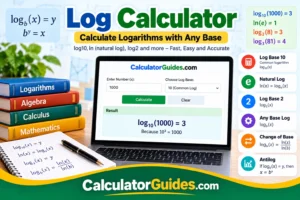
log₁₀(1000) = 3
because:
10³ = 1000
Our online log calculator makes these calculations quick and easy, so you do not have to work through the formula every time.
What Is a Log Calculator?
A log calculator is an online tool used to calculate the logarithm of a number.
It can be useful for:
- Log base 10
- Natural logarithm (ln)
- Log base 2
- Logarithms with any base
- Change of base calculations
- Antilog calculations
- Logarithm equations
- Checking logarithm homework
- Algebra and calculus problems
- Scientific calculations
For a logarithm written as:
logᵦ(x) = y
the question is:
“What power of b gives x?”
In other words:
bʸ = x
For example:
log₂(8) = 3
because:
2³ = 8
This is the basic idea behind every logarithm calculation.
How to Use the Log Calculator
Using a logarithm calculator is simple.
Step 1: Enter the number
Enter the number you want to calculate.
For example:
1000
Step 2: Choose the base
You can use a common base such as:
- 10
- e
- 2
You can also enter your own base if the calculator supports custom logarithms.
Step 3: Calculate
Click the calculate button.
The calculator will show the logarithm value.
Step 4: Check the answer
You can check the answer by raising the base to the calculated power.
For example:
log₂(8) = 3
Check:
2³ = 8
So the answer is correct.
Log Base 10 Calculator
A log base 10 calculator calculates logarithms with 10 as the base.
It is commonly written as:
log(x)
or:
log₁₀(x)
For example:
log₁₀(10) = 1
because:
10¹ = 10
Another example:
log₁₀(100) = 2
because:
10² = 100
And:
log₁₀(1000) = 3
because:
10³ = 1000
Common Log Examples
| Expression | Answer |
|---|---|
| log₁₀(1) | 0 |
| log₁₀(10) | 1 |
| log₁₀(100) | 2 |
| log₁₀(1,000) | 3 |
| log₁₀(10,000) | 4 |
| log₁₀(100,000) | 5 |
The base-10 logarithm is also called the common logarithm.
Natural Log Calculator
The natural logarithm is written as ln.
It uses a special mathematical constant called e as its base.
The value of e is approximately:
e = 2.718281828…
So:
ln(x) = logₑ(x)
For example:
ln(e) = 1
because:
e¹ = e
Another example:
ln(1) = 0
because:
e⁰ = 1
Natural logarithms are widely used in mathematics, calculus, science, statistics, finance, and equations involving continuous growth or decay.
Log Base 2 Calculator
A log base 2 calculator calculates logarithms using 2 as the base.
It is written as:
log₂(x)
For example:
log₂(8) = 3
because:
2³ = 8
Another example:
log₂(16) = 4
because:
2⁴ = 16
Log base 2 is especially common in computer science, binary systems, information theory, algorithms, and problems involving doubling or halving.
Log Calculator With Any Base
You do not always need to use base 10, e, or 2.
You can calculate a logarithm using almost any valid positive base except 1.
For example:
log₃(81) = 4
because:
3⁴ = 81
Another example:
log₅(125) = 3
because:
5³ = 125
If you know the base and the number, an any base log calculator can calculate the answer for you.
Logarithm Formula
The basic logarithm relationship is:
logᵦ(x) = y
This means:
bʸ = x
Where:
- b = base
- x = number or argument
- y = logarithm
For example:
log₄(64) = 3
because:
4³ = 64
Change of Base Formula
If your calculator does not have a button for the base you need, you can use the change of base formula.
The formula is:
logᵦ(x) = ln(x) / ln(b)
You can also use common logarithms:
logᵦ(x) = log(x) / log(b)
Both forms give the same mathematical result.
Example: log₂(8)
Using the change of base formula:
log₂(8) = ln(8) / ln(2)
Approximately:
2.07944 / 0.69315 = 3
Therefore:
log₂(8) = 3
How to Calculate a Logarithm
Let’s look at a simple example.
Suppose you want to calculate:
log₂(32)
Ask:
2 to what power equals 32?
We know:
2⁵ = 32
Therefore:
log₂(32) = 5
The calculator simply gives you the answer without requiring you to work through the calculation manually.
What Is an Antilog?
An antilog is the reverse of a logarithm.
If:
log₁₀(x) = 3
then:
x = 10³
Therefore:
x = 1000
So the antilog of 3 with base 10 is:
1000
In general, if:
logᵦ(x) = y
then:
x = bʸ
An antilog calculator can be useful when you know the logarithm and want to find the original number.
Logarithm Rules
There are several important rules of logarithms.
Product Rule
When multiplying two positive numbers:
logᵦ(xy) = logᵦ(x) + logᵦ(y)
For example:
log₂(8 × 4)
can be written as:
log₂(8) + log₂(4)
Quotient Rule
When dividing:
logᵦ(x/y) = logᵦ(x) − logᵦ(y)
Power Rule
For a power:
logᵦ(xⁿ) = n logᵦ(x)
For example:
log₂(8²) = 2 log₂(8)
Log of 1
For every valid base:
logᵦ(1) = 0
because:
b⁰ = 1
Log of the Base
For every valid base:
logᵦ(b) = 1
because:
b¹ = b
These rules are useful when simplifying logarithmic expressions and solving equations.
Important Logarithm Conditions
There are a few rules about which values can be used.
For real logarithms:
x must be greater than 0.
So:
log(10) is valid.
But:
log(0) is not defined.
And:
log(-10) is not a real number.
The base must also be:
greater than 0 and not equal to 1.
So a base such as 2, 3, 10, or e is valid, while a base of 1 is not.
Why Is log(0) Undefined?
There is no real number y that makes:
bʸ = 0
for a positive base b.
A positive base raised to any real power remains positive.
Therefore:
log(0) is undefined in the real number system.
Why Is the Log of a Negative Number Not a Real Number?
For a positive base, raising the base to a real power produces a positive result.
Therefore, there is no real exponent that makes:
bʸ = -5
So:
log(-5) has no real-number answer.
Complex logarithms can handle negative inputs, but that is a different topic from the basic real logarithm calculator.
Log Calculator Examples
Example 1: log₁₀(100)
We know:
10² = 100
Therefore:
log₁₀(100) = 2
Example 2: log₂(64)
We know:
2⁶ = 64
Therefore:
log₂(64) = 6
Example 3: log₃(27)
We know:
3³ = 27
Therefore:
log₃(27) = 3
Example 4: ln(e²)
Because the natural logarithm uses e as its base:
ln(e²) = 2
Example 5: log₁₀(0.01)
We know:
10⁻² = 0.01
Therefore:
log₁₀(0.01) = -2
A logarithm does not have to be a positive number. The result can be zero or negative depending on the input.
Difference Between Log and ln
The terms log and ln are sometimes confusing.
log
In many school and scientific settings, log means the common logarithm with base 10:
log(x) = log₁₀(x)
ln
ln means the natural logarithm with base e:
ln(x) = logₑ(x)
For example:
log₁₀(100) = 2
while:
ln(100) ≈ 4.6052
The exact convention for “log” can depend on the field, so always check the context of the problem.
Difference Between Log and Exponent
Logarithms and exponents are inverse operations.
An exponent asks:
What number do I get?
For example:
10³ = 1000
A logarithm asks:
What power do I need?
So:
log₁₀(1000) = 3
You can think of a logarithm as an exponent written in reverse.
Where Are Logarithms Used?
Logarithms are not only used in math classes.
They are useful in many areas.
Mathematics
Logarithms are used in algebra, calculus, equations, and functions.
Computer Science
Base-2 logarithms appear in algorithms, binary search, data structures, and information theory.
Chemistry
Logarithmic scales are used in areas such as pH.
Physics
Logarithmic measurements are used for quantities such as sound levels.
Finance
Logarithms can be used in growth models, returns, and financial mathematics.
Science
Logarithmic functions are useful when working with exponential growth and decay.
Log Calculator vs. Scientific Calculator
A scientific calculator can calculate many logarithms, but an online log calculator can be easier when you want to understand the calculation.
A useful online tool can show:
- The selected base
- The input number
- The logarithm result
- Change-of-base calculation
- Formula
- Step-by-step working
- Related log values
This can make it easier for students to check their work and understand why the answer is correct.
Frequently Asked Questions
What is a log calculator?
A log calculator is an online tool that calculates the logarithm of a number using a selected base.
What is a logarithm?
A logarithm tells you the power to which a base must be raised to produce a given number.
For example:
log₂(8) = 3
because:
2³ = 8
What is log base 10?
Log base 10 is the common logarithm.
log₁₀(1000) = 3
What is ln?
ln is the natural logarithm. Its base is the mathematical constant e, approximately 2.71828.
What is log base 2?
Log base 2 uses 2 as the base.
For example:
log₂(8) = 3
because 2³ = 8.
How do I calculate log with any base?
Use the change of base formula:
logᵦ(x) = ln(x) / ln(b)
What is the change of base formula?
The change of base formula converts a logarithm from one base to another:
logᵦ(x) = ln(x) / ln(b)
What is an antilog?
An antilog reverses a logarithm. If:
log₁₀(x) = 3
then:
x = 10³ = 1000
Can I calculate the log of zero?
No. log(0) is undefined in the real number system.
Can I calculate the log of a negative number?
Not as a real logarithm. The argument of a real logarithm must be positive.
Is log the same as ln?
No. In common usage, log usually means base 10, while ln means base e. The exact convention can vary by subject.
What is log₁₀(1)?
log₁₀(1) = 0
because:
10⁰ = 1
What is ln(1)?
ln(1) = 0
because:
e⁰ = 1
What is log₂(1024)?
log₂(1024) = 10
because:
2¹⁰ = 1024
Can I use decimals in a log calculator?
Yes. Positive decimal numbers can be used as logarithm inputs. A valid base must also be positive and cannot equal 1.
Final Thoughts
Logarithms become much easier when you remember one simple idea:
A logarithm asks what power is needed.
For example:
log₂(8) = 3
because:
2³ = 8
Our Log Calculator can help you calculate log base 10, natural log (ln), log base 2, and logarithms with any valid base. You can also use the change of base formula, logarithm rules, and antilog calculations to solve more advanced problems.
Whether you are a student, teacher, researcher, or simply checking a math problem, CalculatorGuides.com makes logarithm calculations quick and easy.