
Right Triangle Calculator-A Right Triangle Calculator helps you solve a triangle that has one 90-degree angle. You can use it to find a missing side, hypotenuse, angle, area, perimeter, or other measurements without doing every calculation by hand.Get quick answers using our free online calculators for finance, mathematics, measurements, and daily needs.
Enter any 2 known values (e.g., 2 sides OR 1 side + 1 angle) to calculate all missing properties:
Right Triangle Calculator
The calculator is useful for geometry homework, school math, construction, carpentry, engineering, DIY projects, roof calculations, ladders, ramps, room diagonals, screen sizes, and many everyday measurements.
The main rule behind the calculator is the Pythagorean theorem:
a² + b² = c²
Here, a and b are the two legs, and c is the hypotenuse.
What Is a Right Triangle?
A right triangle is a triangle that contains exactly one 90° angle.It has:
Two legs – the sides that form the right angle
One hypotenuse – the side opposite the 90° angle
One 90° angle
Two acute angles – both are less than 90°
The two smaller angles always add up to 90°.
For example, if one angle is 30°, the other acute angle is:
90° − 30° = 60°
So the three angles are:
30° + 60° + 90° = 180°
This is one of the easiest ways to check whether your angle calculation makes sense.
What Does a Right Triangle Calculator Find?
Depending on the information you enter, a right triangle calculator can find several measurements.
It can calculate:
- Hypotenus
- Missing leg
- First acute angle
- Second acute angle
- Area
- Perimeter
- Base
- Height
- Altitude to the hypotenuse
- Sine
- Cosine
- Tangent
- Inradius
- Circumradius
- Other useful triangle measurements
The basic version usually needs the two legs. More advanced calculators can solve the triangle when you know a combination such as a leg and hypotenuse or a side and an angle. Current online right-triangle tools commonly use the Pythagorean theorem and trigonometric ratios for these calculations.
How to Use the Right Triangle Calculator
Using the calculator is simple.
Step 1: Enter the known measurements
Enter the values you already know.
For example:
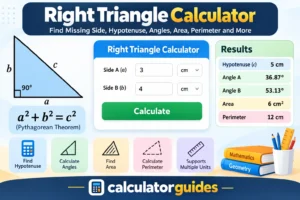
- Leg A = 3
- Leg B = 4
Step 2: Select the unit
You can use units such as:
- Inches
- Feet
- Centimeters
- Meters
- Millimeters
- Yards
The important thing is to use the same unit for the measurements.
Step 3: Click Calculate
The calculator applies the appropriate formula and gives you the missing measurements.
For a 3-4 right triangle, the hypotenuse is:
5
The area is:
6 square units
And the perimeter is:
12 units.
This classic 3-4-5 example is a common Pythagorean triple.
Right Triangle Formula
The most important formula for a right triangle is the Pythagorean theorem.
Pythagorean Theorem
a² + b² = c²
Where:
- a = first leg
- b = second leg
- c = hypotenuse
If you know both legs, you can find the hypotenuse.
Hypotenuse Formula
c = √(a² + b²)
For example, suppose:
a = 6
b = 8
Then:
c = √(6² + 8²)
c = √(36 + 64)
c = √100
c = 10
So the hypotenuse is 10.
How to Find a Missing Leg
Sometimes you know the hypotenuse and one leg, but you need to find the other leg.
You can rearrange the Pythagorean theorem.
Missing Leg Formula
a = √(c² − b²)
or
b = √(c² − a²)
For example:
- Hypotenuse = 13
- Known leg = 5
The missing leg is:
√(13² − 5²)
= √(169 − 25)
= √144
= 12
So the missing side is 12.
This gives the famous 5-12-13 right triangle.
How to Find the Hypotenuse
The hypotenuse is the easiest missing side to calculate when both legs are known.
Use:
c = √(a² + b²)
Example
Suppose:
- a = 9
- b = 12
Then:
c = √(9² + 12²)
c = √(81 + 144)
c = √225
c = 15
The hypotenuse is 15.
This is another Pythagorean triple:
9-12-15
What Is the Hypotenuse?
The hypotenuse is the longest side of a right triangle.
It is always located:
Opposite the 90° angle
A simple way to identify it is to find the right-angle symbol first. The side directly across from that angle is the hypotenuse.
For example:
       /|
      / |
   c /  | b
    /   |
   /____|
      a
     90°
Here:
- a = one leg
- b = another leg
- c = hypotenuse
Because c is opposite the 90° angle, it is the longest side.
Right Triangle Area Calculator
The area of a right triangle is very easy to calculate because the two legs can act as the base and height.
Area Formula
Area = ½ × a × b
Where:
- a = base
- b = height
Example
Suppose:
- Base = 8
- Height = 5
Then:
Area = ½ × 8 × 5
Area = 20
So the triangle has an area of 20 square units.
Remember that area uses square units.
For example:
- 20 cm²
- 20 m²
- 20 ft²
The area formula for a right triangle is half the product of its two legs.
Right Triangle Perimeter Calculator
The perimeter is the total distance around the triangle.
Perimeter Formula
P = a + b + c
For example, if:
- a = 3
- b = 4
- c = 5
Then:
P = 3 + 4 + 5
P = 12
So the perimeter is 12 units.
Right Triangle Angle Calculator
A right triangle always has one angle of:
90°
The remaining two angles are acute and together equal:
90°
To find an unknown angle, you can use trigonometry.
The three basic trigonometric ratios are:
- Sine
- Cosine
- Tangent
These are commonly remembered as:
SOH-CAH-TOA
What Does SOH-CAH-TOA Mean?
SOH-CAH-TOA is a simple way to remember the three main trigonometric formulas.
SOH
sin(θ) = Opposite / Hypotenuse
CAH
cos(θ) = Adjacent / Hypotenuse
TOA
tan(θ) = Opposite / Adjacent
These relationships are used to calculate angles and missing sides when you know one side and an angle.
How to Find an Angle Using Tangent
Suppose:
- Opposite side = 6
- Adjacent side = 8
Use:
tan(θ) = 6 / 8
tan(θ) = 0.75
Then use the inverse tangent:
θ = tan⁻¹(0.75)
The answer is approximately:
36.87°
The other acute angle is:
90° − 36.87° = 53.13°
So the two angles are approximately:
- 36.87°
- 53.13°
The third angle is:
- 90°
Right Triangle With One Side and One Angle
You do not always need two sides.
If you know:
- One side
- One acute angle
you can use trigonometry to find the remaining sides.
For example:
- Hypotenuse = 10
- Angle = 30°
Using sine:
sin(30°) = opposite / 10
Since:
sin(30°) = 0.5
The opposite side is:
10 × 0.5 = 5
Using cosine:
cos(30°) = adjacent / 10
The adjacent side is approximately:
8.66
So the triangle has approximately:
- Opposite = 5
- Adjacent = 8.66
- Hypotenuse = 10
Right Triangle With Two Legs
This is one of the most common calculations.
Suppose:
a = 6
b = 8
First calculate the hypotenuse:
c = √(6² + 8²)
c = 10
Then calculate the area:
A = ½ × 6 × 8
A = 24
Then calculate the perimeter:
P = 6 + 8 + 10
P = 24
The angles are approximately:
- 36.87°
- 53.13°
- 90°
So one calculation can give you almost all the important properties of the triangle.
Right Triangle Example: 3-4-5 Triangle
The 3-4-5 triangle is one of the most famous right triangles.
Its sides are:
- 3
- 4
- 5
Check the Pythagorean theorem:
3² + 4² = 5²
9 + 16 = 25
25 = 25
So it is a right triangle.
Area
½ × 3 × 4 = 6
Perimeter
3 + 4 + 5 = 12
Angles
Approximately:
- 36.87°
- 53.13°
- 90°
Because the proportions stay the same, multiplying every side by the same number creates another right triangle.
For example:
6-8-10
9-12-15
12-16-20
All have the same basic shape.
Common Pythagorean Triples
A Pythagorean triple is a group of three positive whole numbers that satisfies:
a² + b² = c²
Some common examples include:
| Leg A | Leg B | Hypotenuse |
|---|---|---|
| 3 | 4 | 5 |
| 5 | 12 | 13 |
| 6 | 8 | 10 |
| 7 | 24 | 25 |
| 8 | 15 | 17 |
| 9 | 12 | 15 |
| 12 | 16 | 20 |
| 20 | 21 | 29 |
These can be useful when checking geometry problems or construction measurements.
Right Triangle Calculator for a Ladder
A right triangle appears naturally when a ladder leans against a wall.
Imagine:
- The wall is vertical.
- The ground is horizontal.
- The ladder forms the hypotenuse.
If you know the ladder length and its distance from the wall, you can calculate how high the ladder reaches.
Example
Suppose:
- Ladder = 5 m
- Distance from wall = 1.5 m
The ladder is the hypotenuse.
Height:
h = √(5² − 1.5²)
h = √(25 − 2.25)
h = √22.75
h ≈ 4.77 m
So the ladder reaches approximately 4.77 meters high.
For real-world ladder or construction safety, mathematical calculations should not replace applicable safety requirements or professional judgment.
Right Triangle Calculator for a Roof
Right triangles are also common in roof measurements.
You may know:
- Roof rise
- Horizontal run
- Roof slope
- Rafter length
- Roof angle
The right triangle relationship can help calculate the missing measurement.
For example, if:
- Rise = 4 ft
- Run = 8 ft
Then the rafter length is:
√(4² + 8²)
= √80
≈ 8.94 ft
This gives the basic geometric length before considering practical construction details such as overhangs or other measurements.
Right Triangle Calculator for a Ramp
A ramp can also form a right triangle.
The three important measurements are often:
- Horizontal distance
- Vertical rise
- Ramp length
If the rise and horizontal distance are known, the ramp length can be found using the Pythagorean theorem.
For example:
- Rise = 3 ft
- Run = 12 ft
Ramp length:
√(3² + 12²)
= √153
≈ 12.37 ft
For accessibility projects, however, follow the relevant building and accessibility standards rather than relying only on the mathematical result.
Right Triangle Calculator for a Rectangle Diagonal
A rectangle can be divided into two right triangles.
This makes the right triangle formula useful for finding a rectangle’s diagonal.
Formula
Diagonal = √(length² + width²)
For example:
- Length = 12
- Width = 5
Then:
Diagonal = √(12² + 5²)
= √(144 + 25)
= √169
= 13
So the diagonal is 13 units.
This same idea is useful for:
- Rooms
- Floors
- Tables
- Screens
- Boxes
- Frames
- Panels
Right Triangle and Screen Size
Television and monitor screens are rectangular, but their diagonal measurement is related to a right triangle.
If you know the screen’s width and height, you can calculate the diagonal using:
d = √(width² + height²)
This is another everyday application of the Pythagorean theorem.
Note that advertised screen sizes are normally measured diagonally, while the exact width and height depend on the screen’s aspect ratio.
Right Triangle Altitude
An advanced right triangle calculation is the altitude to the hypotenuse.
If the legs are a and b, and the hypotenuse is c, the altitude from the right angle to the hypotenuse can be calculated using:
h = (a × b) / c
Example
Suppose:
- a = 3
- b = 4
- c = 5
Then:
h = (3 × 4) / 5
h = 12 / 5
h = 2.4
So the altitude to the hypotenuse is 2.4 units.
Right Triangle Inradius
The inradius is the radius of the circle that fits inside the triangle and touches all three sides.
For a right triangle:
r = (a + b − c) / 2
For a 3-4-5 triangle:
r = (3 + 4 − 5) / 2
r = 2 / 2
r = 1
So the inradius is 1 unit.
Right Triangle Circumradius
The circumradius is the radius of the circle that passes through all three vertices of the triangle.
For a right triangle, there is a useful shortcut:
R = c / 2
where c is the hypotenuse.
For a 3-4-5 triangle:
R = 5 / 2
R = 2.5
So the circumradius is 2.5 units.
Can You Solve a Right Triangle With Any Two Sides?
Usually, yes, as long as the two measurements are valid and provide enough information.
Common combinations include:
Two legs
You can find:
- Hypotenuse
- Angles
- Area
- Perimeter
One leg and hypotenuse
You can find:
- Other leg
- Angles
- Area
- Perimeter
One side and one acute angle
You can use trigonometry to find the remaining sides and angle.
Two angles only
The shape can be determined, but the actual size cannot.
For example, a triangle with angles:
30°, 60°, 90°
could be:
- 5-8.66-10
- 10-17.32-20
- 20-34.64-40
The angles stay the same, but the triangle can have different sizes. You need at least one side length to determine the actual dimensions.
Difference Between a Right Triangle and a Regular Triangle
Not every triangle is a right triangle.
A right triangle must contain a 90° angle.
A general triangle can have:
- Three acute angles
- One obtuse angle
- One right angle
The Pythagorean theorem applies specifically to right triangles. For a triangle without a 90° angle, other formulas such as the Law of Cosines may be required.
So do not use:
a² + b² = c²
on an ordinary triangle unless you know it is a right triangle.
How to Check if a Triangle Is a Right Triangle
If you know all three side lengths, you can check them with the Pythagorean theorem.
First, identify the longest side and call it c.
Then calculate:
a² + b²
and compare it with:
c²
If:
a² + b² = c²
the triangle is a right triangle.
Example
Sides:
- 6
- 8
- 10
Check:
6² + 8² = 10²
36 + 64 = 100
100 = 100
Therefore, it is a right triangle.
What If the Numbers Do Not Work?
Suppose the sides are:
- 5
- 6
- 8
Check:
5² + 6² = 8²
25 + 36 = 64
61 ≠ 64
Therefore, these sides do not form a right triangle with 8 as the hypotenuse.
This is a useful way to check homework answers and measurements.
Units in a Right Triangle Calculator
You can calculate a right triangle using almost any length unit.
Examples include:
- Millimeters
- Centimeters
- Meters
- Kilometers
- Inches
- Feet
- Yards
- Miles
The Pythagorean theorem itself does not care which length unit you use.
However, do not mix units without converting them first.
For example, do not enter:
- Leg A = 2 meters
- Leg B = 30 centimeters
as if both numbers were in the same unit.
Convert first:
2 meters = 200 centimeters
Then calculate:
√(200² + 30²)
Alternatively, convert 30 cm to 0.3 m and use:
√(2² + 0.3²)
Both approaches give the same physical result.
Why Is the Hypotenuse Always the Longest Side?
The hypotenuse is opposite the 90° angle.
In any triangle, the side opposite the largest angle is the longest side. Because 90° is the largest angle in a right triangle, the side opposite it must be the longest.
You can also see this from the Pythagorean theorem:
c² = a² + b²
Since both a² and b² are positive, c² must be greater than either one individually.
Therefore:
c > a
and
c > b
Common Mistakes When Solving Right Triangles
Even simple formulas can produce wrong answers if the inputs are incorrect.
1. Choosing the wrong hypotenuse
The hypotenuse is always opposite the 90° angle.
2. Using the Pythagorean theorem on a non-right triangle
The basic formula:
a² + b² = c²
is for right triangles.
3. Mixing units
Convert all measurements to the same unit before calculating.
4. Forgetting the square root
If:
c² = 25
then:
c = 5
not 25.
5. Forgetting that area uses square units
If the answer is 20 and the input was in meters, area should be:
20 m²
not 20 m.
6. Using the wrong calculator angle mode
When using a scientific calculator for trigonometry, make sure it is set to degrees if your angle is measured in degrees.
7. Entering an impossible hypotenuse
The hypotenuse must be longer than either leg.
For example, a hypotenuse of 5 cannot be paired with a leg of 7.
Right Triangle Calculator vs Pythagorean Theorem Calculator
These terms are closely related.
A Pythagorean Theorem Calculator mainly focuses on finding a missing side using:
a² + b² = c²
A Right Triangle Calculator can be broader. It may calculate:
- Missing sides
- Hypotenuse
- Angles
- Area
- Perimeter
- Trigonometric ratios
- Altitude
- Radius measurements
So a Pythagorean theorem calculator can be considered a specialized type of right triangle calculator.
Why Use an Online Right Triangle Calculator?
Doing the calculation manually is useful for learning, but an online calculator can save time.
It can help you:
- Check homework
- Verify manual calculations
- Solve construction measurements
- Find a missing side quickly
- Calculate triangle area
- Calculate perimeter
- Find unknown angles
- Reduce arithmetic mistakes
- Work with decimal values
- Understand the steps behind the result
The important part is still understanding why the formula works. The calculator should make the process easier, not hide the mathematics.
Right Triangle Formula Quick Reference
| Calculation | Formula |
|---|---|
| Pythagorean theorem | a² + b² = c² |
| Hypotenuse | c = √(a² + b²) |
| Missing leg | a = √(c² − b²) |
| Missing leg | b = √(c² − a²) |
| Area | A = ½ab |
| Perimeter | P = a + b + c |
| Sine | sin θ = opposite / hypotenuse |
| Cosine | cos θ = adjacent / hypotenuse |
| Tangent | tan θ = opposite / adjacent |
| Acute angles | A + B = 90° |
| Altitude to hypotenuse | h = ab/c |
| Inradius | r = (a + b − c)/2 |
| Circumradius | R = c/2 |
Frequently Asked Questions
What is a right triangle?
A right triangle is a triangle with one angle measuring exactly 90 degrees. The side opposite this angle is called the hypotenuse.
What is the formula for a right triangle?
The main side formula is:
a² + b² = c²
This is the Pythagorean theorem.
How do I calculate the hypotenuse?
Use:
c = √(a² + b²)
Square both legs, add them together, and take the square root.
What is the hypotenuse?
The hypotenuse is the side opposite the 90° angle. It is always the longest side of a right triangle.
How do I find a missing side?
If you know the hypotenuse and one leg, subtract the square of the known leg from the square of the hypotenuse and take the square root.
Missing leg = √(c² − a²)
How do I calculate the area of a right triangle?
Use:
Area = ½ × base × height
For a right triangle, the two legs can be used as the base and height.
How do I calculate the perimeter?
Add all three sides:
P = a + b + c
How do I find a right triangle angle?
You can use inverse sine, inverse cosine, or inverse tangent depending on which sides are known.
What is SOH-CAH-TOA?
SOH-CAH-TOA is a memory trick for remembering:
Sine = Opposite / Hypotenuse
Cosine = Adjacent / Hypotenuse
Tangent = Opposite / Adjacent
Do the two smaller angles always add to 90°?
Yes. A triangle has 180° total, and a right triangle already has a 90° angle. Therefore, the other two angles add up to 90°.
Can I use decimals?
Yes. Right triangle calculations can use whole numbers, decimals, and many other numerical values as long as the measurements are valid.
Can I use different units?
Yes, but convert the measurements to the same unit before calculating.
Can the hypotenuse be shorter than a leg?
No. The hypotenuse is always the longest side.
Does the Pythagorean theorem work for every triangle?
No. The basic Pythagorean theorem applies to right triangles. Other triangles require different methods.
What is a 3-4-5 triangle?
A 3-4-5 triangle is a right triangle because:
3² + 4² = 5²
It is one of the most common Pythagorean triples.
What is the difference between area and perimeter?
Area measures the space inside the triangle and is expressed in square units.
Perimeter measures the total distance around the triangle and is expressed in regular length units.
Can a right triangle have two equal sides?
Yes. If the two legs are equal, it is a 45-45-90 triangle. Its two acute angles are both 45°.
Can a right triangle have more than one 90° angle?
No. A triangle’s angles must total 180°. Two 90° angles would already use the entire 180°, leaving no angle for the third side.
Final Thoughts
A Right Triangle Calculator makes it easy to solve common triangle problems involving the hypotenuse, missing sides, angles, area, perimeter, and trigonometry.
The most important formula to remember is:
a² + b² = c²
If you know the two legs, you can find the hypotenuse. If you know the hypotenuse and one leg, you can find the missing leg. With a side and an acute angle, SOH-CAH-TOA can help you solve the remaining measurements.
Right triangles are not limited to classroom geometry. The same mathematics appears in ladders, roofs, ramps, construction, room diagonals, screens, woodworking, surveying, design, and many everyday measurements.
For a quick answer, enter your known measurements into the calculator, check that the units match, and review the result using the formulas above.