
Pythagorean Theorem Calculator-A Pythagorean Theorem Calculator helps you find the missing side of a right triangle when you know the other two sides. It can calculate the hypotenuse, base, or height quickly without making you work through the formula by hand.Get quick answers using our free online calculators for finance, mathematics,Right Triangle Calculator measurements, and daily needs.
Koi bhi 2 values bharein, 3rd missing value calculate ho jayegi:
Pythagorean Theorem Calculator
• Side A: a = √(c² - b²)
• Side B: b = √(c² - a²)
• Hypotenuse C: c = √(a² + b²)
The Pythagorean theorem is one of the most useful formulas in geometry. It is commonly used in mathematics, construction, engineering, architecture, physics, and everyday measurements.
The basic formula is:
a² + b² = c²
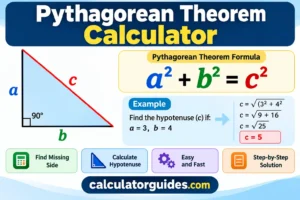
Here, a and b are the two shorter sides of a right triangle, while c is the hypotenuse, which is always the longest side.
With a Pythagorean theorem calculator, you can enter the known measurements and instantly find the missing side.
What Is the Pythagorean Theorem?
The Pythagorean theorem is a mathematical rule used to find the relationship between the three sides of a right triangle.
It states that:
a² + b² = c²
Where:
- a = first leg
- b = second leg
- c = hypotenuse
The theorem only works for a right triangle, which is a triangle containing one angle equal to 90 degrees.
For example, suppose a right triangle has sides of 3 and 4 units.
Using the formula:
3² + 4² = c²
9 + 16 = c²
25 = c²
Taking the square root:
c = 5
So, the missing hypotenuse is 5 units.
This is known as the famous 3-4-5 right triangle.
What Is a Pythagorean Theorem Calculator?
A Pythagorean Theorem Calculator is an online tool that uses the Pythagorean theorem to calculate a missing side of a right triangle.
Instead of manually applying the formula, you simply enter the values you already know.
For example, if you know:
- Side A = 6
- Side B = 8
The calculator can find the hypotenuse:
c = √(6² + 8²)
c = √100
c = 10
The answer is 10.
A calculator is especially useful when the numbers are not simple whole numbers and the final answer contains decimals.
Pythagorean Theorem Calculator Formula
The main Pythagorean theorem formula is:
a² + b² = c²
To calculate the hypotenuse:
c = √(a² + b²)
To calculate side a:
a = √(c² − b²)
To calculate side b:
b = √(c² − a²)
The correct formula depends on which side of the triangle is missing.
Formula to Find the Hypotenuse
When both legs are known, use:
c = √(a² + b²)
Example:
a = 5
b = 12
Therefore:
c = √(5² + 12²)
c = √(25 + 144)
c = √169
c = 13
The hypotenuse is 13 units.
Formula to Find a Missing Leg
If the hypotenuse and one leg are known, subtract the known leg squared from the hypotenuse squared.
a = √(c² − b²)
For example:
c = 13
b = 5
a = √(13² − 5²)
a = √(169 − 25)
a = √144
a = 12
So the missing side is 12 units.
How to Use a Pythagorean Theorem Calculator
Using a Pythagorean theorem calculator is simple.
Step 1: Identify the Right Triangle
First, make sure the triangle has a 90-degree angle.
The theorem does not apply directly to ordinary triangles that do not have a right angle.
Step 2: Identify the Hypotenuse
The hypotenuse is the side opposite the 90-degree angle.
It is also the longest side of a right triangle.
Step 3: Enter the Known Measurements
Enter the two known side lengths into the calculator.
Depending on the calculator, you may select whether you want to calculate:
- Hypotenuse
- First leg
- Second leg
Step 4: Calculate
Press the calculate button.
The calculator applies the correct formula automatically.
Step 5: Check the Unit
The answer uses the same length unit as the measurements you entered.
For example:
- Inches → inches
- Feet → feet
- Meters → meters
- Centimeters → centimeters
If you enter different units, convert them to the same unit before calculating.
Pythagorean Theorem Calculator Examples
Understanding examples makes the formula much easier.
Example 1: Find the Hypotenuse
Suppose a right triangle has:
- a = 8 cm
- b = 15 cm
Use:
c = √(a² + b²)
c = √(8² + 15²)
c = √(64 + 225)
c = √289
c = 17 cm
The hypotenuse is 17 cm.
Example 2: Find a Missing Side
Suppose:
- Hypotenuse = 10 meters
- One leg = 6 meters
Use:
a = √(c² − b²)
a = √(10² − 6²)
a = √(100 − 36)
a = √64
a = 8 meters
The missing side is 8 meters.
Example 3: 3-4-5 Triangle
A right triangle has:
- a = 3
- b = 4
Then:
c = √(3² + 4²)
c = √25
c = 5
Therefore, the three sides are:
3, 4, and 5
This is one of the most common Pythagorean triples.
Example 4: 5-12-13 Triangle
If the two legs are 5 and 12:
c = √(5² + 12²)
c = √169
c = 13
So:
5² + 12² = 13²
This is another common Pythagorean triple.
What Is the Hypotenuse?
The hypotenuse is the longest side of a right triangle.
It is always located opposite the 90-degree angle.
For example, in a right triangle with sides 3, 4, and 5, the side measuring 5 is the hypotenuse.
A simple way to remember it is:
The hypotenuse is opposite the right angle.
When calculating the hypotenuse, use:
c = √(a² + b²)
The hypotenuse can never be shorter than either of the other two sides.
How to Find the Missing Side of a Right Triangle
The Pythagorean theorem can find any missing side as long as you know the other two sides and the triangle is a right triangle.
Missing Hypotenuse
Use:
c = √(a² + b²)
Missing First Leg
Use:
a = √(c² − b²)
Missing Second Leg
Use:
b = √(c² − a²)
The important point is to identify the hypotenuse correctly before choosing the formula.
Pythagorean Theorem Calculator for Feet
You can use the calculator with measurements in feet.
For example:
- Width = 9 ft
- Height = 12 ft
Then:
c = √(9² + 12²)
c = √225
c = 15 ft
The diagonal distance is 15 feet.
This can be useful for:
- Construction measurements
- Room dimensions
- Ladders
- Roofing
- Landscaping
- Property measurements
Pythagorean Theorem Calculator for Inches
The same formula works with inches.
Suppose:
- a = 6 inches
- b = 8 inches
Then:
c = √(6² + 8²)
c = √100
c = 10 inches
The answer is 10 inches.
The calculator does not change the mathematics based on the unit. You only need to make sure both measurements use the same unit.
Pythagorean Theorem Calculator for Meters
For metric measurements, you can use meters, centimeters, millimeters, or other compatible units.
For example:
- a = 7 m
- b = 24 m
Then:
c = √(7² + 24²)
c = √625
c = 25 m
The diagonal is 25 meters.
Pythagorean Theorem Calculator for Centimeters
Suppose a right triangle has two sides measuring:
- 9 cm
- 12 cm
Then:
c = √(9² + 12²)
c = √(81 + 144)
c = √225
c = 15 cm
So the hypotenuse is 15 cm.
Pythagorean Triples
A Pythagorean triple is a group of three positive whole numbers that satisfy the Pythagorean theorem.
In other words:
a² + b² = c²
Some common Pythagorean triples are:
| Side A | Side B | Hypotenuse |
|---|---|---|
| 3 | 4 | 5 |
| 5 | 12 | 13 |
| 6 | 8 | 10 |
| 7 | 24 | 25 |
| 8 | 15 | 17 |
| 9 | 12 | 15 |
| 9 | 40 | 41 |
| 12 | 16 | 20 |
| 20 | 21 | 29 |
These triples are useful because they allow you to recognize right triangles quickly.
For example, if you measure three sides and get 6, 8, and 10, the triangle is a right triangle because:
6² + 8² = 10²
36 + 64 = 100
How to Check If a Triangle Is a Right Triangle
The Pythagorean theorem can also help determine whether a triangle is a right triangle.
First, identify the longest side.
Then use:
a² + b² = c²
Suppose the sides are:
- 7
- 24
- 25
The longest side is 25.
Check:
7² + 24² = 25²
49 + 576 = 625
625 = 625
Therefore, the triangle is a right triangle.
If the two sides squared do not add up to the square of the longest side, the triangle is not a right triangle.
Pythagorean Theorem vs. Distance Formula
The Pythagorean theorem and the distance formula are closely related.
The distance formula is:
d = √[(x₂ − x₁)² + (y₂ − y₁)²]
It is commonly used to find the straight-line distance between two points on a coordinate plane.
The Pythagorean theorem is:
c = √(a² + b²)
Both formulas involve squaring two values, adding them, and taking the square root.
The distance formula can be understood as an application of the Pythagorean theorem to coordinate geometry.
Pythagorean Theorem and Diagonal Length
One of the most common uses of the theorem is finding the diagonal of a rectangle.
Suppose a rectangular screen is:
- 10 inches wide
- 6 inches high
The diagonal can be calculated as:
d = √(10² + 6²)
d = √136
d ≈ 11.66 inches
So the screen diagonal is approximately 11.66 inches.
This same idea can be used for:
- TV screens
- Computer monitors
- Rooms
- Tables
- Doors
- Windows
- Floors
Real-Life Uses of the Pythagorean Theorem
The Pythagorean theorem is not only a school mathematics formula. It is useful in many real-world situations.
Construction
Builders can use the theorem to calculate diagonal distances and check whether corners are square.
A 3-4-5 triangle is especially useful for checking a 90-degree corner.
Ladders
Suppose a ladder is placed against a wall.
If you know the distance between the wall and the bottom of the ladder and the height reached on the wall, you can calculate the ladder’s length.
Roofing
Roofers can use right-triangle calculations to estimate roof slopes, rafter lengths, and diagonal measurements.
Navigation
The theorem can help calculate straight-line distances when horizontal and vertical distances are known.
Engineering
Engineers use right-triangle calculations in structural design, mechanics, electronics, and other technical applications.
Sports
The theorem can be useful for calculating distances across courts, fields, and other spaces.
Home Projects
You can use it for measuring:
- Furniture
- Rooms
- Stairs
- Shelves
- Screens
- Garden layouts
Pythagorean Theorem Calculator for Construction
Construction is one of the practical areas where the theorem is especially useful.
For example, suppose you need to know the diagonal distance across a rectangular area that is:
- 20 feet long
- 15 feet wide
Use:
d = √(20² + 15²)
d = √(400 + 225)
d = √625
d = 25 feet
The diagonal is 25 feet.
This can help when measuring a site, checking a rectangular layout, or determining the length of a diagonal support.
Pythagorean Theorem Calculator for a Ladder
Imagine a ladder reaches a window 12 feet above the ground, and the bottom of the ladder is 5 feet away from the wall.
The ladder length is the hypotenuse.
c = √(12² + 5²)
c = √(144 + 25)
c = √169
c = 13 feet
So the ladder is 13 feet long.
In real-world ladder use, always follow appropriate safety guidance. The mathematical result only gives the geometric distance.
Can the Pythagorean Theorem Be Used for Any Triangle?
No.
The standard Pythagorean theorem applies specifically to right triangles.
A right triangle must have one angle measuring exactly 90 degrees.
For other types of triangles, different mathematical methods may be required, such as the Law of Cosines.
For example, an equilateral triangle does not use the basic Pythagorean theorem directly because it does not contain a 90-degree angle.
Common Mistakes When Using the Pythagorean Theorem
Even though the formula is simple, a few mistakes are common.
1. Using the Formula on a Non-Right Triangle
The basic formula:
a² + b² = c²
is for right triangles.
Always check the triangle first.
2. Choosing the Wrong Hypotenuse
The hypotenuse is opposite the 90-degree angle.
It is also the longest side.
3. Forgetting to Square the Numbers
If a side is 8, its square is:
8² = 64
It is not 16.
4. Adding Instead of Subtracting
When finding a missing leg, you subtract from the square of the hypotenuse.
For example:
a = √(c² − b²)
not:
√(c² + b²)
5. Forgetting the Square Root
After adding or subtracting the squared values, remember to take the square root.
For example:
c² = 100
does not mean:
c = 100
It means:
c = √100 = 10
6. Mixing Units
Do not calculate directly using one side in feet and another side in inches.
Convert the measurements to the same unit first.
Pythagorean Theorem Calculator Accuracy
The mathematical result depends on the measurements you enter.
If your measurements are exact, the calculated result will be mathematically accurate.
However, real-world measurements may have small errors because of:
- Measuring tools
- Rounding
- Uneven surfaces
- Incorrect measurements
- Unit conversion
If the result is a decimal, you can round it according to your needs.
For example:
12.6491106
could be reported as:
12.65
when two decimal places are required.
Pythagorean Theorem Calculator With Decimals
The theorem also works with decimal values.
Suppose:
- a = 4.5
- b = 6.2
Then:
c = √(4.5² + 6.2²)
c = √(20.25 + 38.44)
c = √58.69
c ≈ 7.66
So the hypotenuse is approximately 7.66 units.
A calculator is particularly convenient for decimal calculations because manually calculating square roots can take more time.
Pythagorean Theorem Calculator With Fractions
The theorem can also be used with fractions.
For example:
a = 3/2
and
b = 2
Then:
c = √[(3/2)² + 2²]
c = √(9/4 + 4)
c = √(25/4)
c = 5/2
So:
c = 2.5
The same formula works regardless of whether your measurements are whole numbers, decimals, or fractions.
Why Use an Online Pythagorean Theorem Calculator?
An online calculator can save time and reduce basic calculation errors.
It is useful when you need to:
- Find a missing triangle side
- Calculate a hypotenuse
- Find a diagonal
- Check a right triangle
- Solve geometry homework
- Check manual calculations
- Work with decimals
- Calculate construction measurements
- Find straight-line distances
Instead of repeatedly writing the formula, you can enter your measurements and get the result quickly.
Pythagorean Theorem Calculator for Students
Students often use the theorem when studying:
- Geometry
- Algebra
- Trigonometry
- Coordinate geometry
- Right triangles
- Distance calculations
The calculator can be useful for checking your answer after solving a problem manually.
For learning, it is still important to understand why the formula works rather than only entering numbers into a calculator.
Frequently Asked Questions
What is the Pythagorean theorem?
The Pythagorean theorem is a formula used with right triangles. It states that the square of the hypotenuse equals the sum of the squares of the two other sides.
a² + b² = c²
What is the Pythagorean theorem calculator used for?
It is used to find a missing side of a right triangle when the other two side lengths are known.
What is the formula for the hypotenuse?
The formula is:
c = √(a² + b²)
where c is the hypotenuse.
How do I find a missing leg?
If the hypotenuse and one leg are known, use:
a = √(c² − b²)
or:
b = √(c² − a²)
What is the hypotenuse?
The hypotenuse is the longest side of a right triangle. It is directly opposite the 90-degree angle.
Can I use the Pythagorean theorem for any triangle?
No. The standard Pythagorean theorem is specifically for right triangles.
What is a 3-4-5 triangle?
A 3-4-5 triangle is a right triangle with side lengths 3, 4, and 5 because:
3² + 4² = 5²
What are Pythagorean triples?
Pythagorean triples are three whole numbers that satisfy:
a² + b² = c²
Examples include 3-4-5 and 5-12-13.
Can the calculator work with decimals?
Yes. Decimal measurements can be used in the Pythagorean theorem.
Can I use feet and inches?
Yes, but it is best to convert all measurements into the same unit before calculating.
How do I calculate the diagonal of a rectangle?
Treat the length and width as the two legs of a right triangle.
Use:
d = √(length² + width²)
What is the difference between the Pythagorean theorem and the distance formula?
The distance formula is based on the Pythagorean theorem and is commonly used to calculate the distance between two points on a coordinate plane.
Can the Pythagorean theorem find the height of a triangle?
It can find a missing side when the triangle is a right triangle and enough side measurements are known.
Why is my answer a decimal?
Many combinations of side lengths do not produce a perfect square. In those cases, the square root produces a decimal answer.
Quick Pythagorean Theorem Reference
| What You Know | Formula |
|---|---|
| Two legs | c = √(a² + b²) |
| Hypotenuse + one leg | a = √(c² − b²) |
| Hypotenuse + other leg | b = √(c² − a²) |
| Right triangle check | a² + b² = c² |
| Diagonal of rectangle | d = √(length² + width²) |
Final Thoughts
The Pythagorean Theorem Calculator makes it easy to solve right-triangle problems without doing every calculation manually. The main formula is simple:
a² + b² = c²
If you know the two shorter sides, you can find the hypotenuse. If you know the hypotenuse and one shorter side, you can find the other side.
The theorem is useful far beyond school mathematics. It can help with diagonal measurements, construction, ladders, roofing, room measurements, engineering, coordinate geometry, and many everyday problems.
When using the calculator, first make sure you are working with a right triangle, identify the hypotenuse correctly, and use measurements in the same unit. Once these basics are clear, finding the missing side becomes a quick and straightforward calculation.