
Roman Numeral Converter-Use our free Roman Numeral Converter to convert numbers to Roman numerals and Roman numerals to numbers. Learn Roman numeral rules, symbols, examples,CalculatorGuides ,and common mistakes.
Result: --🏛️ Roman Numeral & Date Converter
📊 Conversion Result
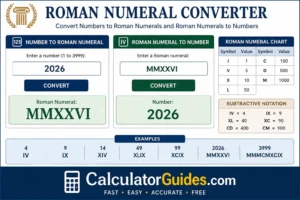
A Roman Numeral Converter converts ordinary numbers into Roman numerals and Roman numerals back into numbers.
Roman numerals are an ancient number system that uses letters from the Latin alphabet instead of the decimal digits we use today.
For example:
1 → I
5 → V
10 → X
50 → L
100 → C
500 → D
1,000 → M
Our free converter makes it easy to:
- Convert numbers to Roman numerals
- Convert Roman numerals to numbers
- Check Roman numeral values
- Learn Roman numeral rules
- Understand subtractive notation
- Verify Roman numeral spelling
What Are Roman Numerals?
Roman numerals are a number system that originated in ancient Rome.
Instead of using digits such as:
1, 2, 3, 4, 5
Roman numerals use letters:
I, V, X, L, C, D, M
The symbols are combined according to specific rules to represent numbers.
For example:
VIII = 8
because:
V + I + I + I = 5 + 1 + 1 + 1 = 8
Roman Numeral Chart
| Number | Roman Numeral |
|---|---|
| 1 | I |
| 2 | II |
| 3 | III |
| 4 | IV |
| 5 | V |
| 6 | VI |
| 7 | VII |
| 8 | VIII |
| 9 | IX |
| 10 | X |
| 20 | XX |
| 30 | XXX |
| 40 | XL |
| 50 | L |
| 60 | LX |
| 70 | LXX |
| 80 | LXXX |
| 90 | XC |
| 100 | C |
| 400 | CD |
| 500 | D |
| 900 | CM |
| 1,000 | M |
Roman Numeral Symbols
There are seven main Roman numeral symbols:
| Symbol | Value |
|---|---|
| I | 1 |
| V | 5 |
| X | 10 |
| L | 50 |
| C | 100 |
| D | 500 |
| M | 1,000 |
These symbols are combined to create larger numbers.
How Roman Numerals Work
Roman numerals generally follow an additive system.
For example:
VI
means:
5 + 1 = 6
Similarly:
XV
means:
10 + 5 = 15
When a smaller-value symbol appears before a larger-value symbol in an accepted subtractive combination, the smaller value is subtracted.
For example:
IV = 4
because:
5 − 1 = 4
Subtractive Roman Numerals
Some Roman numerals use subtraction instead of simply adding values.
The most common subtractive combinations are:
| Roman Numeral | Value |
|---|---|
| IV | 4 |
| IX | 9 |
| XL | 40 |
| XC | 90 |
| CD | 400 |
| CM | 900 |
These combinations are important when converting numbers into standard Roman numeral notation.
Roman Numeral Examples
12
XII
Because:
10 + 1 + 1 = 12
19
XIX
Because:
10 + 9 = 19
25
XXV
Because:
10 + 10 + 5 = 25
49
XLIX
Because:
40 + 9 = 49
99
XCIX
Because:
90 + 9 = 99
500
D
999
CMXCIX
Because:
900 + 90 + 9 = 999
How to Convert a Number to Roman Numerals
The easiest way is to break the number into thousands, hundreds, tens, and ones.
For example:
1987
can be separated into:
1,000 + 900 + 80 + 7
These become:
- 1,000 = M
- 900 = CM
- 80 = LXXX
- 7 = VII
Therefore:
1987 = MCMLXXXVII
How to Convert Roman Numerals to Numbers
To convert Roman numerals back to numbers, identify the value of each symbol and apply the subtractive rule where necessary.
Example:
XIV
Values:
- X = 10
- I = 1
- V = 5
Because I comes before V:
5 − 1 = 4
Therefore:
XIV = 14
Roman Numeral Converter Example
Input
2026
Break it down:
2,000 + 20 + 6
Roman representation:
MM + XX + VI
Result:
MMXXVI
So:
2026 = MMXXVI
Roman Numerals 1 to 100
| Number | Roman | Number | Roman |
|---|---|---|---|
| 1 | I | 51 | LI |
| 2 | II | 52 | LII |
| 3 | III | 53 | LIII |
| 4 | IV | 54 | LIV |
| 5 | V | 55 | LV |
| 6 | VI | 56 | LVI |
| 7 | VII | 57 | LVII |
| 8 | VIII | 58 | LVIII |
| 9 | IX | 59 | LIX |
| 10 | X | 60 | LX |
| 20 | XX | 70 | LXX |
| 30 | XXX | 80 | LXXX |
| 40 | XL | 90 | XC |
| 50 | L | 100 | C |
The intermediate numbers are formed by combining the appropriate symbols.
Roman Numerals 100 to 1,000
Some important values are:
| Number | Roman |
|---|---|
| 100 | C |
| 200 | CC |
| 300 | CCC |
| 400 | CD |
| 500 | D |
| 600 | DC |
| 700 | DCC |
| 800 | DCCC |
| 900 | CM |
| 1,000 | M |
Roman Numerals 1,000 to 4,000
| Number | Roman |
|---|---|
| 1,000 | M |
| 2,000 | MM |
| 3,000 | MMM |
| 4,000 | IV̅ |
The notation for numbers above 3,999 varies between historical and modern conventions.
A calculator should specify which convention it uses.
Roman Numerals and Zero
The traditional Roman numeral system does not have a standard symbol equivalent to the modern number zero.
This is an important difference from the decimal number system.
If you need to represent zero in a historical context, different conventions may be encountered, but there is no universally standard classical Roman numeral for zero.
Roman Numerals and Negative Numbers
Traditional Roman numerals were not designed as a complete modern mathematical notation system for negative numbers.
A modern converter may handle negative values using an additional convention, but that is different from standard classical Roman numeral usage.
Can Roman Numerals Represent Decimals?
Traditional Roman numerals were primarily used for whole numbers.
They do not have a standard decimal-point system equivalent to modern notation.
Modern applications may use additional conventions, but these should not be confused with the classical system.
Roman Numeral Rules
Some basic rules help you read and write standard Roman numerals.
Rule 1: Add Values When Symbols Decrease or Stay in Order
VIII
= 5 + 1 + 1 + 1
= 8
Rule 2: Subtract in Standard Subtractive Combinations
IX
= 10 − 1
= 9
Rule 3: Use Standard Subtractive Pairs
Common forms include:
- IV
- IX
- XL
- XC
- CD
- CM
Rule 4: Avoid Nonstandard Repetition
A symbol such as I, X, C, or M is traditionally limited in repetition under common modern rules.
For example:
III = 3
but:
IIII is generally not the standard form in modern Roman numeral conversion, although historical clock faces sometimes use IIII.
Why Is 4 Sometimes Written as IV and Sometimes IIII?
The standard modern representation is:
IV
However, IIII can also be seen, especially on traditional clock faces.
This is a historical and stylistic variation rather than a calculation error.
For general conversion, IV is normally preferred.
Why Is 9 Written as IX?
Instead of:
VIIII
standard modern notation uses:
IX
This applies the subtractive principle:
10 − 1 = 9
Roman Numerals on Clocks
Roman numerals are still commonly seen on clocks and watches.
One interesting design choice is that some clocks use:
IIII
for four rather than:
IV
This is often associated with traditional clock-face design.
Roman Numerals in Dates
Roman numerals are sometimes used in dates, especially for:
- Book chapters
- Movie sequels
- Events
- Copyright dates
- Formal documents
- Monuments
For example:
MMXXVI
represents:
2026
Roman Numerals in Chapters
Books and documents may use Roman numerals for introductory sections.
For example:
- Chapter I
- Chapter II
- Chapter III
- Chapter IV
This helps distinguish preliminary sections from numbered chapters.
Roman Numerals in Names
Roman numerals are often used to distinguish people with the same name, particularly monarchs and popes.
Examples include:
- Henry VIII
- Louis XIV
- Elizabeth II
The numeral identifies the position in a sequence.
Roman Numeral Converter for Years
Roman numerals can be used to represent years.
For example:
2024 → MMXXIV
2025 → MMXXV
2026 → MMXXVI
2030 → MMXXX
This can be useful for historical or decorative purposes.
How to Use the Roman Numeral Converter
Step 1: Enter a Number
For example:
2026
Step 2: Select Conversion
Choose:
Number → Roman Numeral
or:
Roman Numeral → Number
Step 3: Convert
The calculator processes the value.
Step 4: Check the Result
You can copy the converted Roman numeral or number.
Common Roman Numeral Mistakes
Writing IIII Instead of IV
For standard modern notation, IV is normally preferred for 4.
Writing IL for 49
IL is not the standard form.
The standard representation is:
XLIX
Writing IC for 99
The standard representation is:
XCIX
Writing XM for 990
Standard notation uses:
CMXC
Repeating Symbols Incorrectly
Roman numeral rules limit how certain symbols can be repeated.
Forgetting Subtractive Notation
Values such as 4, 9, 40, 90, 400, and 900 use standard subtractive forms.
Frequently Asked Questions
What is a Roman Numeral Converter?
It is a tool that converts numbers into Roman numerals and Roman numerals into ordinary decimal numbers.
What are the Roman numeral symbols?
The seven main symbols are:
I, V, X, L, C, D, M
What is 10 in Roman numerals?
X
What is 50 in Roman numerals?
L
What is 100 in Roman numerals?
C
What is 500 in Roman numerals?
D
What is 1,000 in Roman numerals?
M
What is 4 in Roman numerals?
The standard modern form is:
IV
What is 9 in Roman numerals?
IX
What is 40 in Roman numerals?
XL
What is 90 in Roman numerals?
XC
What is 400 in Roman numerals?
CD
What is 900 in Roman numerals?
CM
What is 2026 in Roman numerals?
MMXXVI
Does Roman numeral notation have zero?
Traditional Roman numerals do not have a standard classical symbol for zero.
Can Roman numerals represent negative numbers?
Traditional Roman numerals were not designed as a standard system for negative numbers.
What is the largest Roman numeral?
Under the common modern convention without special overline notation, MMMCMXCIX represents 3,999. Larger values can be represented using extended conventions such as overlines.
Is Roman Numeral Converter free?
Yes. The CalculatorGuides.com Roman Numeral Converter is free to use.
Roman Numeral Converter – Quick Reference
| Decimal | Roman |
|---|---|
| 1 | I |
| 4 | IV |
| 5 | V |
| 9 | IX |
| 10 | X |
| 40 | XL |
| 50 | L |
| 90 | XC |
| 100 | C |
| 400 | CD |
| 500 | D |
| 900 | CM |
| 1,000 | M |
| 2,026 | MMXXVI |
Conclusion
The Roman Numeral Converter makes it easy to convert between modern decimal numbers and Roman numerals.
The seven basic Roman numeral symbols are:
I, V, X, L, C, D, M
The most important subtractive combinations are:
IV, IX, XL, XC, CD, CM
For example:
2026 = MMXXVI
Roman numerals are still used today in clocks, book chapters, historical references, names, events, and decorative designs.
Use the CalculatorGuides.com Roman Numeral Converter to quickly convert numbers to Roman numerals or check the decimal value of a Roman numeral.