
Molecular Weight Calculator-Use our free Molecular Weight Calculator to calculate molecular weight, molar mass, and the total atomic mass of a chemical formula. Voltage Drop Calculator , Roman Numeral Converter, Get step-by-step results for compounds and molecules.
Molecular Weight: 0 g/mol SI Unit: 0 kg/mol⚛️ Molecular Weight Calculator | CalculatorGuides
📊 Calculation Summary
Elemental Composition Breakdown
Element
Atoms
Atomic Mass
Total Mass (g/mol)
Mass %
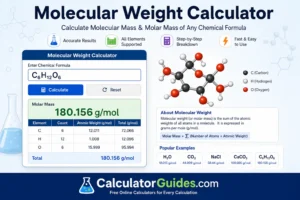
A Molecular Weight Calculator calculates the molecular weight or molecular mass of a chemical compound from its molecular formula.
Simply enter a chemical formula such as:
- H₂O
- CO₂
- NaCl
- C₆H₁₂O₆
- CaCO₃
- H₂SO₄
The calculator determines the contribution of each element and adds the values together.
It can be useful for:
- Chemistry students
- Teachers
- Laboratory work
- Biology
- Pharmaceutical calculations
- Chemical research
- Science homework
- Preparing solutions
What Is Molecular Weight?
Molecular weight is the relative mass of a molecule compared with a standard reference.
In practical chemistry calculations, people often use the term molecular weight when they mean the numerical sum of the atomic weights of all atoms in a molecular formula.
For example, water is:
H₂O
It contains:
- 2 hydrogen atoms
- 1 oxygen atom
Using approximate atomic weights:
H = 1.008
O = 15.999
Therefore:
2(1.008) + 15.999 = 18.015
So the molecular mass of water is approximately:
18.015 u
The corresponding molar mass is approximately:
18.015 g/mol
Molecular Weight vs Molar Mass
These terms are closely related but should not be treated as exactly the same quantity.
Molecular Mass
The mass of an individual molecule, commonly expressed in:
atomic mass units (u or Da)
Molar Mass
The mass of one mole of the substance, expressed in:
g/mol
For many molecular substances, the numerical values are the same.
For example:
H₂O
Molecular mass:
18.015 u
Molar mass:
18.015 g/mol
The units are different.
How Does the Molecular Weight Calculator Work?
The calculator breaks the chemical formula into its elements.
For each element, it determines:
- The element’s atomic weight.
- The number of atoms present.
- The contribution of those atoms.
- The total molecular mass.
The general calculation is:
Molecular Mass = Σ(Number of atoms × Atomic Weight)
For a simple compound:
AB₂
the calculation is:
Atomic Weight of A + 2 × Atomic Weight of B
Molecular Weight Example: Water
Chemical formula:
H₂O
Atomic weights:
- H = 1.008
- O = 15.999
Calculation:
2 × 1.008 + 15.999
= 18.015
Therefore:
H₂O = 18.015 g/mol
for molar mass.
Molecular Weight Example: Carbon Dioxide
Formula:
CO₂
Atomic weights:
- C = 12.011
- O = 15.999
Calculation:
12.011 + 2(15.999)
= 44.009
Therefore:
CO₂ ≈ 44.009 g/mol
Molecular Weight Example: Glucose
Glucose has the formula:
C₆H₁₂O₆
Atomic weights:
- C = 12.011
- H = 1.008
- O = 15.999
Calculation:
6(12.011) + 12(1.008) + 6(15.999)
= 180.156
Therefore:
Glucose ≈ 180.156 g/mol
Molecular Weight Example: Sodium Chloride
Sodium chloride is:
NaCl
Atomic weights:
- Na = 22.990
- Cl = 35.45
Calculation:
22.990 + 35.45
= 58.44
Therefore:
NaCl ≈ 58.44 g/mol
For an ionic compound such as NaCl, formula mass or molar mass is more precise terminology than molecular mass because NaCl does not consist of discrete NaCl molecules in the solid state.
Molecular Weight Example: Calcium Carbonate
Formula:
CaCO₃
Approximate atomic weights:
- Ca = 40.078
- C = 12.011
- O = 15.999
Calculation:
40.078 + 12.011 + 3(15.999)
= 100.086
Therefore:
CaCO₃ ≈ 100.086 g/mol
Molecular Weight Example: Sulfuric Acid
Formula:
H₂SO₄
Atomic weights:
- H = 1.008
- S = 32.06
- O = 15.999
Calculation:
2(1.008) + 32.06 + 4(15.999)
≈ 98.072
Therefore:
H₂SO₄ ≈ 98.072 g/mol
Common Molecular Weights
| Compound | Formula | Approx. Molar Mass |
|---|---|---|
| Water | H₂O | 18.015 g/mol |
| Carbon dioxide | CO₂ | 44.009 g/mol |
| Oxygen | O₂ | 31.998 g/mol |
| Hydrogen | H₂ | 2.016 g/mol |
| Nitrogen | N₂ | 28.014 g/mol |
| Sodium chloride | NaCl | 58.44 g/mol |
| Glucose | C₆H₁₂O₆ | 180.156 g/mol |
| Calcium carbonate | CaCO₃ | 100.086 g/mol |
| Sulfuric acid | H₂SO₄ | 98.072 g/mol |
| Ammonia | NH₃ | 17.031 g/mol |
Values can vary slightly depending on the atomic-weight table and rounding convention used.
How to Calculate Molecular Weight Manually
Suppose the formula is:
CH₄
Step 1: Count the atoms
- C = 1
- H = 4
Step 2: Find atomic weights
- C = 12.011
- H = 1.008
Step 3: Multiply
1 × 12.011 = 12.011
4 × 1.008 = 4.032
Step 4: Add
12.011 + 4.032 = 16.043
Therefore:
CH₄ ≈ 16.043 g/mol
Subscripts in Chemical Formulas
A subscript tells you how many atoms of an element are present.
For example:
H₂O
The 2 means there are:
2 hydrogen atoms
There is no number after O, so there is:
1 oxygen atom
For:
C₆H₁₂O₆
there are:
- 6 carbon atoms
- 12 hydrogen atoms
- 6 oxygen atoms
Parentheses in Chemical Formulas
Some chemical formulas contain parentheses.
For example:
Ca(OH)₂
The subscript 2 applies to everything inside the parentheses.
Therefore, the compound contains:
- 1 calcium atom
- 2 oxygen atoms
- 2 hydrogen atoms
Calculation:
Ca + 2(O + H)
Using approximate atomic weights:
40.078 + 2(15.999 + 1.008)
≈ 74.092 g/mol
Molecular Weight of Compounds With Parentheses
Another example is:
Al₂(SO₄)₃
The 3 applies to the entire sulfate group.
Atom count:
- Al = 2
- S = 3
- O = 12
The calculator must correctly expand the parentheses before calculating the total.
This is one reason an automated molecular-weight calculator is useful.
Hydrates and Dot Notation
Some chemical formulas contain water of crystallization.
For example:
CuSO₄·5H₂O
The dot indicates that five water molecules are associated with each formula unit.
The total molar mass includes:
- CuSO₄
- 5 × H₂O
A calculator that supports hydrates can calculate the complete molar mass.
Molecular Weight of Ions
Charged species can also have a calculated formula mass.
For example:
SO₄²⁻
contains:
- 1 sulfur
- 4 oxygen atoms
The electron difference due to the charge has a negligible effect on ordinary molar-mass calculations, so the atomic masses are generally summed in the usual way.
Molecular Weight and Avogadro’s Number
One mole contains approximately:
6.022 × 10²³ particles
This number is known as Avogadro’s constant.
If a substance has a molar mass of:
18.015 g/mol
then one mole of that substance has a mass of approximately:
18.015 g
For water, this corresponds to approximately:
6.022 × 10²³ water molecules
Molecular Weight and Moles
Molar mass connects mass and amount of substance.
The basic formula is:
Moles = Mass ÷ Molar Mass
or:
n = m ÷ M
Where:
- n = amount in moles
- m = mass in grams
- M = molar mass in g/mol
For example, if you have:
36.03 g of H₂O
and its molar mass is:
18.015 g/mol
then:
36.03 ÷ 18.015 = 2 mol
Mass From Moles
The formula can also be rearranged:
Mass = Moles × Molar Mass
For example:
2 mol H₂O × 18.015 g/mol
= 36.03 g
Molecular Weight and Solution Calculations
Molar mass is commonly needed when preparing solutions.
The relationship:
Moles = Mass ÷ Molar Mass
allows you to convert a measured mass into moles.
Then concentration can be calculated using:
Molarity = Moles ÷ Volume in Liters
This makes molecular-weight calculations an important part of laboratory chemistry.
Molecular Weight vs Formula Weight
Molecular weight is generally used for substances made of molecules.
Formula weight is often more appropriate for ionic compounds because they form extended crystal lattices rather than individual molecules.
For example:
H₂O → molecular mass
NaCl → formula mass
In everyday chemistry discussions, however, people sometimes use “molecular weight” broadly for both.
Average Atomic Weight
The atomic weights used in molecular-weight calculations generally represent naturally occurring isotopic mixtures.
For example, chlorine is commonly represented with an atomic weight around:
35.45
rather than exactly 35 or 37.
This is because naturally occurring chlorine contains multiple isotopes.
As a result, calculated molar masses are usually based on weighted average atomic weights.
Isotopes and Exact Mass
There is a distinction between:
- Average atomic weight
- Exact isotopic mass
- Monoisotopic mass
- Molecular mass
For standard chemistry calculations, average atomic weights are usually appropriate.
Mass spectrometry and other specialized applications may instead require exact or monoisotopic masses.
Molecular Weight Calculator for Chemistry Students
Students can use a molecular-weight calculator to check calculations involving:
- Chemical formulas
- Moles
- Stoichiometry
- Solution preparation
- Chemical equations
- Percent composition
- Limiting reactants
It is still useful to understand how the calculation works rather than relying only on the final number.
Molecular Weight and Percent Composition
Once molar mass is known, the percentage by mass of an element can be calculated.
The formula is:
% Element = (Mass contributed by element ÷ Total molar mass) × 100
For water:
H₂O = 18.015 g/mol
Hydrogen contributes:
2 × 1.008 = 2.016 g/mol
Therefore:
Hydrogen % ≈ 2.016 ÷ 18.015 × 100
≈ 11.19%
How to Use the Molecular Weight Calculator
Step 1: Enter the Chemical Formula
For example:
C₆H₁₂O₆
Step 2: Calculate
The tool identifies each element and its subscript.
Step 3: Review the Breakdown
A useful result can show:
- Element
- Number of atoms
- Atomic weight
- Contribution to total mass
Step 4: Check the Total
The calculator adds all elemental contributions to produce the molecular mass or molar mass.
Common Molecular Weight Calculation Mistakes
Ignoring Subscripts
In:
H₂SO₄
there are four oxygen atoms, not one.
Misreading Parentheses
In:
Ca(OH)₂
the 2 applies to both O and H.
Forgetting Hydration Water
In:
CuSO₄·5H₂O
the five water molecules contribute to the total molar mass.
Using the Wrong Atomic Weight
Atomic weights should come from a reliable periodic table.
Confusing Molecular Mass With Molar Mass
The numerical values can be the same, but their units and meanings differ.
Frequently Asked Questions
What is a Molecular Weight Calculator?
It is a tool that calculates the total molecular mass or molar mass of a chemical formula by adding the atomic-weight contributions of its elements.
How do I calculate molecular weight?
Multiply each element’s atomic weight by the number of atoms present and add the results.
What is the molecular weight of water?
H₂O has a molecular mass of approximately 18.015 u and a molar mass of approximately 18.015 g/mol.
What is the molecular weight of CO₂?
CO₂ has a molar mass of approximately 44.009 g/mol.
What is the molecular weight of glucose?
C₆H₁₂O₆ has a molar mass of approximately 180.156 g/mol.
What is the difference between molecular weight and molar mass?
Molecular mass is commonly expressed in u or Da, while molar mass is expressed in g/mol.
What is formula weight?
Formula weight is the sum of the atomic weights represented by a chemical formula and is particularly useful for ionic compounds.
Can the calculator handle parentheses?
A properly designed molecular-weight calculator should support formulas containing parentheses and subscripts.
Can it calculate hydrates?
If hydrate notation is supported, formulas such as CuSO₄·5H₂O can be calculated as a complete compound.
Why are atomic weights not always whole numbers?
Many elements naturally occur as mixtures of isotopes. Their listed atomic weights are weighted averages.
What is molar mass used for?
Molar mass is used to convert between grams and moles and is important in stoichiometry and solution calculations.
How do I convert grams to moles?
Use:
Moles = Mass in grams ÷ Molar Mass
How do I convert moles to grams?
Use:
Mass = Moles × Molar Mass
Does molecular weight have units?
Relative molecular weight is technically dimensionless. Molecular mass is commonly expressed in u or Da, while molar mass is expressed in g/mol.
Is the Molecular Weight Calculator free?
Yes. The CalculatorGuides.com Molecular Weight Calculator is free to use.
Molecular Weight Calculator – Quick Examples
| Formula | Approx. Molar Mass |
|---|---|
| H₂O | 18.015 g/mol |
| NH₃ | 17.031 g/mol |
| CH₄ | 16.043 g/mol |
| CO₂ | 44.009 g/mol |
| NaCl | 58.44 g/mol |
| CaCO₃ | 100.086 g/mol |
| H₂SO₄ | 98.072 g/mol |
| C₆H₁₂O₆ | 180.156 g/mol |
Conclusion
A Molecular Weight Calculator makes it easy to calculate the molecular mass or molar mass of a chemical compound from its formula.
The basic method is:
Total Mass = Sum of (Number of Atoms × Atomic Weight)
For example, for water:
H₂O
= 2(1.008) + 15.999
= 18.015
Understanding molecular weight is important for moles, stoichiometry, solution preparation, percent composition, and laboratory calculations.
For ionic compounds such as NaCl, formula mass is generally the more precise term, while molecular mass is used for discrete molecules.
Use the CalculatorGuides.com Molecular Weight Calculator to quickly calculate the mass contribution of each element and get the total molar mass of your chemical formula.