
Weight Calculator-Use our free Weight Calculator to calculate weight from mass and gravity. Convert between newtons, kilograms, pounds, and Speed Calculator other weight units with simple formulas and examples.
🎯 Weight Goal & Progress Calculator
Plan your target, view analytics, and get inspired!
A Weight Calculator helps you calculate the gravitational force acting on an object when its mass and the gravitational acceleration are known.
In everyday conversation, people often use weight to mean how heavy something is in kilograms or pounds. In physics, however, weight is a force, while kilograms measure mass.
This calculator can help you understand and calculate:
- Weight
- Mass
- Gravitational acceleration
- Weight in newtons
- Weight on Earth
- Weight on the Moon
- Weight on other planets
- Kilograms to pounds
- Pounds to kilograms
- Weight-force relationships
What Is Weight?
In physics, weight is the force exerted on an object due to gravity.
The standard formula is:
Weight = Mass × Gravitational Acceleration
or:
W = mg
Where:
- W = weight in newtons (N)
- m = mass in kilograms (kg)
- g = gravitational acceleration in m/s²
Near Earth’s surface, gravitational acceleration is approximately:
9.81 m/s²
Therefore, an object with a mass of 10 kg has a weight of approximately:
10 × 9.81 = 98.1 N
Weight vs Mass
One of the most important things to understand is that mass and weight are not the same thing.
Mass
Mass measures how much matter an object contains.
Common unit:
kilogram (kg)
Mass remains essentially the same regardless of location.
Weight
Weight is the gravitational force acting on that mass.
Common unit:
newton (N)
Weight changes when gravitational acceleration changes.
For example, a person’s mass is approximately the same on Earth and the Moon, but their weight is much lower on the Moon because the Moon has weaker gravity.
Weight Formula
The basic formula is:
W = m × g
For example:
Mass = 50 kg
Gravity = 9.81 m/s²
Therefore:
W = 50 × 9.81
= 490.5 N
So the object’s weight is approximately:
490.5 newtons
Calculate Mass From Weight
If weight and gravitational acceleration are known, rearrange the formula:
m = W ÷ g
For example:
Weight = 981 N
g = 9.81 m/s²
Then:
m = 981 ÷ 9.81
= 100 kg
Calculate Gravity From Weight
If mass and weight are known:
g = W ÷ m
For example:
Weight = 196.2 N
Mass = 20 kg
Then:
g = 196.2 ÷ 20
= 9.81 m/s²
Weight on Earth
Near Earth’s surface, standard gravitational acceleration is approximately:
9.80665 m/s²
For many everyday calculations, 9.81 m/s² is sufficient.
For example, a:
70 kg
object has an Earth weight of approximately:
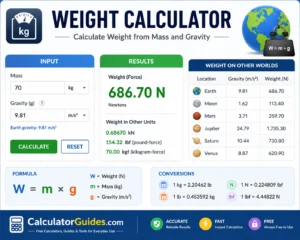
70 × 9.81 = 686.7 N
Weight Calculator in Kilograms
If you enter a mass in kilograms, the calculator can determine the corresponding gravitational force.
For example:
Mass = 80 kg
Using:
g = 9.81 m/s²
Weight:
80 × 9.81 = 784.8 N
Therefore:
80 kg ≈ 784.8 N of weight on Earth
This does not mean 80 kg and 784.8 N are interchangeable units. Kilograms measure mass, while newtons measure force.
Weight Calculator in Pounds
In everyday use, people commonly describe body weight in pounds (lb).
For example:
150 lb ≈ 68.04 kg
Once the mass is converted to kilograms, its gravitational force on Earth can be estimated:
68.04 × 9.81 ≈ 667.5 N
So 150 lb of mass corresponds to approximately 667.5 N of gravitational force on Earth.
Kilograms to Pounds
The commonly used conversion is:
1 kg ≈ 2.20462 lb
Therefore:
50 kg × 2.20462 ≈ 110.23 lb
So:
50 kg ≈ 110.23 lb
Pounds to Kilograms
To convert pounds to kilograms:
kg = lb ÷ 2.20462
For example:
200 lb ÷ 2.20462 ≈ 90.72 kg
Therefore:
200 lb ≈ 90.72 kg
Newtons to Pounds-Force
Newton (N) and pound-force (lbf) are both units of force.
The approximate conversion is:
1 lbf = 4.44822 N
Therefore:
100 N ≈ 22.48 lbf
And:
100 lbf ≈ 444.82 N
This is different from converting kilograms to pounds because kilograms and pounds can refer to mass, while newtons and pound-force refer to force.
Newtons to Kilograms
There is an important distinction here.
You should not simply treat newtons and kilograms as equivalent because they measure different physical quantities.
If you want to determine the mass corresponding to a given weight on Earth, use:
Mass = Weight ÷ 9.81
For example:
98.1 N ÷ 9.81 = 10 kg
So a weight of 98.1 N corresponds to a mass of approximately 10 kg under Earth’s standard gravity.
Weight on the Moon
The Moon’s gravitational acceleration is approximately:
1.62 m/s²
This is much lower than Earth’s approximately:
9.81 m/s²
Suppose an object has a mass of:
60 kg
On Earth:
60 × 9.81 = 588.6 N
On the Moon:
60 × 1.62 = 97.2 N
The object’s mass remains approximately 60 kg, but its weight is much lower on the Moon.
Weight on Mars
Mars has a surface gravitational acceleration of approximately:
3.71 m/s²
For a:
60 kg
object:
60 × 3.71 = 222.6 N
So its weight on Mars would be approximately:
222.6 N
The mass remains approximately 60 kg.
Weight on Different Planets
Approximate surface gravitational accelerations:
| Location | Gravity (m/s²) |
|---|---|
| Earth | 9.81 |
| Moon | 1.62 |
| Mars | 3.71 |
| Venus | 8.87 |
| Mercury | 3.70 |
| Jupiter | 24.79 |
| Saturn | 10.44 |
| Uranus | 8.69 |
| Neptune | 11.15 |
These values are approximate surface gravity values. A person’s actual experience of weight can depend on the specific physical situation.
Example: 70 kg on Different Worlds
For an object with a mass of:
70 kg
Approximate gravitational force would be:
| Location | Approx. Weight |
|---|---|
| Earth | 686.7 N |
| Moon | 113.4 N |
| Mars | 259.7 N |
| Venus | 620.9 N |
| Jupiter | 1,735.3 N |
| Saturn | 730.8 N |
The mass remains:
70 kg
but the weight changes because gravitational acceleration changes.
Weight and Gravity
Weight depends directly on gravity.
From:
W = mg
if mass remains constant:
- Higher gravity → higher weight
- Lower gravity → lower weight
For example, if gravity doubles while mass remains unchanged, gravitational weight also doubles.
Weight and Mass Example
Suppose two objects each have a mass of:
10 kg
Object A is on Earth:
W = 10 × 9.81 = 98.1 N
Object B is on the Moon:
W = 10 × 1.62 = 16.2 N
Both objects have the same mass, but their weights are different.
Is Your Body Weight Mass or Force?
When a bathroom scale displays:
70 kg
it is normally reporting your mass in kilograms, even though everyday language calls this your “weight.”
In physics, your gravitational weight would be approximately:
70 × 9.81 = 686.7 N
on Earth.
This distinction becomes especially useful when studying physics, mechanics, engineering, and space science.
Weight Calculator for Objects
You can calculate the gravitational force of almost any object.
Examples include:
- Boxes
- Vehicles
- Equipment
- Machinery
- Furniture
- Packages
- Building materials
- Scientific objects
Simply determine the object’s mass and multiply it by the appropriate gravitational acceleration.
Weight and Newton’s Second Law
Weight is one type of force.
Newton’s second law states:
F = ma
For gravitational force near a planet’s surface:
F = mg
The acceleration in this case is the local gravitational acceleration.
This is why weight is measured in newtons, just like other forces.
Weight vs Load
In engineering and construction, the word load may refer to forces or masses supported by a structure.
For example, a 100 kg object has an approximate Earth weight of:
100 × 9.81 = 981 N
Engineers may need to consider not only the static weight but also additional forces caused by movement, vibration, impact, or other conditions.
Weight and Gravity at Different Heights
The simple:
W = mg
calculation assumes a known local value of g.
As altitude increases, gravitational acceleration changes slightly.
For everyday calculations near Earth’s surface, using approximately:
9.81 m/s²
is generally adequate.
For precision scientific calculations, local gravitational acceleration or a more detailed gravitational model may be required.
How to Use the Weight Calculator
Step 1: Enter Mass
Enter the object’s mass.
For example:
75 kg
Step 2: Choose Gravity
Use:
9.81 m/s²
for a standard Earth calculation, or enter another gravitational acceleration.
Step 3: Calculate
The calculator applies:
W = mg
Step 4: Review the Result
The result is given as a force, normally in:
newtons (N)
You can also convert the result to other force units when needed.
Common Weight Calculation Mistakes
Confusing Mass and Weight
Kilograms measure mass.
Newtons measure force.
Using Pounds as Newtons
Pounds can refer to mass in some contexts, while pound-force is a force unit.
Forgetting Gravity
Weight depends on gravitational acceleration.
Using the Wrong Gravity
Earth, Moon, and Mars have different gravitational accelerations.
Treating 1 kg as 1 N
A 1 kg mass has an Earth weight of approximately:
9.81 N
not 1 N.
Frequently Asked Questions
What is a Weight Calculator?
A Weight Calculator calculates the gravitational force acting on an object using its mass and gravitational acceleration.
What is the formula for weight?
W = m × g
What is the unit of weight?
The SI unit of weight is the newton (N) because weight is a force.
Is kg a unit of weight?
In everyday use, people often describe body weight in kilograms. Technically, the kilogram is a unit of mass, not force.
How much does a 50 kg object weigh on Earth?
Approximately:
50 × 9.81 = 490.5 N
How much does a 100 kg object weigh on Earth?
Approximately:
981 N
Does mass change on the Moon?
No. An object’s mass remains approximately the same, while its weight changes because the Moon has weaker gravity.
How much does a 60 kg object weigh on the Moon?
Using approximately 1.62 m/s²:
60 × 1.62 = 97.2 N
How do I convert kg to pounds?
Multiply kilograms by approximately:
2.20462
How do I convert pounds to kilograms?
Divide pounds by approximately:
2.20462
How do I convert newtons to pound-force?
Approximately:
1 N = 0.224809 lbf
Can weight be zero?
In physics, an object can experience apparent weightlessness in free fall even though gravity is still acting on it. This is different from saying that gravity itself is zero.
Does weight change with altitude?
Yes, gravitational acceleration decreases slightly as distance from Earth’s center increases, so gravitational weight also changes slightly.
Is the Weight Calculator accurate?
The mathematical calculation is accurate for the mass and gravitational acceleration entered. Real-world gravitational acceleration can vary slightly by location.
Is the Weight Calculator free?
Yes. The CalculatorGuides.com Weight Calculator is free to use.
Weight Calculator – Quick Reference
| Calculation | Formula |
|---|---|
| Weight | W = m × g |
| Mass | m = W ÷ g |
| Gravity | g = W ÷ m |
| kg → lb | kg × 2.20462 |
| lb → kg | lb ÷ 2.20462 |
| N → lbf | N × 0.224809 |
| lbf → N | lbf × 4.44822 |
Conclusion
A Weight Calculator helps you understand the difference between mass and gravitational force and quickly calculate the weight of an object.
The main formula is:
Weight = Mass × Gravity
or:
W = mg
On Earth, using approximately 9.81 m/s², a 70 kg mass has a gravitational weight of about:
686.7 N
The important point is that mass stays essentially constant while weight changes when gravitational acceleration changes. This is why the same object weighs differently on Earth, the Moon, Mars, or another planet.
Use the CalculatorGuides.com Weight Calculator to calculate weight from mass, compare weight under different gravitational conditions, and convert between common mass and force units.