
Mass Calculator-Use our free Mass Calculator to calculate mass from density and volume. Learn the mass formula, convert mass units, and solve common physics problems with simple examples.
Calculated Value: 0⚖️ Mass Calculator | CalculatorGuides
📊 Result
A Mass Calculator helps you calculate the mass of an object when you know its density and volume. It can also calculate density or volume when the other two values are known.Molecular Weight Calculator
Mass is a fundamental physical quantity used in physics, chemistry, engineering, science, and everyday measurements.
You can use a mass calculator to work with:
- Mass
- Density
- Volume
- Kilograms
- Grams
- Milligrams
- Pounds
- Ounces
- Metric tons
- Common material densities
What Is Mass?
Mass is a measure of the amount of matter in an object.
The SI unit of mass is the:
kilogram (kg)
Other commonly used units include:
- Gram (g)
- Milligram (mg)
- Metric ton (t)
- Pound (lb)
- Ounce (oz)
Mass is different from weight. Mass measures an object’s amount of matter, while weight is the gravitational force acting on that mass.
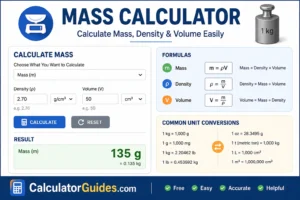
Mass Formula
When density and volume are known, mass can be calculated using:
Mass = Density × Volume
or:
m = ρV
Where:
- m = mass
- ρ = density
- V = volume
For example, if a material has a density of:
2 g/cm³
and a volume of:
10 cm³
then:
Mass = 2 × 10
= 20 g
Calculate Density
If mass and volume are known:
Density = Mass ÷ Volume
or:
ρ = m ÷ V
Example:
Mass:
500 g
Volume:
250 cm³
Density:
500 ÷ 250 = 2 g/cm³
Calculate Volume
If mass and density are known:
Volume = Mass ÷ Density
or:
V = m ÷ ρ
Example:
Mass:
1,000 g
Density:
2 g/cm³
Volume:
1,000 ÷ 2 = 500 cm³
Mass, Density and Volume Relationship
The three formulas are connected:
m = ρV
ρ = m/V
V = m/ρ
If you know any two of the three values, you can calculate the third.
Mass Calculator Example
Suppose a metal has:
Density = 7.85 g/cm³
and:
Volume = 20 cm³
Mass:
m = 7.85 × 20
= 157 g
So the mass is:
157 grams
or:
0.157 kg
Mass Calculator Using Kilograms
Suppose:
Density = 1,000 kg/m³
and:
Volume = 0.5 m³
Then:
Mass = 1,000 × 0.5
= 500 kg
This is the approximate mass of 0.5 cubic meters of water under the stated density assumption.
Mass and Weight Are Different
Mass and weight are often confused because everyday language uses the word “weight” for body mass.
In physics:
Mass
Measured in:
kg
Weight
Measured in:
N
Weight can be calculated using:
W = mg
where g is gravitational acceleration.
For example, a 10 kg mass has approximately:
10 × 9.81 = 98.1 N
of gravitational weight near Earth’s surface.
The mass remains approximately 10 kg if the object is moved to the Moon, but its weight changes because the Moon has different gravity.
Common Mass Units
| Unit | Equivalent |
|---|---|
| 1 kilogram | 1,000 grams |
| 1 gram | 1,000 milligrams |
| 1 metric ton | 1,000 kilograms |
| 1 pound | ≈ 0.453592 kg |
| 1 ounce | ≈ 28.3495 g |
Kilograms to Grams
To convert kilograms to grams:
grams = kilograms × 1,000
Example:
2.5 kg × 1,000 = 2,500 g
Therefore:
2.5 kg = 2,500 g
Grams to Kilograms
To convert grams to kilograms:
kg = grams ÷ 1,000
Example:
750 g ÷ 1,000 = 0.75 kg
Therefore:
750 g = 0.75 kg
Kilograms to Pounds
To convert kilograms to pounds:
lb = kg × 2.20462
Example:
70 kg × 2.20462 ≈ 154.32 lb
Pounds to Kilograms
To convert pounds to kilograms:
kg = lb × 0.453592
Example:
150 lb × 0.453592 ≈ 68.04 kg
Grams to Milligrams
To convert grams to milligrams:
mg = g × 1,000
Example:
5 g = 5,000 mg
Milligrams to Grams
To convert milligrams to grams:
g = mg ÷ 1,000
Example:
2,500 mg = 2.5 g
Mass From Density and Volume
This is one of the most common uses of a mass calculator.
Suppose you know:
- Material density
- Object volume
Use:
m = ρV
For example:
Density = 2.7 g/cm³
Volume = 100 cm³
Then:
m = 2.7 × 100
= 270 g
Mass of Water
Water has a density close to:
1 g/cm³
or approximately:
1,000 kg/m³
near room temperature, although the exact density depends on temperature and conditions.
This makes water an easy example.
For:
500 cm³
of water:
Mass ≈ 1 × 500
= 500 g
Mass of Aluminum
Aluminum has a density of approximately:
2.70 g/cm³
Suppose an aluminum object has a volume of:
50 cm³
Mass:
2.70 × 50
= 135 g
Therefore, the estimated mass is:
135 g
Mass of Iron
Iron has a density of approximately:
7.87 g/cm³
For a volume of:
100 cm³
Mass:
7.87 × 100
= 787 g
The actual density can vary depending on material composition and temperature.
Mass of Copper
Copper has a density of approximately:
8.96 g/cm³
For:
25 cm³
Mass:
8.96 × 25
= 224 g
So the estimated mass is approximately:
224 g
Mass Calculator for Objects
A mass calculator can be used for objects with a known volume and material density, including:
- Metal parts
- Plastic components
- Wooden objects
- Glass
- Water
- Building materials
- Laboratory samples
- Manufactured components
For irregular objects, volume may need to be determined separately.
Mass of an Irregular Object
If an object does not have a simple geometric shape, its volume can sometimes be measured using water displacement.
For example:
- Record the initial water volume.
- Submerge the object.
- Record the new water volume.
- Subtract the initial volume from the final volume.
The difference represents the object’s approximate volume, assuming the object can safely be submerged and does not absorb water.
Once volume is known:
Mass = Density × Volume
Mass and Volume Units Must Match
A common mistake is mixing incompatible units.
For example, if density is:
g/cm³
volume should be:
cm³
If density is:
kg/m³
volume should be:
m³
Otherwise, the result will have the wrong magnitude.
Example With Unit Conversion
Suppose:
Density = 2 g/cm³
and volume is:
0.5 L
First convert volume.
Since:
1 L = 1,000 cm³
then:
0.5 L = 500 cm³
Now calculate:
Mass = 2 × 500
= 1,000 g
or:
1 kg
Mass Calculator for Liquids
For a liquid, mass can be calculated from density and volume:
m = ρV
For example, if a liquid has:
Density = 0.8 g/mL
and:
Volume = 250 mL
then:
Mass = 0.8 × 250
= 200 g
This method works for many liquids when their density is known.
Mass Calculator for Gases
Gas mass can also be calculated from density and volume, but gas density depends strongly on conditions such as:
- Temperature
- Pressure
- Gas composition
For more advanced gas calculations, the ideal gas law can be used:
PV = nRT
Once the number of moles is known, mass can be calculated using:
m = nM
where M is molar mass.
Mass and the Ideal Gas Law
For a gas:
PV = nRT
Where:
- P = pressure
- V = volume
- n = number of moles
- R = gas constant
- T = absolute temperature
Then:
Mass = Molar Mass × Number of Moles
This is useful when gas density is not directly provided.
Mass and Molar Mass
Mass is also related to moles through molar mass.
The formula is:
Mass = Moles × Molar Mass
or:
m = nM
For example, if you have:
2 mol of water
and water has a molar mass of approximately:
18.015 g/mol
then:
Mass = 2 × 18.015
= 36.03 g
Mass Calculator for Chemistry
In chemistry, mass calculations are commonly used for:
- Moles
- Molar mass
- Stoichiometry
- Solution preparation
- Chemical reactions
- Percent composition
Two especially useful formulas are:
m = ρV
and:
m = nM
The correct formula depends on the information provided.
Mass and Significant Figures
The final answer should generally reflect the precision of the measurements used.
For example, if volume is measured only approximately, reporting many extra decimal places in the calculated mass may give a false impression of precision.
A calculator can provide a mathematical result, but the appropriate number of significant figures depends on the input data and purpose of the calculation.
How to Use the Mass Calculator
Step 1: Choose What You Know
You may know:
- Density and volume
- Weight and gravity
- Moles and molar mass
- Mass and volume
Step 2: Enter the Values
Make sure the units are correct.
Step 3: Calculate
The calculator applies the appropriate formula.
Step 4: Check the Units
For example:
g/cm³ × cm³ = g
and:
kg/m³ × m³ = kg
Common Mass Calculation Mistakes
Confusing Mass With Weight
Mass is measured in kilograms; weight is a force measured in newtons.
Mixing Density Units
Do not combine g/cm³ with m³ without conversion.
Forgetting Volume Conversion
For example:
1 L = 1,000 cm³
Using the Wrong Formula
Density problems use:
m = ρV
Mole problems use:
m = nM
Ignoring Temperature
Density can change with temperature, particularly for liquids and gases.
Frequently Asked Questions
What is a Mass Calculator?
A Mass Calculator helps calculate mass using density and volume, moles and molar mass, or other related physical quantities.
What is the formula for mass?
When density and volume are known:
m = ρV
When moles and molar mass are known:
m = nM
What is the SI unit of mass?
The SI unit of mass is the kilogram (kg).
Is mass the same as weight?
No. Mass is the amount of matter, while weight is the gravitational force acting on an object.
How do I calculate mass from density and volume?
Use:
Mass = Density × Volume
How do I calculate mass from moles?
Use:
Mass = Moles × Molar Mass
How many grams are in 1 kilogram?
1,000 grams
How many kilograms are in 1 pound?
Approximately:
0.453592 kg
How many pounds are in 1 kilogram?
Approximately:
2.20462 lb
Does mass change on the Moon?
An object’s mass remains essentially the same on the Moon. Its weight changes because the Moon has weaker gravity.
Can I calculate the mass of a liquid?
Yes, if you know its density and volume.
Can I calculate the mass of a gas?
Yes, provided you know its density and volume or have enough information to calculate its density or number of moles.
Why is density important when calculating mass?
Density describes how much mass is contained in a given volume, allowing mass to be found from volume.
Is the Mass Calculator accurate?
The mathematical result is accurate for the values entered. Real-world measurements can differ because of density variation, temperature, measurement uncertainty, and material composition.
Is the Mass Calculator free?
Yes. The CalculatorGuides.com Mass Calculator is free to use.
Mass Calculator – Quick Reference
| What You Know | Formula |
|---|---|
| Density + Volume | m = ρV |
| Mass + Volume | ρ = m/V |
| Mass + Density | V = m/ρ |
| Moles + Molar Mass | m = nM |
| Weight + Gravity | m = W/g |
| kg → g | kg × 1,000 |
| g → kg | g ÷ 1,000 |
| kg → lb | kg × 2.20462 |
| lb → kg | lb × 0.453592 |
Conclusion
The Mass Calculator makes it easy to calculate mass from density and volume, moles and molar mass, or other related quantities.
The most common formula is:
Mass = Density × Volume
or:
m = ρV
For chemistry:
Mass = Moles × Molar Mass
or:
m = nM
Always check that your units are compatible before calculating. For example, density in g/cm³ should normally be paired with volume in cm³, while density in kg/m³ should be paired with volume in m³.
Remember that mass and weight are different physical quantities. Mass is measured in kilograms, while weight is a gravitational force measured in newtons.
Use the CalculatorGuides.com Mass Calculator to quickly solve mass, density, volume, and common mass-conversion problems.